
Supply Chain Management Software in Thousand Oaks: Single-Source Reagents, Cold Chain, and the Spreadsheet Between You and a Stockout
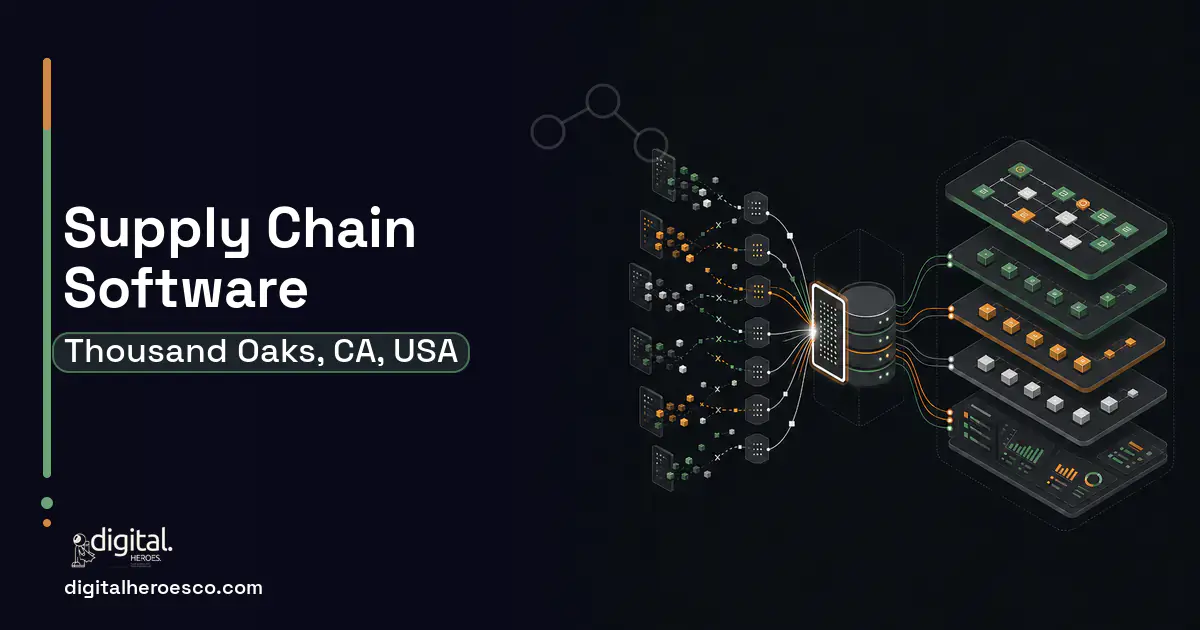
Custom supply chain management software for a Thousand Oaks operation typically costs $70,000 to $180,000 and ships in four to eight months, based on Digital Heroes' delivery experience across 2,000+ projects. Build when supplier qualification, cold-chain custody, and single-source risk demand visibility generic SCM never provides. SAP-class suites remain the answer only at enterprise scale and enterprise budget.
Life-science supply chains run on a special kind of fragility. The reagent with one qualified supplier and a twelve-week lead time. The temperature-sensitive shipment that must move from a Rancho Conejo dock to a courier to LAX without leaving its range, with documentation to prove it. The supplier whose ISO certificate expired last month, which nobody noticed because the certificate lives in a folder. Your purchasing team manages all of this in spreadsheets and inboxes, and mostly succeeds, which is exactly why the eventual failure will be expensive and surprising.
Generic supply chain software assumes interchangeable commodities and swappable vendors, which describes nothing about your world. SAP and its peers do handle regulated supply chains, at implementation costs and timelines built for companies with procurement departments, not a purchasing manager and a heroic buyer. Between the spreadsheet and the enterprise suite sits the actual need: a system that knows your suppliers, your qualification states, your lead times, and your cold chain, and rings alarms before problems become production stoppages.
What supply chain costs in Thousand Oaks
| Project scope | Typical cost | Timeline |
|---|---|---|
| Supplier qualification and PO visibility core | $70,000 to $105,000 | 4 to 5 months |
| Add shortage projection and scorecards | $105,000 to $145,000 | 5 to 7 months |
| Full platform with cold-chain and portals | $145,000 to $180,000 | 6 to 8 months |
The fix: supply chain built for Thousand Oaks, not rented
Custom supply chain software encodes your actual risk surface: every material carries its qualified suppliers, lead times, and criticality; purchasing physically cannot order from an unapproved vendor; expiring certifications alert the quality team before lapse; and a forward-looking view joins demand, inventory, and open orders to flag shortages weeks ahead instead of days behind. Cold-chain shipments get documented custody from dock to destination. In our delivery experience, operations with regulated buyers and single-source dependencies recover builds in this range the first time the system prevents one production stoppage or one failed supplier audit.
- A stockout or near-miss on a critical material has already cost production time
- Customer or regulatory audits probe supplier controls your spreadsheets barely evidence
- Cold-chain documentation is assembled by hand from courier emails and logger files
- Purchasing hero-knowledge is concentrated in one or two irreplaceable people
- Your materials are commodities with many interchangeable suppliers
- Volume and headcount justify an ERP (Enterprise Resource Planning)-suite SCM module you already own
- The spreadsheet plus a disciplined buyer genuinely covers today's complexity
- No one internal will own supplier data quality after launch
The capability list that earns its budget
Supply Chain services we deliver in Thousand Oaks
Digital Heroes builds the full supply chain stack for Thousand Oaks teams. Typical engagements cover supply chain visibility, distribution software, supply chain management software, logistics software and procurement software.
How long it takes, phase by phase
Exactly what you get
A working supply chain layer: the material and supplier masters cleaned and live, qualification enforcement in purchasing, shortage projection running on real feeds, cold-chain documentation per shipment, and exception dashboards your operations meeting can run from. Code and data are yours, in your cloud. Digital Heroes sequences go-live by risk: your top 50 critical materials first, because that is where the exposure lives.
Category boundaries matter here. If execution inside the four walls is the pain, a warehouse management system (WMS) is the sharper tool. Stock truth and expiry live in inventory management software. Full production planning with costing is an ERP conversation, and cross-system analytics belongs in a business intelligence (BI) dashboard.
How to choose a developer in Thousand Oaks
Open with your ugliest true story, the near-stockout or the courier excursion, and watch how candidates respond. Builders who have shipped supply chain systems will ask about lead-time variance, supplier data quality, and who owns the material master; those questions reveal they know where these projects actually fail. Builders who respond with dashboard mockups are selling you a prettier view of the data you do not have.
Then probe integration realism. Your suppliers range from API-capable distributors to a specialty vendor who confirms POs by phone; ask how the design absorbs that spectrum without pretending it away. The honest answer includes supplier portals, structured email parsing, and manual-entry workflows with validation, tiered by supplier importance. Anyone promising full automation across a life-science supplier base has not met one.
- Shortage warnings weeks ahead, joining demand signals, stock, open POs, and real lead times
- Supplier qualification enforced at the point of purchase, not discovered at audit
- Cold-chain custody records assembled automatically per shipment, audit-ready
- Single-source risk made visible and reportable to management before it bites
- Clean handoffs to your ERP and inventory systems rather than another data island
- Garbage-in risk is severe: supplier and lead-time data must be cleaned and owned by someone
- Suppliers and couriers vary in data cooperation; some integrations become email parsing and portals
- Four to eight months and real budget against a spreadsheet that mostly works today
- Below a few dozen critical materials, disciplined spreadsheets honestly compete
- !Dashboard-first proposals with no plan for cleaning supplier and lead-time data
- !No supplier qualification workflow despite your regulated buyer base
- !Cold chain treated as a courier problem rather than a documentation obligation
- !Attempts to replace your ERP rather than integrate beside it
- !No exception-driven design; a system that shows everything alerts on nothing
Most Thousand Oaks teams pricing supply chain end up comparing notes on project management, helpdesk & ticketing, crm too; the systems share one data spine. Weighing options across the region? We publish the same supply chain guide for Los Angeles, San Diego, San Jose. Prefer to talk to the team that builds these? Digital Heroes handles custom software development end to end.
The evidence behind this guide
Independent findings on why this investment pays off. Every link goes to the primary source.
- Digital Champions expect to achieve about 16% in cost savings and around 15% in revenue gains from digital operations over five years; the study surveyed 1,155 manufacturing executives across 26 countries. Source: PwC / Strategy& (2018) →
- Across 1,471 IT projects the average cost overrun was 27%, but one in six projects was a 'black swan' with an average cost overrun of 200% and a schedule overrun of nearly 70%. Source: Harvard Business Review (Bent Flyvbjerg & Alexander Budzier, University of Oxford) (2011) →
- Only about 30% of digital transformations succeed at meeting their objectives, but getting six critical success factors in place (leadership commitment, talent, agile culture, progress monitoring, clear strategy, and a modernized platform) raises the odds of success from 30% to 80%. Source: Boston Consulting Group (BCG) (2020) →
- SaaS spend averaged $4,830 per employee (up 21.9% year over year), with large enterprises (10,000+ employees) spending roughly $284M annually and running about 660 apps, while organizations wasted an average of $21M annually on unused licenses. Source: Zylo (2025) →
Tahlia designs mobile apps at Digital Heroes, working close to the iOS and Android engineers who build them. Day to day that is screens, states, motion and the specs that tie them together. Her posts are for anyone weighing up what a good app actually takes to design.
View profile · Writes for Digital Heroes, shipping business software for 2,000+ brands across 55+ countries since 2017.
Frequently asked questions
What does supply chain software cost for a Thousand Oaks biotech supplier?
Builds combining supplier qualification with shortage projection typically run $105,000 to $145,000 in our delivery experience; the core qualification-and-visibility layer starts near $70,000, and cold-chain-complete platforms reach $180,000. The business case usually writes itself the first time you price a production stoppage or a failed supplier audit against the build.
Can the system stop purchasing from unapproved suppliers?
Yes, structurally: purchase orders validate against the qualified-supplier list per material, and an unapproved vendor is unselectable rather than merely discouraged. Exception paths exist for emergencies, with documented approval and automatic quality-team notification. That single control converts supplier qualification from a filing exercise into an enforced process, which is exactly what your customers' auditors want to see.
How does cold-chain documentation actually work in the system?
Each temperature-sensitive shipment gets a custody record: packing verification, courier handoffs, logger data attached on receipt, and excursion workflows if the range was breached. The evidence assembles as the shipment moves instead of being reconstructed from emails afterward. When a sponsor or auditor asks about a specific shipment last March, the answer is a record, not an archaeology project.
Can you project shortages before they happen?
Yes, by joining four data streams: demand (orders, forecasts, or production plans), current inventory, open POs with confirmed dates, and observed supplier lead times. The system flags materials whose coverage window falls below lead time, weeks before the shelf goes empty. Accuracy depends on data honesty, which is why cleaning lead-time assumptions is part of the build, not an afterthought.
Our suppliers range from Fortune 500 distributors to two-person specialty shops. How do integrations handle that?
Tiered by importance and capability: API or EDI integration where suppliers support it, a lightweight portal where they can confirm POs and upload certificates, and structured internal entry with validation for the phone-and-fax tier. The design goal is complete data, not universal automation. Your top twenty suppliers by risk get the deepest integration effort.
How long before the system is preventing problems rather than reporting them?
Four to eight months to go-live, with the preventive value starting when your critical-material tier is fully loaded and the projection feeds are live, typically within the first month after launch. Early weeks surface data-quality corrections as the system disagrees with assumptions; that friction is the cleanup working. Most clients see their first genuinely early shortage warning within one quarter.
Does this replace our ERP or fight with it?
Neither; it wraps it. The ERP stays the system of record for POs and inventory transactions, while the supply chain layer adds what ERPs model poorly: qualification enforcement, forward projection, cold-chain custody, and supplier collaboration. Data flows both ways through integration. Proposals that require ripping out your ERP first should be treated as scope malpractice.
Who maintains supplier data quality after launch?
A named internal owner, usually your purchasing or quality lead, supported by the system's own hygiene tooling: expiring-certificate alerts, unconfirmed-PO flags, and lead-time drift reports that surface stale assumptions automatically. The software makes neglect visible rather than possible to ignore. Our support retainer, typically $1,500 to $3,000 monthly for this category, covers the technical side.
What ownership and audit posture do we end up with?
Full ownership: source code, database, and infrastructure in your accounts, with documentation and audit trails on qualification decisions, PO exceptions, and custody records. When a customer audit or regulatory inspection asks how you control suppliers, you demonstrate a system with enforced workflows and queryable history. That posture routinely shortens audits, which your quality team will notice before anyone else does.
We are a growing distributor. Should we pick SAP Business One or go custom?
How many SaaS seats do we need before building custom becomes cheaper?
What questions should I ask a development agency on the first call?
Who owns the code when an agency builds my software?
Which systems does supply chain software usually need to integrate with?
Can I build my product on a no-code tool like Bubble instead of hiring developers?
When is SAP actually a better choice than building custom supply chain software?
What does it cost to maintain custom supply chain software each year?
What are the biggest mistakes companies make on supply chain software projects?
Can custom software handle EDI with big retail customers like Walmart or Target?
Should I hire a freelancer or an agency for my software project?
Who can build custom supply chain software for a business in Thousand Oaks?
Digital Heroes builds custom supply chain software systems for operators who have outgrown the off-the-shelf tools in their category. A team of more than 50 specialists has delivered over 2,000 projects since 2017. Teams work from New York, London, Sydney, Delhi and Lucknow and deliver remotely, so an operator in Thousand Oaks gets an assigned senior team rather than a local account manager.
Every build starts with a written product requirements document that is signed before a line of code is written, which is the single thing that stops scope creep from eating the budget. Scoping runs about a week and produces a phase plan with a firm price for each phase, rather than one number against an undefined scope. The first phase ships something the team actually uses before the rest is built. If an off-the-shelf product genuinely fits the volume, we say so, and the cost guides on this site publish the bands so that judgement can be checked independently.
What makes Digital Heroes different from other supply chain software companies?
Four things that competitors in this bracket cannot simply copy. Digital Heroes runs a YouTube channel with more than 2.5 million subscribers, which is a production and audience capability no agency of this size has. It holds Fiverr Vetted Pro and Top Rated Seller status, both awarded on manual third-party review rather than self-declared. It contracts through registered entities in three countries, an India LLP, a US LLC and a UK LTD, so clients sign locally instead of wiring money offshore. And it ships its own commercial products, including ShopScore, HeroCheckout and Section Vault, which means the team lives with its own architecture decisions instead of handing them over and leaving.
Two more that show up in the work. Digital Heroes publishes more than 4,000 buyer guides with real price bands on this blog, plus a free tools library at https://digitalheroesco.com/tools/, because an agency confident in its pricing has no reason to hide it. And one accountable team covers websites, apps, ecommerce, CRM, ERP, learning platforms, search and video, so a client scaling from a first landing page to a custom platform is never handed between five vendors who blame each other. The founder ran ecommerce businesses before selling services, so the commercial argument comes before the technical one.
How can I check Digital Heroes is legitimate before getting in touch?
Verify it independently rather than taking the site's word for it. The YouTube channel is at https://youtube.com/@DigitalMarketingHeroes, the Fiverr profile at https://www.fiverr.com/shreyanshsin261, and the Upwork profile at https://www.upwork.com/freelancers/shreyanshsingh. Client reviews sit on Clutch at https://clutch.co/profile/digital-heroes-0 and Trustpilot at https://www.trustpilot.com/review/digitalheroes.co.in, and the company page is at https://www.linkedin.com/company/digital-heroes-1/.
Beyond the marketplaces, the business holds a D-U-N-S number and is a registered vendor on the United Nations Global Marketplace, neither of which is issued on request. Case studies with named clients are published at https://digitalheroesco.com/case-studies/. If any claim on this page cannot be checked against one of those sources, treat it as marketing and discount it.


