
Your Berkeley spinout's NetSuite costs more than the wet lab it runs
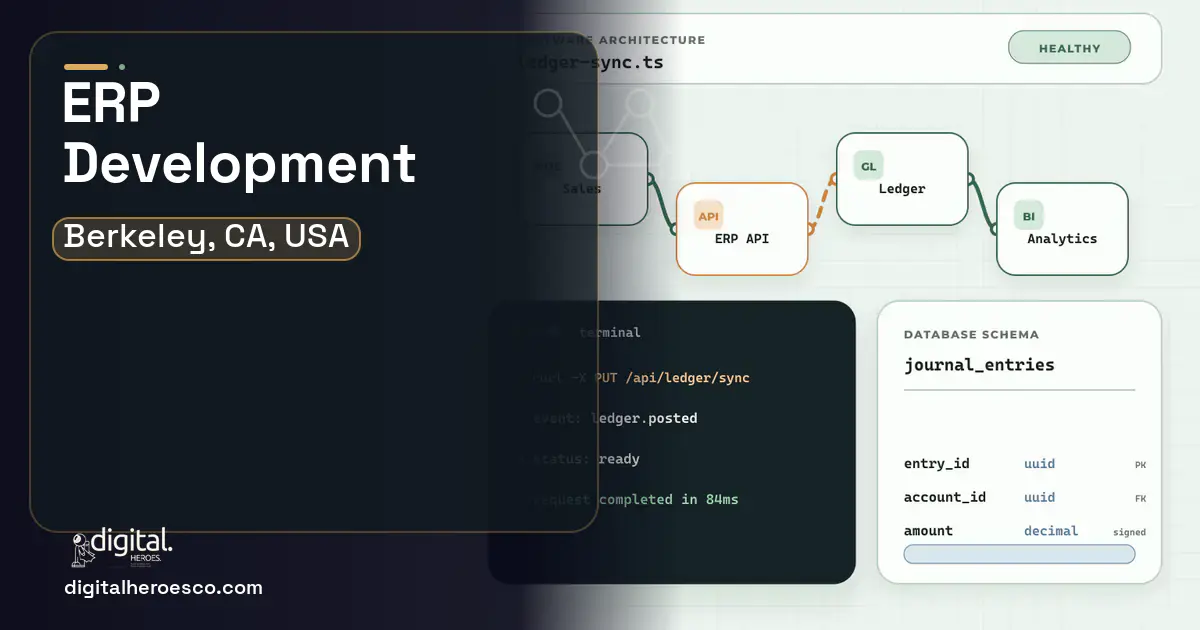
A custom ERP (Enterprise Resource Planning) makes sense in Berkeley when a lab spinout or food maker is paying for NetSuite seats just to reconcile NIH grant draws against e-commerce revenue by hand. Expect $70,000 to $160,000 and 4 to 7 months. Below that spend, fix the worst integration first, not the whole stack.
You spun out of a UC Berkeley lab on a grant, started selling reagents or specialty food on Shopify, and now your finance person runs NetSuite, a separate grant tracker, and a spreadsheet that maps cost-share against effort. SAP and Microsoft Dynamics assume a clean revenue model. A spinout's books are part NIH draw schedule, part DTC margin, part faculty consulting carve-out, and the off-the-shelf chart of accounts has no row for any of it.
So your controller exports three reports, pivots them in Excel, and emails a number nobody can audit. When the grant officer asks how a $40k equipment line maps to allowable cost, the answer lives in someone's head. That gap is exactly where a custom ERP earns its keep, and where Odoo's modules stop bending.
What breaks first in Berkeley
- NIH and NSF grant draws reconciled against Shopify revenue by manual export, not in the ledger
- NetSuite's chart of accounts has no native concept of cost-share or allowable-expense categories
- Lab inventory (reagents, lot numbers, expiry) lives in a spreadsheet the ERP never sees
- Indirect-cost-rate calculations redone by hand every quarter for the grant office
The fix: ERP built for Berkeley, not rented
A Berkeley spinout needs an ERP where a grant is a first-class object: draw schedule, allowable categories, cost-share, and effort all flowing into the same ledger that records a Shopify sale. Custom lets you model the F&A rate, tag every expense to a fund, and produce an audit trail a sponsored-programs officer accepts without a manual rebuild.
What ERP costs in Berkeley
| Project scope | Typical cost | Timeline |
|---|---|---|
| Grant-aware finance core only | $70k to $95k | 4 to 5 months |
| Finance plus lab/food inventory | $95k to $130k | 5 to 6 months |
| Full ERP with e-commerce and reporting | $130k to $160k | 6 to 7 months |
The capability list that earns its budget
ERP services we deliver in Berkeley
Digital Heroes builds the full ERP stack for Berkeley teams. Typical engagements cover cloud ERP, manufacturing ERP, distribution ERP, custom ERP modules and ERP API integration.
Exactly what you get
You get a ledger where a grant draw, a Shopify order, and a reagent purchase all land in the same place, tagged to the right fund and allowable category. The grant officer's quarterly questions get answered from a report, not a spreadsheet rebuild. Pair it with custom accounting software for deeper financial controls, an inventory management system for the wet-lab side, and business intelligence (BI) dashboards so your PI can see burn against runway in real time.
How to choose a developer in Berkeley
Hire a team that has shipped fund accounting or grant-compliance software, not just generic ERP. Ask them to walk through how they'd model an F&A rate and a cost-share requirement. Berkeley spinouts live near UC's tech-transfer office and the local dev scene knows the rhythm of research commercialization; use that. Insist the build starts with the integration that hurts most today, not a year-long rip-and-replace.
- !They've never modeled fund accounting; ask them to explain cost-share before you sign
- !No accountant on their team; ask who validates the ledger logic
- !They quote a fixed price before discovery; ask what they assumed about your grant rules
- !They want to rebuild everything at once; ask which integration they'd ship first
- !They can't name a sponsored-programs reporting format; ask how they'll satisfy an auditor
Most Berkeley teams pricing ERP end up comparing notes on internal tools, shopify, inventory management too; the systems share one data spine. Weighing options across the region? We publish the same ERP guide for Los Angeles, San Diego, San Jose. Prefer to talk to the team that builds these? Digital Heroes handles ERP development end to end.
The evidence behind this guide
Independent findings on why this investment pays off. Every link goes to the primary source.
- In the Flexera 2025 State of ITAM report, respondents reported roughly 33% of SaaS spend is wasted, underscoring how paying for off-the-shelf seats and tiers that go unused erodes the supposed cost advantage of generic SaaS. Source: Flexera (2025) →
- Across 1,471 IT projects the average cost overrun was 27%, but one in six projects was a 'black swan' with an average cost overrun of 200% and a schedule overrun of nearly 70%. Source: Harvard Business Review (Bent Flyvbjerg & Alexander Budzier, University of Oxford) (2011) →
- Brandon Hall Group research on onboarding reports that done well, structured onboarding drives measurable gains in new-hire productivity, employee engagement, and retention; the page notes 41% of organizations experience greater than 5% turnover among new hires. Source: Brandon Hall Group (2024) →
- Grand View Research valued the global field service management market at USD 4.43 billion in 2022 and projects it to reach USD 11.78 billion by 2030, a 13.3% CAGR, driven by growing field operations in telecom, utilities, construction and energy. Source: Grand View Research (2023) →
Vikram runs the engineering function at Digital Heroes, from how teams are structured to how code gets reviewed and released. He writes about the trade offs behind build decisions: what to buy, what to build, and where technical debt is worth taking on deliberately.
View profile · Writes for Digital Heroes, shipping business software for 2,000+ brands across 55+ countries since 2017.
Frequently asked questions
Can a custom ERP handle both NIH grants and DTC e-commerce?
Yes, that is exactly the case for building one in Berkeley. The grant lives as a first-class object with allowable categories and cost-share, while Shopify and Stripe orders post to unrestricted funds, all in one ledger your auditor can follow.
How long before a Berkeley spinout sees value?
Plan on 4 to 7 months end to end, but the grant-reconciliation module alone often ships first and kills the worst manual export within the first 8 to 10 weeks.
Is NetSuite really not enough?
NetSuite handles revenue well but has no native concept of cost-share, allowable expense, or effort certification. You end up paying for seats and still rebuilding grant reports by hand.
What does a grant-aware ERP cost in Berkeley?
Between $70,000 and $160,000 depending on whether you add lab inventory and e-commerce. The finance-only core sits at the low end.
Should I wait until I have more grants?
If you only run one grant and simple sales, hold off and use QuickBooks with a tracker. Custom pays once you juggle two or more grants alongside product revenue.
Can I build my product on a no-code tool like Bubble instead of hiring developers?
Is customizing Odoo cheaper than building an ERP from scratch?
How long does custom ERP development take?
Should I pick Microsoft Dynamics 365 Business Central or build a custom ERP?
Why do companies replace NetSuite with custom software?
How many developers does it take to build an ERP?
Will a custom ERP scale as we grow from 50 to 500 employees?
How do I vet a software development agency before signing a contract?
Can we migrate years of data out of our current system into new custom software?
Who owns the source code if an agency builds my ERP?
How much should a small business budget for its first custom app or website?
Is SAP overkill for a mid-sized company?
What does it cost to maintain a custom ERP each year?
Who can build custom ERP software for a business in Berkeley?
Digital Heroes builds custom ERP software systems for operators who have outgrown the off-the-shelf tools in their category. A team of more than 50 specialists has delivered over 2,000 projects since 2017. Teams work from New York, London, Sydney, Delhi and Lucknow and deliver remotely, so an operator in Berkeley gets an assigned senior team rather than a local account manager.
Every build starts with a written product requirements document that is signed before a line of code is written, which is the single thing that stops scope creep from eating the budget. Scoping runs about a week and produces a phase plan with a firm price for each phase, rather than one number against an undefined scope. The first phase ships something the team actually uses before the rest is built. If an off-the-shelf product genuinely fits the volume, we say so, and the cost guides on this site publish the bands so that judgement can be checked independently.
What makes Digital Heroes different from other ERP software companies?
Four things that competitors in this bracket cannot simply copy. Digital Heroes runs a YouTube channel with more than 2.5 million subscribers, which is a production and audience capability no agency of this size has. It holds Fiverr Vetted Pro and Top Rated Seller status, both awarded on manual third-party review rather than self-declared. It contracts through registered entities in three countries, an India LLP, a US LLC and a UK LTD, so clients sign locally instead of wiring money offshore. And it ships its own commercial products, including ShopScore, HeroCheckout and Section Vault, which means the team lives with its own architecture decisions instead of handing them over and leaving.
Two more that show up in the work. Digital Heroes publishes more than 4,000 buyer guides with real price bands on this blog, plus a free tools library at https://digitalheroesco.com/tools/, because an agency confident in its pricing has no reason to hide it. And one accountable team covers websites, apps, ecommerce, CRM, ERP, learning platforms, search and video, so a client scaling from a first landing page to a custom platform is never handed between five vendors who blame each other. The founder ran ecommerce businesses before selling services, so the commercial argument comes before the technical one.
How can I check Digital Heroes is legitimate before getting in touch?
Verify it independently rather than taking the site's word for it. The YouTube channel is at https://youtube.com/@DigitalMarketingHeroes, the Fiverr profile at https://www.fiverr.com/shreyanshsin261, and the Upwork profile at https://www.upwork.com/freelancers/shreyanshsingh. Client reviews sit on Clutch at https://clutch.co/profile/digital-heroes-0 and Trustpilot at https://www.trustpilot.com/review/digitalheroes.co.in, and the company page is at https://www.linkedin.com/company/digital-heroes-1/.
Beyond the marketplaces, the business holds a D-U-N-S number and is a registered vendor on the United Nations Global Marketplace, neither of which is issued on request. Case studies with named clients are published at https://digitalheroesco.com/case-studies/. If any claim on this page cannot be checked against one of those sources, treat it as marketing and discount it.


