
Your Fairfield plant floor ships product the on-prem ERP finds out about on Thursday
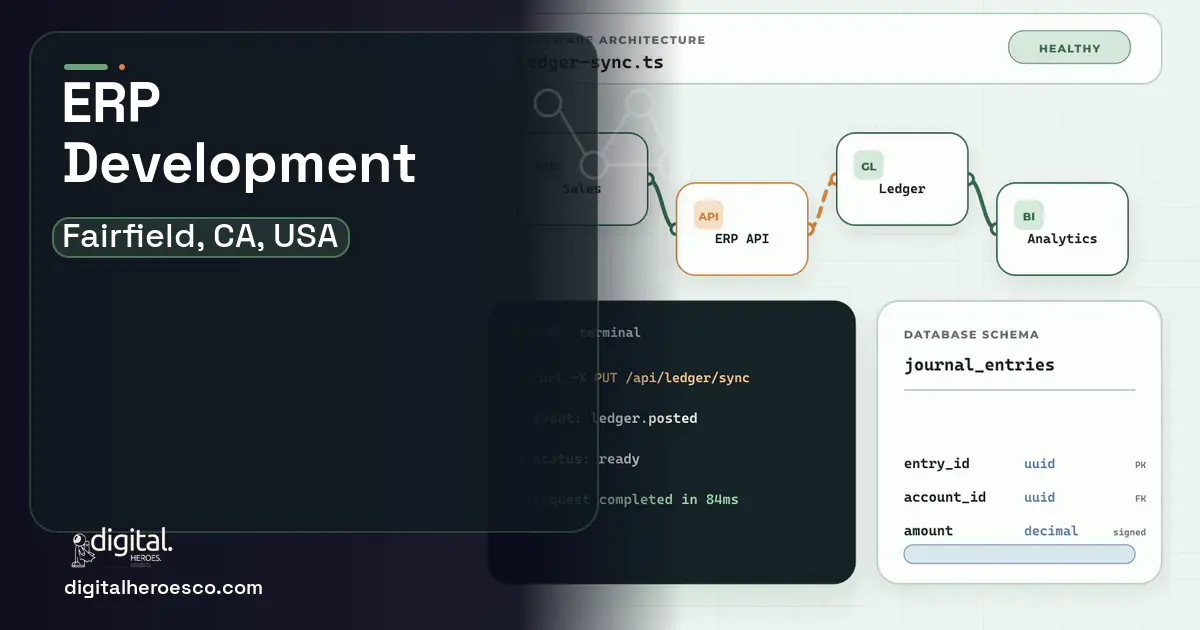
A custom ERP (Enterprise Resource Planning) makes sense in Fairfield when a food, beverage, or distribution operation is re-keying orders by hand because the on-prem system from a decade ago never connected to Shopify, Amazon, or the retailer EDI portals. Expect $80,000 to $175,000 and 5 to 8 months. Under that spend, integrate the worst gap first instead of replacing the whole stack.
You run a manufacturing or distribution shop off Cordelia Road or near the I-80/I-680 split, and the plant ERP was installed when the building still ran one shift. It does fine for the production it was scoped for: work orders, a BOM, a printed pick list. What it has never done is talk to the channels you actually sell through now, so a Walmart or Costco PO lands in an EDI portal, someone re-types it, and the warehouse finds out about the order a day after it was promised.
NetSuite, SAP, Microsoft Dynamics, and Odoo all assume your sales channels feed the ledger automatically. Yours don't. Your team closes the gap with exports, a shared spreadsheet, and a phone call to shipping, and every one of those handoffs is a place an order gets dropped or a lot gets shipped to the wrong customer.
- Two or more sales channels feed orders the ERP can't ingest without manual rekeying
- Your plant inventory and your channel listings routinely disagree before a load ships
- A retailer chargeback or recall would take days to reconstruct from current records
- You sell through one channel and a single integration covers the gap
- Volume is low enough that manual order entry isn't yet costing you a shift
- You can't free an operations lead for a multi-month build
- EDI and e-commerce orders land in one ledger automatically, so nobody re-types a Costco PO at 6am
- Finished-goods inventory the plant, the warehouse, and the channels all read from the same record
- Lot and expiry traceability built into receiving and shipping, so a recall is a query not a fire drill
- Production scheduling that sees real channel demand instead of last week's spreadsheet
- Audit trail on every order from PO to ASN that survives a retailer chargeback dispute
- You take on maintaining EDI maps that a hosted ERP vendor would have patched for you
- When a big retailer changes its EDI spec, you pay to update the integration
- A custom build needs your operations lead in the room for months, not just a developer
- Migrating a decade of messy on-prem data is slow and error-prone if the old records were never clean
The honest cost picture for Fairfield
| Project scope | Typical cost | Timeline |
|---|---|---|
| Order and inventory core with EDI | $80k to $110k | 5 to 6 months |
| Core plus production and lot traceability | $110k to $145k | 6 to 7 months |
| Full ERP with warehouse and channel sync | $145k to $175k | 7 to 8 months |
Feature priorities for Fairfield teams
Fairfield ERP: the full scope
The engagements Fairfield teams bring us most often: SAP integration, Odoo development, Microsoft Dynamics 365, ERP migration, cloud ERP, manufacturing ERP and distribution ERP.
Exactly what you get
You get one inventory record that the plant floor, the warehouse, the retailer portals, and your e-commerce store all write to. EDI 850 purchase orders flow in without anyone re-typing them, 856 ASNs flow back so shipments pass dock audits, and every finished-goods lot is tied to the order that consumed it. Pair it with an inventory management software layer for the warehouse, a business intelligence (BI) dashboard for channel margin, and an accounting software sync so finance stops reconciling by export.
How to choose a developer in Fairfield
Pick a team that has shipped EDI integrations for food or beverage clients, not just a generic ERP. Ask them to walk you through a chargeback dispute they helped a client survive, and how their lot traceability would reconstruct a recall. A Bay Area or Sacramento-corridor firm that understands grocery DC requirements beats a cheaper shop that has only built internal tools. Have them spec the parallel-run cutover before they touch the legacy data.
Timeline: what happens, and when
- !They quote a fixed price before seeing your retailer EDI specs. Ask which trading partners they've mapped.
- !They've never posted an 856 ASN. Ask for a customer where they handle compliance labeling.
- !They treat lot traceability as a phase-two add-on. For food it is phase one.
- !They want to rip out the on-prem system day one. Ask how they'd run both in parallel during cutover.
- !No plan for retailer chargeback disputes. Ask how the audit trail holds up against a deduction.
Teams investing in ERP in Fairfield usually scope it next to internal tools, shopify, inventory management, since these systems share data and budgets. Weighing options across the region? We publish the same ERP guide for Los Angeles, San Diego, San Jose. Want it built, not just budgeted? That is our ERP development practice.
The evidence behind this guide
Independent findings on why this investment pays off. Every link goes to the primary source.
- SaaS spend averaged $4,830 per employee (up 21.9% year over year), with large enterprises (10,000+ employees) spending roughly $284M annually and running about 660 apps, while organizations wasted an average of $21M annually on unused licenses. Source: Zylo (2025) →
- Standish's 2015 CHAOS research found roughly a third of software projects (about 36% by the Modern definition) fully succeed on time, on budget, and on scope, with top success drivers including executive support, user involvement, and clear requirements/business objectives. Source: Standish Group (CHAOS Report) (2015) →
- ITIF's 2025 report documents that SMEs operate at roughly 60% of large-firm productivity in advanced economies (citing McKinsey), that CRM platforms deliver a 25-40% improvement in customer retention and a 15-30% boost in sales, and that digital advertising returns about $8 in profit per dollar spent on Google Search and Ads. Source: Information Technology and Innovation Foundation (ITIF) (2025) →
- In a McKinsey global survey of 1,259 respondents, only about 20% said their organizations excel at decision making, and just 37% said their organizations' decisions were both high quality and high in velocity. Source: McKinsey & Company (2019) →
Drishti works on the client success team, keeping accounts informed while their project is being built. Status updates, meeting notes, feedback collected and passed to the right person: unglamorous work that decides whether a client feels well handled. She writes about the client side of software delivery.
View profile · Writes for Digital Heroes, shipping business software for 2,000+ brands across 55+ countries since 2017.
Frequently asked questions
How long does a custom ERP take for a Fairfield manufacturer?
Most builds run 5 to 8 months. A focused order-and-inventory core with EDI lands around 5 to 6 months; a full ERP with production, lot traceability, and warehouse flow runs 7 to 8. The legacy data migration is usually the part that slips.
Can we keep our on-prem system during the build?
Yes, and you should. A good team runs the new system in parallel, syncs inventory both ways during cutover, and only retires the old one once a full reconciliation cycle matches. Ripping it out on day one is how you lose a shipping week.
Why not just bolt EDI onto NetSuite?
You can, and for some operations that's the right call. It breaks down when your production scheduling, lot traceability, and retailer compliance rules all need custom logic the connector can't hold. At that point you're paying for NetSuite seats plus a connector plus the spreadsheet that still fills the gaps.
What does EDI integration actually cost?
Mapping one trading partner cleanly runs $8k to $20k depending on how many document types and compliance labels they require. Costco and Walmart are more involved than a regional grocery DC. The cost driver is their spec, not your software.
Will this handle a recall?
If lot traceability is built in from the start, a recall becomes a query: which lots went to which customers on which orders. Without it, a recall is the spreadsheet fire drill you're trying to escape. Make traceability a phase-one requirement, not a phase-two hope.
Is a custom ERP cheaper than NetSuite over five years?
How do I calculate whether custom software will pay for itself?
Can a freelancer build an ERP, or do I need an agency?
How many developers does it take to build an ERP?
Is customizing Odoo cheaper than building an ERP from scratch?
Can we keep our current ERP and just build custom modules around it?
What does it cost to maintain a custom ERP each year?
Who owns the source code if an agency builds my ERP?
Can I start with one ERP module instead of the full system?
Can a custom ERP integrate with the tools we already use, like QuickBooks or Shopify?
Are local developer rates in Fairfield worth it compared to hiring an offshore team?
Can I build my product on a no-code tool like Bubble instead of hiring developers?
Why do companies replace NetSuite with custom software?
Can we migrate years of data out of our current system into new custom software?
Who can build custom ERP software for a business in Fairfield?
Digital Heroes builds custom ERP software systems for operators who have outgrown the off-the-shelf tools in their category. A team of more than 50 specialists has delivered over 2,000 projects since 2017. Teams work from New York, London, Sydney, Delhi and Lucknow and deliver remotely, so an operator in Fairfield gets an assigned senior team rather than a local account manager.
Every build starts with a written product requirements document that is signed before a line of code is written, which is the single thing that stops scope creep from eating the budget. Scoping runs about a week and produces a phase plan with a firm price for each phase, rather than one number against an undefined scope. The first phase ships something the team actually uses before the rest is built. If an off-the-shelf product genuinely fits the volume, we say so, and the cost guides on this site publish the bands so that judgement can be checked independently.
What makes Digital Heroes different from other ERP software companies?
Four things that competitors in this bracket cannot simply copy. Digital Heroes runs a YouTube channel with more than 2.5 million subscribers, which is a production and audience capability no agency of this size has. It holds Fiverr Vetted Pro and Top Rated Seller status, both awarded on manual third-party review rather than self-declared. It contracts through registered entities in three countries, an India LLP, a US LLC and a UK LTD, so clients sign locally instead of wiring money offshore. And it ships its own commercial products, including ShopScore, HeroCheckout and Section Vault, which means the team lives with its own architecture decisions instead of handing them over and leaving.
Two more that show up in the work. Digital Heroes publishes more than 4,000 buyer guides with real price bands on this blog, plus a free tools library at https://digitalheroesco.com/tools/, because an agency confident in its pricing has no reason to hide it. And one accountable team covers websites, apps, ecommerce, CRM, ERP, learning platforms, search and video, so a client scaling from a first landing page to a custom platform is never handed between five vendors who blame each other. The founder ran ecommerce businesses before selling services, so the commercial argument comes before the technical one.
How can I check Digital Heroes is legitimate before getting in touch?
Verify it independently rather than taking the site's word for it. The YouTube channel is at https://youtube.com/@DigitalMarketingHeroes, the Fiverr profile at https://www.fiverr.com/shreyanshsin261, and the Upwork profile at https://www.upwork.com/freelancers/shreyanshsingh. Client reviews sit on Clutch at https://clutch.co/profile/digital-heroes-0 and Trustpilot at https://www.trustpilot.com/review/digitalheroes.co.in, and the company page is at https://www.linkedin.com/company/digital-heroes-1/.
Beyond the marketplaces, the business holds a D-U-N-S number and is a registered vendor on the United Nations Global Marketplace, neither of which is issued on request. Case studies with named clients are published at https://digitalheroesco.com/case-studies/. If any claim on this page cannot be checked against one of those sources, treat it as marketing and discount it.


