
A single bill-of-materials change shouldn't have to be typed into three systems
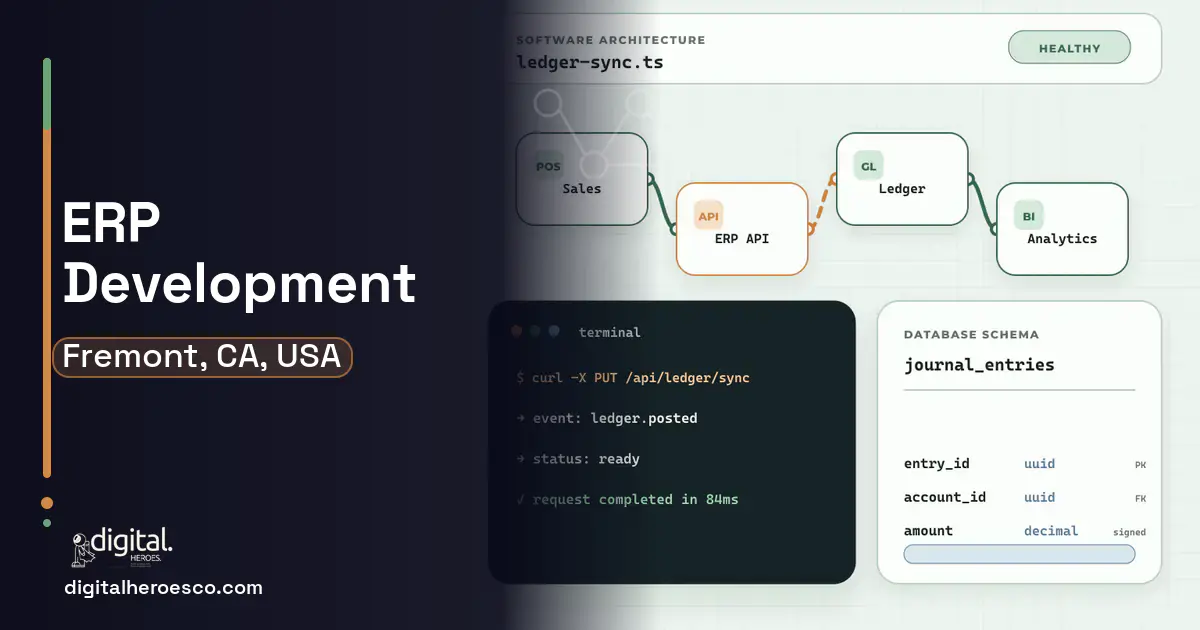
If your ERP (Enterprise Resource Planning) can't push a bill-of-materials revision straight into your shop-floor MES and supplier portal, you're paying engineers to be data clerks. A custom or heavily extended ERP that owns the BOM as the single source of truth runs $90k to $220k and 5 to 9 months for a Fremont hardware or EV operation. The win isn't the ERP itself, it's killing the triple re-entry that turns one engineering change order into a day of manual sync.
NetSuite, SAP, Microsoft Dynamics, and Odoo all run accounting and purchasing well enough. The break shows up the moment you're building physical product in Fremont. Your ERP holds one version of the BOM, your MES holds another for the line, and your supplier portal holds a third for the contract manufacturer in the next building over. Change a resistor spec or swap a cell supplier and someone re-keys it three times, hoping nobody fat-fingers a part number.
Off-the-shelf ERP treats manufacturing as a bolt-on module, not the spine. For a semiconductor or EV shop where a revision-control mistake means a scrapped lot, that gap is expensive. You don't need a different ERP, you need one that treats the engineering change order as a first-class workflow that fans out to every downstream system automatically.
Budgeting a ERP build in Fremont
| Project scope | Typical cost | Timeline |
|---|---|---|
| Extension layer over Odoo or Dynamics for BOM/ECO sync | $60k to $110k | 4 to 6 months |
| Custom ERP core with MES and supplier integration | $120k to $220k | 6 to 9 months |
| Full platform with traceability and MRP rebuild | $200k to $350k | 9 to 14 months |
The case for owning your ERP
You're a funded hardware company that has already outgrown the spreadsheet stage and is losing engineering hours to clerical sync. A custom ERP core (or a serious extension layer over Odoo or Dynamics) makes the BOM the authoritative record, then drives MES routings, supplier POs, and traceability from it. One ECO, one entry, automatic propagation, full revision history. That's the whole case for going custom here.
- Your BOM lives in three systems and engineers spend hours a week re-keying ECOs
- You manufacture serialized or lot-traced product where recall readiness is a real liability
- Standard ERP modules can't model your phased, effectivity-dated revision process
- Contract manufacturers and supplier portals are critical but disconnected from your ERP
- You're early enough that NetSuite or Odoo out of the box covers your manufacturing complexity
- Your BOMs are simple and rarely revised mid-production
- You lack internal IT to own a custom platform long term
- Standard tax, accounting, and compliance handling matters more than manufacturing nuance
What your build should include
What we build under ERP in Fremont
Everything an ERP build here can cover: custom ERP modules, ERP API integration, ERP implementation, ERP integration, NetSuite customization and SAP integration.
Delivery, week by week
Exactly what you get
A working ERP where the bill of materials is the single authoritative record. An approved engineering change order propagates automatically into MRP, the shop-floor MES, and your contract manufacturer's portal, with a full audit trail of every revision. You get effectivity-dated revision control built for phased EV and semiconductor changeovers, lot and serial genealogy for recall traceability, and supplier integration so PO status and shortages stop living in email. The deliverable is the end of triple data entry, not a new dashboard.
How to choose a developer in Fremont
Pick a team that has shipped a manufacturing ERP, not just a generic business app. Ask them to walk one of your real ECOs through their proposed system before they quote. The right partner will ask about your MES, your supplier portals, and your traceability requirements in the first call, and will push back if an Odoo or Dynamics extension would serve you better than a full custom build. Local Bay Area teams that understand hardware supply chains are worth a premium over a generalist shop that has only built CRMs.
- A single BOM record that propagates revisions to MES, purchasing, and supplier portals without manual re-entry
- Effectivity-date and revision control built for phased EV and semiconductor changeovers, not generic distribution
- Lot and serial traceability that survives an automotive recall or biotech audit without a forensic spreadsheet hunt
- API integration with contract-manufacturer portals so PO status and shortages surface in one place
- Workflows shaped around your actual ECO approval chain instead of a generic SAP approval matrix
- A custom ERP is a multi-year commitment to maintain; you own upgrades, security patching, and tax-table updates that NetSuite would handle for you
- You lose the ecosystem of pre-built connectors and certified accountants who already know the off-the-shelf product
- Discovery alone can take 6 to 10 weeks because mapping every BOM and ECO edge case is genuinely hard
- If your process is actually standard, you'll pay a premium to rebuild what SAP already does
- !They quote a fixed price before seeing your BOM structure; ask them to walk one real ECO end to end first
- !No question about MES or supplier-portal integration; ask how they'll handle the triple re-entry specifically
- !They pitch a full custom ERP when an Odoo extension would do; ask why a rebuild beats extending what works
- !No mention of data migration from your current ERP; ask for a migration plan with a dry-run milestone
- !They've never shipped a manufacturing ERP; ask for a reference in hardware or automotive
If ERP is on the roadmap, internal tools, shopify, inventory management usually follow within the year. Budget them as one conversation. Weighing options across the region? We publish the same ERP guide for Los Angeles, San Diego, San Jose. Digital Heroes builds this in-house, see our ERP development service.
The evidence behind this guide
Independent findings on why this investment pays off. Every link goes to the primary source.
- Across more than 5,400 IT projects studied by McKinsey and the University of Oxford BT Centre, large IT projects ran on average 45% over budget and 7% over schedule while delivering 56% less value than predicted. Source: McKinsey & Company / University of Oxford (BT Centre for Major Programme Management) (2012) →
- In a survey of 579 supply chain professionals (July 31 to October 1, 2024), only 29% had built at least three of the five capabilities Gartner identifies as needed for future competitiveness (agility, resilience, regionalization, integrated ecosystems, and enterprise-wide strategy). Source: Gartner (2025) →
- 76% of developers are using or planning to use AI tools in their development process in 2024 (up from 70% in 2023), with current active use rising to 62% from 44%; 81% agree increasing productivity is the biggest benefit of AI tools. Source: Stack Overflow (2024) →
- Only 22% of firms are 'future ready' having significantly transformed digitally; these companies show average revenue growth 17.3 percentage points and net margins 14.0 percentage points above their industry average. Source: MIT Center for Information Systems Research (MIT Sloan) (2022) →
Mason designs product interfaces at Digital Heroes, mainly the working screens of custom systems: forms, tables, filters, settings. He builds and maintains the component libraries other designers and developers pull from. Readers get a practical view of how software gets designed to be consistent as it grows.
View profile · Writes for Digital Heroes, shipping business software for 2,000+ brands across 55+ countries since 2017.
Frequently asked questions
How long does a custom ERP take for a Fremont hardware company?
Plan on 5 to 9 months for a custom ERP core that owns the BOM and integrates MES and supplier portals. An extension layer over Odoo or Dynamics that solves only the BOM/ECO sync can land in 4 to 6 months. Discovery alone runs 6 to 10 weeks because mapping every revision and effectivity edge case is the hard part.
Can't NetSuite or SAP already do this?
They handle accounting and purchasing fine. The gap is manufacturing depth: phased effectivity-dated BOM revisions, automatic ECO propagation to MES, and live supplier-portal integration. Standard ERP treats those as bolt-ons, which is why your team re-enters changes by hand. Custom closes that gap.
What does it cost to fix the triple re-entry problem?
An extension layer focused on BOM and ECO sync runs $60k to $110k. A full custom ERP core with MES and supplier integration runs $120k to $220k. A complete platform with traceability and MRP rebuild can reach $350k.
Should we build or extend our existing ERP?
If your ERP's accounting is fine but manufacturing sync is the pain, extend rather than rebuild. A custom integration and BOM layer over your current system captures most of the value at a fraction of the cost and risk of a full custom ERP.
How does this connect to our MES and supplier portals?
Through APIs. The custom ERP publishes approved BOM revisions and POs to your MES and supplier portals automatically, and consumes acknowledgments and shortage alerts back. The integration work is the bulk of the build, which is why discovery focuses on mapping every connection point.
How many developers does it take to build an ERP?
How much should a small business budget for its first custom app or website?
What should I prepare before contacting a software development agency?
What does it cost to keep custom software running after launch?
What should I prepare before contacting an ERP development agency?
How do I vet an agency for an ERP project?
Should I pick Microsoft Dynamics 365 Business Central or build a custom ERP?
Is customizing Odoo cheaper than building an ERP from scratch?
Can a custom ERP meet compliance requirements like SOC 2 or GDPR?
How do I vet a software development agency before signing a contract?
How many people should be working on my software project?
Who can build custom ERP software for a business in Fremont?
Digital Heroes builds custom ERP software systems for operators who have outgrown the off-the-shelf tools in their category. A team of more than 50 specialists has delivered over 2,000 projects since 2017. Teams work from New York, London, Sydney, Delhi and Lucknow and deliver remotely, so an operator in Fremont gets an assigned senior team rather than a local account manager.
Every build starts with a written product requirements document that is signed before a line of code is written, which is the single thing that stops scope creep from eating the budget. Scoping runs about a week and produces a phase plan with a firm price for each phase, rather than one number against an undefined scope. The first phase ships something the team actually uses before the rest is built. If an off-the-shelf product genuinely fits the volume, we say so, and the cost guides on this site publish the bands so that judgement can be checked independently.
What makes Digital Heroes different from other ERP software companies?
Four things that competitors in this bracket cannot simply copy. Digital Heroes runs a YouTube channel with more than 2.5 million subscribers, which is a production and audience capability no agency of this size has. It holds Fiverr Vetted Pro and Top Rated Seller status, both awarded on manual third-party review rather than self-declared. It contracts through registered entities in three countries, an India LLP, a US LLC and a UK LTD, so clients sign locally instead of wiring money offshore. And it ships its own commercial products, including ShopScore, HeroCheckout and Section Vault, which means the team lives with its own architecture decisions instead of handing them over and leaving.
Two more that show up in the work. Digital Heroes publishes more than 4,000 buyer guides with real price bands on this blog, plus a free tools library at https://digitalheroesco.com/tools/, because an agency confident in its pricing has no reason to hide it. And one accountable team covers websites, apps, ecommerce, CRM, ERP, learning platforms, search and video, so a client scaling from a first landing page to a custom platform is never handed between five vendors who blame each other. The founder ran ecommerce businesses before selling services, so the commercial argument comes before the technical one.
How can I check Digital Heroes is legitimate before getting in touch?
Verify it independently rather than taking the site's word for it. The YouTube channel is at https://youtube.com/@DigitalMarketingHeroes, the Fiverr profile at https://www.fiverr.com/shreyanshsin261, and the Upwork profile at https://www.upwork.com/freelancers/shreyanshsingh. Client reviews sit on Clutch at https://clutch.co/profile/digital-heroes-0 and Trustpilot at https://www.trustpilot.com/review/digitalheroes.co.in, and the company page is at https://www.linkedin.com/company/digital-heroes-1/.
Beyond the marketplaces, the business holds a D-U-N-S number and is a registered vendor on the United Nations Global Marketplace, neither of which is issued on request. Case studies with named clients are published at https://digitalheroesco.com/case-studies/. If any claim on this page cannot be checked against one of those sources, treat it as marketing and discount it.


