
Your Glendale studio renders a feature in ShotGrid and runs the money in QuickBooks that has never heard of a shot
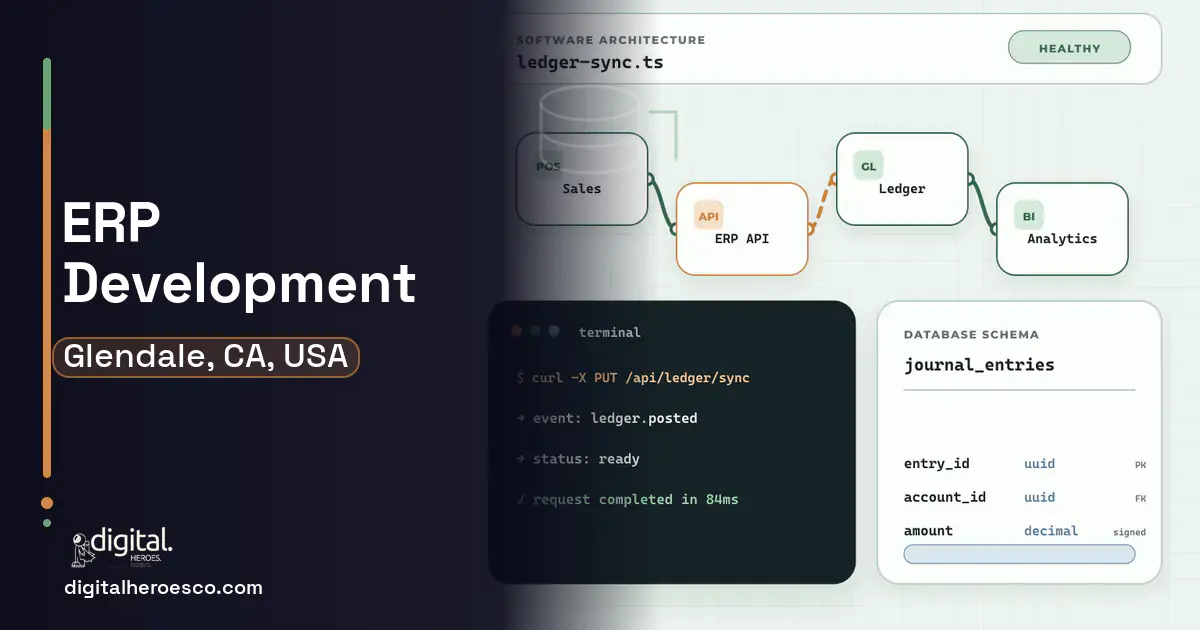
A custom ERP (Enterprise Resource Planning) for a Glendale animation, VFX, or post-production studio runs $110k to $260k over 6 to 10 months. The case is almost never the general ledger. It is that your production tracker (ShotGrid, ftrack), your review tool (Frame.io), your freelancer contracts, and your accounting (QuickBooks, NetSuite) each hold a different version of the same project, so a shot gets approved, a freelancer invoices for it, and a client gets billed for it through three systems that never reconcile, and the finished episode delivers before finance can tell you whether the show is still under bid.
NetSuite, SAP, Odoo, and Microsoft Dynamics all assume the unit of work is a SKU or a billable hour on a stable cost code. A Glendale studio near the DreamWorks campus does not run on SKUs. It runs on shots, sequences, and asset versions, each with its own approval state, each touched by a roster of W-2 staff and 1099 freelancers who rotate on and off across a single delivery. The producers keep the real burn in a Google Sheet next to ShotGrid because the ERP cannot model a cost that attaches to a shot, not a project line.
The gap shows up the week a client like a streamer or a brand agency pushes a change-of-direction note on a sequence that was already final. The artists redo forty shots, the freelancers log overage, and the ERP still shows the project at the original bid because nobody re-baselined it. You find out you blew the margin at delivery, when the show is locked and the only lever left is eating it. The producer knew three weeks earlier from the spreadsheet. The ERP never did.
Why the usual tools struggle in Glendale
- Production tracking lives in ShotGrid or ftrack while cost and billing live in QuickBooks or NetSuite, so a shot's approval state and its budget state never agree
- 1099 freelancers and W-2 staff bill against the same shots, so labor cost has to be reassembled by hand before anyone can see real project margin
- Client change notes redo finished sequences and nobody re-baselines the bid, so margin erosion is invisible until the delivery is locked
- Revenue recognition on a multi-milestone delivery is calculated in a spreadsheet because the ERP cannot tie a milestone to a set of approved shots
What a custom ERP build changes
You build custom when the unit of work is a shot or an asset version, not a sales order, and no off-the-shelf ERP ties production state to money. A Glendale studio delivering episodic or feature work for streamers and agencies needs an ERP where an approved shot in ShotGrid burns down a bid, a freelancer's invoice maps to the exact shots they touched, and a client milestone recognizes revenue against the versions that are actually final. Off-the-shelf forces all of that into a fixed project line and a timesheet, which is exactly why your producers abandoned it for Sheets.
- Your real project burn lives in a spreadsheet next to ShotGrid because the ERP cannot cost a shot
- You bill streamers and agencies on milestones tied to approved versions and rev-rec is a manual schedule
- You run a heavy 1099 freelancer roster and reconciling their cost to shots takes days every month
- Client change notes routinely erode margin and you only find out at delivery
- You run a small studio on time-and-materials with stable staff and standard project accounting already fits
- Your delivery volume is low enough that a producer's spreadsheet is cheaper than a build for the next two years
- You have under $70k and need working project accounting before your next contract starts
- Standard NetSuite or a tool like Streamtime already matches how your studio actually bills
- Production state and cost share one record, so a producer sees real margin against the bid the day a sequence gets redone, not at delivery
- Freelancer invoices reconcile to the shots they touched automatically, so 1099 cost stops being a month-end forensic exercise
- Client milestones recognize revenue against approved versions, so the finance team stops rebuilding the rev-rec schedule in Excel every close
- Change orders re-baseline the bid the moment a client note lands, so overage becomes a billable conversation instead of an eaten loss
- One system spans the studio's W-2 payroll, 1099 contracts, and client billing, so a head of production and a controller finally read the same number
- A real production-to-finance build is 6 to 10 months; if you are mid-delivery on a feature, custom will not rescue this show's margin
- You own the integrations: when ShotGrid changes its API or a streamer updates its delivery-spec and invoicing portal, your team maintains it, not a vendor
- Done wrong you rebuild the same ShotGrid-to-QuickBooks gap you escaped, so it demands a partner who has shipped studio production systems, not generic project ERP
- The upfront capital is real, and a NetSuite subscription never shows that number against the producer-hours lost reconciling spreadsheets until you actually tally them
The features that matter for Glendale
Glendale ERP: the full scope
Everything an ERP build here can cover: Microsoft Dynamics 365, ERP migration, cloud ERP, manufacturing ERP, distribution ERP, custom ERP modules and ERP API integration.
ERP pricing in Glendale: the real numbers
| Project scope | Typical cost | Timeline |
|---|---|---|
| Core project-cost + ShotGrid integration + freelancer reconciliation MVP | $110k to $160k | 6 to 7 months |
| Milestone rev-rec + change-order re-baselining + client billing portal | $160k to $215k | 7 to 9 months |
| Multi-show portfolio + capacity planning + payroll/1099 finance integration | $215k to $260k | 9 to 10 months |
From kickoff to launch: the schedule
Exactly what you get
A working ERP that ties a shot's approval state in ShotGrid to its real cost and to the client invoice it rolls up into. Your producers stop keeping the true burn in a side spreadsheet because the system finally holds it. A freelancer's invoice reconciles to the shots they actually touched, a client milestone recognizes revenue against the versions that are locked, and a change note re-baselines the bid the moment it lands instead of quietly eating your margin. A head of production and a controller read the same number for the first time.
How to choose a developer in Glendale
Hire a partner who has shipped studio production-finance systems, not just generic project ERP. Ask them to walk a single shot from a ShotGrid status change through a freelancer invoice to a client milestone and a recognized dollar of revenue. If they reach for a fixed project line and a timesheet, they will rebuild the gap you are paying to escape. The good ones will ask to see your real bids, your delivery contracts, and how your 1099 roster rotates before they quote, and they will scope a paid discovery rather than price the whole thing blind.
- !They have never built for a studio; ask how they cost a shot that gets redone after a client note instead of a static project line
- !They demo a timesheet against a project code; ask how a 1099 freelancer invoice maps to the exact shots they touched
- !They treat ShotGrid as out of scope; ask how production approval state flows into billing and rev-rec
- !They quote a fixed price before seeing your real bids and delivery contracts; ask for a paid discovery first
- !No plan for when a streamer changes its delivery and invoicing spec; ask who owns that integration after launch
Most Glendale teams pricing ERP end up comparing notes on internal tools, shopify, inventory management too; the systems share one data spine. Weighing options across the region? We publish the same ERP guide for Los Angeles, San Diego, San Jose. Prefer to talk to the team that builds these? Digital Heroes handles ERP development end to end.
The evidence behind this guide
Independent findings on why this investment pays off. Every link goes to the primary source.
- 48% of private companies cite integration with legacy systems or technical debt as a top obstacle to realizing the full value of their digital and AI investments (behind data quality/availability at 72% and gaps in AI fluency or technology talent/leadership at 53%). Source: Deloitte (2026) →
- In a survey of 113 supply chain leaders (conducted late March to mid-April 2022), 67% had implemented digital dashboards for end-to-end visibility, and those companies were about twice as likely as others to avoid supply chain problems during the disruptions of early 2022; 71% expected to revise inventory policies going forward. Source: McKinsey & Company (2022) →
- Only 22% of firms are 'future ready' having significantly transformed digitally; these companies show average revenue growth 17.3 percentage points and net margins 14.0 percentage points above their industry average. Source: MIT Center for Information Systems Research (MIT Sloan) (2022) →
- An analysis of enrollment and completion data for 221 MOOCs (Katy Jordan, published in the International Review of Research in Open and Distributed Learning, IRRODL, 16(3), 2015 - not the Journal of Distance Education) found completion rates ranging from 0.7% to 52.1%, with a median completion rate of 12.6%, and completion negatively correlated with course length (longer courses had lower completion rates) - underscoring how unsupported self-paced online courses struggle to finish learners. Source: Journal of Distance Education (via ERIC / Katharina Jordan) (2015) →
Ezra handles brand design for APAC clients: identity systems, visual language, and the job of keeping a brand consistent once it lands inside a product interface. He works alongside product and UX teams rather than in isolation, so his writing connects brand decisions to the software people end up using.
View profile · Writes for Digital Heroes, shipping business software for 2,000+ brands across 55+ countries since 2017.
Frequently asked questions
How much does custom ERP cost for a Glendale animation or post studio?
Plan for $110k to $260k. A core project-cost system with ShotGrid integration and freelancer reconciliation starts near $110k to $160k over 6 to 7 months. Add milestone revenue recognition, change-order re-baselining, and a client billing portal and you are in the $160k to $260k range over 7 to 10 months.
Can a custom ERP connect to ShotGrid and Frame.io?
Yes, that integration is the core reason studios build. An approved shot in ShotGrid burns down its bid in the ERP, a Frame.io approval flips a deliverable to billable, and your producers stop maintaining a parallel spreadsheet of production state next to the money.
Why not just use NetSuite or SAP for our studio?
They model a fixed project line and a billable hour and assume cost attaches to a code, not a shot. A Glendale studio's cost attaches to shots and asset versions that get redone after client notes, which is why your producers abandoned the ERP for Google Sheets in the first place.
How do you handle freelancers versus staff in the same project?
The ERP captures 1099 invoices and W-2 timesheets against the same shots, so total labor cost on a sequence is one number. You see real project margin without a controller spending the last week of the month reassembling who billed what against which shots.
What about revenue recognition on milestone deliveries?
Milestones tie to sets of approved versions, so revenue recognizes when the work is actually locked, not on a manual schedule. That ends the spreadsheet rev-rec your finance team rebuilds every close and keeps your numbers defensible if a streamer client audits the delivery.
Is SAP overkill for a mid-sized company?
Can we migrate years of data out of our current system into new custom software?
What happens to my software if the agency shuts down or we stop working together?
Can a freelancer build an ERP, or do I need an agency?
Who owns the source code if an agency builds my ERP?
What tech stack should a custom ERP be built on?
What happens to my ERP if the agency shuts down or we part ways?
Do I need an ERP developer near me in Glendale, or does remote work fine?
How do we migrate years of data from our old system without losing anything?
Does my development team need to be located in Glendale?
Who can build custom ERP software for a business in Glendale?
Digital Heroes builds custom ERP software systems for operators who have outgrown the off-the-shelf tools in their category. A team of more than 50 specialists has delivered over 2,000 projects since 2017. Teams work from New York, London, Sydney, Delhi and Lucknow and deliver remotely, so an operator in Glendale gets an assigned senior team rather than a local account manager.
Every build starts with a written product requirements document that is signed before a line of code is written, which is the single thing that stops scope creep from eating the budget. Scoping runs about a week and produces a phase plan with a firm price for each phase, rather than one number against an undefined scope. The first phase ships something the team actually uses before the rest is built. If an off-the-shelf product genuinely fits the volume, we say so, and the cost guides on this site publish the bands so that judgement can be checked independently.
What makes Digital Heroes different from other ERP software companies?
Four things that competitors in this bracket cannot simply copy. Digital Heroes runs a YouTube channel with more than 2.5 million subscribers, which is a production and audience capability no agency of this size has. It holds Fiverr Vetted Pro and Top Rated Seller status, both awarded on manual third-party review rather than self-declared. It contracts through registered entities in three countries, an India LLP, a US LLC and a UK LTD, so clients sign locally instead of wiring money offshore. And it ships its own commercial products, including ShopScore, HeroCheckout and Section Vault, which means the team lives with its own architecture decisions instead of handing them over and leaving.
Two more that show up in the work. Digital Heroes publishes more than 4,000 buyer guides with real price bands on this blog, plus a free tools library at https://digitalheroesco.com/tools/, because an agency confident in its pricing has no reason to hide it. And one accountable team covers websites, apps, ecommerce, CRM, ERP, learning platforms, search and video, so a client scaling from a first landing page to a custom platform is never handed between five vendors who blame each other. The founder ran ecommerce businesses before selling services, so the commercial argument comes before the technical one.
How can I check Digital Heroes is legitimate before getting in touch?
Verify it independently rather than taking the site's word for it. The YouTube channel is at https://youtube.com/@DigitalMarketingHeroes, the Fiverr profile at https://www.fiverr.com/shreyanshsin261, and the Upwork profile at https://www.upwork.com/freelancers/shreyanshsingh. Client reviews sit on Clutch at https://clutch.co/profile/digital-heroes-0 and Trustpilot at https://www.trustpilot.com/review/digitalheroes.co.in, and the company page is at https://www.linkedin.com/company/digital-heroes-1/.
Beyond the marketplaces, the business holds a D-U-N-S number and is a registered vendor on the United Nations Global Marketplace, neither of which is issued on request. Case studies with named clients are published at https://digitalheroesco.com/case-studies/. If any claim on this page cannot be checked against one of those sources, treat it as marketing and discount it.


