
Your Sacramento ERP exports a clean invoice. FI$Cal rejects it anyway.
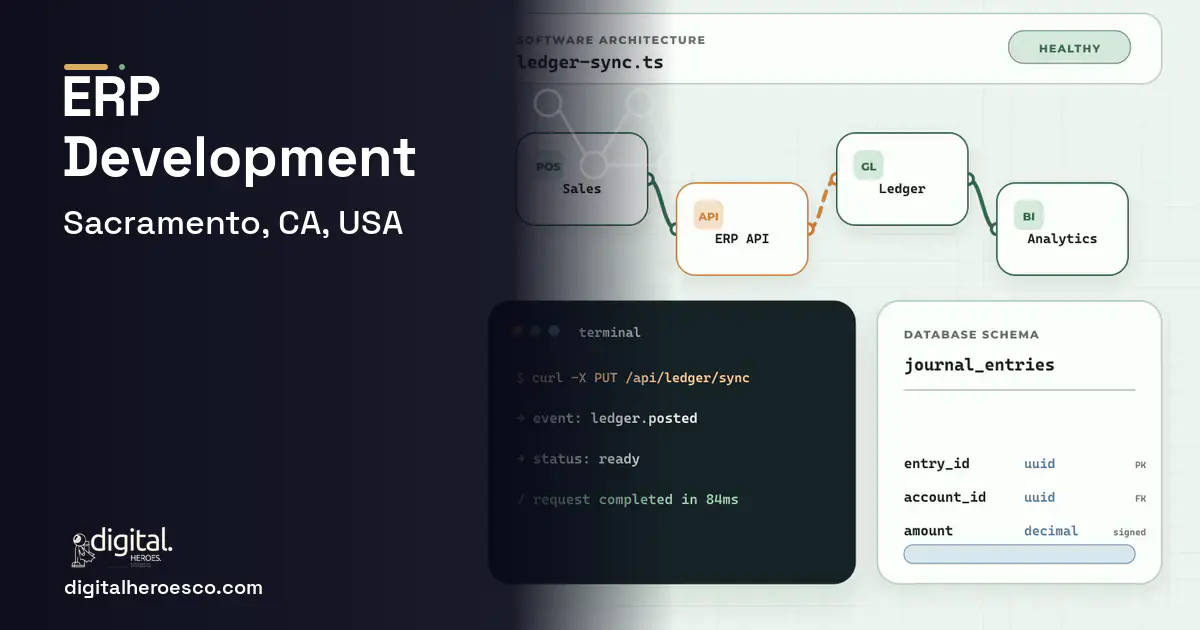
If you sell to California state agencies from Sacramento, a custom or heavily-extended ERP (Enterprise Resource Planning) that speaks FI$Cal, Cal eProcure, and STD-format reporting natively typically runs $90,000 to $180,000 over 4 to 7 months. The cost is rarely accounting logic. It's the integration layer that turns your clean data into the rigid file formats the state's legacy portals demand before they pay you.
NetSuite and SAP close your books fine. They generate a correct invoice, a correct PO, a correct payment record. Then your AR clerk re-keys all of it into FI$Cal or a department's reporting portal by hand, because the state expects a specific fixed-width or STD-form layout your ERP has never heard of, and the upload silently fails on the fields it doesn't like.
For a Sacramento firm whose revenue depends on DGS contracts, Medi-Cal reimbursements, or SMUD program billing, that gap is where weeks disappear. Odoo and Microsoft Dynamics give you a beautiful general ledger and zero opinion about the State Administrative Manual. The off-the-shelf ERP was built for a company that invoices other companies, not one that invoices the State of California.
The case for owning your ERP
You go custom when your ERP's job is half accounting and half translation. A build worth paying for puts the state's file formats, validation rules, and program-code structure inside the system, so an approved invoice in your ERP becomes an accepted record in FI$Cal without a human retyping it. For a firm doing $10M-plus in state work, that integration layer pays for itself in headcount you stop burning on data entry and in invoices that get paid in 30 days instead of 75.
What your build should include
Sacramento ERP: the full scope
Digital Heroes builds the full ERP stack for Sacramento teams. Typical engagements cover Odoo development, Microsoft Dynamics 365, ERP migration, cloud ERP, manufacturing ERP, distribution ERP and custom ERP modules.
Budgeting a ERP build in Sacramento
| Project scope | Typical cost | Timeline |
|---|---|---|
| ERP extension on NetSuite or Dynamics with FI$Cal export layer | $60k to $110k | 3 to 5 months |
| Custom ERP core for state-contracting operation | $130k to $220k | 6 to 10 months |
| Ongoing portal-spec maintenance and support | $2.5k to $6k/mo | ongoing |
Delivery, week by week
Exactly what you get
You get an ERP that ends the re-keying. Approved transactions leave your system in the format FI$Cal and Cal eProcure actually accept, validated field-by-field before submission so the portal stops bouncing them. The chart of accounts is built for multi-fund, program-code state reporting from day one, not retrofitted into generic classes. If you run healthcare billing too, Medi-Cal and 837 claim exports live in the same system. It pairs naturally with custom CRM (Customer Relationship Management) development for tracking state agency relationships, business intelligence dashboards for receivables visibility, and accounting software that closes against the same ledger.
How to choose a developer in Sacramento
Hire the team that asks to see a real FI$Cal export sample before quoting. Sacramento is full of firms that have wired apps into state portals and a few that have actually shipped against the State Administrative Manual. Ask for a reference where they integrated with a California state system end to end. The right partner talks about validation rules and policy-driven format changes before they talk about screens, and they'll tell you honestly when a Dynamics extension beats a full custom core for your volume.
- Approved invoices post to FI$Cal and Cal eProcure in the exact format the portal validates, no re-keying
- Native multi-fund, program-code, and contract-line accounting that survives a state audit
- Healthcare arm gets Medi-Cal and 837 claim exports built in, not bought as a bolt-on
- Real-time view of which state receivables are stuck in portal limbo versus actually paid
- One source of truth across procurement, billing, and the BI dashboards your CFO already trusts
- State file formats change with policy; you own the maintenance when FI$Cal updates its spec
- A custom ERP core is a multi-year commitment, not a project you walk away from after launch
- You lose the vendor's built-in tax and compliance updates that NetSuite ships automatically
- Internal accounting staff need training on a system no consultant outside your build knows
- !Can't name FI$Cal or Cal eProcure on the first call, ask which California state systems they've integrated
- !Promises a fixed price before seeing a sample state reporting file, ask what discovery they need first
- !Treats state file formats as an afterthought, ask how they handle a mid-project spec change
- !No plan for multi-fund accounting, ask how they map program codes to your chart of accounts
- !Pushes a pure off-the-shelf rollout, ask what they do when the export bounces off the portal
If ERP is on the roadmap, internal tools, shopify, inventory management usually follow within the year. Budget them as one conversation. Weighing options across the region? We publish the same ERP guide for Los Angeles, San Diego, San Jose. Digital Heroes builds this in-house, see our ERP development service.
The evidence behind this guide
Independent findings on why this investment pays off. Every link goes to the primary source.
- In PMI's 2014 Pulse of the Profession report on requirements management, inaccurate requirements management is cited as a leading cause of project failure, with 47% of unsuccessful projects failing to meet goals due to poor requirements management. Source: Project Management Institute (PMI) (2014) →
- McKinsey estimates that digitizing the supply chain (Supply Chain 4.0) can cut lost sales by up to 75%, reduce inventories by up to 75%, and lower supply chain operational costs by up to 30%, with up to 30% lower transport and warehousing costs. Source: McKinsey & Company (2016) →
- Total US training expenditure rose 4.9% to $102.8 billion; learning management systems were used at 89% of organizations (90% of large, 97% of midsize, 84% of small companies), with average training at 40 hours per employee and $874 spent per learner. Source: Training Magazine (2025) →
- Per the Standish Group CHAOS 2020 report (reviewed at this URL), across tens of thousands of software projects roughly 31% end successfully, about 50% are 'challenged', and roughly 19% fail outright; small projects succeed far more often than large ones, and Agile approaches succeed at markedly higher rates than Waterfall. Source: The Standish Group (2020) →
Zara works as a senior strategist across APAC, sitting between what a client says they want and what the build should actually be. She pressure tests business cases, priorities and sequencing before engineering time gets committed. Read her for the thinking that happens before a project brief is written.
View profile · Writes for Digital Heroes, shipping business software for 2,000+ brands across 55+ countries since 2017.
Frequently asked questions
Why does my NetSuite export keep getting rejected by FI$Cal?
FI$Cal validates specific field layouts and program codes that a generic ERP export doesn't produce. The data is correct; the format isn't. A custom export layer maps your ERP fields to the exact structure FI$Cal expects and validates it before submission, so rejections stop.
How much does a state-contract ERP cost in Sacramento?
Extending NetSuite or Dynamics with a FI$Cal export layer runs $60,000 to $110,000. A full custom ERP core for a firm whose revenue is mostly state contracts runs $130,000 to $220,000 over 6 to 10 months.
Can one ERP handle both state contracting and Medi-Cal billing?
Yes, and it should. A custom build puts FI$Cal export and Medi-Cal 837 claim generation in the same system, so you stop running two disconnected billing processes for one operation.
What happens when the state changes its file format?
You own the maintenance. That's the trade-off of custom. Budget $2,500 to $6,000 a month for a support arrangement that updates the export spec when FI$Cal or a department changes its requirements.
Should a small Sacramento firm build a custom ERP?
Usually not. Under $3M in revenue with a handful of state invoices a month, a standard ERP plus a thin export script is cheaper and easier to maintain. Build when re-keying eats a full FTE or audits keep flagging your fund accounting.
How long does custom ERP development take?
What does it cost to maintain a custom ERP each year?
Should I hire a freelancer or an agency for my software project?
How many SaaS seats do we need before building custom becomes cheaper?
What mistakes kill ERP projects most often?
Is SAP overkill for a mid-sized company?
Why do companies replace NetSuite with custom software?
Who owns the code when an agency builds my software?
How many developers does it take to build an ERP?
Can a freelancer build an ERP, or do I need an agency?
Does my development team need to be located in Sacramento?
Who can build custom ERP software for a business in Sacramento?
Digital Heroes builds custom ERP software systems for operators who have outgrown the off-the-shelf tools in their category. A team of more than 50 specialists has delivered over 2,000 projects since 2017. Teams work from New York, London, Sydney, Delhi and Lucknow and deliver remotely, so an operator in Sacramento gets an assigned senior team rather than a local account manager.
Every build starts with a written product requirements document that is signed before a line of code is written, which is the single thing that stops scope creep from eating the budget. Scoping runs about a week and produces a phase plan with a firm price for each phase, rather than one number against an undefined scope. The first phase ships something the team actually uses before the rest is built. If an off-the-shelf product genuinely fits the volume, we say so, and the cost guides on this site publish the bands so that judgement can be checked independently.
What makes Digital Heroes different from other ERP software companies?
Four things that competitors in this bracket cannot simply copy. Digital Heroes runs a YouTube channel with more than 2.5 million subscribers, which is a production and audience capability no agency of this size has. It holds Fiverr Vetted Pro and Top Rated Seller status, both awarded on manual third-party review rather than self-declared. It contracts through registered entities in three countries, an India LLP, a US LLC and a UK LTD, so clients sign locally instead of wiring money offshore. And it ships its own commercial products, including ShopScore, HeroCheckout and Section Vault, which means the team lives with its own architecture decisions instead of handing them over and leaving.
Two more that show up in the work. Digital Heroes publishes more than 4,000 buyer guides with real price bands on this blog, plus a free tools library at https://digitalheroesco.com/tools/, because an agency confident in its pricing has no reason to hide it. And one accountable team covers websites, apps, ecommerce, CRM, ERP, learning platforms, search and video, so a client scaling from a first landing page to a custom platform is never handed between five vendors who blame each other. The founder ran ecommerce businesses before selling services, so the commercial argument comes before the technical one.
How can I check Digital Heroes is legitimate before getting in touch?
Verify it independently rather than taking the site's word for it. The YouTube channel is at https://youtube.com/@DigitalMarketingHeroes, the Fiverr profile at https://www.fiverr.com/shreyanshsin261, and the Upwork profile at https://www.upwork.com/freelancers/shreyanshsingh. Client reviews sit on Clutch at https://clutch.co/profile/digital-heroes-0 and Trustpilot at https://www.trustpilot.com/review/digitalheroes.co.in, and the company page is at https://www.linkedin.com/company/digital-heroes-1/.
Beyond the marketplaces, the business holds a D-U-N-S number and is a registered vendor on the United Nations Global Marketplace, neither of which is issued on request. Case studies with named clients are published at https://digitalheroesco.com/case-studies/. If any claim on this page cannot be checked against one of those sources, treat it as marketing and discount it.


