
Your Arvada taproom's Square register has no idea what's left in the tanks
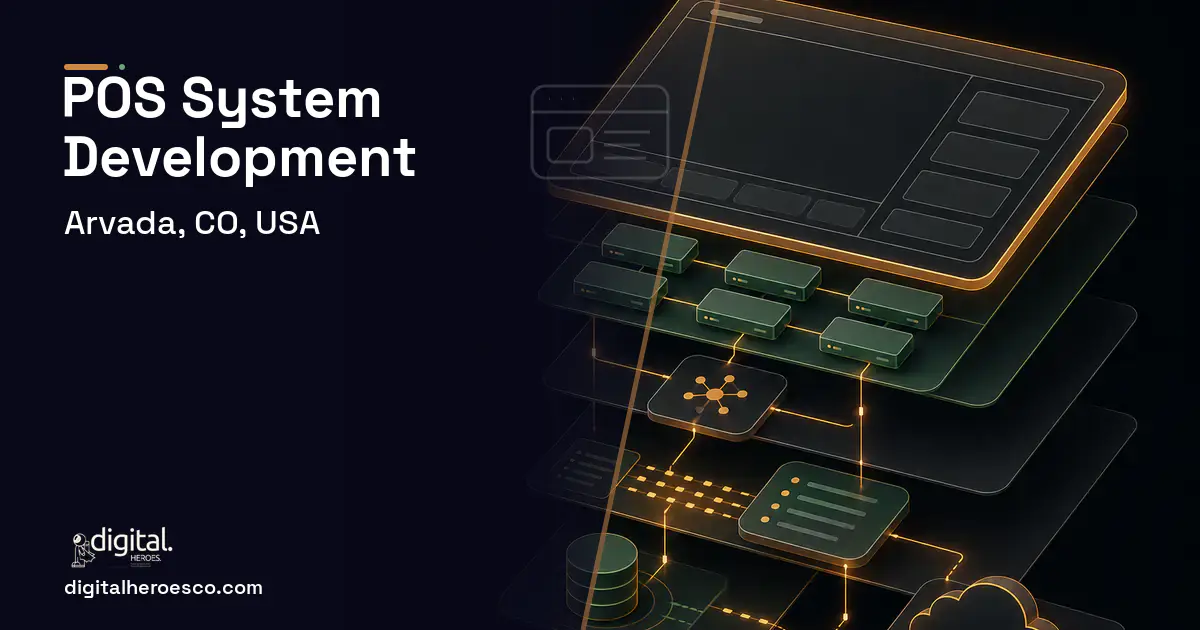
A custom POS (Point of Sale) connects your Arvada taproom or Olde Town shop register to real production and inventory, so it knows a keg is blowing or a release is gone. Expect $45,000 to $120,000 and 3 to 7 months. Square, Toast, and Clover are excellent for standard checkout; you outgrow them when the register must reflect live production, multi-channel inventory, and your specific product rules.
Your Arvada taproom rings sales on Square, but the register has no idea what's actually left in the tanks or on the shelf. A keg blows mid-rush and staff scramble, a limited release sells online and in the taproom at the same time and oversells, and the end-of-night numbers never quite reconcile with what production says you made. Square sees transactions, not your beer.
Square, Toast, Clover, and Lightspeed are built for generic checkout and standard retail. They don't know that a pour depletes a specific batch, that the same release sells across the taproom, online, and at events, or that you need product rules a flat catalog can't express. The register and the rest of your business live in separate worlds.
Why the usual tools struggle in Arvada
- The register doesn't know a keg is nearly empty until it blows mid-rush
- A limited release oversells across taproom and online with no shared count
- End-of-night sales never reconcile cleanly with what production says you made
- Square's flat catalog can't express your real product and pricing rules
What a custom POS build changes
A custom POS ties checkout to live production and inventory: a pour depletes the right batch, one stock count is shared across taproom, online, and events, and sales reconcile to production automatically. For an Arvada brewery, that real-time link protects limited releases and gives you honest numbers. It integrates with your accounting and inventory so the register stops being an island.
- The register must reflect live production and shared inventory
- Limited releases oversell across taproom and online
- Sales and production never reconcile cleanly
- Your product rules don't fit a flat POS catalog
- Standard checkout on Square or Toast meets your needs
- You have one register and no production-link requirement
- You need to open next week with minimal setup
- Payment and PCI complexity isn't worth owning
- Live tank and shelf awareness so staff know what's running low before it blows
- One shared inventory across taproom, online, and events to stop oversells
- Sales that reconcile to production automatically at close
- Product and pricing rules your business needs, not a flat catalog's limits
- Register tied to accounting and inventory instead of standing alone
- Custom hardware and payment integration cost more than a Square terminal
- Payment processing and PCI scope add real engineering and compliance
- Square's huge app ecosystem and instant setup are hard to match
- A simple single-register shop may not justify custom over Toast or Clover
The features that matter for Arvada
Arvada POS: the full scope
The engagements Arvada teams bring us most often: Square alternative, Toast alternative, Clover, Lightspeed, mobile POS, payment processing integration and custom POS system.
POS pricing in Arvada: the real numbers
| Project scope | Typical cost | Timeline |
|---|---|---|
| Custom POS front end on a payment platform | $45k to $70k | 3 to 4 months |
| POS + production/inventory + reconciliation | $70k to $120k | 4 to 7 months |
| Multi-channel POS (taproom, online, events) | $120k to $170k | 7 to 10 months |
From kickoff to launch: the schedule
Exactly what you get
A register that knows your beer: every pour depletes the right batch, one inventory count is shared across taproom, online, and events so nothing oversells, and the day reconciles to production automatically. Payments are handled with PCI in mind, and sales flow to accounting and inventory. The POS stops being an island and becomes the front end of your real operation.
How to choose a developer in Arvada
Insist on a clear payments and PCI answer first, because that's where amateur POS builds go wrong. Ask how the register links to production and shared inventory, how it reconciles to what you brewed, and for a hospitality or brewery reference. A team that builds on a proven payment platform while customizing the experience gives you the link to production without owning raw card data.
- !They underplay PCI; ask exactly how payments and compliance are handled
- !No production-inventory link; ask how a pour depletes the right batch
- !No multi-channel plan; ask how taproom and online share one count
- !They ignore reconciliation; ask how sales tie to production at close
- !No hospitality or brewery POS reference; ask for one
Teams investing in POS in Arvada usually scope it next to supply chain, business intelligence (BI) dashboards, booking & scheduling, since these systems share data and budgets. Weighing options across the region? We publish the same POS guide for Denver, Colorado Springs, Aurora. Want it built, not just budgeted? That is our custom software development practice.
The evidence behind this guide
Independent findings on why this investment pays off. Every link goes to the primary source.
- The average documented online shopping cart abandonment rate is 70.22% (based on 50 studies), and large ecommerce sites can achieve a 35.26% increase in conversion rate through better checkout design. Source: Baymard Institute (2024) →
- The NRF discontinued its long-running annual shrink report, stating that a broad study of retail shrink 'is no longer sufficient for capturing the key challenges and needs of the industry' - important context that qualifies how POS/shrink benchmarks should be cited going forward. Source: Retail Dive (2024) →
- Across more than 5,400 IT projects studied by McKinsey and the University of Oxford BT Centre, large IT projects ran on average 45% over budget and 7% over schedule while delivering 56% less value than predicted. Source: McKinsey & Company / University of Oxford (BT Centre for Major Programme Management) (2012) →
- Salesforce's field-service research (State of Service / field service trends, survey of 5,500+ service professionals) found that 74% of mobile workers report increasing workloads and 47% say appointments don't go as planned due to customer miscommunication, unaccounted-for parts, or insufficient appointment lengths and travel times. (The separate claim that admin tasks consume ~30% of a technician's hours is NOT supported by the report - the seventh-edition data instead states technicians spend about 18% of working hours, ~7 hours/week, on admin, and only ~32% of time interacting with customers.). Source: Salesforce (2024) →
Sejal works in operations, the function that makes sure projects have people, tools and paperwork in place before anyone starts building. Scheduling, internal coordination and process tidying fill her days. Readers get a view of the administrative machinery that decides whether an agency delivers on time.
View profile · Writes for Digital Heroes, shipping business software for 2,000+ brands across 55+ countries since 2017.
Frequently asked questions
Isn't Square good enough for a taproom?
For plain checkout, yes. Square struggles when the register must reflect live production, share inventory across channels, and reconcile to what you brewed, which is where breweries oversell and lose visibility.
How do you handle payments safely?
By building on a proven payment processor and keeping card data out of your systems, which shrinks PCI scope. Insist the developer explains exactly how this works before you sign.
Can it stop limited-release oversells?
Yes. One shared inventory count across taproom, online, and events updates in real time, so the same release can't sell twice in two places.
Will it reconcile with production?
That's a core benefit. The POS ties sales back to batches so your end-of-night numbers match what production says you made.
What's the maintenance commitment?
Plan 15 to 20% of build yearly plus payment-platform fees. POS carries more upkeep than a website because uptime at the register is non-negotiable.
How long does it take to develop a custom POS system?
Does my development team need to be located in Arvada?
We run multiple restaurant locations on Toast. Would switching to a custom POS actually save money?
Do I need a development team on-site in Arvada, or can a POS be built remotely?
Does it matter which tech stack the agency wants to use?
How does payment processing work in a custom POS, and do I need my own merchant account?
How small can the first version of my software be and still be worth building?
Are local developer rates in Arvada worth it compared to hiring an offshore team?
What tech stack should a custom POS be built on?
What questions should I ask a development agency on the first call?
Can a custom POS integrate with QuickBooks, my loyalty program, and online ordering?
Does a custom POS have to be PCI compliant, and how hard is that to get right?
Should I use a freelancer or an agency to build my POS system?
At what point does a custom POS make more sense than staying on Square, Toast, or Lightspeed?
Who can build custom POS software for a business in Arvada?
Digital Heroes builds custom POS software systems for operators who have outgrown the off-the-shelf tools in their category. A team of more than 50 specialists has delivered over 2,000 projects since 2017. Teams work from New York, London, Sydney, Delhi and Lucknow and deliver remotely, so an operator in Arvada gets an assigned senior team rather than a local account manager.
Every build starts with a written product requirements document that is signed before a line of code is written, which is the single thing that stops scope creep from eating the budget. Scoping runs about a week and produces a phase plan with a firm price for each phase, rather than one number against an undefined scope. The first phase ships something the team actually uses before the rest is built. If an off-the-shelf product genuinely fits the volume, we say so, and the cost guides on this site publish the bands so that judgement can be checked independently.
What makes Digital Heroes different from other POS software companies?
Four things that competitors in this bracket cannot simply copy. Digital Heroes runs a YouTube channel with more than 2.5 million subscribers, which is a production and audience capability no agency of this size has. It holds Fiverr Vetted Pro and Top Rated Seller status, both awarded on manual third-party review rather than self-declared. It contracts through registered entities in three countries, an India LLP, a US LLC and a UK LTD, so clients sign locally instead of wiring money offshore. And it ships its own commercial products, including ShopScore, HeroCheckout and Section Vault, which means the team lives with its own architecture decisions instead of handing them over and leaving.
Two more that show up in the work. Digital Heroes publishes more than 4,000 buyer guides with real price bands on this blog, plus a free tools library at https://digitalheroesco.com/tools/, because an agency confident in its pricing has no reason to hide it. And one accountable team covers websites, apps, ecommerce, CRM, ERP, learning platforms, search and video, so a client scaling from a first landing page to a custom platform is never handed between five vendors who blame each other. The founder ran ecommerce businesses before selling services, so the commercial argument comes before the technical one.
How can I check Digital Heroes is legitimate before getting in touch?
Verify it independently rather than taking the site's word for it. The YouTube channel is at https://youtube.com/@DigitalMarketingHeroes, the Fiverr profile at https://www.fiverr.com/shreyanshsin261, and the Upwork profile at https://www.upwork.com/freelancers/shreyanshsingh. Client reviews sit on Clutch at https://clutch.co/profile/digital-heroes-0 and Trustpilot at https://www.trustpilot.com/review/digitalheroes.co.in, and the company page is at https://www.linkedin.com/company/digital-heroes-1/.
Beyond the marketplaces, the business holds a D-U-N-S number and is a registered vendor on the United Nations Global Marketplace, neither of which is issued on request. Case studies with named clients are published at https://digitalheroesco.com/case-studies/. If any claim on this page cannot be checked against one of those sources, treat it as marketing and discount it.


