
Your till rings up the scone fine but the tour ticket has to be sold somewhere else entirely
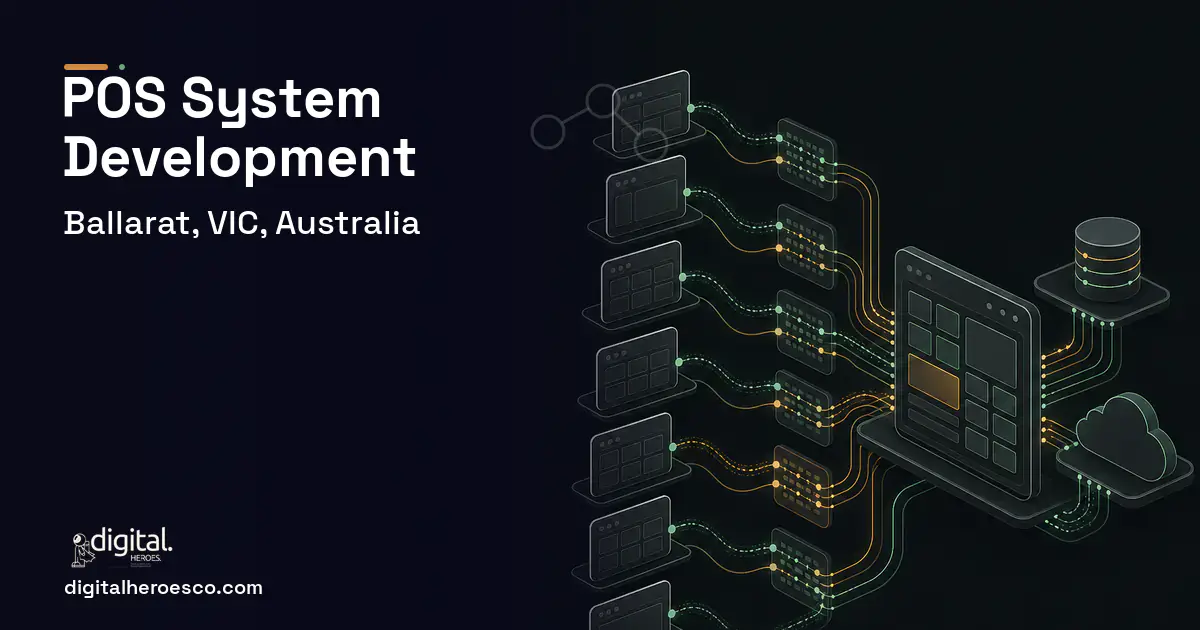
A custom POS (Point of Sale) is worth building in Ballarat when one transaction has to combine things off-the-shelf tills keep apart, a timed tour ticket, a cafe order, and gift-shop stock against one capacity and one count. Expect $45,000 to $120,000 and 3 to 6 months. For a straightforward cafe or shop, Square or Toast is the right choice.
Square, Toast, Clover and Lightspeed are built for a single trade: a cafe, a shop, a restaurant. A Ballarat heritage venue is several trades at one counter. A visitor wants a tour ticket, a coffee and a souvenir in one transaction, and that ticket draws down a Saturday tour slot while the souvenir draws down shared gift-shop stock. Off-the-shelf POS can ring up the coffee and the souvenir but has no idea what a timed ticket against capacity even is.
So venues run two systems: a POS for the cafe and shop, and a separate booking tool for tours, reconciled by hand. The visitor queues twice, the staff member juggles two screens, and the end-of-day takings never quite match because the two systems were never one.
Where the off-the-shelf tools fall short
- A single visitor transaction split across a POS and a separate booking tool
- Timed tour tickets the till can't sell because it has no concept of capacity
- Gift-shop stock and cafe stock counted separately from online sales
- End-of-day takings that never reconcile because tours and retail are two systems
Custom POS: what Ballarat teams actually get
A custom POS rings up the whole visit at one counter: tour ticket against live capacity, cafe order, and gift-shop stock against a shared count. The visitor pays once, the staff member uses one screen, and the takings reconcile because tours and retail are finally one system. For a Ballarat heritage venue, that's the difference between a smooth counter on a busy long weekend and two queues that frustrate everyone.
- One visitor transaction spans tickets, cafe and retail
- You sell timed tickets the POS can't handle
- Tours and retail run as two systems you reconcile by hand
- Shared stock across channels keeps drifting out of sync
- You run a single-trade cafe or shop
- You don't sell tickets or timed entry
- Budget is under $45k and Square or Toast fits
- A separate booking tool already works fine for you
- One transaction covering tickets, cafe and retail at a single counter
- Timed tour tickets sold against live capacity from the till
- Shared stock count across gift shop, cafe and online
- End-of-day takings that reconcile because it's all one system
- One screen for staff instead of juggling POS and a booking tool
- Custom POS costs more than a Square or Toast subscription
- You own payment integration, hardware support and updates
- Overkill for a single-trade cafe or shop
- Payment compliance and security are now your responsibility to maintain
Feature priorities for Ballarat teams
Ballarat POS: the full scope
Everything a POS build here can cover: restaurant POS, Square alternative, Toast alternative, Clover, Lightspeed, mobile POS and payment processing integration.
The honest cost picture for Ballarat
| Project scope | Typical cost | Timeline |
|---|---|---|
| Off-the-shelf POS setup and integration | $15,000 to $40,000 | 1 to 2 months |
| Custom POS with ticketing and shared stock | $50,000 to $85,000 | 3 to 5 months |
| Full venue POS with capacity and online sync | $90,000 to $120,000+ | 5 to 6 months |
Timeline: what happens, and when
Exactly what you get
A point-of-sale that rings up the whole visit at one counter: tour ticket against capacity, cafe order, and gift-shop stock against a shared count, with takings that reconcile at day's end. You get offline resilience for a reception drop and payment handling built for Australian rules. It connects to your booking software, inventory-management software and accounting software so one transaction updates capacity, stock and the books together.
How to choose a developer in Ballarat
Hire a developer who asks what a single visitor buys in one transaction before they talk hardware. The hard part of a heritage venue POS is combining a capacity-bound ticket with shared retail stock, not processing a card. Ask how the till sells a timed ticket, how it shares stock with online, and what happens when reception drops mid-sale. A partner who thinks only in cafe retail will leave you running two queues forever.
- !They treat the POS as retail-only; ask how it sells a timed ticket against capacity
- !No shared-stock plan; ask how the cafe, shop and website share one count
- !They skip offline mode; ask what happens to the till if reception drops mid-transaction
- !No payment compliance story; ask how they handle Australian surcharging and security
- !They can't show venue or ticketing work; ask for a comparable build they've shipped
If POS is on the roadmap, supply chain, business intelligence (BI) dashboards, booking & scheduling usually follow within the year. Budget them as one conversation. Weighing options across the region? We publish the same POS guide for Melbourne, Geelong, Bendigo. Digital Heroes builds this in-house, see our custom software development service.
The evidence behind this guide
Independent findings on why this investment pays off. Every link goes to the primary source.
- The global point-of-sale terminal market is projected to reach approximately $181.47 billion by 2030, growing at an 8.1% CAGR from 2025 to 2030, driven by digital payment adoption and demand across retail, restaurant, and hospitality sectors. Source: Grand View Research (2025) →
- Item-level RFID tagging enabled 99.9% order accuracy in the retail supply chain, versus a baseline where 69% of orders shipped between brands and retailers contained data errors - showing how RFID-at-POS integration reduces inventory inaccuracy. Source: Auburn University RFID Lab & GS1 US (2018) →
- An earlier SHRM benchmarking report (reflecting fiscal year 2015, published 2016) established a widely cited baseline average cost-per-hire of $4,129, illustrating how recruiting costs have climbed over time (SHRM's separate 2025 Benchmarking Report shows $5,475 for nonexecutive roles). Note: the $5,475 figure is not on this linked page; it comes from SHRM's 2025 report. Source: SHRM (Society for Human Resource Management) (2016) →
- An EY survey found one in five U.S. payrolls contains errors, each costing an average of $291 to remediate, with a typical 1,000-employee organization spending roughly 29 workweeks per year fixing common payroll errors. Source: EY (Ernst & Young) (2022) →
Eleanor handles partnerships: the technology vendors, platform teams and referral relationships that sit around a build. She spends her days on scope between two companies rather than one, which gives her a clear view of where integrations and joint projects tend to break down.
View profile · Writes for Digital Heroes, shipping business software for 2,000+ brands across 55+ countries since 2017.
Frequently asked questions
Why can't Square sell our tour tickets?
Square is built for retail and food, not timed entry against capacity. It can take a payment but has no concept of a Saturday tour slot drawing down. A custom POS combines the ticket, the cafe order and the souvenir in one capacity-aware transaction.
Can the till keep working if reception drops?
Yes. A custom POS can run in offline mode and sync when signal returns, so a busy counter at a heritage site doesn't stall mid-transaction. This resilience matters more in regional venues than in a connected city cafe.
How does it stop our takings disagreeing?
By making tickets and retail one system instead of two. When the same POS handles tours, cafe and shop against shared stock and capacity, end-of-day reconciliation is automatic rather than a manual match of two tools.
Do we still need a separate booking system?
Often the POS and booking software share one capacity model, so a ticket sold at the till and a ticket booked online draw from the same slots. Whether they're one product or two integrated ones depends on your setup, but they must read the same capacity.
Is custom POS worth it for a small venue?
If you genuinely sell tickets, cafe and retail in combined transactions, yes, because the alternative is two queues and unreconciled takings. A single-trade cafe with no tickets is better served by Square or Toast.
How many SaaS seats do we need before building custom becomes cheaper?
How do I calculate the payback period on a custom POS?
What happens to a custom POS when the internet goes down?
What questions should I ask a development agency on the first call?
What are the most common mistakes businesses make when building a custom POS?
What happens to my software if the agency shuts down or we stop working together?
We run everything on spreadsheets and Airtable. How do we know it's time for custom software?
Does my development team need to be located in Ballarat?
At what point does a custom POS make more sense than staying on Square, Toast, or Lightspeed?
What tech stack should a custom POS be built on?
Who can build custom POS software for a business in Ballarat?
Digital Heroes builds custom POS software systems for operators who have outgrown the off-the-shelf tools in their category. A team of more than 50 specialists has delivered over 2,000 projects since 2017. Teams work from New York, London, Sydney, Delhi and Lucknow and deliver remotely, so an operator in Ballarat gets an assigned senior team rather than a local account manager.
Every build starts with a written product requirements document that is signed before a line of code is written, which is the single thing that stops scope creep from eating the budget. Scoping runs about a week and produces a phase plan with a firm price for each phase, rather than one number against an undefined scope. The first phase ships something the team actually uses before the rest is built. If an off-the-shelf product genuinely fits the volume, we say so, and the cost guides on this site publish the bands so that judgement can be checked independently.
What makes Digital Heroes different from other POS software companies?
Four things that competitors in this bracket cannot simply copy. Digital Heroes runs a YouTube channel with more than 2.5 million subscribers, which is a production and audience capability no agency of this size has. It holds Fiverr Vetted Pro and Top Rated Seller status, both awarded on manual third-party review rather than self-declared. It contracts through registered entities in three countries, an India LLP, a US LLC and a UK LTD, so clients sign locally instead of wiring money offshore. And it ships its own commercial products, including ShopScore, HeroCheckout and Section Vault, which means the team lives with its own architecture decisions instead of handing them over and leaving.
Two more that show up in the work. Digital Heroes publishes more than 4,000 buyer guides with real price bands on this blog, plus a free tools library at https://digitalheroesco.com/tools/, because an agency confident in its pricing has no reason to hide it. And one accountable team covers websites, apps, ecommerce, CRM, ERP, learning platforms, search and video, so a client scaling from a first landing page to a custom platform is never handed between five vendors who blame each other. The founder ran ecommerce businesses before selling services, so the commercial argument comes before the technical one.
How can I check Digital Heroes is legitimate before getting in touch?
Verify it independently rather than taking the site's word for it. The YouTube channel is at https://youtube.com/@DigitalMarketingHeroes, the Fiverr profile at https://www.fiverr.com/shreyanshsin261, and the Upwork profile at https://www.upwork.com/freelancers/shreyanshsingh. Client reviews sit on Clutch at https://clutch.co/profile/digital-heroes-0 and Trustpilot at https://www.trustpilot.com/review/digitalheroes.co.in, and the company page is at https://www.linkedin.com/company/digital-heroes-1/.
Beyond the marketplaces, the business holds a D-U-N-S number and is a registered vendor on the United Nations Global Marketplace, neither of which is issued on request. Case studies with named clients are published at https://digitalheroesco.com/case-studies/. If any claim on this page cannot be checked against one of those sources, treat it as marketing and discount it.


