
Your Fresno farm market sells by weight and variety and Square wants a fixed price and a flat SKU
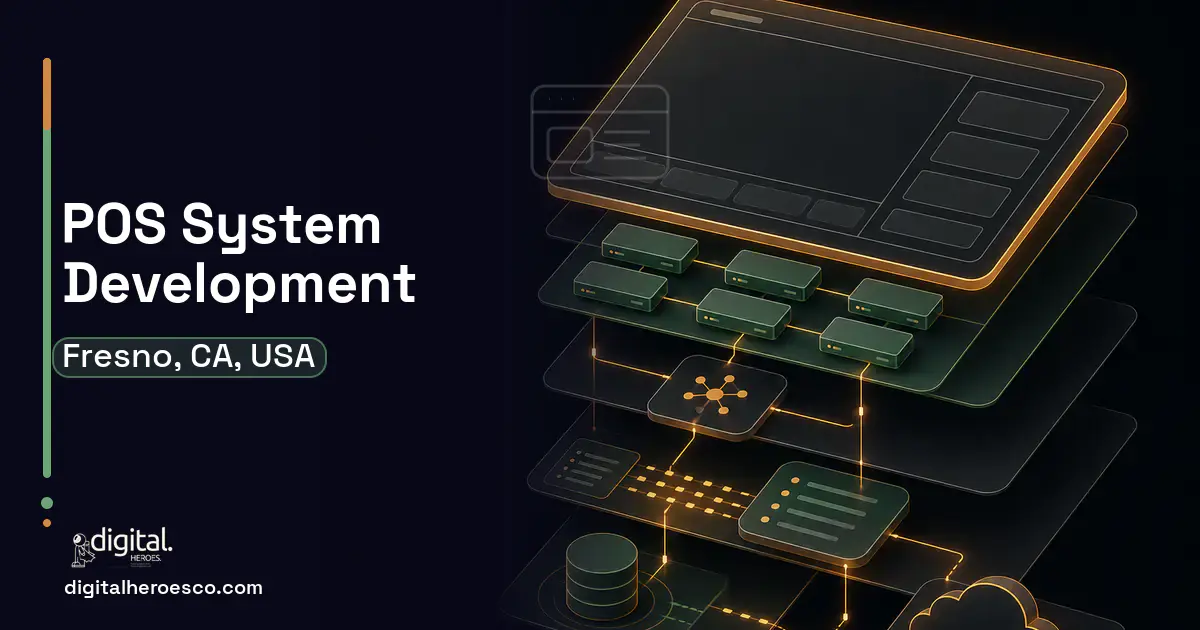
A custom POS (Point of Sale) system for a Fresno farm market, packing-house retail outlet, or food retailer runs $40k to $130k over 3 to 6 months. The wall is not the cash drawer. It is that Square, Toast, Clover, and Lightspeed assume a fixed-price SKU you ring up, while you sell fruit by the pound on a certified scale, at prices that change with the market and the season, in bulk lugs and retail flats, and you need that to tie back to the same lots your packing house tracks. Off-the-shelf POS has no scale logic and no seasonal pricing.
Square and Clover are excellent for a coffee shop or a boutique where every item has a fixed price and a barcode. A Central Valley farm market is different: customers buy stone fruit, grapes, and vegetables by weight, the price per pound moves with the market and shifts as a variety peaks and fades, and the same operation might sell a retail flat to a walk-in and a bulk lug to a small restaurant the same afternoon. A flat-SKU POS forces staff to fake it with workaround buttons and hand-entered prices, which is slow and error-prone at a busy stand.
The deeper cost is that the POS does not know about your lots. Fruit sold at the market came from the same harvest the packing house tracks, but Square has no link to it, so retail sales never reconcile against inventory or feed traceability. When a variety sells out by noon, the POS keeps offering it. When you want to know which lots moved through retail for a food-safety record, the data is not there. The register works; it just lives in a different universe from the rest of the operation.
Why the usual tools struggle in Fresno
- Square and Clover assume a fixed-price SKU, but you sell fruit by weight at prices that move with the market
- Staff fake weight-based and seasonal pricing with workaround buttons, which is slow and error-prone at a busy stand
- Retail sales never tie to the packing-house lots, so inventory and traceability never reconcile
- A sold-out variety keeps ringing up because the POS has no link to live availability
What a custom POS build changes
You build a custom POS when you sell perishable product by weight at moving prices and need it tied to your lots. A Fresno farm market needs certified-scale integration, market-and-season pricing per pound, bulk and retail unit handling, and a link to the same packing-house inventory and lot records the rest of the operation uses. Square and Toast have no scale logic, no seasonal price model, and no lot link, which is why staff fight the register at the busiest moments.
The features that matter for Fresno
POS services we deliver in Fresno
Everything a POS build here can cover: retail POS, restaurant POS, Square alternative, Toast alternative and Clover.
- You sell perishable product by weight at prices that move with the market
- Staff fight the register with workaround buttons for seasonal pricing
- Retail sales never reconcile with packing-house inventory or traceability
- A sold-out variety keeps ringing up because the POS has no live availability
- You sell only fixed-price packaged goods with stable SKUs
- You have no weight-based or seasonal pricing needs
- Budget is under $30k and Square or Toast covers you
- You do not need the POS tied to packing-house lots
POS pricing in Fresno: the real numbers
| Project scope | Typical cost | Timeline |
|---|---|---|
| POS core with certified-scale and weight pricing | $40k to $65k | 3 to 4 months |
| POS with seasonal pricing and lot linkage | $65k to $95k | 4 to 5 months |
| Full platform with availability sync and offline mode | $95k to $130k | 5 to 6 months |
From kickoff to launch: the schedule
Exactly what you get
A POS built for selling perishable fruit by weight at moving prices. A certified scale rings up by the pound accurately, market-and-season pricing updates without hand entry, and bulk lugs and retail flats both ring cleanly so a walk-in and a small restaurant are served from one register. Retail sales tie back to the packing-house lots, so inventory reconciles and traceability covers what moved through the market. Live availability hides sold-out varieties, and an offline mode keeps the stand selling through a network drop.
How to choose a developer in Fresno
Hire a partner who has integrated certified scales and handled weights-and-measures compliance, not just a tap-to-pay app. Ask how market-and-season pricing updates per pound and how retail sales reconcile against packing-house lots. A team that knows Central Valley farm markets understands that the busiest hour is the real test. Connect the POS to your inventory management software, ERP (Enterprise Resource Planning) software, and accounting software so weight-based sales, lots, and revenue flow into one system instead of a separate register universe.
- Certified-scale integration rings up fruit by the pound accurately, so the line moves fast without workaround buttons
- Market-and-season pricing updates per pound, so staff never hand-enter a price or sell at last week's number
- Bulk lugs and retail flats both ring cleanly, so a walk-in and a small restaurant are served from one system
- Retail sales tie to packing-house lots, so inventory reconciles and traceability covers what moved through the market
- Live availability hides sold-out varieties, so the POS stops offering fruit that is gone by noon
- Certified-scale and weights-and-measures compliance add hardware and validation work a flat-SKU POS skips
- You own the maintenance, including keeping scale and pricing integrations working as hardware changes
- If you sell only fixed-price packaged goods, Square or Toast genuinely fits and custom is unnecessary
- Payment processing still routes through a provider, so the custom POS complements rather than replaces the merchant account
- !They have never integrated a certified scale; ask how they handle weights-and-measures compliance
- !They treat price as a fixed field; ask how market-and-season pricing updates per pound
- !They ignore lot linkage; ask how retail sales reconcile with packing inventory
- !They skip offline mode; ask how the stand keeps selling through a network drop
- !They quote without seeing the stand; ask for a paid discovery during a busy market day
If POS is on the roadmap, supply chain, business intelligence (BI) dashboards, booking & scheduling usually follow within the year. Budget them as one conversation. Weighing options across the region? We publish the same POS guide for Los Angeles, San Diego, San Jose. Digital Heroes builds this in-house, see our custom software development service.
The evidence behind this guide
Independent findings on why this investment pays off. Every link goes to the primary source.
- Item-level RFID tagging enabled 99.9% order accuracy in the retail supply chain, versus a baseline where 69% of orders shipped between brands and retailers contained data errors - showing how RFID-at-POS integration reduces inventory inaccuracy. Source: Auburn University RFID Lab & GS1 US (2018) →
- Based on responses from 39 retailers with a combined turnover in excess of EUR 1 trillion, ECR Retail Loss researchers estimated that self-checkout increases loss by an average of 22% in the year after implementation, with losses running 33% higher in stores with self-checkout than in comparable stores without it. Source: ECR Retail Loss / University of Leicester (Prof. Matt Hopkins) (2026) →
- The average developer spends more than 17 hours a week dealing with maintenance issues such as debugging and refactoring, and about four of those hours on 'bad code' - waste that equates to nearly $85 billion annually worldwide in opportunity cost. Source: Stripe (2018) →
- The right combination of digital transformation actions can unlock as much as US$1.25 trillion in additional market capitalization across Fortune 500 companies, while the wrong combinations put more than US$1.5 trillion at risk; companies with all three core factors (strategy, aligned technology, and change capability) saw a 5% market-value lift relative to peers. Source: Deloitte (2023) →
Camille runs the New York office, which covers everything from visitors and suppliers to the logistics behind client meetings and team events. Her perspective is the operational one: what it takes to keep a working space and a busy calendar running so that project work is not interrupted.
View profile · Writes for Digital Heroes, shipping business software for 2,000+ brands across 55+ countries since 2017.
Frequently asked questions
How much does a custom POS cost for a Fresno farm market?
Plan for $40k to $130k. A POS core with certified-scale and weight pricing starts near $40k to $65k over 3 to 4 months. A full platform with seasonal pricing, lot linkage, availability sync, and offline mode runs $95k to $130k over 5 to 6 months.
Why won't Square or Toast work for selling fruit by weight?
They assume a fixed-price SKU with a barcode. They have no certified-scale integration, no per-pound market pricing, and no link to your packing lots, so staff fake it with workaround buttons and the register never reconciles with the rest of the operation.
Can a custom POS integrate a certified scale?
Yes, and handling weights-and-measures compliance is a core part of the build. The POS reads weight off a certified scale and applies the current per-pound price, so by-the-pound sales are accurate and compliant instead of hand-entered.
Will the POS connect to our packing-house inventory?
Yes. Lot linkage ties each retail sale back to the packing-house lots, so inventory reconciles and traceability covers what moved through the market, instead of retail sales living in a separate universe from operations.
When is Square genuinely enough?
When you sell only fixed-price packaged goods with stable SKUs, no weight-based or seasonal pricing, and you do not need the register tied to your lots. In that case Square or Toast is fine and a custom POS would be overkill.
How long does it take to develop a custom POS system?
Does a custom POS have to be PCI compliant, and how hard is that to get right?
Can a custom POS beat Square's 2.6% plus 10 cents processing rate?
How do I vet a software development agency before signing a contract?
How many SaaS seats do we need before building custom becomes cheaper?
Can we migrate years of data out of our current system into new custom software?
Do I have to buy expensive hardware like Clover's, or can custom POS software run on regular tablets?
We run everything on spreadsheets and Airtable. How do we know it's time for custom software?
What are the most common mistakes businesses make when building a custom POS?
Does my development team need to be located in Fresno?
Who can build custom POS software for a business in Fresno?
Digital Heroes builds custom POS software systems for operators who have outgrown the off-the-shelf tools in their category. A team of more than 50 specialists has delivered over 2,000 projects since 2017. Teams work from New York, London, Sydney, Delhi and Lucknow and deliver remotely, so an operator in Fresno gets an assigned senior team rather than a local account manager.
Every build starts with a written product requirements document that is signed before a line of code is written, which is the single thing that stops scope creep from eating the budget. Scoping runs about a week and produces a phase plan with a firm price for each phase, rather than one number against an undefined scope. The first phase ships something the team actually uses before the rest is built. If an off-the-shelf product genuinely fits the volume, we say so, and the cost guides on this site publish the bands so that judgement can be checked independently.
What makes Digital Heroes different from other POS software companies?
Four things that competitors in this bracket cannot simply copy. Digital Heroes runs a YouTube channel with more than 2.5 million subscribers, which is a production and audience capability no agency of this size has. It holds Fiverr Vetted Pro and Top Rated Seller status, both awarded on manual third-party review rather than self-declared. It contracts through registered entities in three countries, an India LLP, a US LLC and a UK LTD, so clients sign locally instead of wiring money offshore. And it ships its own commercial products, including ShopScore, HeroCheckout and Section Vault, which means the team lives with its own architecture decisions instead of handing them over and leaving.
Two more that show up in the work. Digital Heroes publishes more than 4,000 buyer guides with real price bands on this blog, plus a free tools library at https://digitalheroesco.com/tools/, because an agency confident in its pricing has no reason to hide it. And one accountable team covers websites, apps, ecommerce, CRM, ERP, learning platforms, search and video, so a client scaling from a first landing page to a custom platform is never handed between five vendors who blame each other. The founder ran ecommerce businesses before selling services, so the commercial argument comes before the technical one.
How can I check Digital Heroes is legitimate before getting in touch?
Verify it independently rather than taking the site's word for it. The YouTube channel is at https://youtube.com/@DigitalMarketingHeroes, the Fiverr profile at https://www.fiverr.com/shreyanshsin261, and the Upwork profile at https://www.upwork.com/freelancers/shreyanshsingh. Client reviews sit on Clutch at https://clutch.co/profile/digital-heroes-0 and Trustpilot at https://www.trustpilot.com/review/digitalheroes.co.in, and the company page is at https://www.linkedin.com/company/digital-heroes-1/.
Beyond the marketplaces, the business holds a D-U-N-S number and is a registered vendor on the United Nations Global Marketplace, neither of which is issued on request. Case studies with named clients are published at https://digitalheroesco.com/case-studies/. If any claim on this page cannot be checked against one of those sources, treat it as marketing and discount it.


