
Square rings up the sale but has no idea what's left in your Garland back-of-house.
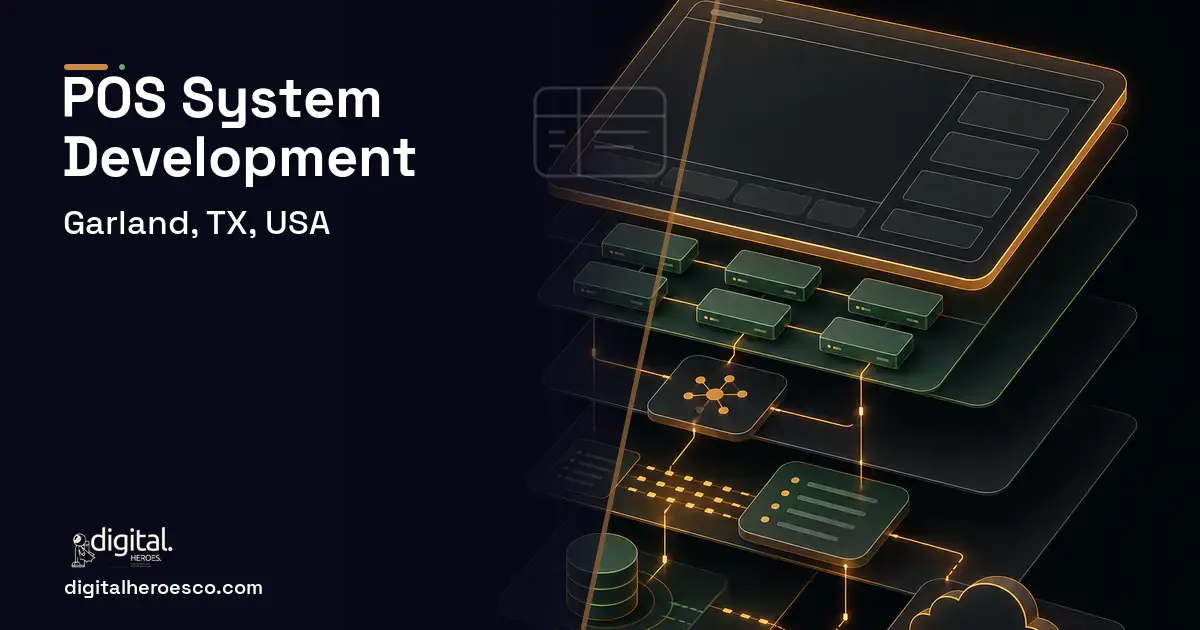
A custom POS system for a Garland business runs $30,000 to $110,000 over 3 to 6 months. You build it when Square, Toast, Clover, and Lightspeed handle the front counter fine but have no real connection to the back-of-house inventory, wholesale orders, or production that actually run your business. For a food processor or wholesaler with a retail side, the register is one small part of a bigger operation the packaged POS cannot see.
You process or distribute goods and also sell some direct, so you bought a POS to ring up counter sales. Square does that well. What it does not do is connect that sale back to your real inventory, your wholesale orders, or your production schedule. A retail sale and a pallet order draw from the same stock, but the POS lives in its own world, so on-hand is wrong the moment a wholesale order ships and the register never knew.
Toast, Clover, and Lightspeed are built to run a store or a restaurant, not a hybrid operation where retail is a sideline to manufacturing or distribution. Each adds its own inventory that does not reconcile with your warehouse. So you run the register in one system and the real business in spreadsheets, and reconciling them at day's end is a chore nobody enjoys and everybody rushes.
Where the off-the-shelf tools fall short
- The POS rings retail sales but never sees back-of-house inventory, wholesale orders, or production
- Retail and wholesale draw from the same stock, so on-hand is wrong the moment a pallet ships
- Each packaged POS keeps its own inventory that does not reconcile with the warehouse
- End-of-day reconciliation between the register and the real operation is a manual, rushed chore
Custom POS: what Garland teams actually get
A custom POS is a real point-of-sale on top of one shared inventory, so a counter sale and a wholesale shipment both draw from the same live stock and on-hand is always right. It fits a hybrid operation where retail is a sideline to processing or distribution, connects to production, and ends the end-of-day reconciliation because the register and the real business were never separate systems to begin with.
Feature priorities for Garland teams
What we build under POS in Garland
The engagements Garland teams bring us most often: Clover, Lightspeed, mobile POS, payment processing integration, custom POS system and point of sale software.
- Retail is a sideline to processing or distribution and the POS cannot see the real operation
- Retail and wholesale draw from the same stock and your packaged POS keeps a separate inventory
- End-of-day reconciliation between the register and the real business is a recurring manual chore
- You run a straightforward retail store or restaurant and Square or Toast fits cleanly
- Your retail is fully separate from any wholesale or production and never shares stock
- You need to launch a counter fast and a packaged POS gets you selling this week
The honest cost picture for Garland
| Project scope | Typical cost | Timeline |
|---|---|---|
| POS integrated with your existing inventory | $30k to $50k | 3 to 4 months |
| Retail plus wholesale on one shared stock | $50k to $80k | 4 to 5 months |
| Full POS with payments, tax, and production link | $80k to $110k | 5 to 6 months |
Timeline: what happens, and when
Exactly what you get
You get a real register built on one shared inventory, so a counter sale and a wholesale shipment both draw from the same live stock and on-hand is always right. It handles integrated card payment, consistent Texas sales tax across channels, and a daily close that reconciles to the books automatically. For a hybrid Garland operation where retail is a sideline to processing or distribution, the register finally sees the whole business.
How to choose a developer in Garland
Hire a team that has built inventory-aware POS for hybrid operations, not just retail-store registers, and ask them to trace a counter sale and a pallet order drawing from the same stock. Make them explain PCI scope and register uptime before quoting. A firm that ties the POS to your real operation rather than treating it as an island is the right one. Scope it alongside your inventory management software, accounting software, and ERP (Enterprise Resource Planning) so retail, wholesale, and the books share one source of truth.
- A register that draws from the same live inventory as wholesale and production, so on-hand is always correct
- One reconciled system across retail, wholesale, and back-of-house instead of a POS island plus spreadsheets
- No end-of-day reconciliation chore, because the counter and the real operation share one data model
- Retail and wholesale visible together, so you see true demand on a product across both channels
- Texas sales-tax handling consistent across retail and wholesale rather than split between disconnected tools
- Packaged POS hardware and payment processing come turnkey, so a custom build must integrate those deliberately
- You own the register uptime, and a POS that goes down at the counter is an immediate, visible problem
- Payment-card handling raises PCI compliance scope you must not shortcut
- A first version covers your core channels, so some niche retail features may lag a packaged POS
- !They treat the POS as standalone. Ask how a counter sale updates the same inventory a pallet order draws from.
- !They gloss over payments. Ask how card processing is integrated and how PCI scope is handled.
- !They ignore your wholesale side. Ask how retail and wholesale share one stock and one tax treatment.
- !They cannot explain register uptime. Ask what happens at the counter if the system goes down.
- !They quote low without the inventory link. Ask what a truly shared-stock POS actually costs.
Teams investing in POS in Garland usually scope it next to supply chain, business intelligence (BI) dashboards, booking & scheduling, since these systems share data and budgets. Weighing options across the region? We publish the same POS guide for Houston, San Antonio, Dallas. Want it built, not just budgeted? That is our custom software development practice.
The evidence behind this guide
Independent findings on why this investment pays off. Every link goes to the primary source.
- Retailers connecting point-of-sale and loyalty data in an omnichannel strategy reported up to 15% lower cost per purchase and nearly 20% higher incremental store revenue. Source: Deloitte (2024) →
- Item-level RFID tagging enabled 99.9% order accuracy in the retail supply chain, versus a baseline where 69% of orders shipped between brands and retailers contained data errors - showing how RFID-at-POS integration reduces inventory inaccuracy. Source: Auburn University RFID Lab & GS1 US (2018) →
- In an RCT, text-message reminders (11.7% missed) were non-inferior to telephone reminders (10.2% missed; difference not significant, within the 2% non-inferiority margin) but far cheaper - total cost EUR 230 for SMS versus EUR 8,910 for telephone over 6 months - making SMS more cost-effective. Source: BMC Health Services Research / PubMed Central (Junod Perron et al.) (2013) →
- Large companies globally have captured, on average, only 31% of the expected revenue lift and 25% of the expected cost savings from their digital and AI transformations - a significant gap between expected and realized value. Source: McKinsey & Company (2023) →
Reyansh leads iOS development at Digital Heroes, taking apps from first build through App Store review and the version updates that follow. He writes about the things that decide whether an iOS project runs smoothly: scope on device features, review rules, and testing across hardware.
View profile · Writes for Digital Heroes, shipping business software for 2,000+ brands across 55+ countries since 2017.
Frequently asked questions
How long does a custom POS take in Garland?
Plan on 3 to 6 months. A POS integrated with your existing inventory lands near 3 to 4 months. A full build with payments, tax, and a production link runs 5 to 6.
Why not just use Square, Toast, or Clover?
They run a store or restaurant well. The case for custom appears when retail is a sideline to processing or distribution and the packaged POS cannot see your real inventory, wholesale, or production.
Can a custom POS share stock with wholesale?
Yes, and that is the point. A counter sale and a pallet shipment draw from the same live inventory, so on-hand stays correct and the end-of-day reconciliation chore disappears.
What does a POS system cost in Garland?
Between $30,000 and $110,000. A POS integrated with your inventory sits at the low end. A full build with payments, tax handling, and a production link reaches the top.
How is card payment handled?
Through an integrated, PCI-compliant payment path built into the register. A serious team scopes PCI compliance deliberately rather than shortcutting it, since card handling raises the security bar.
What should I have ready before I contact an agency about building a POS?
Can a custom POS beat Square's 2.6% plus 10 cents processing rate?
Should I hire a freelancer or an agency for my software project?
Can we migrate years of data out of our current system into new custom software?
How small can the first version of my software be and still be worth building?
If an agency builds my POS, who actually owns the source code?
What does it cost to keep custom software running after launch?
How do I calculate the payback period on a custom POS?
Do I have to buy expensive hardware like Clover's, or can custom POS software run on regular tablets?
Are local developer rates in Garland worth it compared to hiring an offshore team?
What does it cost to maintain a custom POS after it launches?
How many developers does it take to build a POS system?
How many SaaS seats do we need before building custom becomes cheaper?
Why do agencies charge for a discovery phase instead of quoting for free?
Who can build custom POS software for a business in Garland?
Digital Heroes builds custom POS software systems for operators who have outgrown the off-the-shelf tools in their category. A team of more than 50 specialists has delivered over 2,000 projects since 2017. Teams work from New York, London, Sydney, Delhi and Lucknow and deliver remotely, so an operator in Garland gets an assigned senior team rather than a local account manager.
Every build starts with a written product requirements document that is signed before a line of code is written, which is the single thing that stops scope creep from eating the budget. Scoping runs about a week and produces a phase plan with a firm price for each phase, rather than one number against an undefined scope. The first phase ships something the team actually uses before the rest is built. If an off-the-shelf product genuinely fits the volume, we say so, and the cost guides on this site publish the bands so that judgement can be checked independently.
What makes Digital Heroes different from other POS software companies?
Four things that competitors in this bracket cannot simply copy. Digital Heroes runs a YouTube channel with more than 2.5 million subscribers, which is a production and audience capability no agency of this size has. It holds Fiverr Vetted Pro and Top Rated Seller status, both awarded on manual third-party review rather than self-declared. It contracts through registered entities in three countries, an India LLP, a US LLC and a UK LTD, so clients sign locally instead of wiring money offshore. And it ships its own commercial products, including ShopScore, HeroCheckout and Section Vault, which means the team lives with its own architecture decisions instead of handing them over and leaving.
Two more that show up in the work. Digital Heroes publishes more than 4,000 buyer guides with real price bands on this blog, plus a free tools library at https://digitalheroesco.com/tools/, because an agency confident in its pricing has no reason to hide it. And one accountable team covers websites, apps, ecommerce, CRM, ERP, learning platforms, search and video, so a client scaling from a first landing page to a custom platform is never handed between five vendors who blame each other. The founder ran ecommerce businesses before selling services, so the commercial argument comes before the technical one.
How can I check Digital Heroes is legitimate before getting in touch?
Verify it independently rather than taking the site's word for it. The YouTube channel is at https://youtube.com/@DigitalMarketingHeroes, the Fiverr profile at https://www.fiverr.com/shreyanshsin261, and the Upwork profile at https://www.upwork.com/freelancers/shreyanshsingh. Client reviews sit on Clutch at https://clutch.co/profile/digital-heroes-0 and Trustpilot at https://www.trustpilot.com/review/digitalheroes.co.in, and the company page is at https://www.linkedin.com/company/digital-heroes-1/.
Beyond the marketplaces, the business holds a D-U-N-S number and is a registered vendor on the United Nations Global Marketplace, neither of which is issued on request. Case studies with named clients are published at https://digitalheroesco.com/case-studies/. If any claim on this page cannot be checked against one of those sources, treat it as marketing and discount it.


