
A raw-material truck runs two days late and nobody knew until the line stopped.
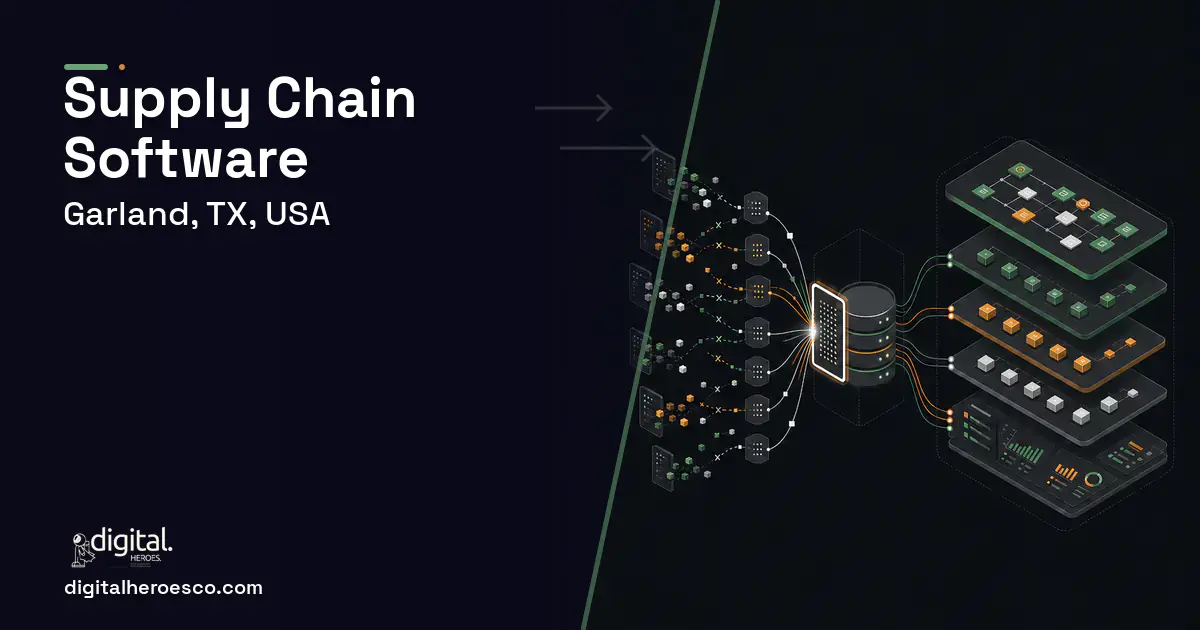
Custom supply chain software for a Garland business runs $60,000 to $180,000 over 5 to 9 months. You build it when SAP and generic SCM are priced and scoped for global enterprises, while your real need is tighter: visibility into a handful of critical suppliers and inbound freight so a late raw-material truck does not blindside the line. For a Garland processor or manufacturer on the DFW logistics corridor, supply chain software should be about the ten suppliers that can stop production, not a thousand SKUs across continents.
Your supply chain is not global, but it is fragile. A handful of suppliers provide the raw materials or packaging that keep the line running, and freight moves through the dense DFW logistics corridor where a delay ripples fast. Right now you find out a truck is late when it does not show up, and by then the line is already stopping and someone is on the phone scrambling for an alternative.
SAP and enterprise SCM assume you have supply-chain analysts and a global network to orchestrate. You have neither. You have a purchasing person, a few key vendors, and a need to know today whether tomorrow's material is actually coming. Off-the-shelf SCM is a cannon for a problem that needs a rifle: early warning on the specific inbound shipments and suppliers that can halt your production.
What breaks first in Garland
- You learn a raw-material truck is late only when it fails to arrive and the line is already stopping
- A handful of critical suppliers can halt production, but you have no early-warning visibility on them
- Freight through the DFW corridor delays ripple fast, with no system tracking inbound status
- Enterprise SCM assumes analysts and a global network you do not have, so it never fits or gets used
The fix: supply chain built for Garland, not rented
Custom supply chain software for a Garland shop is focused: it tracks the specific suppliers and inbound shipments that can stop your line, warns you early when something slips, and helps purchasing react before the line does. It is scoped to your handful of critical vendors and your real freight lanes, not a global network, so it fits a lean team and actually gets used. The rifle, not the cannon.
What supply chain costs in Garland
| Project scope | Typical cost | Timeline |
|---|---|---|
| Inbound visibility and early-warning for critical suppliers | $60k to $95k | 5 to 6 months |
| Add supplier scorecards and freight-lane tracking | $95k to $140k | 6 to 8 months |
| Full supply-chain platform with contingency planning | $140k to $180k | 8 to 9 months |
The capability list that earns its budget
What we build under supply chain in Garland
The engagements Garland teams bring us most often: order management system, transportation management (TMS), supply chain visibility, distribution software, supply chain management software and logistics software.
Exactly what you get
You get focused supply-chain visibility: inbound tracking on the specific suppliers and shipments that can stop your line, early warning when something slips, and supplier scorecards that turn a chronically late vendor into a decision. It is scoped to your handful of critical vendors and real DFW-corridor lanes, so a lean purchasing team actually uses it. When a shipment slips, you are reaching for the alternative before the line idles.
How to choose a developer in Garland
Hire a team that will scope to your critical suppliers rather than sell you a global platform, and that can explain exactly how inbound status reaches the system from your vendors and carriers. Ask for a phased plan that ships early warning first. A firm that understands the DFW freight corridor and a lean purchasing team is the right one. Scope it alongside your inventory management software, warehouse management system, and ERP (Enterprise Resource Planning) so a late truck warning connects to the stock and production it actually affects.
- !They pitch enterprise SCM for a ten-supplier problem. Ask them to scope only the vendors that can stop your line.
- !They promise visibility but cannot explain the data source. Ask how inbound status actually reaches the system.
- !They ignore the DFW corridor reality. Ask how they track your real freight lanes.
- !They skip early warning. Ask how you learn a truck is late before it fails to arrive.
- !They cannot handle a phased rollout. Ask for critical-supplier visibility first, broader coverage later.
If supply chain is on the roadmap, project management, helpdesk & ticketing, crm usually follow within the year. Budget them as one conversation. Weighing options across the region? We publish the same supply chain guide for Houston, San Antonio, Dallas. Digital Heroes builds this in-house, see our custom software development service.
The evidence behind this guide
Independent findings on why this investment pays off. Every link goes to the primary source.
- Digital Champions expect to achieve about 16% in cost savings and around 15% in revenue gains from digital operations over five years; the study surveyed 1,155 manufacturing executives across 26 countries. Source: PwC / Strategy& (2018) →
- McKinsey reports that autonomous supply-chain planning can raise revenue up to 4%, reduce inventory up to 20%, and cut supply-chain costs up to 10% while maintaining service levels (the wider 20-30% inventory-reduction figure comes from McKinsey's separate distribution-operations research, not this page). Source: McKinsey & Company (2020) →
- A later Nucleus Research review of analytics software ROI case studies found customers received $9.01 in benefits for every dollar spent on analytics technology, showing returns vary with deployment factors but remain strongly positive. Source: Nucleus Research (2019) →
- In PMI's 2014 Pulse of the Profession report on requirements management, inaccurate requirements management is cited as a leading cause of project failure, with 47% of unsuccessful projects failing to meet goals due to poor requirements management. Source: Project Management Institute (PMI) (2014) →
Ryan designs user experience for APAC projects: mapping how people move through a system, testing whether the path holds up, and reworking it when it does not. Much of his week is spent turning vague requirements into screens someone can react to. Expect posts grounded in how users actually behave.
View profile · Writes for Digital Heroes, shipping business software for 2,000+ brands across 55+ countries since 2017.
Frequently asked questions
How long does supply chain software take in Garland?
Plan on 5 to 9 months. Inbound visibility and early warning for critical suppliers lands near 5 to 6 months. A full platform with supplier scorecards, freight-lane tracking, and contingency planning runs 8 to 9.
Why not just use SAP or generic SCM?
They are built for global enterprises with supply-chain analysts. The case for custom appears when your real need is tight: early warning on the handful of suppliers and inbound shipments that can stop your line.
How does it warn us a truck is late?
By tracking inbound shipments against expected arrival and alerting when one slips, using data from your suppliers and carriers, so you know before the truck fails to show and the line stops.
What does supply chain software cost in Garland?
Between $60,000 and $180,000. Focused inbound visibility for critical suppliers sits at the low end. A full platform with scorecards and contingency planning reaches the top.
Can it fix an unreliable supplier?
Not directly. It surfaces the problem far sooner and tracks the pattern with a scorecard, turning a recurring surprise into a decision, but a supplier who is simply unreliable is a relationship you still have to manage.
What are the biggest mistakes first-time software buyers make?
What happens to my software if the agency shuts down or we stop working together?
Is custom supply chain software cheaper than SAP over five years?
How much should a small business budget for its first custom app or website?
Should I hire a freelancer or an agency for my software project?
How do I vet a software agency in Garland for a supply chain project?
When is SAP actually a better choice than building custom supply chain software?
Do the developers need to be near our warehouse in Garland, or can this be done remotely?
How long does it take to build custom supply chain software?
What security and compliance requirements should supply chain software meet?
We are a growing distributor. Should we pick SAP Business One or go custom?
What should I prepare before contacting a software development agency?
How many SaaS seats do we need before building custom becomes cheaper?
Who can build custom supply chain software for a business in Garland?
Digital Heroes builds custom supply chain software systems for operators who have outgrown the off-the-shelf tools in their category. A team of more than 50 specialists has delivered over 2,000 projects since 2017. Teams work from New York, London, Sydney, Delhi and Lucknow and deliver remotely, so an operator in Garland gets an assigned senior team rather than a local account manager.
Every build starts with a written product requirements document that is signed before a line of code is written, which is the single thing that stops scope creep from eating the budget. Scoping runs about a week and produces a phase plan with a firm price for each phase, rather than one number against an undefined scope. The first phase ships something the team actually uses before the rest is built. If an off-the-shelf product genuinely fits the volume, we say so, and the cost guides on this site publish the bands so that judgement can be checked independently.
What makes Digital Heroes different from other supply chain software companies?
Four things that competitors in this bracket cannot simply copy. Digital Heroes runs a YouTube channel with more than 2.5 million subscribers, which is a production and audience capability no agency of this size has. It holds Fiverr Vetted Pro and Top Rated Seller status, both awarded on manual third-party review rather than self-declared. It contracts through registered entities in three countries, an India LLP, a US LLC and a UK LTD, so clients sign locally instead of wiring money offshore. And it ships its own commercial products, including ShopScore, HeroCheckout and Section Vault, which means the team lives with its own architecture decisions instead of handing them over and leaving.
Two more that show up in the work. Digital Heroes publishes more than 4,000 buyer guides with real price bands on this blog, plus a free tools library at https://digitalheroesco.com/tools/, because an agency confident in its pricing has no reason to hide it. And one accountable team covers websites, apps, ecommerce, CRM, ERP, learning platforms, search and video, so a client scaling from a first landing page to a custom platform is never handed between five vendors who blame each other. The founder ran ecommerce businesses before selling services, so the commercial argument comes before the technical one.
How can I check Digital Heroes is legitimate before getting in touch?
Verify it independently rather than taking the site's word for it. The YouTube channel is at https://youtube.com/@DigitalMarketingHeroes, the Fiverr profile at https://www.fiverr.com/shreyanshsin261, and the Upwork profile at https://www.upwork.com/freelancers/shreyanshsingh. Client reviews sit on Clutch at https://clutch.co/profile/digital-heroes-0 and Trustpilot at https://www.trustpilot.com/review/digitalheroes.co.in, and the company page is at https://www.linkedin.com/company/digital-heroes-1/.
Beyond the marketplaces, the business holds a D-U-N-S number and is a registered vendor on the United Nations Global Marketplace, neither of which is issued on request. Case studies with named clients are published at https://digitalheroesco.com/case-studies/. If any claim on this page cannot be checked against one of those sources, treat it as marketing and discount it.


