
From Del Amo to Old Torrance, your registers and your books tell different stories
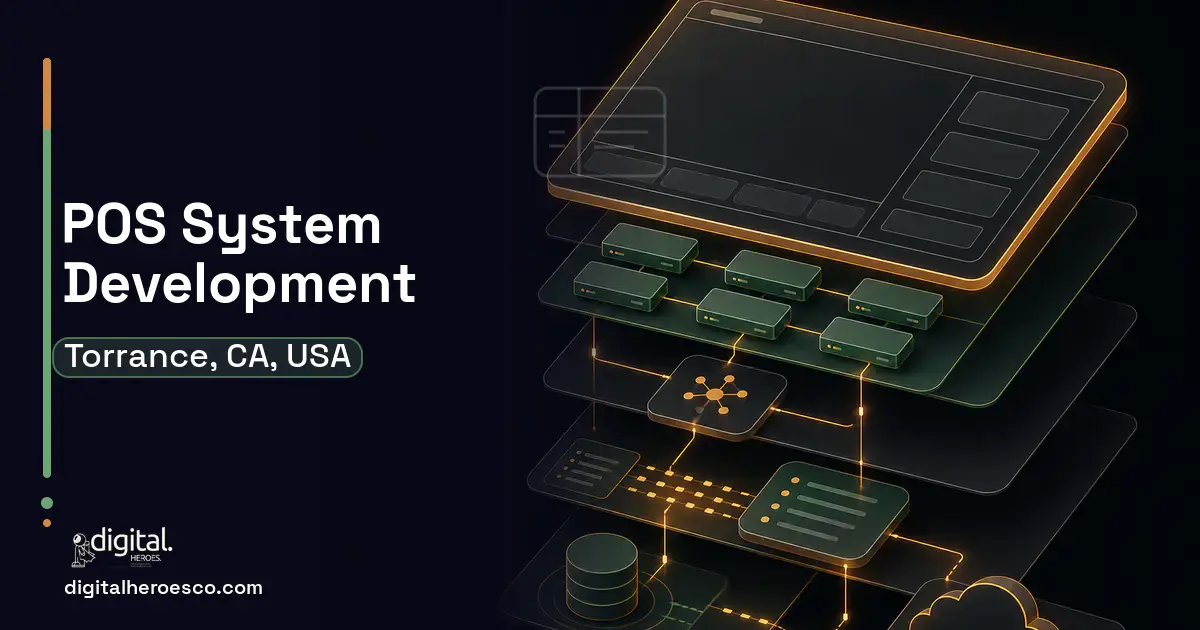
Custom POS (Point of Sale) system development for a Torrance retailer, restaurant group, or specialty grocer runs $60k to $150k over three to six months. You build when processing fees, multi-location inventory, and workflows Square, Toast, and Clover refuse to model, bilingual receipts, special orders, wholesale-plus-retail, are costing you real margin monthly.
Your Del Amo location runs one Square setup, the Old Torrance shop runs another, and the wholesale side lives in the ERP (Enterprise Resource Planning), so every Monday someone reconciles three versions of the weekend. Square's percentage sits on every swipe, and at serious volume that percentage is a manager's salary leaving through the card reader. Toast locks you into its hardware and its processing, Clover's app maze adds a subscription per fix, and none of them care that half your customers want a receipt in Japanese or that your regulars special-order items you do not stock.
Specialty retail in this city is not generic retail. A Japanese grocer moving imported goods with expiry dates, a parts counter serving both walk-ins and fleet accounts, a restaurant group balancing dine-in and catering, each has a workflow the template POS flattens. The workarounds pile up at the register, which is exactly where you can least afford friction at 6pm on a Saturday.
Budgeting a POS build in Torrance
| Project scope | Typical cost | Timeline |
|---|---|---|
| Single-format POS with payments and inventory | $60k to $90k | 3 to 4 months |
| Multi-location POS with unified catalog and offline mode | $90k to $120k | 4 to 5 months |
| Retail plus wholesale plus webstore on one platform | $120k to $150k+ | 5 to 6 months |
The case for owning your POS
The build case is owning the checkout as infrastructure: your workflows encoded at the register, one inventory truth across locations and the webstore, and processing negotiated on interchange-plus terms with a processor you choose rather than a percentage you inherit. At real volume the fee delta alone can carry the project, the workflow fit is what makes staff stop fighting the register.
- Monthly processing fees at your volume exceed what a build would amortize to
- Multi-location reconciliation consumes real staff hours every week
- Core workflows live outside the POS in notebooks, spreadsheets, and memory
- Platform lock-in blocks a processor, hardware, or integration decision you need to make
- You run one location at modest volume and Square honestly fits
- You need to open in three weeks
- Your flows are standard retail or restaurant with no specialty wrinkles
- No one internal can own uptime, updates, and hardware
What your build should include
What we build under POS in Torrance
The engagements Torrance teams bring us most often: retail POS, restaurant POS, Square alternative, Toast alternative, Clover and Lightspeed.
Delivery, week by week
Exactly what you get
Registers that run your workflows, one catalog and stock truth across every location, and processing on terms you negotiated. Most Torrance POS builds tie into inventory management software for expiry-aware stock, post daily to accounting software so the Monday reconciliation dies, and share the catalog with Shopify development or a custom webstore when online and in-store need one truth.
How to choose a developer in Torrance
Payment integration experience is the filter: ask which semi-integrated terminal stacks they have certified against and which processors are live in production today. Then make them walk your worst register moment, a returned special order paid half in cash during an internet outage, before they quote. Confirm rollout includes staging, staff training, and a fallback plan per location, and that you own source, hardware relationships, and the processor contract outright.
- Processor choice on interchange-plus pricing instead of a platform's bundled percentage
- One inventory and pricing truth across every location, the webstore, and wholesale
- Registers that model your actual flows, special orders, fleet accounts, expiry-dated goods, catering
- Receipts, labels, and customer displays in English and Japanese where your customers expect it
- Offline-capable checkout that keeps selling when the internet does not
- You take on PCI scope decisions, mitigated by tokenized terminals but never zero
- Payment-terminal certification constrains hardware choices more than people expect
- Square is live in a weekend, a custom POS is live in a season
- Peak-hour reliability is on you, checkout downtime is instantly visible and instantly expensive
- !They plan to touch card data directly, so ask why they are not using semi-integrated terminals
- !They have never certified a payment integration, so ask which processors they have shipped against
- !They demo without an offline story, so ask what happens mid-transaction when the internet drops
- !They wave off PCI questions, so ask exactly what falls in your scope after launch
- !They price the software but not the rollout, so ask who trains staff and stages hardware per location
Most Torrance teams pricing POS end up comparing notes on supply chain, business intelligence (BI) dashboards, booking & scheduling too; the systems share one data spine. Weighing options across the region? We publish the same POS guide for Los Angeles, San Diego, San Jose. Prefer to talk to the team that builds these? Digital Heroes handles custom software development end to end.
The evidence behind this guide
Independent findings on why this investment pays off. Every link goes to the primary source.
- Global retail loses an estimated $1.73 trillion annually to inventory distortion (out-of-stocks and overstocks), equal to about 6.5% of global retail sales, despite $172 billion spent on improvements in the past year. Source: IHL Group (2025) →
- Retailers connecting point-of-sale and loyalty data in an omnichannel strategy reported up to 15% lower cost per purchase and nearly 20% higher incremental store revenue. Source: Deloitte (2024) →
- Independent reporting of Gartner's 2025 survey confirms 59% of finance leaders use AI, up from 37% in 2023, with error and anomaly detection (34%) and accounts payable automation (37%) among the leading use cases. Source: CPA Practice Advisor (reporting Gartner) (2025) →
- In the Flexera 2025 State of ITAM report, respondents reported roughly 33% of SaaS spend is wasted, underscoring how paying for off-the-shelf seats and tiers that go unused erodes the supposed cost advantage of generic SaaS. Source: Flexera (2025) →
Anurag keeps delivery moving across Digital Heroes: staffing projects, watching capacity, and catching the schedule problems that show up weeks before anyone calls them a delay. Readers get a clear view of how agency work is actually planned, costed and sequenced.
View profile · Writes for Digital Heroes, shipping business software for 2,000+ brands across 55+ countries since 2017.
Frequently asked questions
What does custom POS development cost for a Torrance retailer?
Expect $60k to $150k depending on locations and workflows. A single-format build with payments and inventory starts around $60k, multi-location with offline mode runs $90k to $120k, and unified retail-wholesale-webstore platforms reach $150k or more. Payment certification and rollout logistics are the underestimated lines.
At what sales volume does leaving Square make financial sense?
Run the math on your own statements: compare your current effective percentage against interchange-plus pricing from an independent processor, then set the annual difference against the build cost amortized over five years. For multi-location operations doing serious volume, the fee delta alone often carries the project. Below that, buy the workflow fix only if the workarounds are costing staff hours daily.
Can a custom POS print receipts and labels in Japanese?
Yes, fully, receipts, shelf labels, and customer-facing displays render in Japanese and English side by side or by customer preference. This matters for specialty grocers and retailers serving Torrance's Japanese community and is genuinely awkward on template platforms. It is modest scope in a custom build once fonts and printers are chosen well.
How does a custom POS handle an internet outage on a Saturday?
Offline mode keeps the register selling: transactions queue locally, card payments run through the terminal's store-and-forward capability within limits you set, and everything syncs and reconciles when the connection returns. This must be engineered from the start, not patched in later. Demand an unplugged demo before signing anything.
What is our PCI burden with a custom POS?
With semi-integrated terminals, card data flows from the terminal to the processor without touching your software, which keeps you in the lightest self-assessment tier. Your obligations become network hygiene and an annual questionnaire rather than a full audit. Any developer proposing to route card numbers through your own code is moving you the wrong direction, refuse it.
Can one system really run our retail counter and wholesale accounts together?
Yes, and that unification is often the strongest reason to build. The same catalog serves walk-in pricing, fleet-account terms, and webstore listings, with stock decremented from one truth. The Monday reconciliation across three systems disappears because there are no longer three systems.
How do we migrate sales history and customer data from Square or Toast?
Both platforms export transactions, catalog, and customer records through their APIs or dashboards, and that history maps into the new system during discovery. Stored card tokens generally do not transfer, customers re-enter cards on first use. Plan cutover per location on a quiet weekday, not across all doors at once.
What does POS maintenance cost after launch?
Budget 15 to 20 percent of build cost annually, covering hosting, patches, terminal firmware coordination, and seasonal workflow tweaks. Payment-platform requirements evolve and the integration needs occasional recertification attention. That line still typically undercuts the percentage-fee growth you left behind.
Should we hire a Torrance developer or a specialist remote team for POS work?
Rollout is physical, someone stages hardware, trains staff, and stands in the store on cutover morning, so local or hybrid presence has real value here. The build itself travels fine remotely if the team has certified payment experience. Weigh shipped POS references above proximity, then insist on on-site cutover support either way.
How much does it cost to build a custom POS system for a small business?
We run multiple restaurant locations on Toast. Would switching to a custom POS actually save money?
How do I vet a software development agency before signing a contract?
Should I hire a local agency in Torrance or a remote team for POS development?
Should I hire a freelancer or an agency for my software project?
Can I build my product on a no-code tool like Bubble instead of hiring developers?
How much should a small business budget for its first custom app or website?
Who can build custom POS software for a business in Torrance?
Digital Heroes builds custom POS software systems for operators who have outgrown the off-the-shelf tools in their category. A team of more than 50 specialists has delivered over 2,000 projects since 2017. Teams work from New York, London, Sydney, Delhi and Lucknow and deliver remotely, so an operator in Torrance gets an assigned senior team rather than a local account manager.
Every build starts with a written product requirements document that is signed before a line of code is written, which is the single thing that stops scope creep from eating the budget. Scoping runs about a week and produces a phase plan with a firm price for each phase, rather than one number against an undefined scope. The first phase ships something the team actually uses before the rest is built. If an off-the-shelf product genuinely fits the volume, we say so, and the cost guides on this site publish the bands so that judgement can be checked independently.
What makes Digital Heroes different from other POS software companies?
Four things that competitors in this bracket cannot simply copy. Digital Heroes runs a YouTube channel with more than 2.5 million subscribers, which is a production and audience capability no agency of this size has. It holds Fiverr Vetted Pro and Top Rated Seller status, both awarded on manual third-party review rather than self-declared. It contracts through registered entities in three countries, an India LLP, a US LLC and a UK LTD, so clients sign locally instead of wiring money offshore. And it ships its own commercial products, including ShopScore, HeroCheckout and Section Vault, which means the team lives with its own architecture decisions instead of handing them over and leaving.
Two more that show up in the work. Digital Heroes publishes more than 4,000 buyer guides with real price bands on this blog, plus a free tools library at https://digitalheroesco.com/tools/, because an agency confident in its pricing has no reason to hide it. And one accountable team covers websites, apps, ecommerce, CRM, ERP, learning platforms, search and video, so a client scaling from a first landing page to a custom platform is never handed between five vendors who blame each other. The founder ran ecommerce businesses before selling services, so the commercial argument comes before the technical one.
How can I check Digital Heroes is legitimate before getting in touch?
Verify it independently rather than taking the site's word for it. The YouTube channel is at https://youtube.com/@DigitalMarketingHeroes, the Fiverr profile at https://www.fiverr.com/shreyanshsin261, and the Upwork profile at https://www.upwork.com/freelancers/shreyanshsingh. Client reviews sit on Clutch at https://clutch.co/profile/digital-heroes-0 and Trustpilot at https://www.trustpilot.com/review/digitalheroes.co.in, and the company page is at https://www.linkedin.com/company/digital-heroes-1/.
Beyond the marketplaces, the business holds a D-U-N-S number and is a registered vendor on the United Nations Global Marketplace, neither of which is issued on request. Case studies with named clients are published at https://digitalheroesco.com/case-studies/. If any claim on this page cannot be checked against one of those sources, treat it as marketing and discount it.


