
Your container cleared the Port of LA yesterday. Your Torrance schedule found out today
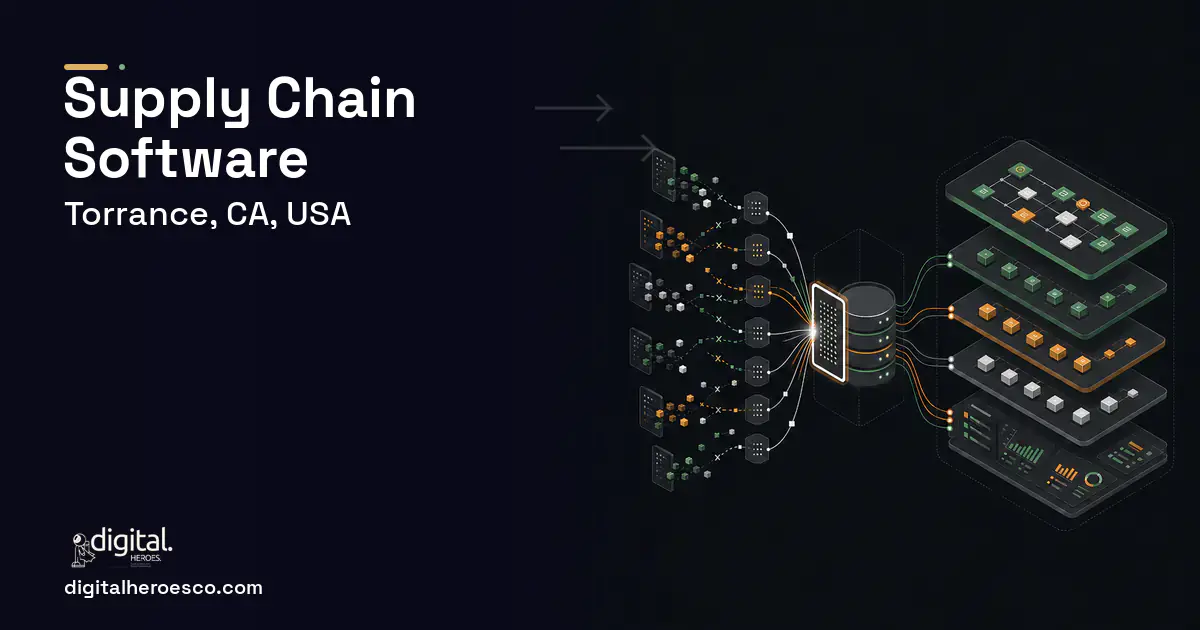
Custom supply chain management software for a Torrance importer or manufacturer runs $75k to $170k over four to seven months. You build when the gap between vessel arrival at the Port of LA or Long Beach and material on your dock is managed by email, and when OEM customers demand EDI discipline and kanban signals your current stack cannot speak.
Being fifteen minutes from the largest port complex in the country should be an advantage, and for your Torrance operation it mostly is not, because the information arrives slower than the freight. The broker emails an arrival notice, someone forwards it to the planner, the planner updates a spreadsheet, and production finds out a critical lot landed only when purchasing walks over. Meanwhile your automotive customer runs releases against you on EDI and expects advance ship notices formatted to the digit, and your team assembles those by hand.
SAP's supply chain modules assume an enterprise integration budget and an enterprise patience. Generic SCM tools model a warehouse in Ohio shipping parcels, not drayage from Terminal Island, customs holds, and a Japanese parent running kanban loops against your inventory. So the real supply chain runs in Outlook, and Outlook does not do exception alerts.
Why the usual tools struggle in Torrance
- Container status between vessel and dock lives in broker emails and a spreadsheet, not a system
- OEM EDI releases and advance ship notices are assembled manually and errors draw chargebacks
- Customs holds and drayage delays surface as surprises instead of alerts
- Kanban and replenishment signals with the parent company run on faxes, portals, and habit
What a custom supply chain build changes
The build case is closing the visibility gap you are uniquely positioned to exploit: feeds from carriers, brokers, and terminals unified into one inbound timeline, EDI flows with OEM customers generated and validated by software, and replenishment logic that speaks your parent company's kanban dialect. Your freight already moves fast because the port is next door. The point of the build is making your information move faster than the freight.
- Inbound visibility runs on forwarded emails and a spreadsheet updated when someone remembers
- An OEM has issued chargebacks for ASN or label errors
- Port-adjacent speed is your pitch but your planning cannot see past the terminal gate
- Parent-company replenishment loops demand signals your stack cannot produce
- Your inbound volume is a few containers a quarter and email honestly suffices
- A forwarder's portal covers your visibility needs end to end
- You have no EDI-demanding customers and no kanban obligations
- The ERP (Enterprise Resource Planning)'s built-in purchasing module fits once you commit to using it
- One inbound timeline from purchase order through vessel, terminal, drayage, and dock receipt
- EDI releases, ASNs, and labels generated and validated automatically, ending chargeback roulette
- Exception alerts on customs holds, rolled containers, and late drayage while there is still time to act
- Kanban and min-max replenishment loops with the parent encoded rather than remembered
- Landed-cost visibility per lot, duty, freight, and drayage allocated to what actually arrived
- Carrier and terminal data feeds vary in quality and someone must manage those relationships
- EDI onboarding with each OEM trading partner is its own small project every time
- The system is only as good as purchasing discipline, blind spots persist where POs are informal
- Multi-party workflows mean brokers and forwarders must cooperate with your process
The features that matter for Torrance
Torrance supply chain: the full scope
Everything a supply chain build here can cover: supplier management, order management system, transportation management (TMS), supply chain visibility, distribution software, supply chain management software and logistics software.
Supply Chain pricing in Torrance: the real numbers
| Project scope | Typical cost | Timeline |
|---|---|---|
| Inbound visibility core with broker and carrier feeds | $75k to $105k | 4 to 5 months |
| Visibility plus OEM EDI engine and labels | $105k to $140k | 5 to 6 months |
| Full platform with kanban loops and landed cost | $140k to $170k+ | 6 to 8 months |
From kickoff to launch: the schedule
Exactly what you get
A single screen where every inbound PO shows its vessel, terminal status, drayage appointment, and expected dock date, with alerts firing while intervention is still possible, and an EDI engine that answers OEM releases without a human formatting ASNs at 4pm. Torrance builds usually hand received lots to inventory management software, direct putaway through a warehouse management system (WMS), and post landed costs into ERP software so purchasing and finance finally agree on what a part costs.
How to choose a developer in Torrance
Test candidates with your messiest real week: a customs exam on one container, a rolled sailing on another, and an OEM release change mid-cycle. Teams that have shipped supply chain software will ask about your brokers, your terminals, and your EDI specs by name. Confirm they will manage trading-partner certification, not just build the engine, and that source and schema are yours. Port adjacency is Torrance's edge, hire someone who understands that the software's job is to cash it in.
- !They have never onboarded an EDI trading partner, so ask which OEM specs they have certified against
- !They promise every carrier feed works the same, so ask how they handle a broker who only sends PDFs
- !They model outbound parcels when your problem is inbound containers, so ask them to walk a drayage delay
- !They skip exception design, so ask what fires when a container rolls at the terminal
- !They cannot discuss kanban conventions, so ask how a parent-company pull signal enters the system
Teams investing in supply chain in Torrance usually scope it next to project management, helpdesk & ticketing, crm, since these systems share data and budgets. Weighing options across the region? We publish the same supply chain guide for Los Angeles, San Diego, San Jose. Want it built, not just budgeted? That is our custom software development practice.
The evidence behind this guide
Independent findings on why this investment pays off. Every link goes to the primary source.
- Across 1,471 IT projects the average cost overrun was 27%, but one in six projects was a 'black swan' with an average cost overrun of 200% and a schedule overrun of nearly 70%. Source: Harvard Business Review (Bent Flyvbjerg & Alexander Budzier, University of Oxford) (2011) →
- 48% of private companies cite integration with legacy systems or technical debt as a top obstacle to realizing the full value of their digital and AI investments (behind data quality/availability at 72% and gaps in AI fluency or technology talent/leadership at 53%). Source: Deloitte (2026) →
- An analysis of enrollment and completion data for 221 MOOCs (Katy Jordan, published in the International Review of Research in Open and Distributed Learning, IRRODL, 16(3), 2015 - not the Journal of Distance Education) found completion rates ranging from 0.7% to 52.1%, with a median completion rate of 12.6%, and completion negatively correlated with course length (longer courses had lower completion rates) - underscoring how unsupported self-paced online courses struggle to finish learners. Source: Journal of Distance Education (via ERIC / Katharina Jordan) (2015) →
- Per Sensor Tower's State of Mobile 2026, worldwide consumers spent about $85 billion on apps in 2025 (up 21% YoY), and for the first time non-game apps surpassed games in consumer spending; generative-AI in-app purchase revenue more than tripled to top $5 billion. Source: Sensor Tower (via TechCrunch) (2026) →
Zayn sets the direction of UK engagements before any code is written, working out which problems are worth solving first and what a sensible first release looks like. Readers get a view of how buying decisions are actually made, including the ones that get deferred.
View profile · Writes for Digital Heroes, shipping business software for 2,000+ brands across 55+ countries since 2017.
Frequently asked questions
What does custom supply chain software cost for a Torrance importer?
Expect $75k to $170k. An inbound visibility core with broker and carrier feeds starts around $75k, adding an OEM EDI engine runs $105k to $140k, and full platforms with kanban loops and landed cost reach $170k or more. EDI partner certification is the line most buyers underestimate.
Can software really track containers from vessel to our Torrance dock?
Yes, by combining carrier APIs, terminal availability data, and your drayage provider's milestones into one timeline per container. Coverage varies by carrier and broker, which is why discovery includes auditing your actual freight mix. Even partial automation beats the forwarded-email system it replaces.
Our automotive customer keeps issuing ASN chargebacks. Will this fix it?
That is one of the clearest returns. The EDI engine generates advance ship notices and labels from shipment data automatically, validates them against the customer's spec before transmission, and blocks the malformed ones. Chargebacks drop because the error source, manual assembly under time pressure, is removed.
How does the system handle kanban signals from our Japanese parent?
Pull signals enter through whatever channel the parent uses, EDI, portal, or structured files, and the system converts them into replenishment orders against your inventory with the loop sizes and lead times encoded. Signals stop depending on one planner's memory. Bilingual labeling on the loop documents is a routine scope item.
What is landed cost tracking and why does it matter here?
Landed cost allocates duty, ocean freight, and drayage to each received lot, so you know what a part truly cost rather than its invoice price. For import-heavy Torrance operations the spread between invoice and landed cost decides real margin. Quoting from invoice price alone quietly gives that margin away.
How long does EDI onboarding with an OEM take?
Each trading partner is typically two to six weeks of mapping, testing, and certification against their spec, and the honest answer depends on the partner's responsiveness as much as yours. Plan the first partner inside the build timeline and subsequent partners as fast-follow work. A team that has done this before will have the test checklists ready.
Do our customs broker and freight forwarder need to change how they work?
They keep their systems, the software ingests what they already produce, API feeds where available, structured documents where not. The ask is consistency, not conversion. Most brokers cooperate readily once they see fewer status-request phone calls coming their way.
Can this integrate with our existing ERP and warehouse tools?
It must, or you have added another silo. Receipts post to the ERP, putaway hands to the warehouse system, and landed costs land in finance. Integration scope is defined in discovery against your actual stack, which is why credible quotes come after that mapping, not before.
What does ongoing maintenance look like for supply chain software?
Budget 15 to 20 percent of build cost annually, weighted toward feed upkeep, carriers change APIs, brokers change formats, and OEMs revise EDI specs on their own schedule. Exception rules also get tuned as you learn which alerts matter. You own the source, so that work is yours to place anywhere.
Who owns the code when an agency builds my supply chain software?
Who owns the code when an agency builds my software?
What tech stack is best for custom supply chain software?
How do I vet a software agency in Torrance for a supply chain project?
Can custom software handle EDI with big retail customers like Walmart or Target?
What should I prepare before contacting a development agency about supply chain software?
Is custom software more secure than off-the-shelf SaaS?
How long does it take to build a custom web or mobile app from scratch?
What does it cost to maintain custom supply chain software each year?
What are the biggest mistakes first-time software buyers make?
Who can build custom supply chain software for a business in Torrance?
Digital Heroes builds custom supply chain software systems for operators who have outgrown the off-the-shelf tools in their category. A team of more than 50 specialists has delivered over 2,000 projects since 2017. Teams work from New York, London, Sydney, Delhi and Lucknow and deliver remotely, so an operator in Torrance gets an assigned senior team rather than a local account manager.
Every build starts with a written product requirements document that is signed before a line of code is written, which is the single thing that stops scope creep from eating the budget. Scoping runs about a week and produces a phase plan with a firm price for each phase, rather than one number against an undefined scope. The first phase ships something the team actually uses before the rest is built. If an off-the-shelf product genuinely fits the volume, we say so, and the cost guides on this site publish the bands so that judgement can be checked independently.
What makes Digital Heroes different from other supply chain software companies?
Four things that competitors in this bracket cannot simply copy. Digital Heroes runs a YouTube channel with more than 2.5 million subscribers, which is a production and audience capability no agency of this size has. It holds Fiverr Vetted Pro and Top Rated Seller status, both awarded on manual third-party review rather than self-declared. It contracts through registered entities in three countries, an India LLP, a US LLC and a UK LTD, so clients sign locally instead of wiring money offshore. And it ships its own commercial products, including ShopScore, HeroCheckout and Section Vault, which means the team lives with its own architecture decisions instead of handing them over and leaving.
Two more that show up in the work. Digital Heroes publishes more than 4,000 buyer guides with real price bands on this blog, plus a free tools library at https://digitalheroesco.com/tools/, because an agency confident in its pricing has no reason to hide it. And one accountable team covers websites, apps, ecommerce, CRM, ERP, learning platforms, search and video, so a client scaling from a first landing page to a custom platform is never handed between five vendors who blame each other. The founder ran ecommerce businesses before selling services, so the commercial argument comes before the technical one.
How can I check Digital Heroes is legitimate before getting in touch?
Verify it independently rather than taking the site's word for it. The YouTube channel is at https://youtube.com/@DigitalMarketingHeroes, the Fiverr profile at https://www.fiverr.com/shreyanshsin261, and the Upwork profile at https://www.upwork.com/freelancers/shreyanshsingh. Client reviews sit on Clutch at https://clutch.co/profile/digital-heroes-0 and Trustpilot at https://www.trustpilot.com/review/digitalheroes.co.in, and the company page is at https://www.linkedin.com/company/digital-heroes-1/.
Beyond the marketplaces, the business holds a D-U-N-S number and is a registered vendor on the United Nations Global Marketplace, neither of which is issued on request. Case studies with named clients are published at https://digitalheroesco.com/case-studies/. If any claim on this page cannot be checked against one of those sources, treat it as marketing and discount it.


