
POS System Development in Vallejo: When the Ferry Unloads and Your Square Setup Meets 200 Customers an Hour
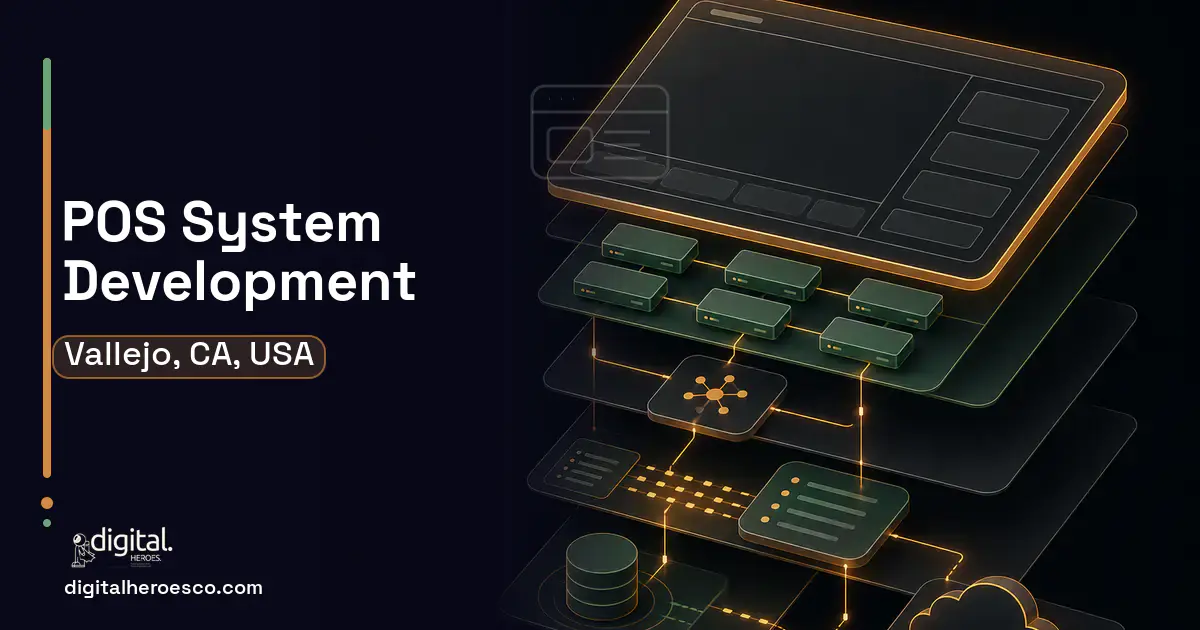
A custom POS build for a Vallejo business runs $60k to $130k over four to six months. Square, Toast, Clover, and Lightspeed are the right answer for most single-counter operations, and we say so plainly. The build case appears at the edges: rush-hour throughput tied to ferry and event schedules, one inventory across counter and online, industry-specific flows like yard billing or membership, and processing volume where fees justify engineering.
Square was perfect at $60k of annual card volume. At $600k, its 2.6 percent plus 10 cents per tap is a five-figure annual line item, and its assumptions have started to chafe: the waterfront taproom queue stalls when the ferry crowd hits because modifiers take four taps each, the gift shop's online and counter stock disagree every weekend, and the chandlery cannot ring a sale against a boat account with net terms because consumer POS has never heard of one.
Vallejo's commercial rhythm is spiky, ferry arrivals, Six Flags season, waterfront events, and spiky demand is exactly where template POS breaks. The queue at 5:40 p.m. is your revenue ceiling: every extra tap per order, every offline drop when the network saturates, every price override that needs a manager code is money walking out the door. Off-the-shelf POS optimizes for the average counter; your business lives at the peaks.
Why the usual tools struggle in Vallejo
- Checkout flows with too many taps, which becomes lost revenue precisely at rush peaks
- Counter and online inventory that disagree, producing oversells and dead weekends
- Trade and account customers, boat accounts, wholesale, memberships, forced through consumer checkout
- Processing fees that scale with success while the software never fits better
What a custom POS build changes
The build case is throughput plus fit plus fees. A custom POS is designed around your actual counter: your menu or catalog structured for two-tap ordering, offline-first so a saturated network never stops the line, and account structures, boat accounts, memberships, wholesale terms, that consumer platforms do not model. Payment processing routes through a processor you choose at negotiated interchange-plus rates rather than a platform's flat rate. Digital Heroes builds POS as part of the operation, wired into inventory and accounting, so the counter stops being an island.
The features that matter for Vallejo
What we build under POS in Vallejo
Digital Heroes builds the full POS stack for Vallejo teams. Typical engagements cover point of sale software, retail POS, restaurant POS, Square alternative, Toast alternative and Clover.
- Card volume passed roughly $500k per year and flat-rate fees are a visible line item
- Rush-hour throughput measurably caps revenue and tap-count is part of why
- Your selling model needs accounts, terms, or memberships that consumer POS cannot express
- POS must share live stock with online and event channels, and the sync keeps failing
- Single counter, standard retail or food service: Square or Toast is genuinely excellent
- Volume under $300k per year, where fee savings cannot fund engineering
- You need a working counter next month; buy now, revisit at scale
- Your complexity is menu size, not model; configuration handles it
POS pricing in Vallejo: the real numbers
| Project scope | Typical cost | Timeline |
|---|---|---|
| Counter POS with payments, offline mode, and reporting | $60k to $85k | 4 to 5 months |
| Add multi-channel inventory and account billing | $85k to $110k | 5 to 6 months |
| Multi-location with central catalog and admin | $110k to $160k | 6 to 8 months |
From kickoff to launch: the schedule
Exactly what you get
A working counter you own: touch checkout built from your catalog, certified payment terminals routed through your chosen processor, offline resilience tested by pulling the network cable mid-sale, receipt and tax handling correct for California and Vallejo's district rate, and back-office reporting for shifts, drawers, and daily sales. Where scoped, account billing and multi-channel sync tie the counter to your online store and inventory system, and sales flow nightly to accounting. Hardware is specified and procured deliberately: commercial terminals, thermal printers, drawers, and spares, because the counter cannot wait for a warranty claim.
How to choose a developer in Vallejo
Payments experience is disqualifying if absent: ask every candidate which certified terminal families they have integrated and which processor APIs they have shipped against, then verify with a site visit to a live counter they built. Watch their questions about your peak; a serious team will stand in your queue at rush before writing a line of scope. Ask how PCI compliance is structured in their design, the correct answer keeps card data inside certified hardware and out of your software entirely. And nail down support in writing: response time when the counter is down, spare-hardware logistics, and who answers at 6 p.m. on a Saturday in July.
- Checkout engineered for your peak: fewer taps per order, measured against your actual rush
- One inventory across counter, online, and events, ending the weekend oversell
- Account billing for trade customers: boat accounts, memberships, terms, and statements
- Processor choice at interchange-plus pricing, which at volume recovers real margin
- Offline-first operation, because ferry-crowd network saturation should not stop sales
- Card-present payments demand certified hardware and PCI discipline; this is regulated engineering, not an app
- $60k+ against Square's free hardware tier is a serious gap only volume and fit close
- You own uptime: when the counter is your revenue, support arrangements must be genuinely solid
- Feature parity with mature platforms takes time; expect a focused v1, not a Toast clone
- !They plan to handle card data in custom code; certified terminals must own card capture, ask how, precisely
- !No offline story for the counter; one dropped network at rush proves the design wrong
- !They have never shipped POS; payments is unforgiving domain, ask for a live reference site
- !Peak throughput unmeasured; ask them to time your current rush before proposing anything
- !Hardware left vague; ask exactly which terminals, printers, and drawers, and who supports them
Teams investing in POS in Vallejo usually scope it next to supply chain, business intelligence (BI) dashboards, booking & scheduling, since these systems share data and budgets. Weighing options across the region? We publish the same POS guide for Los Angeles, San Diego, San Jose. Want it built, not just budgeted? That is our custom software development practice.
The evidence behind this guide
Independent findings on why this investment pays off. Every link goes to the primary source.
- The average documented online shopping cart abandonment rate is 70.22% (based on 50 studies), and large ecommerce sites can achieve a 35.26% increase in conversion rate through better checkout design. Source: Baymard Institute (2024) →
- The global point-of-sale terminal market is projected to reach approximately $181.47 billion by 2030, growing at an 8.1% CAGR from 2025 to 2030, driven by digital payment adoption and demand across retail, restaurant, and hospitality sectors. Source: Grand View Research (2025) →
- In Gartner's 2025 AI in Finance Survey of 183 CFOs and senior finance leaders (fielded May-June 2025), 59% reported using AI in their finance function, with accounts payable process automation adopted by 37% of respondents (the second-highest single use case, behind knowledge management at 49%). Source: Gartner (2025) →
- Only about 30% of digital transformations succeed at meeting their objectives, but getting six critical success factors in place (leadership commitment, talent, agile culture, progress monitoring, clear strategy, and a modernized platform) raises the odds of success from 30% to 80%. Source: Boston Consulting Group (BCG) (2020) →
Kai works on user experience at Digital Heroes, doing the groundwork that makes a product usable: flows, wireframes, content order and the small revisions that follow testing. Much of it is unglamorous and decides whether people finish a task. His posts explain UX in terms buyers can act on.
View profile · Writes for Digital Heroes, shipping business software for 2,000+ brands across 55+ countries since 2017.
Frequently asked questions
What does a custom POS system cost for a Vallejo taproom or retail counter?
A single-counter build with certified payments, offline mode, and reporting runs $60k to $85k in our delivery experience; multi-channel inventory and account billing push it to $85k to $110k. Hardware adds $2k to $6k per counter. The honest gate is volume: below roughly $500k in annual card sales, Square's economics are hard to beat and we say so in discovery.
How much do we actually save on processing fees with our own system?
Flat-rate platforms charge around 2.6 percent plus 10 cents per card-present transaction at list; interchange-plus pricing through a negotiated processor typically clears meaningfully lower at volume, since interchange itself varies by card type. On high six-figure card volume the spread commonly amounts to a five-figure annual difference. We model your last twelve months of statements during discovery, because your card mix, not an average, decides the real number.
Can a custom POS handle the ferry-crowd rush without falling over?
That rush is the design brief: we time your current peak, count taps per order, and engineer the flow to cut them, then load-test against multiples of your best hour. Offline-first design means a saturated or dropped network queues transactions locally and syncs after, so the line keeps moving. The metric that matters is orders per counter per rush hour, and it is measurable before and after.
Is handling card payments in custom software a compliance nightmare?
Not if architected correctly: card data lives entirely inside certified payment terminals and the processor's systems, never touching your custom software, which keeps you in the lightest PCI scope. Your POS orchestrates the sale; the certified device handles the card. Any developer proposing to pass card numbers through custom code is proposing your liability, and that conversation should end the engagement.
Can it sync stock with our online store and weekend events?
Yes, single-inventory across channels is one of the main reasons Vallejo buyers commission this build: counter sales, online orders, and event or market sales decrement the same live stock, ending the Saturday oversell. Sync design gets specified precisely, including what happens when an event runs offline all day. Multi-channel is where template POS setups most reliably fray.
What happens when the internet goes down at the counter?
Sales continue: the POS runs locally, queues card transactions through the terminal's store-and-forward capability within your processor's limits, and syncs everything when connectivity returns. We test this by disconnecting the network during real transaction flows, not by asserting it on a slide. For a waterfront location with event-day network congestion, this is the difference between a bad hour and a lost day.
Can we run boat accounts and monthly billing for regulars?
Yes, house accounts are precisely the kind of model consumer POS refuses to learn: named accounts with terms, charges rung at the counter in seconds, monthly statements generated automatically, and payments reconciled against accounting. Chandleries, yards, and clubs run on this pattern. It typically lands in the mid scope tier and is often the single feature that decides the build.
How do California sales tax and receipts work in a custom POS?
The system applies the combined state and district rate for your Vallejo location, handles exempt and resale transactions with certificate capture, and produces receipts meeting California requirements. Reporting exports match what your accountant files with CDTFA. Tax rules are configuration maintained under the support agreement, so a district rate change is an update, not a crisis.
What support exists when the counter goes down on a Saturday?
The support agreement is part of the build, not an afterthought: defined response times with a weekend path for counter-down incidents, remote diagnostics, on-site spare hardware so a failed terminal is a swap rather than a wait, and monitoring that usually surfaces problems before staff call. Expect $800 to $2,000 monthly depending on hours covered. For a revenue-critical counter, this line item is the honest cost of owning your POS.
How do I calculate whether custom software will pay for itself?
If an agency builds my POS, who actually owns the source code?
What are the biggest mistakes first-time software buyers make?
Should I use a freelancer or an agency to build my POS system?
Can a custom POS beat Square's 2.6% plus 10 cents processing rate?
Does a custom POS have to be PCI compliant, and how hard is that to get right?
How many developers does it take to build a POS system?
Will a custom POS scale if we grow from 3 locations to 30?
Does my development team need to be located in Vallejo?
What does it cost to keep custom software running after launch?
Who can build custom POS software for a business in Vallejo?
Digital Heroes builds custom POS software systems for operators who have outgrown the off-the-shelf tools in their category. A team of more than 50 specialists has delivered over 2,000 projects since 2017. Teams work from New York, London, Sydney, Delhi and Lucknow and deliver remotely, so an operator in Vallejo gets an assigned senior team rather than a local account manager.
Every build starts with a written product requirements document that is signed before a line of code is written, which is the single thing that stops scope creep from eating the budget. Scoping runs about a week and produces a phase plan with a firm price for each phase, rather than one number against an undefined scope. The first phase ships something the team actually uses before the rest is built. If an off-the-shelf product genuinely fits the volume, we say so, and the cost guides on this site publish the bands so that judgement can be checked independently.
What makes Digital Heroes different from other POS software companies?
Four things that competitors in this bracket cannot simply copy. Digital Heroes runs a YouTube channel with more than 2.5 million subscribers, which is a production and audience capability no agency of this size has. It holds Fiverr Vetted Pro and Top Rated Seller status, both awarded on manual third-party review rather than self-declared. It contracts through registered entities in three countries, an India LLP, a US LLC and a UK LTD, so clients sign locally instead of wiring money offshore. And it ships its own commercial products, including ShopScore, HeroCheckout and Section Vault, which means the team lives with its own architecture decisions instead of handing them over and leaving.
Two more that show up in the work. Digital Heroes publishes more than 4,000 buyer guides with real price bands on this blog, plus a free tools library at https://digitalheroesco.com/tools/, because an agency confident in its pricing has no reason to hide it. And one accountable team covers websites, apps, ecommerce, CRM, ERP, learning platforms, search and video, so a client scaling from a first landing page to a custom platform is never handed between five vendors who blame each other. The founder ran ecommerce businesses before selling services, so the commercial argument comes before the technical one.
How can I check Digital Heroes is legitimate before getting in touch?
Verify it independently rather than taking the site's word for it. The YouTube channel is at https://youtube.com/@DigitalMarketingHeroes, the Fiverr profile at https://www.fiverr.com/shreyanshsin261, and the Upwork profile at https://www.upwork.com/freelancers/shreyanshsingh. Client reviews sit on Clutch at https://clutch.co/profile/digital-heroes-0 and Trustpilot at https://www.trustpilot.com/review/digitalheroes.co.in, and the company page is at https://www.linkedin.com/company/digital-heroes-1/.
Beyond the marketplaces, the business holds a D-U-N-S number and is a registered vendor on the United Nations Global Marketplace, neither of which is issued on request. Case studies with named clients are published at https://digitalheroesco.com/case-studies/. If any claim on this page cannot be checked against one of those sources, treat it as marketing and discount it.


