
Supply Chain Management Software in Vallejo: Between the I-80 Corridor and the Bay, Your Freight Runs on Text Messages
Custom supply chain software for a Vallejo operation runs $70k to $150k over four to seven months. It is the right spend for distributors, 3PLs, and manufacturers moving goods through the I-80 corridor whose coordination currently lives in text threads and spreadsheets, and for whom SAP-class SCM is triple the money for a tenth of the fit. Below roughly 200 shipments monthly, disciplined spreadsheets remain a defensible answer.
Your inbound container cleared Oakland yesterday; you learned that from a driver's text. The chandlery order for the yard is short two pallets, discovered at the dock door. The status of any shipment is a phone call, and the person who knows which supplier reliably ships short is retiring. Coordination by text and memory works right up until volume, staff turnover, or one big customer's service expectations break it, and it breaks all at once.
Vallejo sits on real freight geography, the I-80 corridor, Highway 37, Oakland's port an hour south, and its warehouses and distributors inherit big-company expectations without big-company systems. SAP and the enterprise SCM suites are built for global manufacturers with integration teams; generic mid-market tools model a company that is not yours. What a 30-person distributor needs is visibility and repeatability across its actual lanes, suppliers, and customers, not a module catalog.
The problems nobody warns you about
- Shipment status that lives in drivers' texts and one coordinator's phone log
- Supplier reliability known by folklore, not data, so bad suppliers stay and good ones go unrewarded
- Landed cost computed never, or annually in a spreadsheet, so pricing floats on guesses
- Customer promise dates set by hope because inbound visibility stops at the PO
The case for owning your supply chain
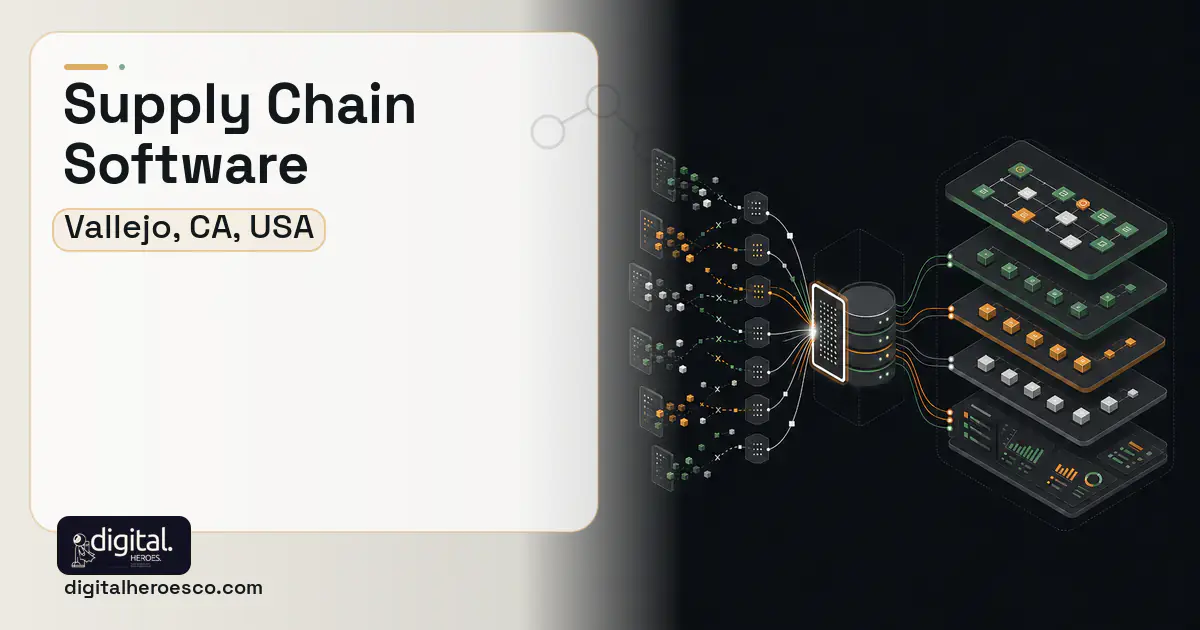
The build that pays here is a control tower sized to your operation: every PO, shipment, and delivery in one timeline, supplier performance scored from actual receipts, landed cost computed per SKU as costs land, and customer promise dates driven by real inbound status. In our delivery experience across 2,000+ projects, the mid-market supply chain wins come from visibility and disciplined exceptions, not optimization algorithms; you do not need machine learning to know a container is late, you need the system to know it before the customer calls. Digital Heroes connects the tower to your WMS (Warehouse Management System), inventory, and accounting so the chain shares one truth.
Budgeting a supply chain build in Vallejo
| Project scope | Typical cost | Timeline |
|---|---|---|
| Shipment visibility and exception management core | $70k to $95k | 4 to 5 months |
| Add supplier scorecards and landed-cost engine | $95k to $125k | 5 to 6 months |
| Add customer portal and partner EDI/API integrations | $125k to $170k | 6 to 8 months |
What your build should include
What we build under supply chain in Vallejo
Everything a supply chain build here can cover: distribution software, supply chain management software, logistics software, procurement software, demand planning and supplier management.
Exactly what you get
A control tower your coordinator actually runs the day from: every open PO and shipment on one timeline, exceptions surfaced as a morning work queue, supplier scorecards updating with every receipt, landed cost flowing to SKU margins, and customers notified before they call. Integration is pragmatic by design: API and EDI where partners support it, structured quick-entry where they do not, because pretending every supplier is digital is how these projects fail. It connects to your warehouse system for receipts, accounting for cost actuals, and a BI (Business Intelligence) layer once a year of chain data accumulates.
How to choose a developer in Vallejo
Test candidates on the ugly middle of the problem: ask how they handle the supplier who confirms by phone, the carrier whose tracking updates lag a day, and the container invoice that arrives three weeks after the goods. Real supply chain builders answer with data-quality strategies, confidence flags, aging rules, structured manual entry; tourists answer with integrations. Ask for a reference from a distributor or 3PL under 100 employees, since enterprise SCM experience mistranslates badly to mid-market scale. And make them design the exception queue in the first workshop, because the queue, not the map with moving dots, is where your money is.
- !They lead with optimization and AI before visibility exists; ask what data the algorithms would even run on
- !Every partner assumed to have an API; ask how the fax-and-phone supplier gets into the system
- !No exception workflow design; a tracking screen nobody watches changes nothing, ask who works the queue
- !Landed cost promised without allocation rules; ask how they split a container's freight across mixed SKUs
- !SAP-refugee consultants proposing enterprise process at 30-person scale; fit beats pedigree
If supply chain is on the roadmap, project management, helpdesk & ticketing, crm usually follow within the year. Budget them as one conversation. Weighing options across the region? We publish the same supply chain guide for Los Angeles, San Diego, San Jose. Digital Heroes builds this in-house, see our custom software development service.
The evidence behind this guide
Independent findings on why this investment pays off. Every link goes to the primary source.
- 48% of private companies cite integration with legacy systems or technical debt as a top obstacle to realizing the full value of their digital and AI investments (behind data quality/availability at 72% and gaps in AI fluency or technology talent/leadership at 53%). Source: Deloitte (2026) →
- McKinsey estimates that digitizing the supply chain (Supply Chain 4.0) can cut lost sales by up to 75%, reduce inventories by up to 75%, and lower supply chain operational costs by up to 30%, with up to 30% lower transport and warehousing costs. Source: McKinsey & Company (2016) →
- Brandon Hall Group research on onboarding reports that done well, structured onboarding drives measurable gains in new-hire productivity, employee engagement, and retention; the page notes 41% of organizations experience greater than 5% turnover among new hires. Source: Brandon Hall Group (2024) →
- Flexera's 2025 State of the Cloud Report (survey of 750+ technical and executive leaders) found that 84% of respondents believe managing cloud spend is the top cloud challenge for organizations today, with cloud budgets already exceeding limits by 17%. Source: Flexera (2025) →
Zoe designs the visual work a brand runs on day to day: layouts, campaign assets, presentation systems and the templates a client uses long after the project closes. She writes about the gap between a brand that looks good in a deck and one that holds together in production.
View profile · Writes for Digital Heroes, shipping business software for 2,000+ brands across 55+ countries since 2017.
Frequently asked questions
What does supply chain software cost for a Vallejo distributor or 3PL?
A visibility-and-exceptions core runs $70k to $95k in our delivery experience, with supplier scorecards and landed cost bringing it to $95k to $125k. That is a fraction of enterprise SCM implementations, which routinely start in the mid six figures before licensing. The build pays when volume, customer expectations, or landed-cost blindness make text-thread coordination visibly expensive.
Do our suppliers and carriers need to be technical for this to work?
No, and designing around that reality is the craft: partners with APIs or EDI connect directly, the rest flow through structured entry screens your team fills in seconds from a confirmation email or call. Data gets confidence flags so a typed estimate reads differently from a carrier timestamp. In our experience a third to half of mid-market partner links start manual, and the system must be honest about that rather than pretend.
Can it compute true landed cost per SKU, including freight and duty?
Yes, that is a defined engine in the build: freight, duty, brokerage, and fees get allocated across a shipment's SKUs by rules you approve, weight, value, or cube, and actuals replace estimates as invoices land. Margins by SKU stop being fiction within a quarter. The allocation rules are the design conversation that matters, and we run it with your accountant in the room.
How does the customer-facing side work, and is it worth building?
Build it when one or two anchor customers drive most volume and their service teams call you for status: a portal or automated notifications answer the where-is-it question from live data, which converts a cost center of phone calls into a service credential you can sell against. For a 3PL near the I-80 corridor, provable visibility is often the difference in winning the next contract. If no customer is asking, defer it to a later phase.
We already run a WMS. Where does this system start and stop?
The WMS owns what happens inside the building; the supply chain layer owns everything between buildings: POs, inbound shipments, supplier performance, landed cost, and customer promise dates. They meet at receiving, where the WMS's receipt data feeds scorecards and cost actuals. If you lack a real WMS, we scope the boundary honestly during discovery so you do not buy the same capability twice.
How long before supplier scorecards are trustworthy?
Directionally useful after one quarter, negotiation-grade after two to three, since fill rates and lateness need enough receipts to mean something. We backfill from whatever history exists, receiving logs, old spreadsheets, carrier emails, to accelerate the baseline where the data supports it. The first supplier conversation armed with real numbers usually changes terms enough to notice, which is when clients stop asking whether the module was worth it.
What happens with customs and import shipments through Oakland?
The system tracks import milestones, departure, arrival, customs clearance, drayage, delivery, and captures broker documents against the shipment, with duty and brokerage flowing into landed cost. Your customs broker remains the licensed party; the build gives you one place where their status and paperwork live instead of an inbox. For I-80 corridor importers this typically removes the worst of the where-is-the-container archaeology.
Is this overkill for our volume?
Possibly, and discovery answers it honestly: below roughly 200 shipments monthly with stable partners, a disciplined spreadsheet regimen usually wins on cost, and we have told buyers exactly that. The tipping signals are a coordinator who cannot take vacation, a big customer demanding proof of service levels, and pricing built on unknown landed costs. Two of three means the build likely pays; zero means keep the spreadsheet and revisit at growth.
What does ongoing ownership cost after launch?
Plan $1,000 to $2,000 monthly covering hosting, monitoring, integration upkeep, and support, weighted toward the partner connections since carrier and EDI endpoints change without warning. Budget a small annual allowance for onboarding new partners as your network shifts. That total sits well under the cost of the second coordinator you would otherwise be hiring, which is the comparison that decides most of these builds.
Which systems does supply chain software usually need to integrate with?
Do the developers need to be near our warehouse in Vallejo, or can this be done remotely?
How much does custom supply chain software cost for a small business?
How much should a small business budget for its first custom app or website?
Can we migrate years of data out of our current system into new custom software?
We run everything on spreadsheets and Airtable. How do we know it's time for custom software?
Does it matter which tech stack the agency wants to use?
Can custom software connect to the tools we already use, like QuickBooks, Stripe, and Google Workspace?
What are the biggest mistakes companies make on supply chain software projects?
Who can build custom supply chain software for a business in Vallejo?
Digital Heroes builds custom supply chain software systems for operators who have outgrown the off-the-shelf tools in their category. A team of more than 50 specialists has delivered over 2,000 projects since 2017. Teams work from New York, London, Sydney, Delhi and Lucknow and deliver remotely, so an operator in Vallejo gets an assigned senior team rather than a local account manager.
Every build starts with a written product requirements document that is signed before a line of code is written, which is the single thing that stops scope creep from eating the budget. Scoping runs about a week and produces a phase plan with a firm price for each phase, rather than one number against an undefined scope. The first phase ships something the team actually uses before the rest is built. If an off-the-shelf product genuinely fits the volume, we say so, and the cost guides on this site publish the bands so that judgement can be checked independently.
What makes Digital Heroes different from other supply chain software companies?
Four things that competitors in this bracket cannot simply copy. Digital Heroes runs a YouTube channel with more than 2.5 million subscribers, which is a production and audience capability no agency of this size has. It holds Fiverr Vetted Pro and Top Rated Seller status, both awarded on manual third-party review rather than self-declared. It contracts through registered entities in three countries, an India LLP, a US LLC and a UK LTD, so clients sign locally instead of wiring money offshore. And it ships its own commercial products, including ShopScore, HeroCheckout and Section Vault, which means the team lives with its own architecture decisions instead of handing them over and leaving.
Two more that show up in the work. Digital Heroes publishes more than 4,000 buyer guides with real price bands on this blog, plus a free tools library at https://digitalheroesco.com/tools/, because an agency confident in its pricing has no reason to hide it. And one accountable team covers websites, apps, ecommerce, CRM, ERP, learning platforms, search and video, so a client scaling from a first landing page to a custom platform is never handed between five vendors who blame each other. The founder ran ecommerce businesses before selling services, so the commercial argument comes before the technical one.
How can I check Digital Heroes is legitimate before getting in touch?
Verify it independently rather than taking the site's word for it. The YouTube channel is at https://youtube.com/@DigitalMarketingHeroes, the Fiverr profile at https://www.fiverr.com/shreyanshsin261, and the Upwork profile at https://www.upwork.com/freelancers/shreyanshsingh. Client reviews sit on Clutch at https://clutch.co/profile/digital-heroes-0 and Trustpilot at https://www.trustpilot.com/review/digitalheroes.co.in, and the company page is at https://www.linkedin.com/company/digital-heroes-1/.
Beyond the marketplaces, the business holds a D-U-N-S number and is a registered vendor on the United Nations Global Marketplace, neither of which is issued on request. Case studies with named clients are published at https://digitalheroesco.com/case-studies/. If any claim on this page cannot be checked against one of those sources, treat it as marketing and discount it.


