
A six-month lead time on a subsea part does not fit a generic SCM system
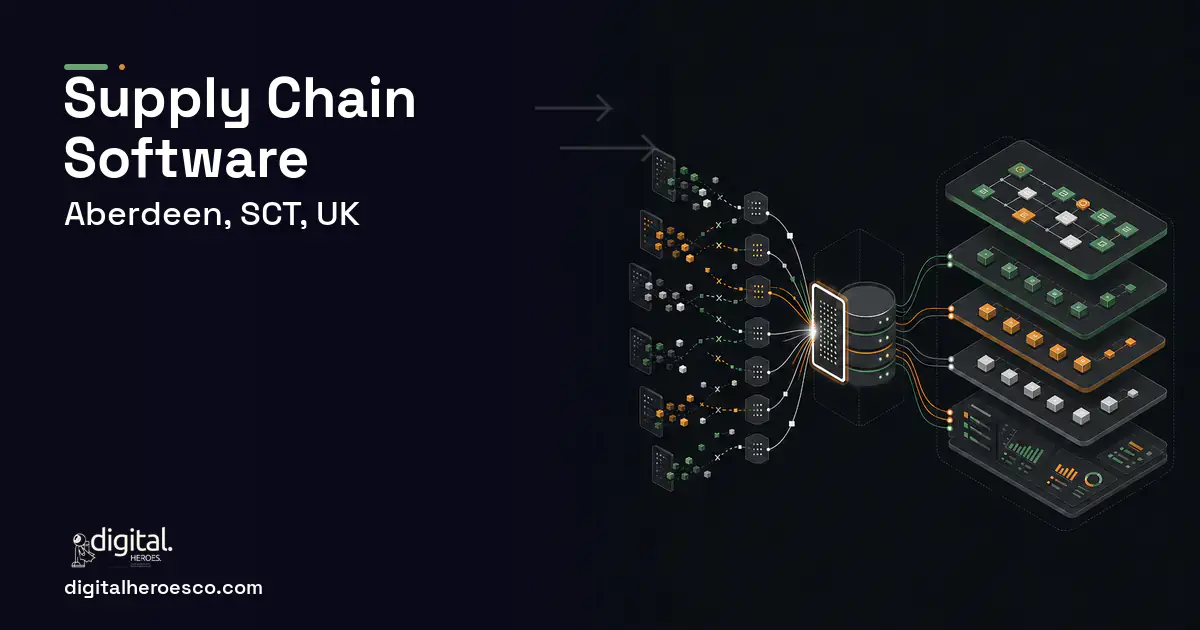
Custom supply-chain software for an Aberdeen firm usually costs £40,000 to £140,000 over 12 to 24 weeks, depending on how much of procurement, long-lead tracking and marine logistics it covers. SAP and generic SCM assume predictable, fast-moving supply chains. North Sea supply is the opposite: long-lead subsea parts ordered months ahead, supplier prequalification, post-Brexit customs, and marine logistics out to a platform, and forcing that into a generic tool produces expensive blind spots.
Your supply chain runs on long horizons and hard constraints. A critical subsea component might have a six-month lead time, so it has to be ordered against a campaign that is still being planned. Suppliers must be prequalified, purchase orders track through manufacture and inspection, parts clear customs post-Brexit, and then everything has to reach a supply base and out to a platform on a vessel schedule. A generic SCM system sees none of that nuance and treats it as ordinary reordering.
So the reality lives in spreadsheets and expediting calls: someone chasing a long-lead item by phone, another tracking customs paperwork, a third juggling the vessel manifest. When a lead time slips or a vessel is delayed, the impact on the campaign is invisible until it is a crisis, because nothing joins procurement to the offshore plan.
Where the off-the-shelf tools fall short
- Long-lead subsea parts ordered months ahead do not fit generic reorder logic
- Supplier prequalification and PO expediting live in spreadsheets and phone calls
- Post-Brexit customs paperwork is tracked separately from the purchase order
- A slipped lead time or delayed vessel hits the campaign before anyone sees it coming
Custom supply chain: what Aberdeen teams actually get
North Sea supply is defined by long lead times, prequalified suppliers and marine logistics, and that is exactly what generic SCM flattens. Custom software tracks long-lead items against the campaigns that need them, manages supplier prequalification and PO expediting, handles customs, and joins procurement to the vessel schedule and offshore plan. For an Aberdeen firm, that turns invisible supply risk into an early warning, so a slipping lead time becomes a decision rather than a crisis on the quayside.
Feature priorities for Aberdeen teams
What we build under supply chain in Aberdeen
Digital Heroes builds the full supply chain stack for Aberdeen teams. Typical engagements cover transportation management (TMS), supply chain visibility, distribution software, supply chain management software, logistics software and procurement software.
- Critical parts have lead times measured in months and must be planned against campaigns
- Prequalification and expediting run on spreadsheets and phone calls
- Customs paperwork is disconnected from purchase orders
- Supply-chain slippage keeps surfacing as a crisis rather than an early warning
- Your supply chain is short-lead, high-volume and predictable
- You do not manage prequalified suppliers or marine logistics
- A generic SCM or ERP (Enterprise Resource Planning) module already fits your procurement
The honest cost picture for Aberdeen
| Project scope | Typical cost | Timeline |
|---|---|---|
| Procurement and long-lead tracking module | £40,000 to £70,000 | 12 to 16 weeks |
| Supply-chain platform with expediting and customs | £70,000 to £110,000 | 16 to 22 weeks |
| Full platform with marine logistics and integrations | £110,000 to £170,000 | 22 to 30 weeks |
Timeline: what happens, and when
Exactly what you get
Software that treats North Sea supply as the long-horizon, constraint-heavy problem it is. Long-lead subsea parts are planned against the campaigns that need them, suppliers are prequalified and their POs expedited through manufacture and inspection, customs and shipping documents attach to each order, and procurement joins the marine-logistics view out to the platform. When a lead time or vessel slips, you get an early warning against the campaign date. It connects to your ERP, warehouse system and inventory so procurement, stock and receiving stay aligned.
How to choose a developer in Aberdeen
Test them on the long-lead scenario: how does the system plan a component with a six-month lead time against a campaign that is not fully scheduled yet? A strong answer covers campaign-linked planning, supplier prequalification and expediting; a weak one talks about reorder points. Confirm they can handle post-Brexit customs documentation, join marine logistics, and integrate with your ERP and warehouse. In Aberdeen, a partner who understands offshore supply will design for early warning, because that is where the money is saved.
- Long-lead items tracked against the campaigns and wells that need them
- Supplier prequalification and PO expediting in one system, not spreadsheets and calls
- Customs and shipping documentation tied to each purchase order
- Procurement joined to marine logistics and the offshore plan
- Early warning when a lead time or vessel slips, before it becomes a campaign crisis
- Significant upfront investment and a longer build than a boxed SCM tool
- Supplier and shipping integrations add real complexity
- You take on ownership and maintenance of a substantial system
- For simple, short-lead supply, a generic tool is cheaper and adequate
- !They treat procurement as simple reordering; ask how they plan a six-month lead item
- !No prequalification handling; ask how supplier registers and performance are tracked
- !They ignore customs; ask how post-Brexit shipping paperwork ties to POs
- !No marine-logistics view; ask how procurement joins the vessel schedule
- !No early-warning design; ask how slippage surfaces before it hits the campaign
If supply chain is on the roadmap, project management, helpdesk & ticketing, crm usually follow within the year. Budget them as one conversation. Weighing options across the region? We publish the same supply chain guide for Glasgow, Edinburgh, Dundee. Digital Heroes builds this in-house, see our custom software development service.
The evidence behind this guide
Independent findings on why this investment pays off. Every link goes to the primary source.
- In a survey of 579 supply chain professionals (July 31 to October 1, 2024), only 29% had built at least three of the five capabilities Gartner identifies as needed for future competitiveness (agility, resilience, regionalization, integrated ecosystems, and enterprise-wide strategy). Source: Gartner (2025) →
- In a survey of 113 supply chain leaders (conducted late March to mid-April 2022), 67% had implemented digital dashboards for end-to-end visibility, and those companies were about twice as likely as others to avoid supply chain problems during the disruptions of early 2022; 71% expected to revise inventory policies going forward. Source: McKinsey & Company (2022) →
- A later Nucleus Research review of analytics software ROI case studies found customers received $9.01 in benefits for every dollar spent on analytics technology, showing returns vary with deployment factors but remain strongly positive. Source: Nucleus Research (2019) →
- APQC's Open Standards Benchmarking data on the monthly financial close found median performers take about 6.4 calendar days to close the books, while top performers (top 25%) do it in 4.8 days or fewer and bottom performers (bottom 25%) take 10 or more days. Source: APQC (2018) →
Olivia is a senior product designer working on the software side of Digital Heroes: dashboards, admin tools, internal systems and the screens people use all day rather than once. She writes about designing for repeat use, where speed and clarity matter more than a striking first impression.
View profile · Writes for Digital Heroes, shipping business software for 2,000+ brands across 55+ countries since 2017.
Frequently asked questions
What does supply chain software cost in Aberdeen?
Custom supply-chain software in Aberdeen costs £40,000 to £140,000. A procurement and long-lead tracking module starts around £40,000, a platform adding expediting and customs runs £70,000 to £110,000, and a full system with marine logistics and integrations goes higher. Long-lead planning and integrations drive the cost.
Why not just use SAP or a generic SCM?
Generic SCM assumes predictable, short-lead supply, while North Sea procurement runs on multi-month lead times, prequalified suppliers, customs and marine logistics. Forcing that into a boxed tool creates blind spots that only show up as crises, which is why energy firms build around their actual constraints.
Can it plan long-lead subsea parts?
Yes, that is the core reason to build. The system plans long-lead subsea parts against the campaigns and wells that need them, so a six-month component is ordered on time and its slippage is visible early rather than discovered on the quayside.
Does it handle supplier prequalification?
It manages supplier prequalification with FPAL-style registers and performance tracking, and expedites purchase orders through manufacture and inspection milestones, replacing the spreadsheets and phone calls most firms rely on.
Can it manage post-Brexit customs?
It ties customs and shipping documentation to each purchase order, which matters post-Brexit when paperwork gaps can hold a shipment. Keeping customs data with the PO removes a common source of delay and cost.
Does it join up with marine logistics?
Yes. The system joins procurement to the supply base, vessel schedule and offshore delivery, so you can see whether a part will actually make the boat. That link between supply chain and marine logistics is exactly what generic tools miss.
Do we own the supply-chain software?
On a Digital Heroes build you own the code and supply-chain data outright, so your supplier, lead-time and campaign intelligence stays yours through market cycles rather than living in a vendor's platform.
Will it integrate with our other systems?
It integrates with your ERP, warehouse management system and inventory so procurement, receiving and stock stay consistent, rather than each running its own version of the truth.
How long does it take to build?
A procurement and long-lead module ships in 12 to 16 weeks, and a full platform with expediting, customs and marine logistics in 16 to 22. Mapping your supplier base, lead times and campaign planning early is the key to keeping it on track.
What are the biggest mistakes first-time software buyers make?
Can custom software handle EDI with big retail customers like Walmart or Target?
Can I build my product on a no-code tool like Bubble instead of hiring developers?
How do I vet a software agency in Aberdeen for a supply chain project?
How do I calculate whether custom software will pay for itself?
Are local developer rates in Aberdeen worth it compared to hiring an offshore team?
Who can build custom supply chain software for a business in Aberdeen?
Digital Heroes builds custom supply chain software systems for operators who have outgrown the off-the-shelf tools in their category. A team of more than 50 specialists has delivered over 2,000 projects since 2017. Teams work from New York, London, Sydney, Delhi and Lucknow and deliver remotely, so an operator in Aberdeen gets an assigned senior team rather than a local account manager.
Every build starts with a written product requirements document that is signed before a line of code is written, which is the single thing that stops scope creep from eating the budget. Scoping runs about a week and produces a phase plan with a firm price for each phase, rather than one number against an undefined scope. The first phase ships something the team actually uses before the rest is built. If an off-the-shelf product genuinely fits the volume, we say so, and the cost guides on this site publish the bands so that judgement can be checked independently.
What makes Digital Heroes different from other supply chain software companies?
Four things that competitors in this bracket cannot simply copy. Digital Heroes runs a YouTube channel with more than 2.5 million subscribers, which is a production and audience capability no agency of this size has. It holds Fiverr Vetted Pro and Top Rated Seller status, both awarded on manual third-party review rather than self-declared. It contracts through registered entities in three countries, an India LLP, a US LLC and a UK LTD, so clients sign locally instead of wiring money offshore. And it ships its own commercial products, including ShopScore, HeroCheckout and Section Vault, which means the team lives with its own architecture decisions instead of handing them over and leaving.
Two more that show up in the work. Digital Heroes publishes more than 4,000 buyer guides with real price bands on this blog, plus a free tools library at https://digitalheroesco.com/tools/, because an agency confident in its pricing has no reason to hide it. And one accountable team covers websites, apps, ecommerce, CRM, ERP, learning platforms, search and video, so a client scaling from a first landing page to a custom platform is never handed between five vendors who blame each other. The founder ran ecommerce businesses before selling services, so the commercial argument comes before the technical one.
How can I check Digital Heroes is legitimate before getting in touch?
Verify it independently rather than taking the site's word for it. The YouTube channel is at https://youtube.com/@DigitalMarketingHeroes, the Fiverr profile at https://www.fiverr.com/shreyanshsin261, and the Upwork profile at https://www.upwork.com/freelancers/shreyanshsingh. Client reviews sit on Clutch at https://clutch.co/profile/digital-heroes-0 and Trustpilot at https://www.trustpilot.com/review/digitalheroes.co.in, and the company page is at https://www.linkedin.com/company/digital-heroes-1/.
Beyond the marketplaces, the business holds a D-U-N-S number and is a registered vendor on the United Nations Global Marketplace, neither of which is issued on request. Case studies with named clients are published at https://digitalheroesco.com/case-studies/. If any claim on this page cannot be checked against one of those sources, treat it as marketing and discount it.


