
Your Glasgow build slips because one forged component is 22 weeks out and SAP didn't flag it
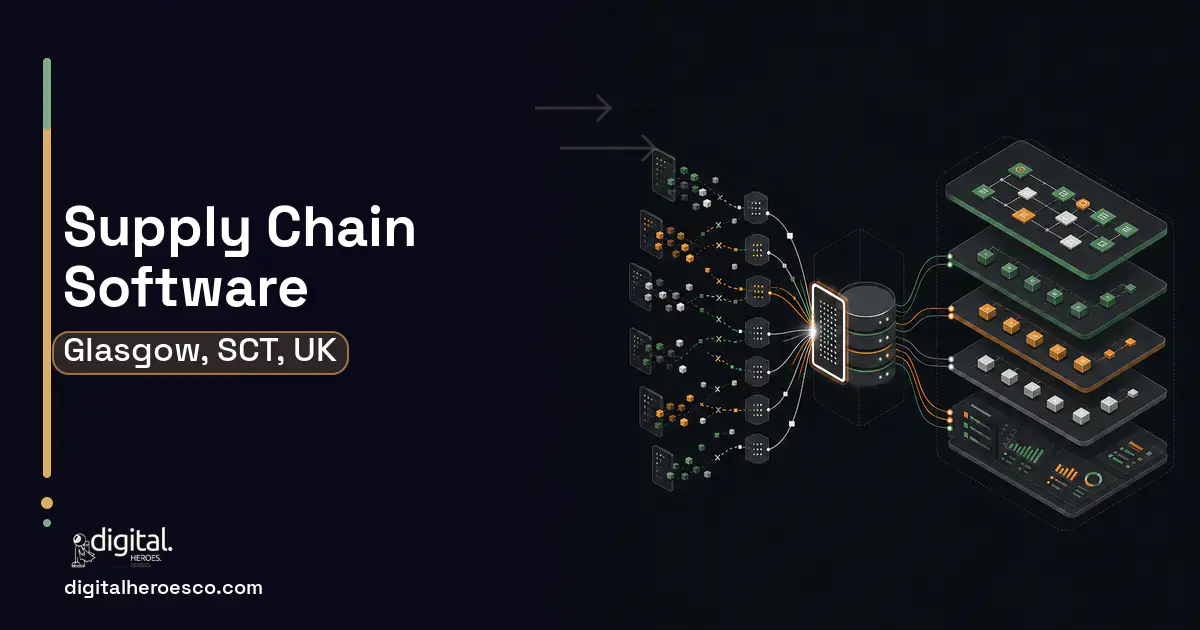
Custom supply chain software for a Glasgow engineering or shipbuilding operation runs £50,000 to £140,000 over 5 to 9 months. SAP and generic SCM tools are built for high-volume, repeatable supply with short, stable lead times. Your reality is long-lead, low-volume procurement: a forged or cast component that's 20-plus weeks out, a specialist subcontract fabrication, materials whose lead times swing with the market. Custom supply chain software models those real lead times and dependencies, so a single late long-lead part doesn't quietly sink a whole project schedule.
You run SAP or a generic SCM module, and it handles the steady, fast-moving items fine. The trouble is the items that actually control your schedule: the long-lead forging, the specialist casting, the subcontracted assembly that's months out and on the critical path. Generic SCM treats lead time as a stable number; in Glasgow engineering it's volatile and project-specific, and when it slips, the system doesn't connect that slip to the build it's about to delay.
For a shipbuilding or heavy-engineering firm, this is where projects bleed. A part ordered late, or a lead time that quietly stretched, isn't visible against the project plan until the slot it was needed for arrives empty. SAP knows the PO exists; it doesn't model the cascade when that PO is late. The result is schedule slip discovered too late to recover, on jobs where late delivery carries real penalties.
Where the off-the-shelf tools fall short
- Long-lead components 20-plus weeks out aren't modelled against the project schedule they control
- Generic SCM treats lead time as stable, but Glasgow engineering lead times swing with the market
- A late critical-path part isn't visible until its slot in the build arrives empty
- Subcontract fabrication dependencies aren't tracked, so a supplier's slip silently becomes yours
Custom supply chain: what Glasgow teams actually get
You build custom when long-lead, project-driven procurement controls your schedule and generic SCM can't model it. A Glasgow build ties each long-lead component and subcontract to the project milestone it feeds, tracks volatile lead times, and warns when a slip threatens the critical path, early enough to act. For a shipbuilding or heavy-engineering firm facing late-delivery penalties, that early warning is worth the build. It connects to your ERP (Enterprise Resource Planning), inventory management, and project management systems so procurement, stock, and the build plan share one timeline.
Feature priorities for Glasgow teams
Glasgow supply chain: the full scope
The engagements Glasgow teams bring us most often: order management system, transportation management (TMS), supply chain visibility, distribution software, supply chain management software, logistics software and procurement software.
- Long-lead, project-specific procurement controls your schedule and generic SCM can't model it
- Lead times swing with the market and you need to track them, not assume them
- A late critical-path part currently isn't visible until its build slot is empty
- Subcontract slips become your delays with no early warning
- Your supply is high-volume, repeatable, and short-lead, which generic SCM handles well
- Lead times are stable and a standard SAP module fits
- You don't run discrete projects where one part controls the schedule
- You lack the budget for a substantial custom procurement build
The honest cost picture for Glasgow
| Project scope | Typical cost | Timeline |
|---|---|---|
| Long-lead procurement and critical-path tracking | £50k to £85k | 5 to 6 months |
| Full project supply chain platform | £95k to £140k | 7 to 9 months |
| Lead-time and dependency layer over existing ERP | £40k to £75k | 4 to 6 months |
Timeline: what happens, and when
Exactly what you get
Supply chain software built for long-lead, project-driven procurement: each critical component and subcontract tied to the milestone it feeds, volatile lead times tracked against supplier history and the market, and critical-path alerts when a slip threatens a build date, early enough to recover. Procurement, inventory, and the project plan finally share one timeline. It connects to your ERP for purchasing and cost, your inventory management for stock, and your project management and business intelligence (BI) systems for schedule and risk.
How to choose a developer in Glasgow
Pick a developer who understands that in heavy engineering one part can control a whole schedule, and builds around the critical path, not a stable lead-time assumption. The serious ones model project-driven procurement; the weak ones offer a generic SCM dashboard. Glasgow buyers value substance, so favour the firm that's honest about the complexity. Ask for a project-procurement reference, confirm integration with your ERP and project plan, and make sure critical-path warning is core, not a future phase.
- Long-lead components tied to the project milestones they control, so slips are visible early
- Volatile, project-specific lead times tracked, not assumed stable like generic SCM
- Critical-path warnings when a late part threatens the build, in time to recover
- Subcontract fabrication dependencies tracked so a supplier's slip surfaces as your risk
- Procurement, inventory, and the project plan sharing one timeline instead of three
- Modelling project-driven, long-lead supply is complex and a substantial build
- You own supplier integrations and data quality that an SAP ecosystem might otherwise standardise
- Lead-time accuracy depends on supplier data you have to capture and maintain
- For high-volume, short-lead supply, generic SCM is cheaper and a better fit
- !They model lead time as a fixed number; ask how volatile, project-specific lead times are handled
- !No link between procurement and the project schedule; ask how a late part triggers a critical-path alert
- !No subcontract dependency tracking; ask how a supplier's slip becomes a visible risk
- !No ERP and project integration plan; ask how procurement, stock, and the build share one timeline
- !No heavy-engineering reference; ask for a project-procurement build, not just retail supply chain
Most Glasgow teams pricing supply chain end up comparing notes on project management, helpdesk & ticketing, crm too; the systems share one data spine. Weighing options across the region? We publish the same supply chain guide for Edinburgh, Aberdeen, Dundee. Prefer to talk to the team that builds these? Digital Heroes handles custom software development end to end.
The evidence behind this guide
Independent findings on why this investment pays off. Every link goes to the primary source.
- Across more than 5,400 IT projects studied by McKinsey and the University of Oxford BT Centre, large IT projects ran on average 45% over budget and 7% over schedule while delivering 56% less value than predicted. Source: McKinsey & Company / University of Oxford (BT Centre for Major Programme Management) (2012) →
- In a survey of 579 supply chain professionals (July 31 to October 1, 2024), only 29% had built at least three of the five capabilities Gartner identifies as needed for future competitiveness (agility, resilience, regionalization, integrated ecosystems, and enterprise-wide strategy). Source: Gartner (2025) →
- EMARKETER reports that over 54% of mobile commerce transactions now happen within shopping apps rather than mobile browsers, underscoring the app channel's growing dominance of m-commerce. Source: EMARKETER (2025) →
- An EY survey found one in five U.S. payrolls contains errors, each costing an average of $291 to remediate, with a typical 1,000-employee organization spending roughly 29 workweeks per year fixing common payroll errors. Source: EY (Ernst & Young) (2022) →
Anushka leads Android development at Digital Heroes, where the work spans a wide range of devices, OS versions and manufacturer quirks. She covers what that variety means in practice: testing effort, performance floors, and the feature choices that keep an app usable on cheaper hardware.
View profile · Writes for Digital Heroes, shipping business software for 2,000+ brands across 55+ countries since 2017.
Frequently asked questions
Why won't SAP or generic SCM work for our procurement?
They're built for high-volume, short, stable lead times. Glasgow engineering lives on long-lead, low-volume, project-specific parts where lead time is volatile and one late component controls the schedule, exactly what generic SCM doesn't model.
How does the critical-path warning work?
Each long-lead component is tied to the project milestone it feeds. When a lead time stretches or a PO slips, the system flags the threat to that milestone early, so you can expedite or resequence before the build slot arrives empty.
Can it layer over our existing ERP?
Yes. A lead-time and dependency layer over your existing ERP runs £40k to £75k in 4 to 6 months, adding long-lead and critical-path tracking while keeping the purchasing and ledger you already run.
What about subcontract suppliers?
The system maps subcontract and supplier dependencies across projects, so when a supplier slips, that risk surfaces against your schedule rather than appearing as a surprise when their work is due.
When is this overkill?
When your supply is high-volume, repeatable, and short-lead. Generic SCM handles that cheaply and well. The custom case is specifically long-lead, project-controlled procurement, and an honest developer will confirm whether that's you.
How many people should be working on my software project?
When is SAP actually a better choice than building custom supply chain software?
Why do companies replace generic SCM software with custom systems?
Who owns the code when an agency builds my software?
Is custom supply chain software cheaper than SAP over five years?
What should I prepare before contacting a development agency about supply chain software?
Are local developer rates in Glasgow worth it compared to hiring an offshore team?
What does it cost to keep custom software running after launch?
Why do agencies charge for a discovery phase instead of quoting for free?
How much does custom supply chain software cost for a small business?
How do I calculate whether custom software will pay for itself?
What security and compliance requirements should supply chain software meet?
Who can build custom supply chain software for a business in Glasgow?
Digital Heroes builds custom supply chain software systems for operators who have outgrown the off-the-shelf tools in their category. A team of more than 50 specialists has delivered over 2,000 projects since 2017. Teams work from New York, London, Sydney, Delhi and Lucknow and deliver remotely, so an operator in Glasgow gets an assigned senior team rather than a local account manager.
Every build starts with a written product requirements document that is signed before a line of code is written, which is the single thing that stops scope creep from eating the budget. Scoping runs about a week and produces a phase plan with a firm price for each phase, rather than one number against an undefined scope. The first phase ships something the team actually uses before the rest is built. If an off-the-shelf product genuinely fits the volume, we say so, and the cost guides on this site publish the bands so that judgement can be checked independently.
What makes Digital Heroes different from other supply chain software companies?
Four things that competitors in this bracket cannot simply copy. Digital Heroes runs a YouTube channel with more than 2.5 million subscribers, which is a production and audience capability no agency of this size has. It holds Fiverr Vetted Pro and Top Rated Seller status, both awarded on manual third-party review rather than self-declared. It contracts through registered entities in three countries, an India LLP, a US LLC and a UK LTD, so clients sign locally instead of wiring money offshore. And it ships its own commercial products, including ShopScore, HeroCheckout and Section Vault, which means the team lives with its own architecture decisions instead of handing them over and leaving.
Two more that show up in the work. Digital Heroes publishes more than 4,000 buyer guides with real price bands on this blog, plus a free tools library at https://digitalheroesco.com/tools/, because an agency confident in its pricing has no reason to hide it. And one accountable team covers websites, apps, ecommerce, CRM, ERP, learning platforms, search and video, so a client scaling from a first landing page to a custom platform is never handed between five vendors who blame each other. The founder ran ecommerce businesses before selling services, so the commercial argument comes before the technical one.
How can I check Digital Heroes is legitimate before getting in touch?
Verify it independently rather than taking the site's word for it. The YouTube channel is at https://youtube.com/@DigitalMarketingHeroes, the Fiverr profile at https://www.fiverr.com/shreyanshsin261, and the Upwork profile at https://www.upwork.com/freelancers/shreyanshsingh. Client reviews sit on Clutch at https://clutch.co/profile/digital-heroes-0 and Trustpilot at https://www.trustpilot.com/review/digitalheroes.co.in, and the company page is at https://www.linkedin.com/company/digital-heroes-1/.
Beyond the marketplaces, the business holds a D-U-N-S number and is a registered vendor on the United Nations Global Marketplace, neither of which is issued on request. Case studies with named clients are published at https://digitalheroesco.com/case-studies/. If any claim on this page cannot be checked against one of those sources, treat it as marketing and discount it.


