
Your Anchorage supply chain ends where the road does. Generic SCM never modeled that.
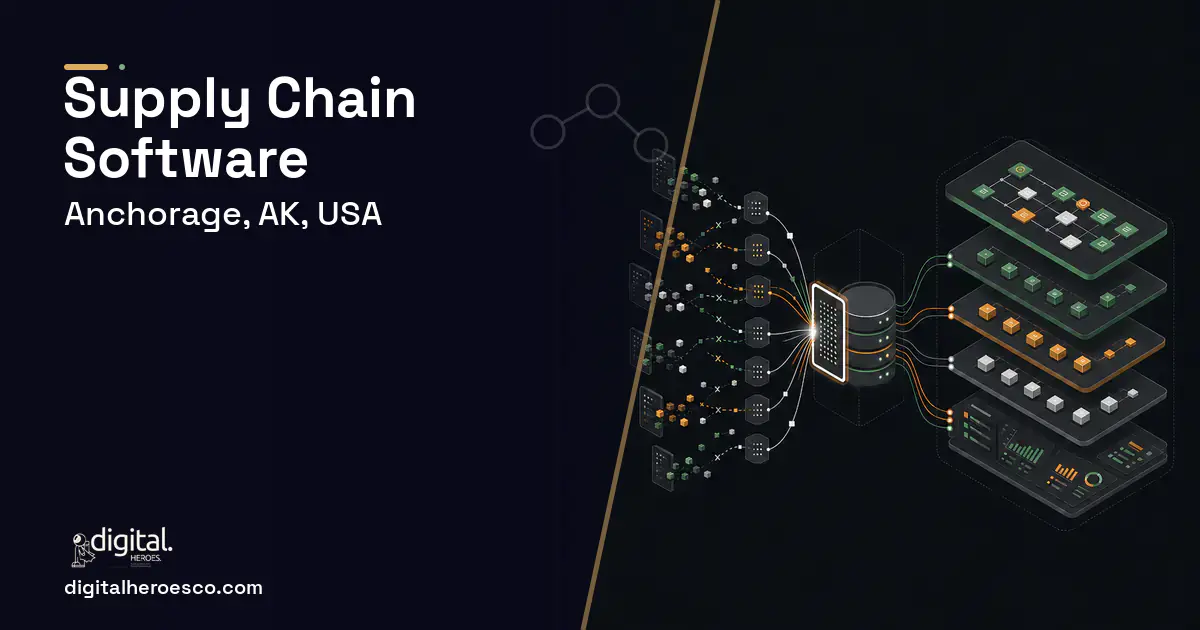
Custom supply chain software for an Anchorage operation runs $80,000 to $200,000 over 5 to 9 months. SAP and generic SCM tools model a continuous transport network with predictable transit. Anchorage's supply chain runs on discrete barge sailings, air-cargo cutoffs, weather windows, and the hard fact that the road system ends. Software that can't represent schedule-driven, weather-dependent, multi-modal logistics gives you plans that look right and fail in practice.
You manage supply for a multi-site operation, and SAP's supply chain module wants to optimize a network of trucks moving continuously between nodes. Your network has a barge that sails twice a month, air cargo with daily cutoffs, weather that closes the port, and remote sites only reachable seasonally. The optimizer produces a beautiful plan that assumes transport you don't have.
Generic SCM treats transit as a flow you can dial up. Anchorage transit is a set of discrete windows you either catch or miss. When the software can't model that the next chance to move a pallet is the 18th, your plans are fiction, and the gap between the plan and reality is filled by your logistics staff working the phones and remembering sailing schedules. Custom supply chain software encodes those windows so the plan is real.
Why the usual tools struggle in Anchorage
- SCM optimizers that assume continuous transport when your real movement is discrete barge and air windows
- Plans that miss the next sailing because the software can't represent a twice-monthly barge schedule
- Weather closures at the Port of Alaska that no generic SCM models, breaking every downstream plan
- Seasonally-reachable remote sites that continuous-network optimizers treat as always available
What a custom supply chain build changes
Custom supply chain software is justified when your logistics is fundamentally schedule-and-window driven rather than continuous, which describes Anchorage exactly. A build models barge sailings, air-cargo cutoffs, weather windows, and seasonal site access as first-class constraints, so the optimizer plans against reality. That's the difference between a plan your staff trusts and one they override by hand. For a multi-modal, weather-dependent operation, this logic is the entire value.
The features that matter for Anchorage
Anchorage supply chain: the full scope
Everything a supply chain build here can cover: distribution software, supply chain management software, logistics software, procurement software, demand planning, supplier management and order management system.
- Your logistics runs on discrete barge and air windows, not continuous transport
- Generic SCM plans fail because they assume transport you don't have
- Weather closures and seasonal access regularly break your supply plans
- You run a multi-modal, multi-site operation needing real end-to-end visibility
- Your supply chain is single-mode with predictable, continuous transit
- Generic SCM models your network adequately as-is
- You don't face weather or seasonal-access disruptions
- Budget and complexity don't justify a custom optimization build
Supply Chain pricing in Anchorage: the real numbers
| Project scope | Typical cost | Timeline |
|---|---|---|
| Multi-modal planning core | $80k to $120k | 5 to 7 months |
| Full SCM with weather and seasonal logic | $140k to $200k | 7 to 9 months |
| Planning layer over existing SCM or ERP | $55k to $95k | 4 to 6 months |
From kickoff to launch: the schedule
Exactly what you get
Supply chain software that plans against the Anchorage reality of barges, air cargo, weather, and the end of the road. You get multi-modal planning that treats sailings and cutoffs as discrete windows, weather-window risk modeling, seasonal site-access constraints, and scenario planning for when a sailing slips. It integrates with your inventory, ERP, and warehouse systems for end-to-end visibility. The result is a plan your logistics staff trust instead of override, because the software finally models the windows they've been holding in their heads.
How to choose a developer in Anchorage
Ask how their planning engine handles a pallet that misses the 18th sailing, because that single scenario separates real multi-modal modeling from continuous-flow optimization dressed up. Demand logistics or marine experience and a plan for weather and seasonal constraints. A capable team integrates with your existing ERP, inventory, and warehouse systems rather than rebuilding them, and they'll tell you honestly when a planning layer over your current SCM beats a ground-up build.
- Multi-modal planning that respects discrete barge sailings and air-cargo cutoffs as real constraints
- Weather-window modeling so plans account for likely port closures, not idealized transit
- Seasonal site-access logic so remote locations are planned only when actually reachable
- Realistic, trustworthy plans that reduce the phone-and-memory firefighting your staff does now
- Integration with inventory, ERP, and warehouse systems for end-to-end visibility
- A major investment in both money and timeline before full value lands
- You own complex optimization logic and its maintenance going forward
- Integrating legacy data and systems into the new model is substantial work
- For a simple single-mode supply chain, generic SCM is cheaper and adequate
- !Their optimizer assumes continuous transport; ask how it models discrete sailing windows
- !No weather-disruption modeling; ask how plans account for port closures
- !They ignore seasonal site access; ask how unreachable sites are handled
- !No scenario planning for missed sailings; ask how the system replans after a slip
- !They underestimate the modeling difficulty; ask for a logistics or marine reference
Most Anchorage teams pricing supply chain end up comparing notes on project management, helpdesk & ticketing, crm too; the systems share one data spine. Prefer to talk to the team that builds these? Digital Heroes handles custom software development end to end.
The evidence behind this guide
Independent findings on why this investment pays off. Every link goes to the primary source.
- Across more than 5,400 IT projects studied by McKinsey and the University of Oxford BT Centre, large IT projects ran on average 45% over budget and 7% over schedule while delivering 56% less value than predicted. Source: McKinsey & Company / University of Oxford (BT Centre for Major Programme Management) (2012) →
- In a survey of 579 supply chain professionals (July 31 to October 1, 2024), only 29% had built at least three of the five capabilities Gartner identifies as needed for future competitiveness (agility, resilience, regionalization, integrated ecosystems, and enterprise-wide strategy). Source: Gartner (2025) →
- The average number of formal learning hours used per employee fell to 13.7 in 2024, down from 17.4 in 2023, a decline the report attributes partly to a shift toward informal and on-the-job learning not captured in the formal-hours metric. Source: Association for Talent Development (ATD) (2025) →
- Almost half of all the activities people are paid almost $16 trillion in wages to do in the global economy have the potential to be automated by adapting currently demonstrated technologies. Source: McKinsey Global Institute (2017) →
Jack looks after people operations for the APAC team, from hiring and onboarding through to the day to day of keeping a distributed office running. He sees which skills are hard to hire and how project teams are actually staffed. That perspective is useful if you are deciding between hiring and outsourcing.
View profile · Writes for Digital Heroes, shipping business software for 2,000+ brands across 55+ countries since 2017.
Frequently asked questions
Why does SAP's supply chain module fail in Anchorage?
SAP optimizes a continuous transport network, assuming you can move goods between nodes more or less whenever needed. Anchorage moves goods in discrete windows: a barge twice a month, air cargo with daily cutoffs, weather closing the port. When the model assumes transport you don't have, its plans are fiction your staff must override.
What does discrete-window planning mean?
It means the software knows the next chance to move a shipment is a specific sailing or cutoff, not a continuous flow you can dial up. Planning against real windows produces schedules that actually happen, which is the core reason Anchorage operators need custom supply chain logic.
Can this connect to our existing ERP and inventory?
Yes, and end-to-end visibility depends on it. The supply chain software integrates with your ERP, inventory management, and warehouse systems so plans reflect real stock and orders. Often the best approach is a planning layer over systems you already run.
How does it handle weather closures?
It models weather windows as risk, so plans account for likely port closures rather than assuming idealized transit. When weather closes the port, the system can replan around the next viable window instead of leaving your staff to scramble manually.
Is this overkill for a single-mode operation?
If your supply chain is single-mode with predictable transit, yes, generic SCM is cheaper and adequate. Custom supply chain software earns its cost specifically for multi-modal, weather-dependent, seasonally-constrained operations where continuous-flow optimizers produce unworkable plans.
Can custom software connect to the tools we already use, like QuickBooks, Stripe, and Google Workspace?
We run everything on spreadsheets and Airtable. How do we know it's time for custom software?
Is custom supply chain software cheaper than SAP over five years?
What happens to our system if the agency shuts down or we part ways?
What should I prepare before contacting a software development agency?
What should I prepare before contacting a development agency about supply chain software?
How do I vet a software agency in Anchorage for a supply chain project?
Who owns the code when an agency builds my supply chain software?
What questions should I ask a development agency on the first call?
Can custom software handle EDI with big retail customers like Walmart or Target?
What security and compliance requirements should supply chain software meet?
Does my development team need to be located in Anchorage?
Who can build custom supply chain software for a business in Anchorage?
Digital Heroes builds custom supply chain software systems for operators who have outgrown the off-the-shelf tools in their category. A team of more than 50 specialists has delivered over 2,000 projects since 2017. Teams work from New York, London, Sydney, Delhi and Lucknow and deliver remotely, so an operator in Anchorage gets an assigned senior team rather than a local account manager.
Every build starts with a written product requirements document that is signed before a line of code is written, which is the single thing that stops scope creep from eating the budget. Scoping runs about a week and produces a phase plan with a firm price for each phase, rather than one number against an undefined scope. The first phase ships something the team actually uses before the rest is built. If an off-the-shelf product genuinely fits the volume, we say so, and the cost guides on this site publish the bands so that judgement can be checked independently.
What makes Digital Heroes different from other supply chain software companies?
Four things that competitors in this bracket cannot simply copy. Digital Heroes runs a YouTube channel with more than 2.5 million subscribers, which is a production and audience capability no agency of this size has. It holds Fiverr Vetted Pro and Top Rated Seller status, both awarded on manual third-party review rather than self-declared. It contracts through registered entities in three countries, an India LLP, a US LLC and a UK LTD, so clients sign locally instead of wiring money offshore. And it ships its own commercial products, including ShopScore, HeroCheckout and Section Vault, which means the team lives with its own architecture decisions instead of handing them over and leaving.
Two more that show up in the work. Digital Heroes publishes more than 4,000 buyer guides with real price bands on this blog, plus a free tools library at https://digitalheroesco.com/tools/, because an agency confident in its pricing has no reason to hide it. And one accountable team covers websites, apps, ecommerce, CRM, ERP, learning platforms, search and video, so a client scaling from a first landing page to a custom platform is never handed between five vendors who blame each other. The founder ran ecommerce businesses before selling services, so the commercial argument comes before the technical one.
How can I check Digital Heroes is legitimate before getting in touch?
Verify it independently rather than taking the site's word for it. The YouTube channel is at https://youtube.com/@DigitalMarketingHeroes, the Fiverr profile at https://www.fiverr.com/shreyanshsin261, and the Upwork profile at https://www.upwork.com/freelancers/shreyanshsingh. Client reviews sit on Clutch at https://clutch.co/profile/digital-heroes-0 and Trustpilot at https://www.trustpilot.com/review/digitalheroes.co.in, and the company page is at https://www.linkedin.com/company/digital-heroes-1/.
Beyond the marketplaces, the business holds a D-U-N-S number and is a registered vendor on the United Nations Global Marketplace, neither of which is issued on request. Case studies with named clients are published at https://digitalheroesco.com/case-studies/. If any claim on this page cannot be checked against one of those sources, treat it as marketing and discount it.


