
Generic SCM tracks pallets, but a biotech input has a lot number, an expiry, and a supplier qualification behind it
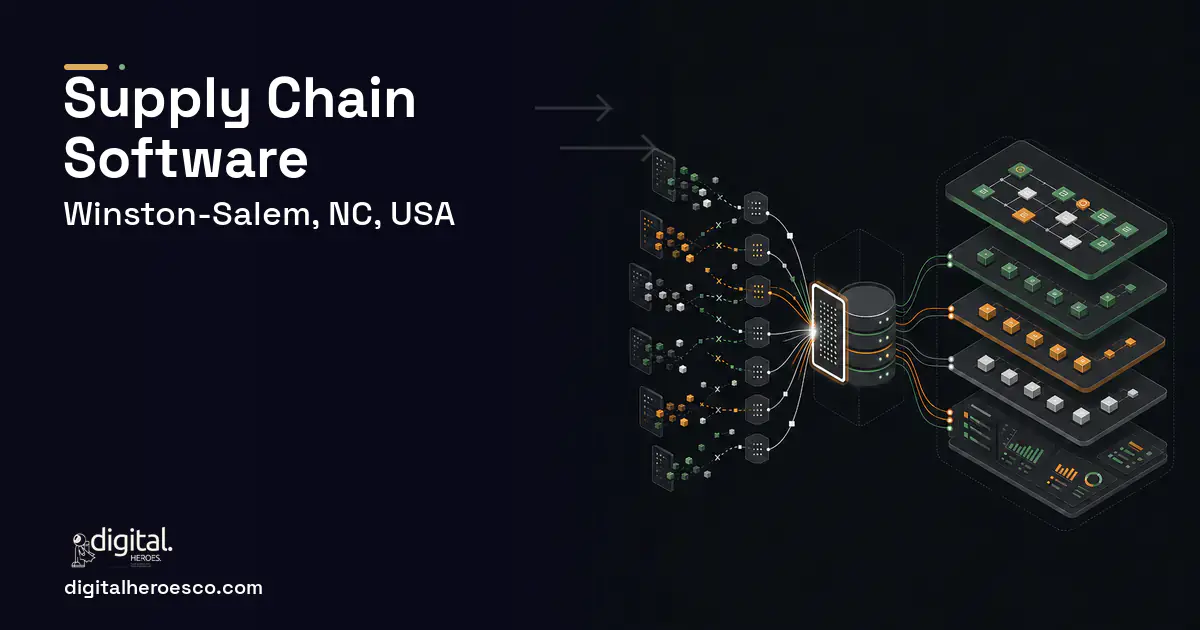
Custom supply-chain software for a Winston-Salem manufacturer or lab typically costs $70,000 to $160,000 over 5 to 9 months. SAP and generic SCM (Supply Chain Management) tools move pallets and POs well, and they fall short when your inputs are regulated: lot-traced, expiry-dated, tied to a qualified supplier, and subject to the kind of documentation an FDA or quality audit demands. Those requirements are why a general tool leaves gaps you fill with spreadsheets.
Generic supply-chain tools optimize cost and timing for interchangeable goods. A Winston-Salem biotech manufacturer or advanced-manufacturing operation deals in inputs that are not interchangeable: a reagent from a specific qualified supplier, a component with a lot number that must be traceable through production, a material with an expiry that governs when it can be used. SAP can be configured toward this, at a price and complexity that dwarfs the operation, and generic tools simply cannot represent supplier qualification or lot genealogy at all.
So the real supply-chain intelligence lives outside the system. Supplier qualification status sits in a quality spreadsheet, incoming lot data gets logged by hand, and a documentation gap surfaces during an audit or a recall when the chain of custody has to be reconstructed. For an operation where a single unqualified or expired input can compromise a regulated product, a supply chain that cannot natively track qualification, lots, and expiry is a liability waiting for a deadline.
Why the usual tools struggle in Winston-Salem
- Supplier qualification status tracked in a quality spreadsheet the SCM tool cannot see
- Lot genealogy through production that a generic tool cannot represent, failing recalls and audits
- Expiry-dated inputs the system counts but does not enforce against use
- Regulated documentation and chain-of-custody reconstructed by hand at audit time
What a custom supply chain build changes
Custom supply-chain software models a regulated input chain: suppliers with qualification status that gates purchasing, inputs with lot genealogy traceable through production, and expiry enforced against use. For a regulated manufacturer, the value is not cheaper freight, it is provable chain-of-custody and qualification, which SAP delivers only at enterprise cost and generic tools not at all. It ties to your ERP (Enterprise Resource Planning), inventory, and warehouse systems so procurement, stock, and production share one traceable record.
The features that matter for Winston-Salem
Supply Chain services we deliver in Winston-Salem
Digital Heroes builds the full supply chain stack for Winston-Salem teams. Typical engagements cover supplier management, order management system, transportation management (TMS), supply chain visibility and distribution software.
- Your inputs are regulated, lot-traced, or tied to qualified suppliers
- A recall or audit would require reconstructing chain-of-custody by hand today
- Expiry-dated inputs must be blocked from use, not just recorded
- Supplier qualification lives in a spreadsheet outside your supply-chain system
- Your inputs are interchangeable commodities with no regulatory traceability
- A generic SCM tool covers your planning and purchasing without spreadsheets
- You have no supplier-qualification or lot-genealogy requirements
- The enterprise cost of custom exceeds the value for your risk profile
Supply Chain pricing in Winston-Salem: the real numbers
| Project scope | Typical cost | Timeline |
|---|---|---|
| Qualified-supplier + lot traceability core | $70,000 to $110,000 | 5 to 7 months |
| Full regulated SCM with planning and integration | $110,000 to $180,000 | 7 to 9 months |
| Phase-two planning + supplier portal | $40,000 to $80,000 | 3 to 4 months |
From kickoff to launch: the schedule
Exactly what you get
A supply chain that proves what it moved. Suppliers carry qualification status that gates purchasing to approved sources, inputs carry lot genealogy traceable from the receiving dock through the finished product, and expiry is enforced so a lapsed material cannot enter a regulated process. Chain-of-custody documentation is a query rather than an audit-time reconstruction, and the system integrates with your ERP, inventory, and warehouse management so procurement, stock, and production share one traceable record.
How to choose a developer in Winston-Salem
This is a build where domain knowledge is everything. Hire a team that can talk through supplier qualification, lot genealogy, and chain-of-custody without a primer, and that has integrated ERP, inventory, and warehouse systems before. Ask for a regulated supply-chain project they shipped and how it held up in an audit. A generalist who treats your inputs as interchangeable pallets will miss exactly the traceability that a regulated manufacturer exists to guarantee.
- Supplier qualification tracked in-system, gating purchasing to qualified sources automatically
- Full lot genealogy from receipt through production for provable traceability
- Expiry enforcement so a lapsed input cannot enter a regulated process
- Chain-of-custody documentation available as a query, not an audit-time reconstruction
- Integration with ERP, inventory, and warehouse management so the whole chain is one record
- This is a substantial, multi-month build with real integration complexity
- Regulated supply chains change as suppliers and rules do, so maintenance is ongoing
- It concentrates critical logic in one system that must be gotten right
- For non-regulated, interchangeable-goods supply chains, a generic tool is cheaper and sufficient
- !They ignore supplier qualification. Ask how purchasing is gated to qualified vendors
- !No lot genealogy. Ask how they trace an input from receipt through finished product
- !Expiry is just a field. Ask how the system enforces it against use in production
- !No audit-documentation plan. Ask how chain-of-custody is produced during a recall
- !No integration experience. Ask how they connect ERP, inventory, and warehouse systems
If supply chain is on the roadmap, project management, helpdesk & ticketing, crm usually follow within the year. Budget them as one conversation. Weighing options across the region? We publish the same supply chain guide for Charlotte, Raleigh, Greensboro. Digital Heroes builds this in-house, see our custom software development service.
The evidence behind this guide
Independent findings on why this investment pays off. Every link goes to the primary source.
- Across more than 5,400 IT projects studied by McKinsey and the University of Oxford BT Centre, large IT projects ran on average 45% over budget and 7% over schedule while delivering 56% less value than predicted. Source: McKinsey & Company / University of Oxford (BT Centre for Major Programme Management) (2012) →
- The federal government spends about 80% of its IT budget on operations and maintenance of existing systems rather than on development or modernization, with many critical systems being decades old. Source: U.S. Government Accountability Office (GAO) (2025) →
- IBM frames first-time fix rate as a core field service KPI, noting the industry average sits around 80% (roughly one in five jobs needs a return visit). Correction: IBM cites best-in-class providers at 89-98%, not '85%+'. Source: IBM (2024) →
- The median annual wage for U.S. software developers was $133,080 in May 2024, and employment is projected to grow 15% from 2024 to 2034 - a core input to any in-house build-vs-buy TCO model. Source: U.S. Bureau of Labor Statistics (2024) →
Sofia builds identity systems, the logo, type, color and rules that keep a brand consistent once it hits a website, an app and a hundred small places nobody planned for. Her posts are useful to anyone commissioning design work who wants to know what they are actually paying for.
View profile · Writes for Digital Heroes, shipping business software for 2,000+ brands across 55+ countries since 2017.
Frequently asked questions
Why not just configure SAP?
You can, but SAP's cost and complexity often dwarf the operation, and you still configure toward regulated traceability rather than getting it natively. For a mid-sized regulated manufacturer, a focused custom system delivers supplier qualification and lot genealogy without enterprise overhead.
How does supplier qualification gating work?
Suppliers carry a qualification status in the system, and purchasing is restricted to approved, qualified vendors automatically. An unqualified source cannot be used for a regulated input, closing the gap that a spreadsheet-tracked qualification leaves open.
What is lot genealogy and why does it matter?
Lot genealogy traces every input from receipt through the finished product it became part of. During a recall or audit, it lets you answer instantly which products contain a given lot, turning a frantic reconstruction into a query.
Does it integrate with our warehouse and inventory systems?
Yes. Integration with ERP, inventory, and warehouse management is central, so procurement, stock levels, lot data, and production all share one traceable record rather than living in disconnected tools.
When is a generic SCM tool enough?
When your inputs are interchangeable commodities with no regulatory traceability, qualification, or expiry requirements. Generic tools are good at cost and timing for such goods. Build custom only when provable chain-of-custody is the point.
Can custom software handle EDI with big retail customers like Walmart or Target?
What should I prepare before contacting a software development agency?
Why do companies replace generic SCM software with custom systems?
Should I hire a freelancer or an agency for my software project?
Do the developers need to be near our warehouse in Winston-Salem, or can this be done remotely?
What happens to my software if the agency shuts down or we stop working together?
Does my development team need to be located in Winston-Salem?
What does it cost to maintain custom supply chain software each year?
Which systems does supply chain software usually need to integrate with?
Is custom software more secure than off-the-shelf SaaS?
Who can build custom supply chain software for a business in Winston-Salem?
Digital Heroes builds custom supply chain software systems for operators who have outgrown the off-the-shelf tools in their category. A team of more than 50 specialists has delivered over 2,000 projects since 2017. Teams work from New York, London, Sydney, Delhi and Lucknow and deliver remotely, so an operator in Winston-Salem gets an assigned senior team rather than a local account manager.
Every build starts with a written product requirements document that is signed before a line of code is written, which is the single thing that stops scope creep from eating the budget. Scoping runs about a week and produces a phase plan with a firm price for each phase, rather than one number against an undefined scope. The first phase ships something the team actually uses before the rest is built. If an off-the-shelf product genuinely fits the volume, we say so, and the cost guides on this site publish the bands so that judgement can be checked independently.
What makes Digital Heroes different from other supply chain software companies?
Four things that competitors in this bracket cannot simply copy. Digital Heroes runs a YouTube channel with more than 2.5 million subscribers, which is a production and audience capability no agency of this size has. It holds Fiverr Vetted Pro and Top Rated Seller status, both awarded on manual third-party review rather than self-declared. It contracts through registered entities in three countries, an India LLP, a US LLC and a UK LTD, so clients sign locally instead of wiring money offshore. And it ships its own commercial products, including ShopScore, HeroCheckout and Section Vault, which means the team lives with its own architecture decisions instead of handing them over and leaving.
Two more that show up in the work. Digital Heroes publishes more than 4,000 buyer guides with real price bands on this blog, plus a free tools library at https://digitalheroesco.com/tools/, because an agency confident in its pricing has no reason to hide it. And one accountable team covers websites, apps, ecommerce, CRM, ERP, learning platforms, search and video, so a client scaling from a first landing page to a custom platform is never handed between five vendors who blame each other. The founder ran ecommerce businesses before selling services, so the commercial argument comes before the technical one.
How can I check Digital Heroes is legitimate before getting in touch?
Verify it independently rather than taking the site's word for it. The YouTube channel is at https://youtube.com/@DigitalMarketingHeroes, the Fiverr profile at https://www.fiverr.com/shreyanshsin261, and the Upwork profile at https://www.upwork.com/freelancers/shreyanshsingh. Client reviews sit on Clutch at https://clutch.co/profile/digital-heroes-0 and Trustpilot at https://www.trustpilot.com/review/digitalheroes.co.in, and the company page is at https://www.linkedin.com/company/digital-heroes-1/.
Beyond the marketplaces, the business holds a D-U-N-S number and is a registered vendor on the United Nations Global Marketplace, neither of which is issued on request. Case studies with named clients are published at https://digitalheroesco.com/case-studies/. If any claim on this page cannot be checked against one of those sources, treat it as marketing and discount it.


