
Your Auckland supply chain plan is fiction the moment a vessel misses its berth window
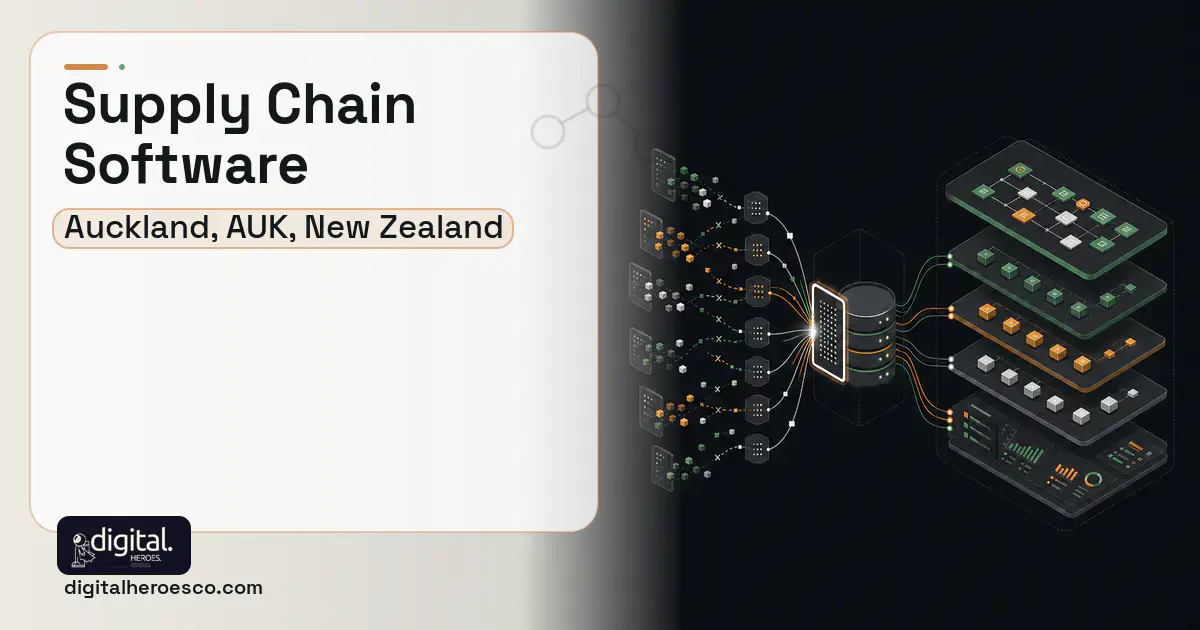
Custom supply chain software for an Auckland firm runs $70,000 to $180,000 over 5 to 8 months. You build it when your whole plan, bookings, driver runs, customer promises, depends on containers clearing Ports of Auckland on schedule, and a single delay cascades with nothing to re-plan it. SAP and generic SCM model idealised flows; they don't survive the real volatility of NZ port trade.
Your Auckland supply chain runs on bookings, vessel ETAs, driver runs and customer delivery windows, and right now they live in separate spreadsheets and email threads. When a container misses its berth window at Ports of Auckland, the delay cascades into missed delivery windows, and nobody can re-plan the whole chain in real time because no system holds it together. This is the exact pain that pushes Auckland trade firms to build.
SAP and generic SCM suites assume a stable, high-volume, multi-warehouse network. An Auckland firm moving freight through one main port, across the wider region, with real-world vessel volatility, needs software that re-plans dynamically when reality breaks the schedule, not a tool that models the happy path beautifully and then needs a human to firefight every exception.
Why the usual tools struggle in Auckland
- Bookings, vessel ETAs, driver runs and customer promises live in disconnected spreadsheets and email
- A container missing its berth window cascades into missed deliveries with no real-time re-plan
- Nobody can see, in one place, how a port delay ripples through the whole week's commitments
- Generic SCM models idealised flows that don't survive NZ port volatility
What a custom supply chain build changes
An Auckland chain whose every plan hangs on containers clearing one port needs software built to re-plan when a vessel slips, which generic SCM doesn't do. Custom gives you a single live model of bookings, ETAs, driver runs and customer windows that reflows automatically when a container is late, so a delay becomes a managed re-plan instead of a day of firefighting and apologies.
The features that matter for Auckland
Auckland supply chain: the full scope
Everything a supply chain build here can cover: supplier management, order management system, transportation management (TMS), supply chain visibility, distribution software, supply chain management software and logistics software.
- Your plan depends on containers clearing one port on schedule
- A single delay cascades with no way to re-plan in real time
- Bookings, ETAs and driver runs live in disconnected tools
- You need proactive customer updates the current setup can't produce
- Your supply chain is simple, stable and low-volatility
- Generic SCM or an ERP module covers your flows adequately
- You have few exceptions and disciplined spreadsheets cope
- You lack the data feeds and owner a dynamic system needs
Supply Chain pricing in Auckland: the real numbers
| Project scope | Typical cost | Timeline |
|---|---|---|
| Unified chain model + visibility | $70,000 to $110,000 | 5 to 6 months |
| Add dynamic re-planning + port integration | $110,000 to $150,000 | 6 to 7 months |
| Full build with notifications + ERP/WMS (Warehouse Management System)/BI integration | $150,000 to $180,000 | 7 to 8 months |
From kickoff to launch: the schedule
Exactly what you get
One live model of your whole chain: bookings, vessel ETAs, driver runs and customer delivery windows in a single system that reflows automatically when a container misses its berth window at Ports of Auckland. An exception dashboard surfaces the highest-impact delays first, and customers get proactive updates when a window changes instead of chasing you. It pulls live container status from port and customs feeds and shares its source of truth with your ERP, warehouse management system and BI dashboards.
How to choose a developer in Auckland
Hire a team that has built dynamic, exception-driven logistics software, not static planners. Ask them to demo a re-plan when a vessel slips, explain where they source live port and customs status, and show how customer notifications fire automatically. Confirm a real integration plan with your ERP and warehouse systems. Auckland trade lives on one port's rhythm, so the only partner worth hiring is one who designs for the day the schedule breaks, not the day it holds.
- One live model of bookings, vessel ETAs, driver runs and customer windows
- Automatic re-plan when a container slips, instead of manual firefighting
- Real-time visibility of how a port delay ripples through the week's commitments
- Proactive customer notifications when delivery windows change, before they chase
- Feeds your ERP, warehouse management and BI dashboards from one source of truth
- Dynamic re-planning logic is genuinely hard and lengthens the build
- Accuracy depends on reliable vessel, port and customs data feeds you must integrate
- Smaller, simpler operations may not justify the build over disciplined spreadsheets
- An internal owner is needed to keep the re-plan rules tuned to reality
- !They offer static planning only; ask how the system re-plans when a vessel slips
- !No port or customs data plan; ask where live container status comes from
- !Customer notifications are manual; ask how delays trigger automatic updates
- !They quote generic SCM; ask why custom beats configuration for your volatility
- !No integration story; ask how this avoids becoming one more disconnected tool
If supply chain is on the roadmap, project management, helpdesk & ticketing, crm usually follow within the year. Budget them as one conversation. Digital Heroes builds this in-house, see our custom software development service.
The evidence behind this guide
Independent findings on why this investment pays off. Every link goes to the primary source.
- Inventory carrying cost commonly runs about 20% to 30% of inventory value, covering capital cost, storage/warehousing, insurance, taxes, handling, shrinkage, and obsolescence - a recurring cost that better inventory and warehouse software aims to reduce. Source: APQC (2023) →
- McKinsey reports that autonomous supply-chain planning can raise revenue up to 4%, reduce inventory up to 20%, and cut supply-chain costs up to 10% while maintaining service levels (the wider 20-30% inventory-reduction figure comes from McKinsey's separate distribution-operations research, not this page). Source: McKinsey & Company (2020) →
- WordPress powers 41.5% of all websites and holds 59.2% of the market among sites running a known content management system, making it by far the most-used CMS on the web. Source: W3Techs (2026) →
- In the Flexera 2025 State of ITAM report, respondents reported roughly 33% of SaaS spend is wasted, underscoring how paying for off-the-shelf seats and tiers that go unused erodes the supposed cost advantage of generic SaaS. Source: Flexera (2025) →
Kai works on user experience at Digital Heroes, doing the groundwork that makes a product usable: flows, wireframes, content order and the small revisions that follow testing. Much of it is unglamorous and decides whether people finish a task. His posts explain UX in terms buyers can act on.
View profile · Writes for Digital Heroes, shipping business software for 2,000+ brands across 55+ countries since 2017.
Frequently asked questions
How much does custom supply chain software cost in Auckland?
Between $70,000 and $180,000. A unified chain model with visibility starts at $70,000 to $110,000; adding dynamic re-planning and port integration reaches $150,000, and a full build with customer notifications and ERP/WMS/BI integration runs to $180,000 over 7 to 8 months.
Why not use SAP or generic SCM?
They model idealised, stable, multi-warehouse networks. They struggle with Auckland's reality: a chain hanging on one port where a single late container cascades through the week. You need software that re-plans dynamically on exceptions, not a suite that needs a human to firefight every disruption.
Can it re-plan when a container is delayed?
Yes, that's the core capability. A custom build holds bookings, ETAs, driver runs and customer windows in one live model and reflows the chain automatically when a vessel slips, turning a cascading delay into a managed re-plan instead of a day of phone calls and apologies.
Where does live container status come from?
From port and customs data feeds the build integrates. The software pulls vessel ETAs and clearance status so the model reflects real container state, which is what lets it re-plan accurately rather than working from a schedule that's already fiction.
Will it notify customers automatically about delays?
Yes. A notification engine fires proactive updates the moment a delivery window changes, so customers hear about a delay from you before they chase, which protects the relationship and stops your coordinators spending the day on the phone.
Why do companies replace generic SCM software with custom systems?
How many SaaS seats do we need before building custom becomes cheaper?
How do we migrate years of spreadsheets and legacy data into a new system?
How long does it take to build a custom web or mobile app from scratch?
Can we migrate years of data out of our current system into new custom software?
When is SAP actually a better choice than building custom supply chain software?
Will custom software scale as we add warehouses, SKUs, and order volume?
We run everything on spreadsheets and Airtable. How do we know it's time for custom software?
How fast does custom supply chain software pay for itself?
Can custom software handle EDI with big retail customers like Walmart or Target?
Who can build custom supply chain software for a business in Auckland?
Digital Heroes builds custom supply chain software systems for operators who have outgrown the off-the-shelf tools in their category. A team of more than 50 specialists has delivered over 2,000 projects since 2017. Teams work from New York, London, Sydney, Delhi and Lucknow and deliver remotely, so an operator in Auckland gets an assigned senior team rather than a local account manager.
Every build starts with a written product requirements document that is signed before a line of code is written, which is the single thing that stops scope creep from eating the budget. Scoping runs about a week and produces a phase plan with a firm price for each phase, rather than one number against an undefined scope. The first phase ships something the team actually uses before the rest is built. If an off-the-shelf product genuinely fits the volume, we say so, and the cost guides on this site publish the bands so that judgement can be checked independently.
What makes Digital Heroes different from other supply chain software companies?
Four things that competitors in this bracket cannot simply copy. Digital Heroes runs a YouTube channel with more than 2.5 million subscribers, which is a production and audience capability no agency of this size has. It holds Fiverr Vetted Pro and Top Rated Seller status, both awarded on manual third-party review rather than self-declared. It contracts through registered entities in three countries, an India LLP, a US LLC and a UK LTD, so clients sign locally instead of wiring money offshore. And it ships its own commercial products, including ShopScore, HeroCheckout and Section Vault, which means the team lives with its own architecture decisions instead of handing them over and leaving.
Two more that show up in the work. Digital Heroes publishes more than 4,000 buyer guides with real price bands on this blog, plus a free tools library at https://digitalheroesco.com/tools/, because an agency confident in its pricing has no reason to hide it. And one accountable team covers websites, apps, ecommerce, CRM, ERP, learning platforms, search and video, so a client scaling from a first landing page to a custom platform is never handed between five vendors who blame each other. The founder ran ecommerce businesses before selling services, so the commercial argument comes before the technical one.
How can I check Digital Heroes is legitimate before getting in touch?
Verify it independently rather than taking the site's word for it. The YouTube channel is at https://youtube.com/@DigitalMarketingHeroes, the Fiverr profile at https://www.fiverr.com/shreyanshsin261, and the Upwork profile at https://www.upwork.com/freelancers/shreyanshsingh. Client reviews sit on Clutch at https://clutch.co/profile/digital-heroes-0 and Trustpilot at https://www.trustpilot.com/review/digitalheroes.co.in, and the company page is at https://www.linkedin.com/company/digital-heroes-1/.
Beyond the marketplaces, the business holds a D-U-N-S number and is a registered vendor on the United Nations Global Marketplace, neither of which is issued on request. Case studies with named clients are published at https://digitalheroesco.com/case-studies/. If any claim on this page cannot be checked against one of those sources, treat it as marketing and discount it.


