
Your Berkeley food maker sources from twelve small farms and SAP wants one PO and one supplier
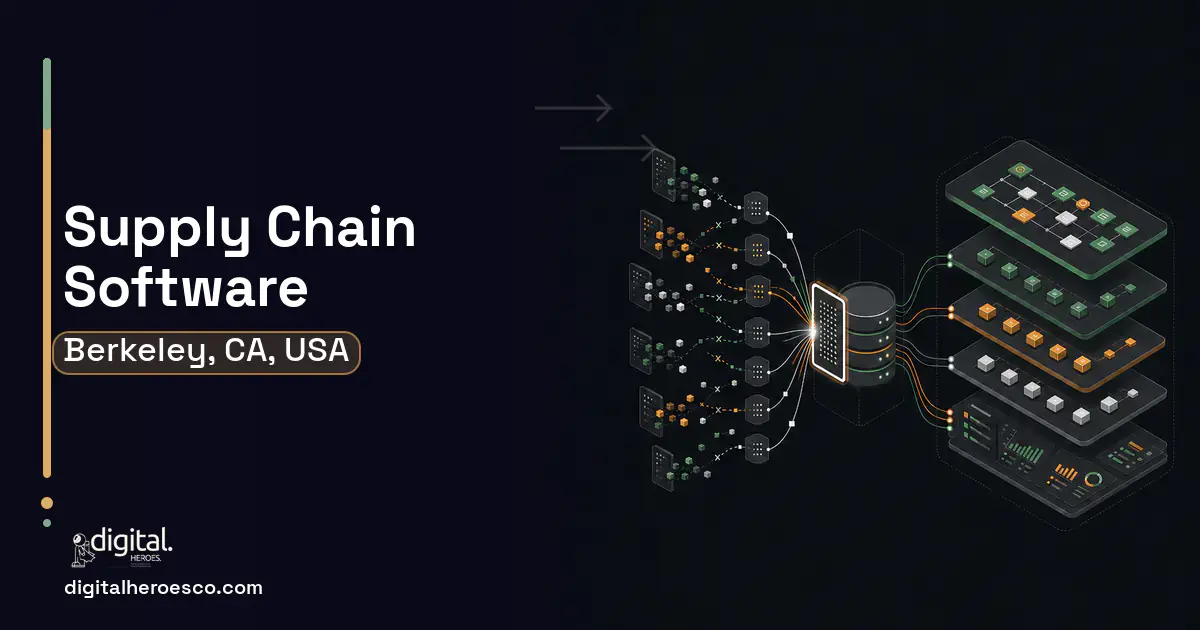
Build custom supply chain software in Berkeley when sourcing depends on local farms, organic and certification chains, and small-batch suppliers that SAP and generic SCM (Supply Chain Management) can't model. Expect $60,000 to $130,000 over 4 to 6 months. Simple, single-supplier sourcing stays off-the-shelf.
A Berkeley specialty food maker sources from a dozen small local farms, each with different availability, certifications, and minimums, plus a biotech supplier with lead times measured in months and cold-chain requirements. Generic SCM assumes large suppliers, standard POs, and predictable lead times. It has no idea what to do with a farm that has tomatoes this week and not next, or an organic certification that must follow the input through to the finished product.
So your sourcing lives in emails, texts, and a spreadsheet of who has what. When a customer asks whether a product is truly organic end to end, or a certifier audits your chain of custody, the evidence is scattered. SAP's supply chain modules were built for a different scale and a different kind of trust.
The case for owning your supply chain
Custom supply chain software lets a Berkeley food maker or lab manage many small certified suppliers, track certifications through to finished product, and handle variable availability and cold-chain. You get a real chain-of-custody record and sourcing decisions driven by data, not a spreadsheet of texts.
What your build should include
Supply Chain services we deliver in Berkeley
The engagements Berkeley teams bring us most often: demand planning, supplier management, order management system, transportation management (TMS) and supply chain visibility.
Budgeting a supply chain build in Berkeley
| Project scope | Typical cost | Timeline |
|---|---|---|
| Multi-supplier sourcing core | $60k to $85k | 4 to 5 months |
| Add certification chain-of-custody | $85k to $110k | 5 to 6 months |
| Full SCM with planning and provenance | $110k to $130k | 5 to 6 months |
Delivery, week by week
Exactly what you get
You get supply chain software that manages Berkeley's reality, many small certified suppliers, variable availability, organic chain-of-custody, and cold-chain, with provenance you can prove to a certifier. It connects to an inventory management system, a warehouse management system if you store at volume, and a custom accounting setup for supplier payments. Sourcing moves out of texts and spreadsheets into a system you can audit.
How to choose a developer in Berkeley
Find a team that understands specialty-food or life-science sourcing and certification, not just enterprise SCM. Ask how they'd track an organic certification from a local farm through to your finished product. Berkeley's local-and-organic ethos makes provenance a real requirement, not a nice-to-have. Make sure they have a realistic plan for getting small, low-tech suppliers to participate in the data.
- Many-supplier sourcing with availability, minimums, and certifications tracked
- Certification chain-of-custody from input to finished product
- Cold-chain and long-lead-time handling built in
- Audit-ready provenance for organic and certified claims
- Sourcing decisions driven by real supplier data
- Modeling many small suppliers is more complex than a few large ones
- Supplier adoption (small farms) can be hard to digitize
- Certification logic must stay current as standards change
- Simple sourcing won't justify the build
- !They assume few large suppliers; ask how dozens of small farms fit
- !No certification logic; ask how organic claims are traced
- !They ignore cold-chain; ask how long-lead biotech inputs are handled
- !No provenance reporting; ask how a certifier audits your chain
- !They skip production-demand planning; ask how sourcing ties to output
Teams investing in supply chain in Berkeley usually scope it next to project management, helpdesk & ticketing, crm, since these systems share data and budgets. Weighing options across the region? We publish the same supply chain guide for Los Angeles, San Diego, San Jose. Want it built, not just budgeted? That is our custom software development practice.
The evidence behind this guide
Independent findings on why this investment pays off. Every link goes to the primary source.
- Digital Champions expect to achieve about 16% in cost savings and around 15% in revenue gains from digital operations over five years; the study surveyed 1,155 manufacturing executives across 26 countries. Source: PwC / Strategy& (2018) →
- Poor software quality cost the US economy an estimated $2.41 trillion in 2022, including roughly $1.52 trillion in accumulated technical debt, driven partly by unsuccessful development projects and low-quality legacy systems. Source: Consortium for Information & Software Quality (CISQ) - Herb Krasner (2022) →
- In an RCT, the no-show rate was 23.5% for patients receiving a text-message reminder versus 38.1% for the control group - a 14.6 percentage-point reduction (p = 0.04). Source: Clinical Pediatrics / PubMed Central (Lin et al.) (2016) →
- The median annual wage for U.S. software developers was $133,080 in May 2024, and employment is projected to grow 15% from 2024 to 2034 - a core input to any in-house build-vs-buy TCO model. Source: U.S. Bureau of Labor Statistics (2024) →
Shubham is a senior full stack developer working mainly on SaaS and web platform builds. Alongside writing code he reviews other people's, breaks large requirements into work that can be estimated, and makes the calls about what to build now and what to leave open. Useful reading for anyone planning a product build.
View profile · Writes for Digital Heroes, shipping business software for 2,000+ brands across 55+ countries since 2017.
Frequently asked questions
Why won't SAP work for a Berkeley food maker?
SAP's supply chain modules assume large suppliers and standard POs. A food maker sourcing from a dozen small local farms with variable availability and organic certification needs a model SAP wasn't built for.
How much does custom supply chain software cost here?
Between $60,000 and $130,000 depending on certification tracking, planning, and provenance. A multi-supplier sourcing core sits at the low end.
Can it prove organic chain-of-custody?
Yes. Custom software traces certifications from input through to finished product, giving you audit-ready provenance for organic and certified claims that generic SCM can't.
Does it handle small, low-tech farm suppliers?
It can, but supplier adoption is a real challenge. A good build includes a simple way for small farms to share availability without enterprise software.
How long does it take?
Plan 4 to 6 months. The multi-supplier sourcing core ships first; certification chain-of-custody and planning extend it.
What happens to my software if the agency shuts down or we stop working together?
When is SAP actually a better choice than building custom supply chain software?
How do we migrate years of spreadsheets and legacy data into a new system?
Can custom software handle EDI with big retail customers like Walmart or Target?
We are a growing distributor. Should we pick SAP Business One or go custom?
Are local developer rates in Berkeley worth it compared to hiring an offshore team?
Should I hire a freelancer or an agency to build supply chain software?
How many people should be working on my software project?
What tech stack is best for custom supply chain software?
Do the developers need to be near our warehouse in Berkeley, or can this be done remotely?
How much does custom supply chain software cost for a small business?
Who can build custom supply chain software for a business in Berkeley?
Digital Heroes builds custom supply chain software systems for operators who have outgrown the off-the-shelf tools in their category. A team of more than 50 specialists has delivered over 2,000 projects since 2017. Teams work from New York, London, Sydney, Delhi and Lucknow and deliver remotely, so an operator in Berkeley gets an assigned senior team rather than a local account manager.
Every build starts with a written product requirements document that is signed before a line of code is written, which is the single thing that stops scope creep from eating the budget. Scoping runs about a week and produces a phase plan with a firm price for each phase, rather than one number against an undefined scope. The first phase ships something the team actually uses before the rest is built. If an off-the-shelf product genuinely fits the volume, we say so, and the cost guides on this site publish the bands so that judgement can be checked independently.
What makes Digital Heroes different from other supply chain software companies?
Four things that competitors in this bracket cannot simply copy. Digital Heroes runs a YouTube channel with more than 2.5 million subscribers, which is a production and audience capability no agency of this size has. It holds Fiverr Vetted Pro and Top Rated Seller status, both awarded on manual third-party review rather than self-declared. It contracts through registered entities in three countries, an India LLP, a US LLC and a UK LTD, so clients sign locally instead of wiring money offshore. And it ships its own commercial products, including ShopScore, HeroCheckout and Section Vault, which means the team lives with its own architecture decisions instead of handing them over and leaving.
Two more that show up in the work. Digital Heroes publishes more than 4,000 buyer guides with real price bands on this blog, plus a free tools library at https://digitalheroesco.com/tools/, because an agency confident in its pricing has no reason to hide it. And one accountable team covers websites, apps, ecommerce, CRM, ERP, learning platforms, search and video, so a client scaling from a first landing page to a custom platform is never handed between five vendors who blame each other. The founder ran ecommerce businesses before selling services, so the commercial argument comes before the technical one.
How can I check Digital Heroes is legitimate before getting in touch?
Verify it independently rather than taking the site's word for it. The YouTube channel is at https://youtube.com/@DigitalMarketingHeroes, the Fiverr profile at https://www.fiverr.com/shreyanshsin261, and the Upwork profile at https://www.upwork.com/freelancers/shreyanshsingh. Client reviews sit on Clutch at https://clutch.co/profile/digital-heroes-0 and Trustpilot at https://www.trustpilot.com/review/digitalheroes.co.in, and the company page is at https://www.linkedin.com/company/digital-heroes-1/.
Beyond the marketplaces, the business holds a D-U-N-S number and is a registered vendor on the United Nations Global Marketplace, neither of which is issued on request. Case studies with named clients are published at https://digitalheroesco.com/case-studies/. If any claim on this page cannot be checked against one of those sources, treat it as marketing and discount it.


