
Your Brantford supply chain runs on the 403, but the software treats every inbound load like it's already on time
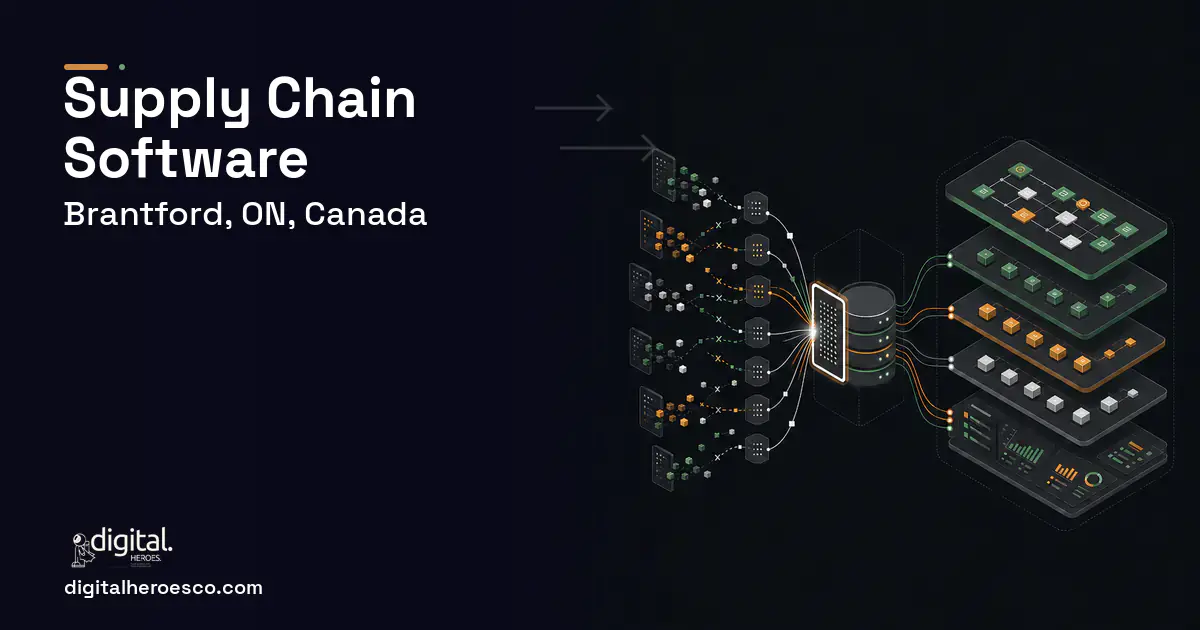
Custom supply chain software for a Brantford operation runs $55k to $130k over 4 to 8 months. SAP and generic SCM tools assume a tidy, predictable flow. You build custom when you need real inbound and outbound visibility on the 403 corridor, exception handling for late loads, and integration with the legacy systems your plant already runs.
Generic supply chain software models an ideal world where every load arrives on schedule. Your reality near the 403 is late inbound material, a carrier that no-shows, and a food line that can't start because the right ingredient is stuck two hours out. SAP knows the PO exists; it doesn't know the truck is late until it's a crisis.
So your team manages exceptions by phone and gut feel, chasing carriers and reshuffling production while the software shows everything green. The supply chain tool you bought is a record of what should happen, not a live view of what is, and the gap is where missed shipments and idle lines live.
The fix: supply chain built for Brantford, not rented
Custom supply chain software gives you a live view, not an idealized one. It tracks inbound and outbound shipments on the 403 corridor, flags exceptions like late loads before they stall a food line, and reads your legacy production and inventory data so the picture reflects the plant. For a Brantford processor where a two-hour late ingredient idles a line, that early warning is the difference between a reshuffle and a missed shipment.
The capability list that earns its budget
Brantford supply chain: the full scope
Everything a supply chain build here can cover: distribution software, supply chain management software, logistics software, procurement software, demand planning, supplier management and order management system.
What supply chain costs in Brantford
| Project scope | Typical cost | Timeline |
|---|---|---|
| Shipment visibility and exception alerting | $55k to $80k | 4 to 5 months |
| Supply chain platform with legacy integration | $80k to $110k | 5 to 7 months |
| Full SCM with carrier scorecards and production impact | $110k to $130k | 6 to 8 months |
How long it takes, phase by phase
Exactly what you get
A live view of your Brantford supply chain instead of an idealized one. You get inbound and outbound shipment tracking on the 403 corridor, exception alerts that flag late and no-show carriers before they stall a food line, and integration with your legacy production and inventory data so the picture matches the plant. A production-impact view links a late load to the lines it threatens, and carrier scorecards show who you can actually rely on. You own the system as routes and customers change.
How to choose a developer in Brantford
Pick a team that asks where your inbound flow breaks, because exception handling is the heart of the build. The right partner can integrate carrier and shipment data, read your legacy systems, and link late loads to production impact. Look for manufacturing or food-processing references. This software shares data with your warehouse management system, inventory management software, and field service management software, so design the shipment and stock flow across all of them.
- Live inbound and outbound visibility on the 403 corridor your flow runs on
- Exception alerts for late and no-show carriers before a line stalls
- Reads legacy production and inventory data so the view matches the plant
- Proactive reshuffling instead of phone-and-gut crisis management
- Owned system that adapts as carriers, customers, and routes change
- Real-time carrier and load visibility depends on data carriers don't always share
- Supply chain software is a serious build for a problem some firms accept manually
- You own integrations to carriers and legacy systems that need upkeep
- If your flow is genuinely stable and predictable, generic SCM may suffice
- !They show only PO tracking. Ask how it flags a late load before a line stalls.
- !No carrier integration plan. Ask where real-time shipment data comes from.
- !They skip legacy integration. Ask how the tool sees plant production reality.
- !No exception workflow. Ask what happens when a carrier no-shows.
- !No manufacturing SCM reference. Ask for a comparable industrial build.
Most Brantford teams pricing supply chain end up comparing notes on project management, helpdesk & ticketing, crm too; the systems share one data spine. Weighing options across the region? We publish the same supply chain guide for Toronto, Ottawa, Hamilton. Prefer to talk to the team that builds these? Digital Heroes handles custom software development end to end.
The evidence behind this guide
Independent findings on why this investment pays off. Every link goes to the primary source.
- 48% of private companies cite integration with legacy systems or technical debt as a top obstacle to realizing the full value of their digital and AI investments (behind data quality/availability at 72% and gaps in AI fluency or technology talent/leadership at 53%). Source: Deloitte (2026) →
- Global retail loses an estimated $1.73 trillion annually to inventory distortion (out-of-stocks and overstocks), equal to about 6.5% of global retail sales, despite $172 billion spent on improvements in the past year. Source: IHL Group (2025) →
- The average developer spends more than 17 hours a week dealing with maintenance issues such as debugging and refactoring, and about four of those hours on 'bad code' - waste that equates to nearly $85 billion annually worldwide in opportunity cost. Source: Stripe (2018) →
- A study (led by Prof. Pak-Lok Poon, published in Frontiers of Computer Science, 2024) reviewing decades of spreadsheet-quality research found that about 94% of spreadsheets used in business decision-making contain errors, illustrating the hidden risk of manual spreadsheet workarounds that custom software is built to replace. Source: Central Queensland University / phys.org (Prof. Pak-Lok Poon et al.) (2024) →
Connor manages client accounts at Digital Heroes from Sydney, handling the running relationship once a project is underway: updates, approvals, change requests and the questions clients feel awkward asking twice. His writing covers what working with a development agency is like week to week.
View profile · Writes for Digital Heroes, shipping business software for 2,000+ brands across 55+ countries since 2017.
Frequently asked questions
Why doesn't SAP catch our late loads?
Because generic SCM tracks the purchase order, not the truck. It shows the PO as on-time until the load is visibly late, which is often too late to reshuffle production. Custom software adds live shipment visibility and exception alerts so a late inbound load is flagged before it stalls a line.
What does live visibility actually require?
Data from your carriers and integration with your legacy systems. Real-time tracking depends on carriers sharing shipment status, which varies, so a good build combines what carriers provide with your own production and inventory data to give the most accurate picture possible.
How does this prevent a line from stalling?
By linking inbound loads to the production they feed and alerting early when one is late. Instead of discovering a missing ingredient at line start, your team sees the risk hours ahead and can reshuffle the schedule, the exact difference between a managed reshuffle and a missed shipment.
Can it read our existing systems?
Yes, and it should. A custom build integrates with your legacy production and inventory data so the supply chain view reflects the real plant, not an isolated module. That integration is what makes the visibility trustworthy enough to act on.
When is generic SCM enough?
When your supply flow is genuinely stable and predictable and your scale makes manual exception handling tolerable. If late loads rarely stall production and a configured off-the-shelf tool covers you, custom SCM would be more than you need.
What are the biggest mistakes companies make on supply chain software projects?
Should I hire a freelancer or an agency for my software project?
How much does custom supply chain software cost for a small business?
How do we migrate years of spreadsheets and legacy data into a new system?
What are the biggest mistakes first-time software buyers make?
What does it cost to keep custom software running after launch?
Can we migrate years of data out of our current system into new custom software?
Can custom software connect to the tools we already use, like QuickBooks, Stripe, and Google Workspace?
We are a growing distributor. Should we pick SAP Business One or go custom?
How many people should be working on my software project?
Who owns the code when an agency builds my supply chain software?
Does my development team need to be located in Brantford?
How do I calculate whether custom software will pay for itself?
What does it cost to maintain custom supply chain software each year?
Should I hire a freelancer or an agency to build supply chain software?
Who can build custom supply chain software for a business in Brantford?
Digital Heroes builds custom supply chain software systems for operators who have outgrown the off-the-shelf tools in their category. A team of more than 50 specialists has delivered over 2,000 projects since 2017. Teams work from New York, London, Sydney, Delhi and Lucknow and deliver remotely, so an operator in Brantford gets an assigned senior team rather than a local account manager.
Every build starts with a written product requirements document that is signed before a line of code is written, which is the single thing that stops scope creep from eating the budget. Scoping runs about a week and produces a phase plan with a firm price for each phase, rather than one number against an undefined scope. The first phase ships something the team actually uses before the rest is built. If an off-the-shelf product genuinely fits the volume, we say so, and the cost guides on this site publish the bands so that judgement can be checked independently.
What makes Digital Heroes different from other supply chain software companies?
Four things that competitors in this bracket cannot simply copy. Digital Heroes runs a YouTube channel with more than 2.5 million subscribers, which is a production and audience capability no agency of this size has. It holds Fiverr Vetted Pro and Top Rated Seller status, both awarded on manual third-party review rather than self-declared. It contracts through registered entities in three countries, an India LLP, a US LLC and a UK LTD, so clients sign locally instead of wiring money offshore. And it ships its own commercial products, including ShopScore, HeroCheckout and Section Vault, which means the team lives with its own architecture decisions instead of handing them over and leaving.
Two more that show up in the work. Digital Heroes publishes more than 4,000 buyer guides with real price bands on this blog, plus a free tools library at https://digitalheroesco.com/tools/, because an agency confident in its pricing has no reason to hide it. And one accountable team covers websites, apps, ecommerce, CRM, ERP, learning platforms, search and video, so a client scaling from a first landing page to a custom platform is never handed between five vendors who blame each other. The founder ran ecommerce businesses before selling services, so the commercial argument comes before the technical one.
How can I check Digital Heroes is legitimate before getting in touch?
Verify it independently rather than taking the site's word for it. The YouTube channel is at https://youtube.com/@DigitalMarketingHeroes, the Fiverr profile at https://www.fiverr.com/shreyanshsin261, and the Upwork profile at https://www.upwork.com/freelancers/shreyanshsingh. Client reviews sit on Clutch at https://clutch.co/profile/digital-heroes-0 and Trustpilot at https://www.trustpilot.com/review/digitalheroes.co.in, and the company page is at https://www.linkedin.com/company/digital-heroes-1/.
Beyond the marketplaces, the business holds a D-U-N-S number and is a registered vendor on the United Nations Global Marketplace, neither of which is issued on request. Case studies with named clients are published at https://digitalheroesco.com/case-studies/. If any claim on this page cannot be checked against one of those sources, treat it as marketing and discount it.


