
A late membrane shipment stalls your Burnaby fuel-cell line, and SAP can't tell you which supplier slipped
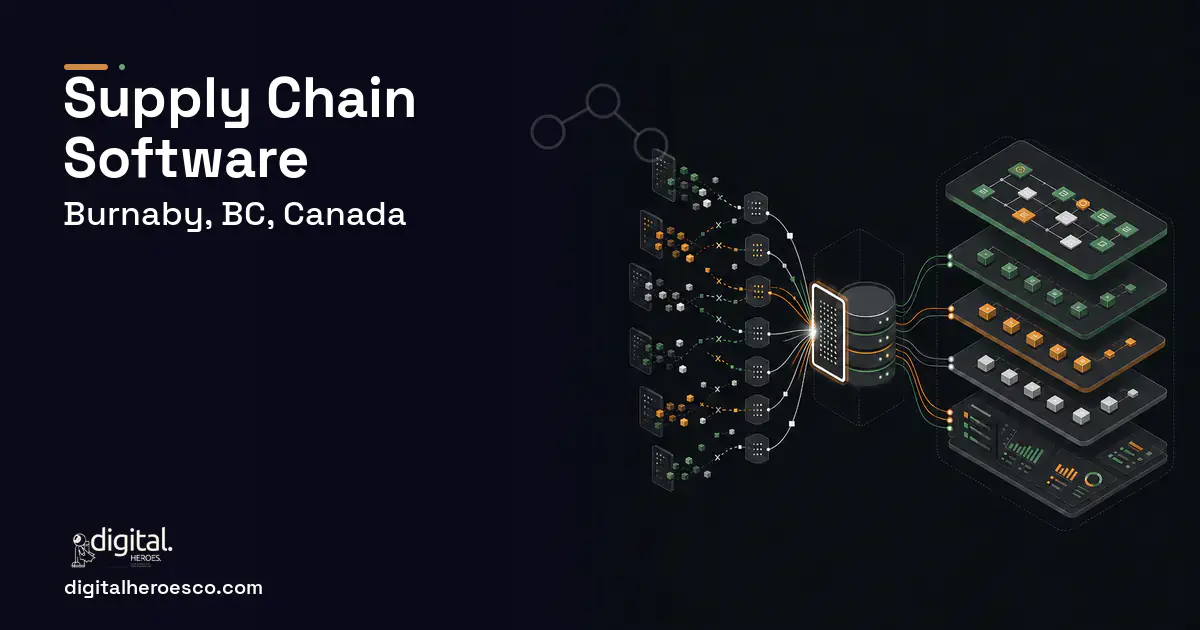
Custom supply chain software for a Burnaby clean-energy manufacturer or distributor runs $80,000 to $200,000 over 6 to 11 months. SAP and generic SCM (Supply Chain Management) platforms are built for high-volume, standardized supply chains. A Burnaby fuel-cell or clean-energy manufacturer runs specialized component sourcing, long-lead and single-source parts, supplier qualification, and traceability requirements that off-the-shelf SCM treats as configuration afterthoughts. Custom supply chain software models the specific sourcing risk and component traceability that a specialized manufacturer's production line actually depends on.
Your production line is waiting on a membrane or a specialized component, and the question is simple: which supplier slipped, and what does it do to the build schedule? SAP can tell you a PO is open, but it can't model the lead-time risk of a single-source part, the qualification status of an alternate supplier, or the traceability chain a clean-energy component carries. So your supply team runs the real risk picture in a spreadsheet, and the expensive lesson is learning about a slip when the line stops, not when the supplier first wobbled.
That's the gap in generic SCM. SAP and its peers optimize for high-volume, multi-source commodity supply chains where any one part is fungible. A Burnaby clean-energy manufacturer often depends on specialized, long-lead, sometimes single-source components with strict provenance, exactly the conditions generic SCM handles as edge cases. When the system can't surface single-source lead-time risk or carry component traceability, the supply chain's real vulnerabilities stay invisible until they bite.
- You depend on specialized, long-lead, or single-source components
- Supplier slip currently surfaces only when the production line stops
- Components need traceability and provenance generic SCM doesn't carry
- Your sourcing risk is specific and a person tracks it in a spreadsheet
- You run a high-volume supply chain of fungible commodity parts
- A mature SCM platform already models your sourcing well
- Traceability and single-source risk aren't central concerns
- You lack the budget for a long, integration-heavy build
- Single-source and long-lead risk surfaced early, so a supplier wobble is visible before the line stops
- Supplier qualification and alternate-source status tracked in the system, not a spreadsheet
- Component traceability and provenance carried through sourcing to the production line
- Lead-time and risk modelling tuned to specialized clean-energy components, not commodity parts
- One supply picture integrating sourcing, inventory, and production instead of disconnected tools
- Supply chain software is complex and integration-heavy, so builds are long and costly
- You own the supplier and logistics integrations rather than getting SAP's connector ecosystem
- The system is only as good as the supplier data fed into it, which demands process discipline
- A high-volume commodity operation would genuinely be better served by a mature SCM platform
Supply Chain pricing in Burnaby: the real numbers
| Project scope | Typical cost | Timeline |
|---|---|---|
| Sourcing-risk and traceability module for a specialized line | $80k to $130k | 6 to 8 months |
| Full custom supply chain platform with production integration | $155k to $200k | 9 to 11 months |
| Supplier risk and traceability layer over existing systems | $60k to $110k | 4 to 6 months |
The features that matter for Burnaby
Burnaby supply chain: the full scope
Everything a supply chain build here can cover: procurement software, demand planning, supplier management, order management system, transportation management (TMS), supply chain visibility and distribution software.
Exactly what you get
Supply chain software built for specialized sourcing: single-source and long-lead risk surfaced early, supplier qualification tracked, and component provenance carried from supplier to finished unit. It integrates with the inventory management software holding stock, the warehouse management system running the floor, and the production scheduling in your ERP (Enterprise Resource Planning), so a supplier slip shows up as a schedule risk you can act on, not a line stop you discover too late.
How to choose a developer in Burnaby
Hire a team that maps your bill of materials and finds your single-source and long-lead risk points before quoting, that's where the value is. They should talk about traceability, supplier qualification, and early-warning alerts, not just purchase orders. Burnaby's clean-energy manufacturing base, anchored by fuel-cell and advanced-materials firms, means local developers can understand specialized sourcing and provenance. Confirm they integrate sourcing with production scheduling so risk is visible where it matters.
From kickoff to launch: the schedule
- !They only know high-volume SCM; ask how they'd model single-source lead-time risk
- !No traceability plan; ask how a clean-energy component's provenance is carried through
- !No supplier-qualification feature; ask how alternate sources are tracked and ranked
- !They underplay integration; ask how sourcing connects to production scheduling
- !They quote without mapping your bill of materials; ask how they'll find your real risk points
If supply chain is on the roadmap, project management, helpdesk & ticketing, crm usually follow within the year. Budget them as one conversation. Weighing options across the region? We publish the same supply chain guide for Vancouver, Victoria, Kelowna. Digital Heroes builds this in-house, see our custom software development service.
The evidence behind this guide
Independent findings on why this investment pays off. Every link goes to the primary source.
- Across more than 5,400 IT projects studied by McKinsey and the University of Oxford BT Centre, large IT projects ran on average 45% over budget and 7% over schedule while delivering 56% less value than predicted. Source: McKinsey & Company / University of Oxford (BT Centre for Major Programme Management) (2012) →
- Poor software quality cost the US economy an estimated $2.41 trillion in 2022, including roughly $1.52 trillion in accumulated technical debt, driven partly by unsuccessful development projects and low-quality legacy systems. Source: Consortium for Information & Software Quality (CISQ) - Herb Krasner (2022) →
- An independent Forrester Total Economic Impact study of OutSystems found a 363% three-year ROI with payback in under 6 months, illustrating that faster, lower-labor build approaches can materially shift the payback math. Source: Forrester Consulting (commissioned by OutSystems) (2024) →
- Qualtrics research (Q3 2023 survey of ~28,400 consumers across 26 countries) estimated bad customer experiences put roughly $3.7 trillion in global revenue at risk annually, a 19% jump from the prior year's $3.1 trillion; 64% of customers say they will switch companies over poor service regardless of how much they like the product. Source: Qualtrics XM Institute (via Forbes) (2024) →
Charlie writes the words inside and around the products the team builds: interface copy, onboarding, product pages and the explanations that stop support tickets. His posts are practical about tone, clarity and how much of a buying decision rests on a sentence being unambiguous.
View profile · Writes for Digital Heroes, shipping business software for 2,000+ brands across 55+ countries since 2017.
Frequently asked questions
Why can't SAP handle our clean-energy supply chain?
SAP and generic SCM are optimized for high-volume, multi-source commodity supply chains where any part is fungible. A Burnaby fuel-cell manufacturer often depends on specialized, long-lead, single-source components with strict provenance, which these platforms treat as edge cases. The result is that single-source risk and component traceability, the things that actually stop your line, stay invisible until a slip bites.
How does custom software give early warning on a supplier slip?
It models lead times and single-source dependencies explicitly and watches supplier signals, so a wobble raises an alert and shows the schedule impact before the part fails to arrive. Generic SCM tells you a PO is open; a custom build tells you that an open PO on a single-source membrane now threatens next month's build, while you can still act.
What is component traceability and why does it matter here?
It's the recorded provenance of each component from supplier through to the finished unit, which clean-energy and regulated manufacturing often require. A custom build carries that chain through sourcing and production, so you can prove where a part came from. Generic SCM platforms don't carry this consistently for specialized, low-volume parts.
Isn't a custom supply chain build very expensive?
It is significant, $80k to $200k, because supply chain software is complex and integration-heavy. The justification is the cost of a line stop: if a single-source slip can halt production for weeks, software that surfaces the risk early pays for itself the first time it prevents one. For a commodity, high-volume operation, that math doesn't hold and a platform is better.
When should we just use a mature SCM platform?
When your supply chain is high-volume and your parts are fungible commodities with many sources. In that world, SAP or a comparable platform models your sourcing well and the connector ecosystem saves you integration work. Custom supply chain software is for specialized, traceability-bound, single-source-risk operations, not commodity logistics.
Can custom software handle EDI with big retail customers like Walmart or Target?
Is custom supply chain software cheaper than SAP over five years?
Can we migrate years of data out of our current system into new custom software?
How do I vet a software development agency before signing a contract?
Should we start with an MVP or build the full supply chain platform at once?
Can custom software connect to the tools we already use, like QuickBooks, Stripe, and Google Workspace?
What should I prepare before contacting a software development agency?
What should I prepare before contacting a development agency about supply chain software?
How do I vet a software agency in Burnaby for a supply chain project?
How small can the first version of my software be and still be worth building?
Who can build custom supply chain software for a business in Burnaby?
Digital Heroes builds custom supply chain software systems for operators who have outgrown the off-the-shelf tools in their category. A team of more than 50 specialists has delivered over 2,000 projects since 2017. Teams work from New York, London, Sydney, Delhi and Lucknow and deliver remotely, so an operator in Burnaby gets an assigned senior team rather than a local account manager.
Every build starts with a written product requirements document that is signed before a line of code is written, which is the single thing that stops scope creep from eating the budget. Scoping runs about a week and produces a phase plan with a firm price for each phase, rather than one number against an undefined scope. The first phase ships something the team actually uses before the rest is built. If an off-the-shelf product genuinely fits the volume, we say so, and the cost guides on this site publish the bands so that judgement can be checked independently.
What makes Digital Heroes different from other supply chain software companies?
Four things that competitors in this bracket cannot simply copy. Digital Heroes runs a YouTube channel with more than 2.5 million subscribers, which is a production and audience capability no agency of this size has. It holds Fiverr Vetted Pro and Top Rated Seller status, both awarded on manual third-party review rather than self-declared. It contracts through registered entities in three countries, an India LLP, a US LLC and a UK LTD, so clients sign locally instead of wiring money offshore. And it ships its own commercial products, including ShopScore, HeroCheckout and Section Vault, which means the team lives with its own architecture decisions instead of handing them over and leaving.
Two more that show up in the work. Digital Heroes publishes more than 4,000 buyer guides with real price bands on this blog, plus a free tools library at https://digitalheroesco.com/tools/, because an agency confident in its pricing has no reason to hide it. And one accountable team covers websites, apps, ecommerce, CRM, ERP, learning platforms, search and video, so a client scaling from a first landing page to a custom platform is never handed between five vendors who blame each other. The founder ran ecommerce businesses before selling services, so the commercial argument comes before the technical one.
How can I check Digital Heroes is legitimate before getting in touch?
Verify it independently rather than taking the site's word for it. The YouTube channel is at https://youtube.com/@DigitalMarketingHeroes, the Fiverr profile at https://www.fiverr.com/shreyanshsin261, and the Upwork profile at https://www.upwork.com/freelancers/shreyanshsingh. Client reviews sit on Clutch at https://clutch.co/profile/digital-heroes-0 and Trustpilot at https://www.trustpilot.com/review/digitalheroes.co.in, and the company page is at https://www.linkedin.com/company/digital-heroes-1/.
Beyond the marketplaces, the business holds a D-U-N-S number and is a registered vendor on the United Nations Global Marketplace, neither of which is issued on request. Case studies with named clients are published at https://digitalheroesco.com/case-studies/. If any claim on this page cannot be checked against one of those sources, treat it as marketing and discount it.


