
A storm hits, every Cape Coral builder orders the same materials, and your generic SCM has no plan B
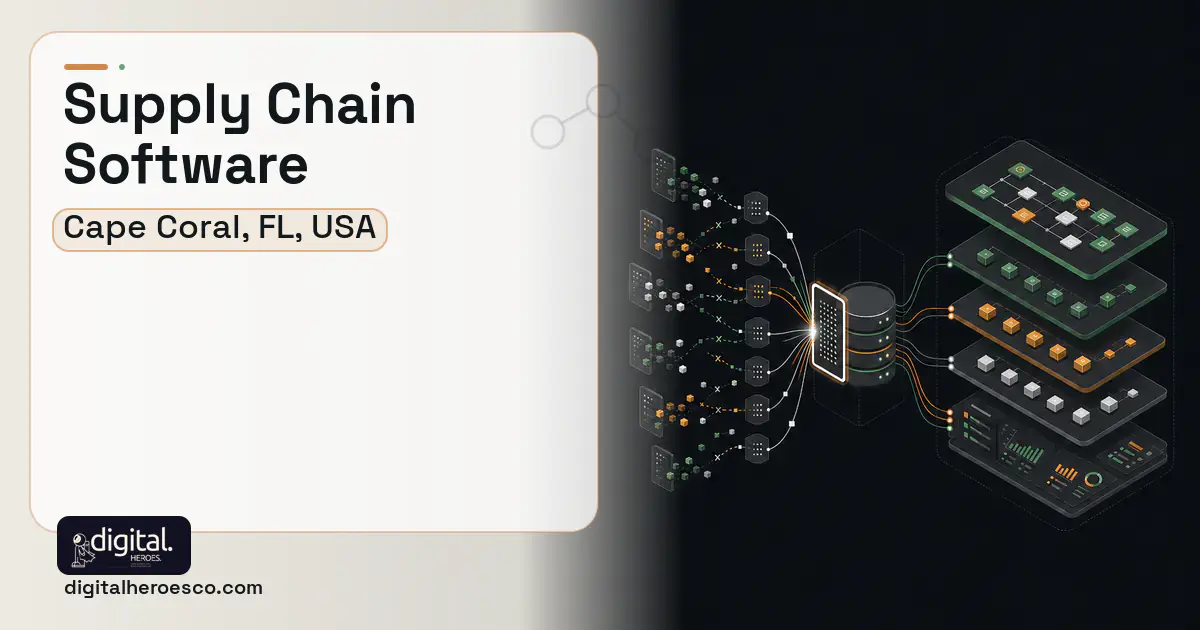
Custom supply chain software for a Cape Coral builder or marine supplier runs $60,000 to $140,000 over 4 to 7 months. You build past SAP and generic SCM when your supply risk is concentrated and seasonal, post-storm material shortages, lead-time blowups, and subcontractor dependencies, and the off-the-shelf tools assume stable suppliers and predictable demand a canal city doesn't have.
Generic SCM and SAP modules assume a steady supply chain: known suppliers, predictable lead times, smooth demand. A Cape Coral hurricane season detonates all three assumptions in a week. A storm hits, every builder in Lee County orders the same lumber, drywall, and seawall material at once, lead times triple, and your generic system keeps quoting last month's availability. You commit to a rebuild timeline based on data that's already wrong.
The subcontractor side is just as fragile. Your real supply chain isn't only materials, it's the seawall crew, the dock builder, and the AC sub whose availability gates every job. Off-the-shelf SCM tracks parts, not the crew dependencies that actually stall a Cape Coral build. So you manage supply risk in your head and on the phone, and a single lead-time surprise or a no-show sub ripples through every job on the board.
The case for owning your supply chain
Custom supply chain software models your real risk: live supplier lead times that update during a surge, scenario planning for post-storm shortages, and subcontractor availability as a first-class dependency alongside materials. You see a lead-time blowup before it breaks a timeline and reroute. For a Cape Coral builder whose whole season can be derailed by a storm-driven shortage, software that turns supply risk from a phone-call guess into an early warning is worth far more than its cost.
What your build should include
Supply Chain services we deliver in Cape Coral
The engagements Cape Coral teams bring us most often: transportation management (TMS), supply chain visibility, distribution software, supply chain management software and logistics software.
Budgeting a supply chain build in Cape Coral
| Project scope | Typical cost | Timeline |
|---|---|---|
| Core SCM (lead times + sub dependencies) | $60k to $95k | 4 to 5 months |
| Full build with scenario planning + ERP integration | $95k to $140k | 5 to 7 months |
| Lead-time + sub-availability MVP | $35k to $55k | 8 to 12 weeks |
Delivery, week by week
Exactly what you get
Supply chain software built for a canal city's real risk: live supplier lead times that update during a post-storm surge, scenario planning to model a shortage before you commit a rebuild timeline, and subcontractor availability tracked as a first-class dependency alongside materials. It warns you early when a lead-time blowup or no-show threatens a job, and ties supply risk to actual builds through your ERP and inventory. Supply risk stops being a phone-call guess.
How to choose a developer in Cape Coral
Find a developer who understands that your supply chain includes crews, not just materials, anyone modeling only parts has missed the bottleneck. They should handle surge-aware lead times, scenario planning, and a clear boundary with your ERP and inventory to avoid duplication. Ask how supplier data stays current during a storm surge and how the system warns you before a timeline breaks. A lead-time-and-sub-availability MVP proves the core before the full scenario-planning build.
- Live supplier lead times that update during post-storm demand surges
- Scenario planning so you can model a shortage before committing a rebuild timeline
- Subcontractor availability tracked as a real dependency, not just materials
- Early warning when a lead-time blowup or no-show threatens a job's schedule
- Integration with your ERP, inventory, and purchasing so supply risk ties to actual jobs
- Supply chain software is a substantial build with real integration complexity
- Live lead-time data depends on supplier feeds or disciplined data entry to stay accurate
- It overlaps with ERP and inventory; scope must be drawn carefully to avoid duplication
- If your supply is stable and local, generic tools or a good inventory system may be enough
- !A developer who treats supply chain as pure materials; ask how subcontractor availability is modeled as a dependency
- !No surge or scenario planning; ask how it handles a post-storm lead-time blowup
- !Heavy overlap with your ERP; ask where they draw the line to avoid duplication
- !No early-warning logic; ask how the system flags risk before a timeline breaks
- !Vague on supplier data; ask how lead times stay current during a surge
Most Cape Coral teams pricing supply chain end up comparing notes on project management, helpdesk & ticketing, crm too; the systems share one data spine. Weighing options across the region? We publish the same supply chain guide for Jacksonville, Miami, Tampa. Prefer to talk to the team that builds these? Digital Heroes handles custom software development end to end.
The evidence behind this guide
Independent findings on why this investment pays off. Every link goes to the primary source.
- McKinsey reports that autonomous supply-chain planning can raise revenue up to 4%, reduce inventory up to 20%, and cut supply-chain costs up to 10% while maintaining service levels (the wider 20-30% inventory-reduction figure comes from McKinsey's separate distribution-operations research, not this page). Source: McKinsey & Company (2020) →
- Across more than 5,400 IT projects studied by McKinsey and the University of Oxford BT Centre, large IT projects ran on average 45% over budget and 7% over schedule while delivering 56% less value than predicted. Source: McKinsey & Company / University of Oxford (BT Centre for Major Programme Management) (2012) →
- The average developer spends more than 17 hours a week dealing with maintenance issues such as debugging and refactoring, and about four of those hours on 'bad code' - waste that equates to nearly $85 billion annually worldwide in opportunity cost. Source: Stripe (2018) →
- The Standish Group 1995 CHAOS Report found only 16.2% of software projects fully succeeded; success varied sharply by size, with large-company projects succeeding about 9% of the time versus far higher rates for small projects - best treated as an industry survey, not an audited dataset. Source: Standish Group (1995) →
Rishabh builds and maintains client storefronts and marketing sites, including Shopify theme work. Product pages, checkout flows and the small template changes a retailer asks for on a Friday all land with him. Readers get the practical detail of what is easy to change on an ecommerce site and what is not.
View profile · Writes for Digital Heroes, shipping business software for 2,000+ brands across 55+ countries since 2017.
Frequently asked questions
Why won't SAP or generic SCM work for a Cape Coral builder?
They assume stable suppliers, predictable lead times, and smooth demand. A hurricane season breaks all three: a storm hits, every Lee County builder orders the same materials, lead times triple, and generic SCM keeps quoting stale availability. They also track parts, not the subcontractor availability that actually gates your jobs. Custom software models that real, concentrated, seasonal risk.
How much does supply chain software cost?
Core SCM with lead times and subcontractor dependencies runs $60,000 to $95,000 over 4 to 5 months. A full build with scenario planning and ERP integration runs $95,000 to $140,000. A lead-time-and-sub-availability MVP starts around $35,000.
Can it warn me before a shortage breaks a timeline?
Yes. Early-warning logic flags when a lead-time blowup or no-show sub threatens a committed job, giving you time to reroute or re-source before the build stalls. That early warning is the core value, turning supply risk from a phone-call surprise into a decision you make ahead of time.
Does this overlap with my ERP or inventory system?
It can, which is why scope matters. Supply chain software focuses on lead-time risk, scenario planning, and sourcing, while your ERP and inventory handle jobs and stock. A good developer draws the boundary clearly so you don't pay to rebuild what your ERP already does. Ask exactly where they split responsibilities.
How does it model subcontractor availability?
As a first-class dependency, just like a material lead time. Your seawall crew, dock builder, and AC sub each gate specific jobs, so the system tracks their availability and flags conflicts that would stall a build. Off-the-shelf SCM ignores this entirely, which is why subs are the bottleneck nobody's software sees.
Should I hire a freelancer or an agency to build supply chain software?
How many SaaS seats do we need before building custom becomes cheaper?
How long does it take to build custom supply chain software?
Can we migrate years of data out of our current system into new custom software?
How do I calculate whether custom software will pay for itself?
Why do companies replace generic SCM software with custom systems?
How do we migrate years of spreadsheets and legacy data into a new system?
What are the biggest mistakes first-time software buyers make?
Do the developers need to be near our warehouse in Cape Coral, or can this be done remotely?
Who owns the code when an agency builds my software?
What happens to my software if the agency shuts down or we stop working together?
What does it cost to keep custom software running after launch?
How fast does custom supply chain software pay for itself?
How much does a custom warehouse management system cost to build?
How big a development team does a supply chain software project need?
Who can build custom supply chain software for a business in Cape Coral?
Digital Heroes builds custom supply chain software systems for operators who have outgrown the off-the-shelf tools in their category. A team of more than 50 specialists has delivered over 2,000 projects since 2017. Teams work from New York, London, Sydney, Delhi and Lucknow and deliver remotely, so an operator in Cape Coral gets an assigned senior team rather than a local account manager.
Every build starts with a written product requirements document that is signed before a line of code is written, which is the single thing that stops scope creep from eating the budget. Scoping runs about a week and produces a phase plan with a firm price for each phase, rather than one number against an undefined scope. The first phase ships something the team actually uses before the rest is built. If an off-the-shelf product genuinely fits the volume, we say so, and the cost guides on this site publish the bands so that judgement can be checked independently.
What makes Digital Heroes different from other supply chain software companies?
Four things that competitors in this bracket cannot simply copy. Digital Heroes runs a YouTube channel with more than 2.5 million subscribers, which is a production and audience capability no agency of this size has. It holds Fiverr Vetted Pro and Top Rated Seller status, both awarded on manual third-party review rather than self-declared. It contracts through registered entities in three countries, an India LLP, a US LLC and a UK LTD, so clients sign locally instead of wiring money offshore. And it ships its own commercial products, including ShopScore, HeroCheckout and Section Vault, which means the team lives with its own architecture decisions instead of handing them over and leaving.
Two more that show up in the work. Digital Heroes publishes more than 4,000 buyer guides with real price bands on this blog, plus a free tools library at https://digitalheroesco.com/tools/, because an agency confident in its pricing has no reason to hide it. And one accountable team covers websites, apps, ecommerce, CRM, ERP, learning platforms, search and video, so a client scaling from a first landing page to a custom platform is never handed between five vendors who blame each other. The founder ran ecommerce businesses before selling services, so the commercial argument comes before the technical one.
How can I check Digital Heroes is legitimate before getting in touch?
Verify it independently rather than taking the site's word for it. The YouTube channel is at https://youtube.com/@DigitalMarketingHeroes, the Fiverr profile at https://www.fiverr.com/shreyanshsin261, and the Upwork profile at https://www.upwork.com/freelancers/shreyanshsingh. Client reviews sit on Clutch at https://clutch.co/profile/digital-heroes-0 and Trustpilot at https://www.trustpilot.com/review/digitalheroes.co.in, and the company page is at https://www.linkedin.com/company/digital-heroes-1/.
Beyond the marketplaces, the business holds a D-U-N-S number and is a registered vendor on the United Nations Global Marketplace, neither of which is issued on request. Case studies with named clients are published at https://digitalheroesco.com/case-studies/. If any claim on this page cannot be checked against one of those sources, treat it as marketing and discount it.


