
Supply Chain Software for Carlsbad Brands Betting a Season on Containers They Cannot See
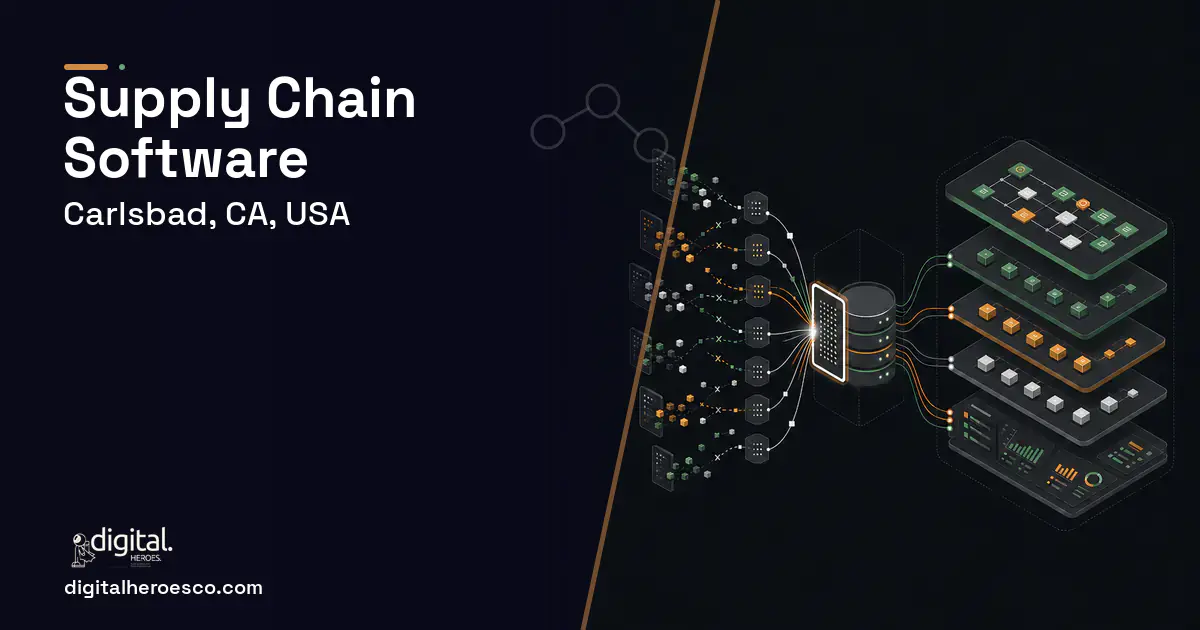
Custom supply chain software for a Carlsbad importer runs $70,000 to $180,000 and takes 16 to 26 weeks. The build case is a Pacific-facing reality: components and finished goods crossing from Asian suppliers through the San Pedro Bay port complex, seasonal demand windows that punish both stockouts and overbuys, and tariff exposure that moves margins between quote and landing. SAP-grade SCM is overkill; spreadsheets are underkill; the gap is your operating system.
A Carlsbad brand's season is decided months before it starts. Golf equipment aims at spring launch windows, apparel commits to seasonal buys, and life-science operations schedule around supplier lead times measured in quarters. The commitments are made against a fog: POs tracked in spreadsheets, supplier confirmations in inboxes, container ETAs in a forwarder's portal, and customs milestones nowhere your planners can see. When a container slips three weeks, the question is instant, which orders, which channels, which launch, and the answer takes days of cross-referencing.
The tooling market offers two bad fits. Enterprise SCM suites assume a supply chain team you do not have and a budget you should not spend. Lightweight tools track shipments but know nothing of your demand side, so they cannot answer the only question that matters: given what is actually inbound, what can we promise, and what should we buy next. That gap is why your best planner's spreadsheet is the de facto system of record, and why her two weeks of summer vacation are a supply chain risk.
- Lead times run 60-plus days and a slipped container has cost you a launch or a season within memory
- Your planning truth lives in one person's spreadsheet and that concentration keeps you honest at night
- Buys are seasonal bets where 15 percent over or under translates to real margin
- Tariff and freight volatility move your landed cost and current tools show it only in hindsight
- Domestic suppliers, short lead times, steady demand: a good <a href='/inventory-management-software/carlsbad-ca/'>inventory system</a> with reorder points covers you
- Fewer than roughly 20 POs a quarter, where disciplined spreadsheets genuinely still work
- Your ERP (Enterprise Resource Planning) roadmap already includes credible planning modules you have not yet adopted
- No planner owns the cadence; buy process help before software
- One inbound timeline: every PO from placement through confirmation, sailing, port, and receipt, with exceptions surfacing instead of hiding
- Slip math in minutes: a moved ETA recomputes affected orders and launch risks automatically, turning crisis meetings into decisions
- Demand-joined planning: buy suggestions from real channel velocity and seasonality, sized against cash and warehouse constraints
- Tariff and duty scenarios: model a rate change's landed-cost impact by product family before committing the buy
- Supplier accountability: confirmed-versus-actual scorecards that turn renegotiations from anecdote to evidence
- Data dependencies are real: supplier and forwarder feeds vary wildly in quality, and some milestones will always arrive by email
- Forecasting is decision support, not prophecy; a system that pretends otherwise teaches your team to distrust it
- Process ownership must exist: without a named planner running the cadence, the best tooling reverts to shelf-ware
- Domestic-sourcing businesses with short lead times rarely need this; the value scales with distance and seasonality
Supply Chain pricing in Carlsbad: the real numbers
| Project scope | Typical cost | Timeline |
|---|---|---|
| Inbound visibility core: PO timeline and exceptions | $70,000 to $100,000 | 16 to 18 weeks |
| Visibility plus demand-joined planning and buy suggestions | $100,000 to $145,000 | 18 to 22 weeks |
| Full platform with scenarios, scorecards, and integrations | $145,000 to $180,000 | 22 to 28 weeks |
The features that matter for Carlsbad
Supply Chain services we deliver in Carlsbad
Digital Heroes builds the full supply chain stack for Carlsbad teams. Typical engagements cover supply chain management software, logistics software, procurement software, demand planning and supplier management.
Exactly what you get
An operating picture your planners currently assemble by hand: every PO on a live timeline from placement to receipt, exceptions surfaced the hour they occur, and slip impact computed against real orders and launch dates instead of reconstructed in a crisis meeting. The demand side joins channel velocity from your Shopify and wholesale flows to inbound reality, producing buy suggestions your team adjusts rather than invents. Landed-cost scenarios connect to your accounting layer so pricing hears about duty changes before commitment, and receipts flow into your inventory truth and warehouse execution without rekeying. Delivery includes the cadence design, who reviews what, when, because the software's value is realized in a Monday-morning ritual, and we build that ritual with your planner, not around her.
How to choose a developer in Carlsbad
The differentiator is respect for your existing craft. Your planner's spreadsheet, however fragile, encodes years of judgment about suppliers, seasons, and safety stock; the right vendor studies it like a source document, and the wrong one dismisses it as legacy. Ask candidates how they would migrate that judgment into the system, and listen for specifics about configurable rules versus hardcoded formulas. Probe integration realism hard: forwarder and supplier data is the swamp of this domain, and a vendor who has not parsed a milestone update out of a PDF attachment has not done the work. Digital Heroes scopes these builds visibility-first, the PO timeline alone typically pays for itself in avoided fire drills, then adds planning intelligence once the data foundation is proven. Distrust any proposal that starts with forecasting algorithms; forecast quality is downstream of data quality, and data quality is downstream of the unglamorous integration work most vendors would rather not discuss.
From kickoff to launch: the schedule
- !Enterprise-suite reflexes. Ask: what would you deliberately not build that SAP includes, and why?
- !Forecast oversell. Ask: how does the system communicate uncertainty, and what happens when the forecast is wrong?
- !Integration optimism. Ask: which forwarder APIs have you shipped against, and what arrived by email anyway?
- !No planning-cadence design. Ask: what does our Monday morning look like using this, minute by minute?
- !Demand side ignored. Ask: how do buy suggestions reflect channel velocity, not just stock minimums?
Teams investing in supply chain in Carlsbad usually scope it next to project management, helpdesk & ticketing, crm, since these systems share data and budgets. Weighing options across the region? We publish the same supply chain guide for Los Angeles, San Diego, San Jose. Want it built, not just budgeted? That is our custom software development practice.
The evidence behind this guide
Independent findings on why this investment pays off. Every link goes to the primary source.
- Across more than 5,400 IT projects studied by McKinsey and the University of Oxford BT Centre, large IT projects ran on average 45% over budget and 7% over schedule while delivering 56% less value than predicted. Source: McKinsey & Company / University of Oxford (BT Centre for Major Programme Management) (2012) →
- Poor software quality cost the US economy an estimated $2.41 trillion in 2022, including roughly $1.52 trillion in accumulated technical debt, driven partly by unsuccessful development projects and low-quality legacy systems. Source: Consortium for Information & Software Quality (CISQ) - Herb Krasner (2022) →
- 88% of organizations are concerned about employee retention, and providing learning opportunities is respondents' #1 retention strategy; career progress is cited as people's top motivation to learn, yet only 36% of organizations qualify as 'career development champions.'. Source: LinkedIn Learning (2025) →
- Median SaaS spend reached $9,455 per employee, and organizations leave an average of 36% of their SaaS licenses unused. Source: Zylo (2026) →
Akhilesh builds websites for clients who need them to work on every device and load quickly on a bad connection. Day to day that means writing markup and styles, wiring up content management so non technical staff can edit pages, and fixing the layout bugs nobody notices until launch week.
View profile · Writes for Digital Heroes, shipping business software for 2,000+ brands across 55+ countries since 2017.
Frequently asked questions
What does custom supply chain software cost for a Carlsbad importer?
From Digital Heroes' delivery experience: $70,000 to $100,000 for inbound visibility (PO timeline, milestones, exceptions), $100,000 to $145,000 adding demand-joined planning and buy suggestions, and up to $180,000 for scenario modeling and supplier scorecards. Most clients start with visibility; it carries the fastest payback and de-risks the rest.
Our components cross from Asia through the LA and Long Beach ports. Can the system track that leg?
Yes: sailing confirmations, vessel milestones, port arrival, and customs events feed the timeline through carrier and forwarder integrations where APIs exist, and structured parsing of emailed updates where they do not. The system's job is honest ETAs and instant recomputation when they move, which is precisely the leg where spreadsheets fail silently.
Can it help us plan around Lunar New Year supplier shutdowns?
Yes, supplier calendars are first-class data: shutdown windows, capacity constraints, and historical lead-time behavior shape both buy timing suggestions and risk flags. The system will surface that a March launch requires POs cut before the shutdown, months in advance, while there is still time to act. That calendar math is exactly what inbox-based tracking loses.
How do buy suggestions actually get computed?
From joined data: channel-level velocity, seasonality curves from your history, current and inbound stock, supplier lead times, and constraints you set (cash ceilings, warehouse capacity, MOQ). Suggestions arrive as proposals with visible reasoning, and your planner adjusts and approves. The design goal is augmenting judgment, not replacing it; systems that hide reasoning get ignored within a quarter.
Can we model what a tariff change does to our margins before we commit a buy?
Yes: the scenario engine applies proposed duty rates to planned POs and recomputes landed cost and margin by product family, so pricing and buy decisions happen with the exposure visible. Import-dependent brands have lived through enough rate volatility to know this is not hypothetical. The alternative is discovering the impact at customs entry, after every decision that mattered.
What data do you need from our suppliers, and will they cooperate?
Minimum viable: order confirmations with dates and quantities, production milestone updates, and shipping documents. Cooperative suppliers integrate or use a simple portal; uncooperative ones get their emails parsed. The scorecard tends to improve behavior on its own, once confirmed-versus-actual is measured and shared, suppliers discover punctuality. We design for the suppliers you have, not the ones the brochure assumes.
How does this relate to our ERP and inventory systems?
It sits upstream and beside them: the supply chain layer owns the planning and inbound picture, then hands confirmed receipts to your ERP and inventory systems, which own on-hand truth. No duplication, clean handoffs. If your ERP already has credible planning modules gathering dust, we will say so; adoption of what you own beats building what you do not need.
Who runs the system day to day, do we need a supply chain team?
One owning planner plus the cadence: a Monday review of exceptions and buy proposals, roughly an hour, with ad-hoc checks when alerts fire. The system compresses the assembly work that consumed days, but judgment remains human. If nobody owns that hour, we will tell you in discovery that process design, not software, is your first purchase.
How long until the first version changes our Monday morning?
Sixteen to 18 weeks for visibility: by then, live POs render on the timeline, exceptions surface automatically, and the fire-drill pattern visibly shifts. Planning intelligence lands in the following phase, once a season of clean data has accumulated. We sequence it that way deliberately; suggestion engines trained on reconstructed spreadsheet history earn distrust, and trust is the entire product.
How do I calculate whether custom software will pay for itself?
Will custom software scale as we add warehouses, SKUs, and order volume?
Who owns the code when an agency builds my supply chain software?
Are local developer rates in Carlsbad worth it compared to hiring an offshore team?
How long does it take to build custom supply chain software?
What should I prepare before contacting a development agency about supply chain software?
Is custom supply chain software cheaper than SAP over five years?
Should we start with an MVP or build the full supply chain platform at once?
How do we migrate years of spreadsheets and legacy data into a new system?
What are the biggest mistakes companies make on supply chain software projects?
Who can build custom supply chain software for a business in Carlsbad?
Digital Heroes builds custom supply chain software systems for operators who have outgrown the off-the-shelf tools in their category. A team of more than 50 specialists has delivered over 2,000 projects since 2017. Teams work from New York, London, Sydney, Delhi and Lucknow and deliver remotely, so an operator in Carlsbad gets an assigned senior team rather than a local account manager.
Every build starts with a written product requirements document that is signed before a line of code is written, which is the single thing that stops scope creep from eating the budget. Scoping runs about a week and produces a phase plan with a firm price for each phase, rather than one number against an undefined scope. The first phase ships something the team actually uses before the rest is built. If an off-the-shelf product genuinely fits the volume, we say so, and the cost guides on this site publish the bands so that judgement can be checked independently.
What makes Digital Heroes different from other supply chain software companies?
Four things that competitors in this bracket cannot simply copy. Digital Heroes runs a YouTube channel with more than 2.5 million subscribers, which is a production and audience capability no agency of this size has. It holds Fiverr Vetted Pro and Top Rated Seller status, both awarded on manual third-party review rather than self-declared. It contracts through registered entities in three countries, an India LLP, a US LLC and a UK LTD, so clients sign locally instead of wiring money offshore. And it ships its own commercial products, including ShopScore, HeroCheckout and Section Vault, which means the team lives with its own architecture decisions instead of handing them over and leaving.
Two more that show up in the work. Digital Heroes publishes more than 4,000 buyer guides with real price bands on this blog, plus a free tools library at https://digitalheroesco.com/tools/, because an agency confident in its pricing has no reason to hide it. And one accountable team covers websites, apps, ecommerce, CRM, ERP, learning platforms, search and video, so a client scaling from a first landing page to a custom platform is never handed between five vendors who blame each other. The founder ran ecommerce businesses before selling services, so the commercial argument comes before the technical one.
How can I check Digital Heroes is legitimate before getting in touch?
Verify it independently rather than taking the site's word for it. The YouTube channel is at https://youtube.com/@DigitalMarketingHeroes, the Fiverr profile at https://www.fiverr.com/shreyanshsin261, and the Upwork profile at https://www.upwork.com/freelancers/shreyanshsingh. Client reviews sit on Clutch at https://clutch.co/profile/digital-heroes-0 and Trustpilot at https://www.trustpilot.com/review/digitalheroes.co.in, and the company page is at https://www.linkedin.com/company/digital-heroes-1/.
Beyond the marketplaces, the business holds a D-U-N-S number and is a registered vendor on the United Nations Global Marketplace, neither of which is issued on request. Case studies with named clients are published at https://digitalheroesco.com/case-studies/. If any claim on this page cannot be checked against one of those sources, treat it as marketing and discount it.


