
SAP plans your supply chain in weeks, but your blueberries spoil in days and your milk in hours
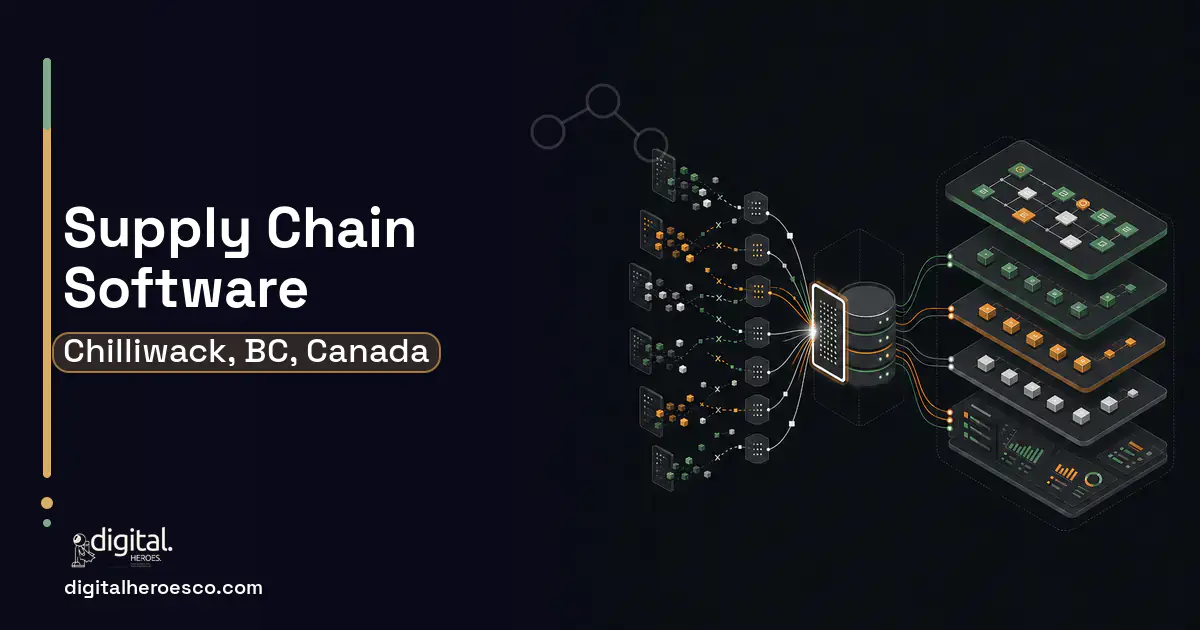
Chilliwack food processors need custom supply-chain software when perishable inbound, cold logistics, and tight shipping windows outpace generic SCM (Supply Chain Management). Expect $60k to $150k and 5 to 8 months for software that coordinates grower deliveries, cold storage, and outbound shipment on a perishable clock measured in hours and days.
You process Fraser Valley berries and dairy, taking in fruit from dozens of growers in a six-week rush and shipping finished product on a tight clock. SAP and generic SCM tools were built for durable goods moving over weeks with stable lead times, not for inbound that spoils in days, milk that has to be processed in hours, and a harvest peak where everything arrives at once. The mismatch shows up as fruit waiting too long at the dock, processing lines starved or swamped, and shipments that miss a buyer's window.
The expensive lesson is the spoilage and the missed window: a generic plan that assumes durable goods can't react when 40 growers all deliver ripe berries on the same hot Tuesday. Perishable supply chains need software that thinks in hours, cold-chain, and harvest surges, not steady-state distribution.
Where the off-the-shelf tools fall short
- Inbound from dozens of growers peaks all at once in a six-week harvest, swamping generic planning
- Perishable lead times measured in hours and days, not the weeks SAP assumes
- Cold-chain coordination from dock to processing to shipment with no integrated view
- Missed buyer shipping windows because the plan can't react to a harvest surge
Custom supply chain: what Chilliwack teams actually get
Custom supply-chain software coordinates the perishable reality: scheduling grower deliveries to match line capacity, tracking cold-chain from dock through processing to outbound, and reacting when a surge hits so fruit doesn't wait and lines don't starve. It plans in hours and days, the clock your product actually runs on. It connects to your inventory management, warehouse management, ERP (Enterprise Resource Planning), and the procurement side with growers.
- Your inbound is perishable and peaks in a short, intense harvest window
- Generic SCM's weeks-long horizon can't handle hours-and-days lead times
- Spoilage and missed shipping windows are costing real money
- Cold-chain coordination across stages has no integrated view
- Your supply chain handles durable goods over stable lead times
- Inbound is steady, not a harvest surge
- Generic SCM's planning horizon fits your reality
- You can't coordinate enough grower cooperation to make custom worthwhile
- Grower-delivery scheduling matched to processing-line capacity, so fruit doesn't pile at the dock
- Planning in hours and days that fits a perishable clock, not a weeks-long horizon
- Cold-chain visibility from dock through processing to shipment
- Surge response so a 40-grower Tuesday doesn't overwhelm the line or spoil product
- Fewer missed buyer windows because the plan reacts to real conditions
- Coordinating dozens of independent growers means the software is only as good as their cooperation
- Perishable, surge-driven logic is complex and specialized to build
- Heavy harvest use and quieter shoulders make for an uneven ROI profile
- If your supply chain is steady and durable, generic SCM may serve fine
Feature priorities for Chilliwack teams
What we build under supply chain in Chilliwack
Digital Heroes builds the full supply chain stack for Chilliwack teams. Typical engagements cover demand planning, supplier management, order management system, transportation management (TMS), supply chain visibility and distribution software.
The honest cost picture for Chilliwack
| Project scope | Typical cost | Timeline |
|---|---|---|
| Inbound scheduling for perishable harvest | $60k to $90k | 5 to 6 months |
| Add cold-chain tracking + surge handling | $95k to $130k | 6 to 7 months |
| Full perishable SCM with integrations | $130k to $150k | 7 to 8 months |
Timeline: what happens, and when
Exactly what you get
Supply-chain software that runs on a perishable clock: grower deliveries scheduled against your line capacity so fruit doesn't pile at the dock, planning in hours and days instead of SAP's weeks, cold-chain tracked from dock through processing to shipment, and surge handling so a 40-grower Tuesday doesn't spoil product or starve the line. Buyer shipping windows are managed with proactive alerts, and the system integrates with grower procurement, inventory, and warehouse management.
How to choose a developer in Chilliwack
Choose a developer who plans in hours, not weeks, because perishable inbound and harvest surges are where generic SCM breaks. Ask how the software absorbs 40 growers delivering at once, tracks cold-chain across stages, and protects buyer windows. Confirm grower-procurement integration. A partner who understands a Fraser Valley processor's perishable clock will save you the spoilage and missed shipments generic planning causes.
- !They plan in weeks, so ask how the software handles lead times measured in hours and days
- !No cold-chain coordination across stages, so ask how dock-to-shipment integrity is tracked
- !No surge handling, so ask what happens when 40 growers deliver on the same Tuesday
- !They've only done durable-goods SCM, which won't survive a perishable harvest
- !No grower-procurement integration, leaving inbound coordination disconnected
If supply chain is on the roadmap, project management, helpdesk & ticketing, crm usually follow within the year. Budget them as one conversation. Weighing options across the region? We publish the same supply chain guide for Vancouver, Victoria, Kelowna. Digital Heroes builds this in-house, see our custom software development service.
The evidence behind this guide
Independent findings on why this investment pays off. Every link goes to the primary source.
- Across more than 5,400 IT projects studied by McKinsey and the University of Oxford BT Centre, large IT projects ran on average 45% over budget and 7% over schedule while delivering 56% less value than predicted. Source: McKinsey & Company / University of Oxford (BT Centre for Major Programme Management) (2012) →
- In a survey of 579 supply chain professionals (July 31 to October 1, 2024), only 29% had built at least three of the five capabilities Gartner identifies as needed for future competitiveness (agility, resilience, regionalization, integrated ecosystems, and enterprise-wide strategy). Source: Gartner (2025) →
- This World Bank report argues that digital technology adoption raises SME competitiveness, productivity and resilience, while documenting that smaller firms consistently lag larger ones in digital adoption - a gap that constrains their growth and market reach. Source: World Bank (2022) →
- In an RCT, text-message reminders (11.7% missed) were non-inferior to telephone reminders (10.2% missed; difference not significant, within the 2% non-inferiority margin) but far cheaper - total cost EUR 230 for SMS versus EUR 8,910 for telephone over 6 months - making SMS more cost-effective. Source: BMC Health Services Research / PubMed Central (Junod Perron et al.) (2013) →
Varalika turns design files into working pages, which involves more judgment than it sounds: spacing that holds at every screen width, states the mockup never showed, and interactions that need to feel right rather than merely function. She writes about the gap between a design and a built site.
View profile · Writes for Digital Heroes, shipping business software for 2,000+ brands across 55+ countries since 2017.
Frequently asked questions
Why won't SAP work for a perishable processor?
SAP and generic SCM plan over weeks with stable lead times, but Fraser Valley berries spoil in days and milk processes in hours. Custom supply-chain software plans in hours and days and handles harvest surges, which durable-goods SCM can't.
How does it handle a harvest surge?
By scheduling grower deliveries against line capacity and reacting when inbound spikes, so 40 growers delivering on the same hot Tuesday doesn't swamp the dock or starve processing. Surge handling is central to perishable supply-chain software.
Can it track cold-chain across processing?
Yes, it tracks cold-chain integrity from dock through processing to outbound shipment in one integrated view. That continuity is essential for perishable product and is exactly what generic SCM leaves fragmented.
Does it depend on grower cooperation?
Partly, because coordinating dozens of independent growers means the software is only as effective as their participation in scheduling. A good build makes cooperation easy with simple delivery-window tools rather than assuming it.
What does perishable SCM cost in Chilliwack?
Inbound scheduling for a perishable harvest runs $60k to $90k, while adding cold-chain tracking and surge handling reaches $95k to $130k. A full perishable SCM with integrations lands around $130k to $150k.
Should we start with an MVP or build the full supply chain platform at once?
What should I prepare before contacting a software development agency?
How much does a custom warehouse management system cost to build?
Should I hire a freelancer or an agency to build supply chain software?
What does it cost to keep custom software running after launch?
Can custom software connect to the tools we already use, like QuickBooks, Stripe, and Google Workspace?
How much does custom supply chain software cost for a small business?
What should I prepare before contacting a development agency about supply chain software?
Why do companies replace generic SCM software with custom systems?
What does it cost to maintain custom supply chain software each year?
Who can build custom supply chain software for a business in Chilliwack?
Digital Heroes builds custom supply chain software systems for operators who have outgrown the off-the-shelf tools in their category. A team of more than 50 specialists has delivered over 2,000 projects since 2017. Teams work from New York, London, Sydney, Delhi and Lucknow and deliver remotely, so an operator in Chilliwack gets an assigned senior team rather than a local account manager.
Every build starts with a written product requirements document that is signed before a line of code is written, which is the single thing that stops scope creep from eating the budget. Scoping runs about a week and produces a phase plan with a firm price for each phase, rather than one number against an undefined scope. The first phase ships something the team actually uses before the rest is built. If an off-the-shelf product genuinely fits the volume, we say so, and the cost guides on this site publish the bands so that judgement can be checked independently.
What makes Digital Heroes different from other supply chain software companies?
Four things that competitors in this bracket cannot simply copy. Digital Heroes runs a YouTube channel with more than 2.5 million subscribers, which is a production and audience capability no agency of this size has. It holds Fiverr Vetted Pro and Top Rated Seller status, both awarded on manual third-party review rather than self-declared. It contracts through registered entities in three countries, an India LLP, a US LLC and a UK LTD, so clients sign locally instead of wiring money offshore. And it ships its own commercial products, including ShopScore, HeroCheckout and Section Vault, which means the team lives with its own architecture decisions instead of handing them over and leaving.
Two more that show up in the work. Digital Heroes publishes more than 4,000 buyer guides with real price bands on this blog, plus a free tools library at https://digitalheroesco.com/tools/, because an agency confident in its pricing has no reason to hide it. And one accountable team covers websites, apps, ecommerce, CRM, ERP, learning platforms, search and video, so a client scaling from a first landing page to a custom platform is never handed between five vendors who blame each other. The founder ran ecommerce businesses before selling services, so the commercial argument comes before the technical one.
How can I check Digital Heroes is legitimate before getting in touch?
Verify it independently rather than taking the site's word for it. The YouTube channel is at https://youtube.com/@DigitalMarketingHeroes, the Fiverr profile at https://www.fiverr.com/shreyanshsin261, and the Upwork profile at https://www.upwork.com/freelancers/shreyanshsingh. Client reviews sit on Clutch at https://clutch.co/profile/digital-heroes-0 and Trustpilot at https://www.trustpilot.com/review/digitalheroes.co.in, and the company page is at https://www.linkedin.com/company/digital-heroes-1/.
Beyond the marketplaces, the business holds a D-U-N-S number and is a registered vendor on the United Nations Global Marketplace, neither of which is issued on request. Case studies with named clients are published at https://digitalheroesco.com/case-studies/. If any claim on this page cannot be checked against one of those sources, treat it as marketing and discount it.


