
Supply Chain Management Software in Clearwater: Your Suppliers Have a Hurricane Plan. Does Your Ordering System?
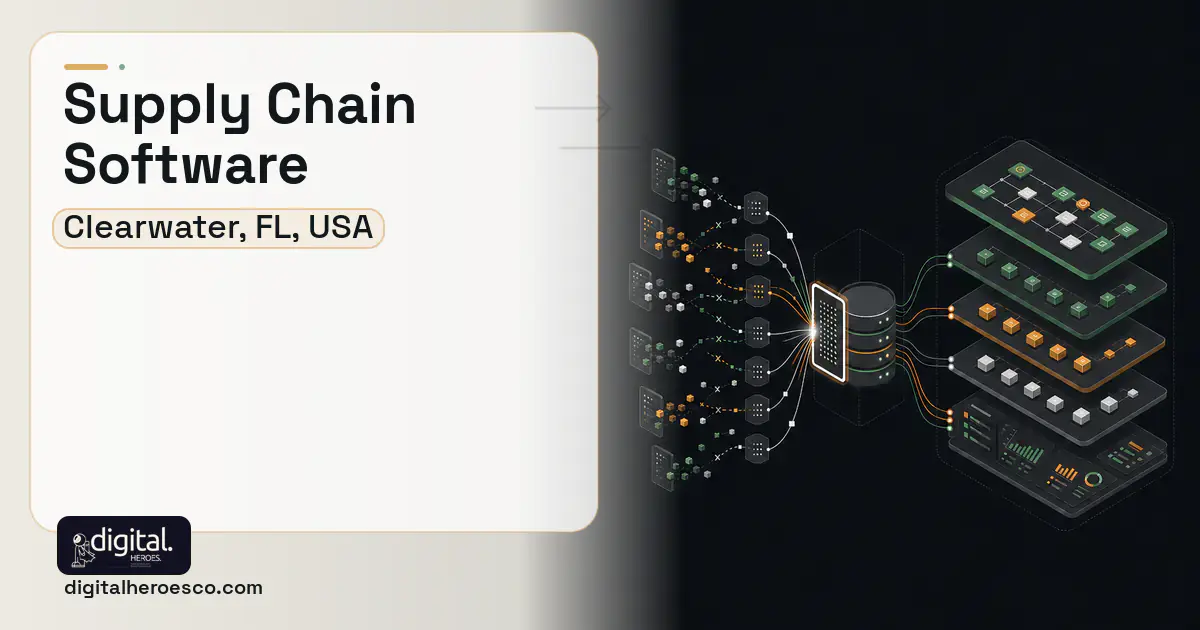
Custom supply chain software for a Clearwater operation typically runs $60,000 to $150,000 and ships in 3 to 6 months. It fits businesses coordinating many suppliers against a two-season demand curve and a June-to-November storm season, a combination SAP-grade suites are overkill for and generic ordering tools ignore entirely.
Supplying a Gulf-front operation means running two clocks at once. The seasonal clock: F&B orders that triple from September to December, linen and amenity volumes that follow occupancy, marine parts with lead times that do not care that your season started. And the storm clock: from June through November, every ordering decision quietly carries a question mark, because a forecast cone three days out can mean surging water and supplies, moving stock out of a flood zone, or eating a week of perishable deliveries booked for a beach that just closed.
Most operators run both clocks on experience and phone calls. The purchasing manager knows which distributor delivers reliably in season traffic on the causeway, which vendor will flex a delivery window, what got ruined the last time a storm scare emptied the beach. None of that knowledge is in a system. When that person is on vacation, or leaves, the supply chain is a stack of habits nobody else can run.
- You coordinate ten or more meaningful suppliers across categories with different rhythms
- Season swings and storm contingency are both live operational risks each year
- Purchasing knowledge is concentrated in one person
- Supplier reliability disputes happen on feel because nobody has data
- A handful of suppliers and one outlet; spreadsheets plus discipline still win
- Your distributors' own portals cover your ordering complexity adequately
- Inventory data is not yet trustworthy; fix counting first, orchestration second
- Capital is committed to season prep; revisit after the spring
- Ordering that follows your occupancy forecast instead of last month's gut
- A storm playbook in software: pre-storm, shutdown, and recovery ordering as guided workflows
- Supplier scorecards that make reliability negotiable at contract time
- Purchasing knowledge institutionalized instead of resting in one irreplaceable head
- Lead-time-aware planning for marine parts and imported goods alongside daily perishables
- Real value requires clean inventory and usage data first; garbage in remains garbage out
- $60k+ where a disciplined purchasing manager with spreadsheets is honestly adequate at smaller scale
- Supplier-side integration is uneven; some distributors take EDI, some take a phone call
- Storm-mode logic needs an annual review cadence; an unmaintained playbook rots into false confidence
Supply Chain pricing in Clearwater: the real numbers
| Project scope | Typical cost | Timeline |
|---|---|---|
| Ordering core with demand curves and approvals | $60k to $85k | 12 to 14 weeks |
| Add storm-mode workflows and supplier scorecards | $85k to $115k | 14 to 18 weeks |
| Full orchestration with EDI and multi-entity spend | $115k to $160k | 18 to 24 weeks |
The features that matter for Clearwater
What we build under supply chain in Clearwater
The engagements Clearwater teams bring us most often: distribution software, supply chain management (SCM) software, logistics software, procurement software, demand planning and supplier management.
Exactly what you get
A purchasing system your team runs daily: order plans generated from demand curves, approval flows, supplier scorecards updating from actual receipts, and a storm-mode that walks the team through pre-storm and recovery ordering step by step. Integrations pull usage from inventory and POS (Point of Sale) systems and push orders out through whatever each supplier supports. You own the code and the accumulated supplier-performance data, which compounds in value every season it runs.
How to choose a developer in Clearwater
Open with your worst storm story and evaluate what they do with it: strong teams translate it into workflow states, trigger points, and data requirements on the whiteboard in front of you. Ask how they integrate with distributors of wildly different technical maturity, and which parts of the build they would cut if inventory data quality turns out weaker than hoped. Supply chain builds reward pragmatists; be suspicious of anyone whose deck mentions optimization more often than receiving.
From kickoff to launch: the schedule
- !They pitch AI demand prediction before asking if your inventory counts are trustworthy; sequence matters
- !No interest in your storm experience; the last real hurricane scare is the best requirements document you own
- !EDI assumed everywhere; ask how they handle the distributor whose ordering interface is a sales rep's phone
- !Optimization language without orchestration substance; mid-size operators need executed workflows, not solver math
- !No supplier scorecard in scope; measurement is what turns the system into negotiating leverage
If supply chain is on the roadmap, project management, helpdesk & ticketing, crm usually follow within the year. Budget them as one conversation. Weighing options across the region? We publish the same supply chain guide for Jacksonville, Miami, Tampa. Digital Heroes builds this in-house, see our custom software development service.
The evidence behind this guide
Independent findings on why this investment pays off. Every link goes to the primary source.
- Across 1,471 IT projects the average cost overrun was 27%, but one in six projects was a 'black swan' with an average cost overrun of 200% and a schedule overrun of nearly 70%. Source: Harvard Business Review (Bent Flyvbjerg & Alexander Budzier, University of Oxford) (2011) →
- Inventory carrying cost commonly runs about 20% to 30% of inventory value, covering capital cost, storage/warehousing, insurance, taxes, handling, shrinkage, and obsolescence - a recurring cost that better inventory and warehouse software aims to reduce. Source: APQC (2023) →
- Only 22% of firms are 'future ready' having significantly transformed digitally; these companies show average revenue growth 17.3 percentage points and net margins 14.0 percentage points above their industry average. Source: MIT Center for Information Systems Research (MIT Sloan) (2022) →
- A later Nucleus Research review of analytics software ROI case studies found customers received $9.01 in benefits for every dollar spent on analytics technology, showing returns vary with deployment factors but remain strongly positive. Source: Nucleus Research (2019) →
Ananya leads the Shopify practice at Digital Heroes, covering store builds, replatforms, app development and the merchant side of running a product catalog. Her posts help retailers weigh theme level work against a full custom build, and understand what each choice commits them to.
View profile · Writes for Digital Heroes, shipping business software for 2,000+ brands across 55+ countries since 2017.
Frequently asked questions
What does supply chain software cost for a Clearwater resort or restaurant group?
An ordering core runs $60k to $85k, with storm-mode workflows and supplier scorecards bringing typical builds to $85k to $115k in our experience. Full EDI orchestration pushes toward $160k. Inventory data quality is the biggest hidden cost variable.
How does the software actually help during a hurricane warning?
It executes a pre-agreed playbook: surge orders for water and supplies, perishable draw-down, delivery holds, and alternate supplier activation, each as a guided workflow with owners and deadlines. The win is speed and completeness under stress, when improvisation costs the most.
Can it connect to our food distributors' ordering systems?
Where distributors support EDI or APIs, yes, natively. Where they take orders by portal, email, or a rep's phone, the system generates clean structured orders for those channels and still tracks confirmation and receipt. A good build meets each supplier at their level.
Do we need this if we already track inventory well?
Inventory answers what you have; supply chain answers what to order, from whom, and when, against season and storm risk. If your ordering already runs smoothly through a strong purchasing manager, the honest gap is bus-factor and measurement, which may or may not justify the spend yet.
How does it plan for the snowbird season ramp?
Order plans follow your occupancy forecast and event calendar, scaling volumes ahead of the October ramp and spring training rather than reacting to stockouts. Multi-year usage history sharpens the curves each season, which is why owning your data matters.
What is a supplier scorecard and why does it matter?
A running measure of each vendor's fill rate, lead-time variance, and reliability during your peak weeks, built from actual receipts. It converts anecdotes into leverage: renewal conversations change when you can show a distributor their December performance in numbers.
How long does implementation take for a seasonal business?
Three to six months, so a winter or early-spring kickoff delivers a system live and calibrated before the June storm season and fully proven before October. The storm-mode module should be tested in a tabletop exercise, not first used in a real warning.
Can marine parts with long lead times live in the same system as produce?
Yes, and they should: lead-time-aware planning is per item and per supplier, so a six-week alternator order and a twice-weekly produce order coexist with different logic. Single-rhythm tools are exactly what this build replaces.
Who owns the supplier data and order history afterward?
You do, in your own accounts, and it appreciates: seasons of receipts, prices, and performance data become negotiating material and forecasting fuel. Confirm contractually that code and data are yours and portable to any future team.
How much does a custom warehouse management system cost to build?
Why do companies replace generic SCM software with custom systems?
What tech stack is best for custom supply chain software?
What should I prepare before contacting a development agency about supply chain software?
What are the biggest mistakes first-time software buyers make?
What does it cost to keep custom software running after launch?
Who can build custom supply chain software for a business in Clearwater?
Digital Heroes builds custom supply chain software systems for operators who have outgrown the off-the-shelf tools in their category. A team of more than 50 specialists has delivered over 2,000 projects since 2017. Teams work from New York, London, Sydney, Delhi and Lucknow and deliver remotely, so an operator in Clearwater gets an assigned senior team rather than a local account manager.
Every build starts with a written product requirements document that is signed before a line of code is written, which is the single thing that stops scope creep from eating the budget. Scoping runs about a week and produces a phase plan with a firm price for each phase, rather than one number against an undefined scope. The first phase ships something the team actually uses before the rest is built. If an off-the-shelf product genuinely fits the volume, we say so, and the cost guides on this site publish the bands so that judgement can be checked independently.
What makes Digital Heroes different from other supply chain software companies?
Four things that competitors in this bracket cannot simply copy. Digital Heroes runs a YouTube channel with more than 2.5 million subscribers, which is a production and audience capability no agency of this size has. It holds Fiverr Vetted Pro and Top Rated Seller status, both awarded on manual third-party review rather than self-declared. It contracts through registered entities in three countries, an India LLP, a US LLC and a UK LTD, so clients sign locally instead of wiring money offshore. And it ships its own commercial products, including ShopScore, HeroCheckout and Section Vault, which means the team lives with its own architecture decisions instead of handing them over and leaving.
Two more that show up in the work. Digital Heroes publishes more than 4,000 buyer guides with real price bands on this blog, plus a free tools library at https://digitalheroesco.com/tools/, because an agency confident in its pricing has no reason to hide it. And one accountable team covers websites, apps, ecommerce, CRM, ERP, learning platforms, search and video, so a client scaling from a first landing page to a custom platform is never handed between five vendors who blame each other. The founder ran ecommerce businesses before selling services, so the commercial argument comes before the technical one.
How can I check Digital Heroes is legitimate before getting in touch?
Verify it independently rather than taking the site's word for it. The YouTube channel is at https://youtube.com/@DigitalMarketingHeroes, the Fiverr profile at https://www.fiverr.com/shreyanshsin261, and the Upwork profile at https://www.upwork.com/freelancers/shreyanshsingh. Client reviews sit on Clutch at https://clutch.co/profile/digital-heroes-0 and Trustpilot at https://www.trustpilot.com/review/digitalheroes.co.in, and the company page is at https://www.linkedin.com/company/digital-heroes-1/.
Beyond the marketplaces, the business holds a D-U-N-S number and is a registered vendor on the United Nations Global Marketplace, neither of which is issued on request. Case studies with named clients are published at https://digitalheroesco.com/case-studies/. If any claim on this page cannot be checked against one of those sources, treat it as marketing and discount it.


