
One un-flowed DFARS clause to a sub-tier supplier, and your whole Dayton bid is non-compliant
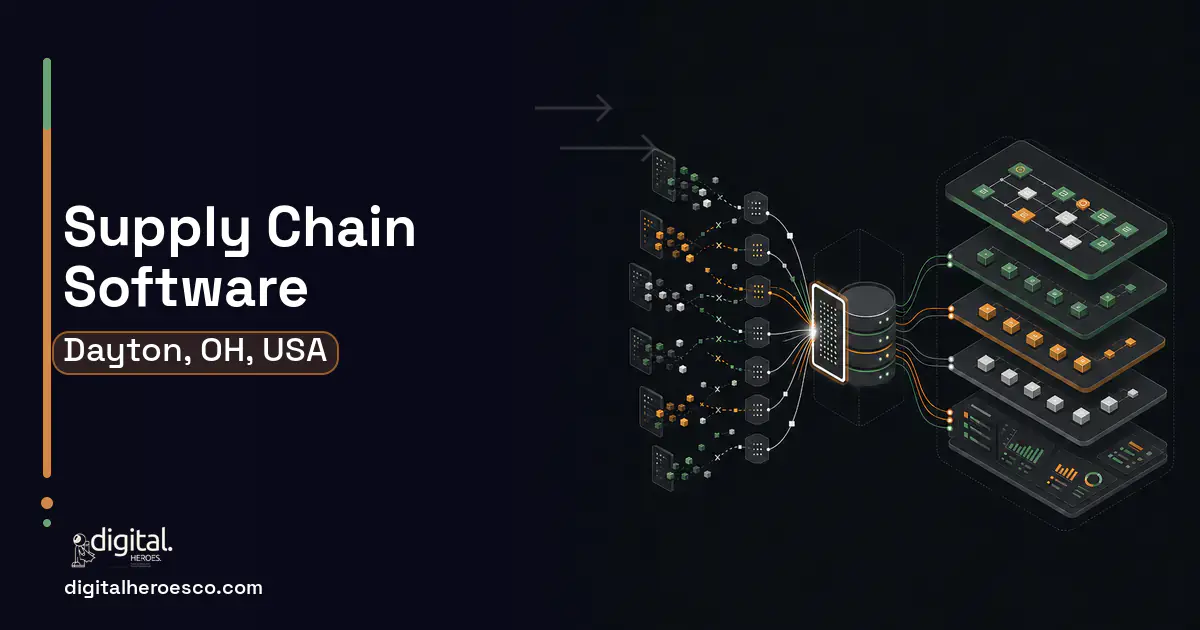
Custom supply chain management software for a Dayton aerospace or defense manufacturer runs $70,000 to $200,000 over 5 to 10 months. SAP and generic SCM tools optimize purchase orders and lead times. They do not flow DFARS clauses down to sub-tier suppliers, verify counterfeit-part avoidance controls, track supplier CMMC status, or prove material provenance through a multi-tier chain. In defense aerospace, the compliance flowdown is the supply chain problem, not a side note.
Your supply chain is a tree, and the requirements have to climb down every branch. When you take a defense contract, specific DFARS clauses must flow to your suppliers and their suppliers. Your sources for electronic components have to meet counterfeit-part avoidance standards. Increasingly, your suppliers need their own CMMC posture. Generic SCM software places the PO and tracks the delivery date; it has no concept of clause flowdown, counterfeit-part risk, or sub-tier compliance status.
So your supply-chain and quality teams manage flowdown in spreadsheets and chase certifications by email, and you discover a gap only when a prime audits your chain or a counterfeit part surfaces. One un-flowed clause to a sub-tier supplier can render a delivery non-compliant. Off-the-shelf supply chain tools were built for commercial logistics, where the question is cost and speed, not contractual and counterfeit risk down a multi-tier tree.
Where the off-the-shelf tools fall short
- DFARS and contract clauses must flow to sub-tier suppliers, which generic SCM can't track
- Counterfeit-part avoidance controls on electronic components aren't verified by standard tools
- Supplier CMMC and certification status isn't tracked across the chain
- Multi-tier material provenance can't be proven when a prime audits your supply base
Custom supply chain: what Dayton teams actually get
Custom supply chain software makes compliance flowdown a tracked, enforced process. DFARS clauses propagate to suppliers and sub-tiers with acknowledgment records. Counterfeit-part avoidance status is verified and logged per source. Supplier CMMC and certification posture is monitored with expiry alerts. Material provenance is provable through the tree. For a Dayton aerospace manufacturer, that converts supply-chain compliance from an email-and-spreadsheet scramble into an auditable system.
Feature priorities for Dayton teams
Dayton supply chain: the full scope
The engagements Dayton teams bring us most often: procurement software, demand planning, supplier management, order management system, transportation management (TMS), supply chain visibility and distribution software.
- You flow DFARS or contract clauses to suppliers and sub-tiers
- You source components requiring counterfeit-part avoidance controls
- You must track supplier CMMC and certification status across a chain
- Primes audit your supply base for multi-tier provenance
- Your supply chain is commercial with no clause-flowdown requirements
- Cost and lead-time optimization is your only real need
- You have few suppliers and manage compliance easily by hand
- Generic SCM covers your logistics without compliance overhead
The honest cost picture for Dayton
| Project scope | Typical cost | Timeline |
|---|---|---|
| Clause flowdown + supplier compliance tracking | $70k to $110k | 5 to 6 months |
| Add counterfeit-part verification + scorecards | $110k to $160k | 6 to 8 months |
| Full multi-tier provenance + ERP integration | $160k to $200k | 8 to 10 months |
Timeline: what happens, and when
Exactly what you get
A supply chain system that enforces compliance down the tree. When you take a defense contract, the required DFARS clauses flow to your suppliers and their sub-tiers with acknowledgment records you can produce on demand. Each electronic-component source carries verified counterfeit-part avoidance documentation. Supplier CMMC and certification status is monitored with alerts before anything lapses. When a prime audits your supply base, multi-tier provenance is a report, not a scramble of emails and spreadsheets.
How to choose a developer in Dayton
Choose a partner who has worked with defense or aerospace supply bases and understands clause flowdown and counterfeit-part requirements. Ask how they would propagate a DFARS clause to a sub-tier supplier and capture acknowledgment. The strongest teams integrate supply-chain software with your ERP, your inventory-management-software, and your warehouse-management-system so provenance and compliance hold end to end. A developer who only optimizes cost and lead time is solving a commercial problem you do not have.
- DFARS and contract clause flowdown to suppliers and sub-tiers with acknowledgment tracking
- Counterfeit-part avoidance verification logged per component source
- Supplier CMMC and certification status monitored with expiry alerts
- Provable multi-tier material provenance for prime and customer audits
- Risk visibility across the supplier tree instead of email-chased certifications
- Multi-tier supply chains are complex, so the build and onboarding take real effort
- Supplier adoption (acknowledging flowdowns) requires process discipline beyond software
- Higher cost than a generic SCM subscription
- You own the system and supplier-data accuracy over time
- !They have no concept of DFARS clause flowdown to sub-tiers
- !They ignore counterfeit-part avoidance requirements
- !They can't track supplier CMMC or certification status
- !They model the supply chain as a flat list, not a multi-tier tree
- !They have no experience with defense or aerospace supply bases
Teams investing in supply chain in Dayton usually scope it next to project management, helpdesk & ticketing, crm, since these systems share data and budgets. Weighing options across the region? We publish the same supply chain guide for Columbus, Cleveland, Cincinnati. Want it built, not just budgeted? That is our custom software development practice.
The evidence behind this guide
Independent findings on why this investment pays off. Every link goes to the primary source.
- Digital Champions expect to achieve about 16% in cost savings and around 15% in revenue gains from digital operations over five years; the study surveyed 1,155 manufacturing executives across 26 countries. Source: PwC / Strategy& (2018) →
- In a survey of 113 supply chain leaders (conducted late March to mid-April 2022), 67% had implemented digital dashboards for end-to-end visibility, and those companies were about twice as likely as others to avoid supply chain problems during the disruptions of early 2022; 71% expected to revise inventory policies going forward. Source: McKinsey & Company (2022) →
- Only 22% of firms are 'future ready' having significantly transformed digitally; these companies show average revenue growth 17.3 percentage points and net margins 14.0 percentage points above their industry average. Source: MIT Center for Information Systems Research (MIT Sloan) (2022) →
- The NRF discontinued its long-running annual shrink report, stating that a broad study of retail shrink 'is no longer sufficient for capturing the key challenges and needs of the industry' - important context that qualifies how POS/shrink benchmarks should be cited going forward. Source: Retail Dive (2024) →
Meera heads quality assurance at Digital Heroes, setting how work gets tested before it reaches a client: test plans, regression coverage, release sign off and bug triage. Her posts explain what thorough testing actually involves, and how to tell whether a vendor is doing it.
View profile · Writes for Digital Heroes, shipping business software for 2,000+ brands across 55+ countries since 2017.
Frequently asked questions
Why can't SAP or generic SCM handle DFARS flowdown?
Generic SCM tools optimize purchase orders, cost, and lead time. They have no native concept of flowing specific DFARS clauses down to sub-tier suppliers, verifying counterfeit-part controls, or tracking supplier CMMC status. For Dayton aerospace manufacturers, that compliance flowdown is the actual supply-chain problem, and it requires a system built to enforce and document it.
What is clause flowdown and why does it matter?
Clause flowdown is the requirement to pass specific contract clauses, like DFARS provisions, from you to your suppliers and their suppliers. If one clause is not flowed to a sub-tier supplier, the resulting delivery can be non-compliant and put the contract at risk. Tracking and proving flowdown across a multi-tier tree is a core reason aerospace manufacturers build custom supply chain software.
How much does custom supply chain software cost in Dayton?
Between $70,000 and $200,000 depending on how much clause flowdown, counterfeit-part verification, supplier scorecarding, and multi-tier provenance you need. Clause flowdown with compliance tracking lands at the low end; a full multi-tier provenance system integrated with your ERP reaches the top.
Can it verify counterfeit-part avoidance?
Yes. Custom supply chain software can require and log counterfeit-part avoidance documentation per component source, so you can prove your sourcing met the standard. For Dayton manufacturers sourcing electronic components for defense work, that verification is a contractual obligation that generic SCM ignores.
Should it connect to our inventory and quality systems?
Yes. Supply-chain compliance and material provenance only hold if they connect to your inventory-management-software and quality records. Integrating supply chain software with your ERP and warehouse-management-system means a received lot carries its supplier compliance and provenance into your shop, keeping the chain unbroken from sub-tier to finished part.
How much does a custom warehouse management system cost to build?
We are a growing distributor. Should we pick SAP Business One or go custom?
How many people should be working on my software project?
How do I vet a software agency in Dayton for a supply chain project?
How do I calculate whether custom software will pay for itself?
Should I hire a freelancer or an agency to build supply chain software?
Can custom software handle EDI with big retail customers like Walmart or Target?
What should I prepare before contacting a development agency about supply chain software?
How long does it take to build a custom web or mobile app from scratch?
Is custom software more secure than off-the-shelf SaaS?
Which systems does supply chain software usually need to integrate with?
Should we start with an MVP or build the full supply chain platform at once?
How much should a small business budget for its first custom app or website?
Will an app built for 10 users survive growing to 500?
Who can build custom supply chain software for a business in Dayton?
Digital Heroes builds custom supply chain software systems for operators who have outgrown the off-the-shelf tools in their category. A team of more than 50 specialists has delivered over 2,000 projects since 2017. Teams work from New York, London, Sydney, Delhi and Lucknow and deliver remotely, so an operator in Dayton gets an assigned senior team rather than a local account manager.
Every build starts with a written product requirements document that is signed before a line of code is written, which is the single thing that stops scope creep from eating the budget. Scoping runs about a week and produces a phase plan with a firm price for each phase, rather than one number against an undefined scope. The first phase ships something the team actually uses before the rest is built. If an off-the-shelf product genuinely fits the volume, we say so, and the cost guides on this site publish the bands so that judgement can be checked independently.
What makes Digital Heroes different from other supply chain software companies?
Four things that competitors in this bracket cannot simply copy. Digital Heroes runs a YouTube channel with more than 2.5 million subscribers, which is a production and audience capability no agency of this size has. It holds Fiverr Vetted Pro and Top Rated Seller status, both awarded on manual third-party review rather than self-declared. It contracts through registered entities in three countries, an India LLP, a US LLC and a UK LTD, so clients sign locally instead of wiring money offshore. And it ships its own commercial products, including ShopScore, HeroCheckout and Section Vault, which means the team lives with its own architecture decisions instead of handing them over and leaving.
Two more that show up in the work. Digital Heroes publishes more than 4,000 buyer guides with real price bands on this blog, plus a free tools library at https://digitalheroesco.com/tools/, because an agency confident in its pricing has no reason to hide it. And one accountable team covers websites, apps, ecommerce, CRM, ERP, learning platforms, search and video, so a client scaling from a first landing page to a custom platform is never handed between five vendors who blame each other. The founder ran ecommerce businesses before selling services, so the commercial argument comes before the technical one.
How can I check Digital Heroes is legitimate before getting in touch?
Verify it independently rather than taking the site's word for it. The YouTube channel is at https://youtube.com/@DigitalMarketingHeroes, the Fiverr profile at https://www.fiverr.com/shreyanshsin261, and the Upwork profile at https://www.upwork.com/freelancers/shreyanshsingh. Client reviews sit on Clutch at https://clutch.co/profile/digital-heroes-0 and Trustpilot at https://www.trustpilot.com/review/digitalheroes.co.in, and the company page is at https://www.linkedin.com/company/digital-heroes-1/.
Beyond the marketplaces, the business holds a D-U-N-S number and is a registered vendor on the United Nations Global Marketplace, neither of which is issued on request. Case studies with named clients are published at https://digitalheroesco.com/case-studies/. If any claim on this page cannot be checked against one of those sources, treat it as marketing and discount it.


