
From San Pasqual grove to a San Diego distributor, your produce moves through six handoffs and SAP sees maybe two of them
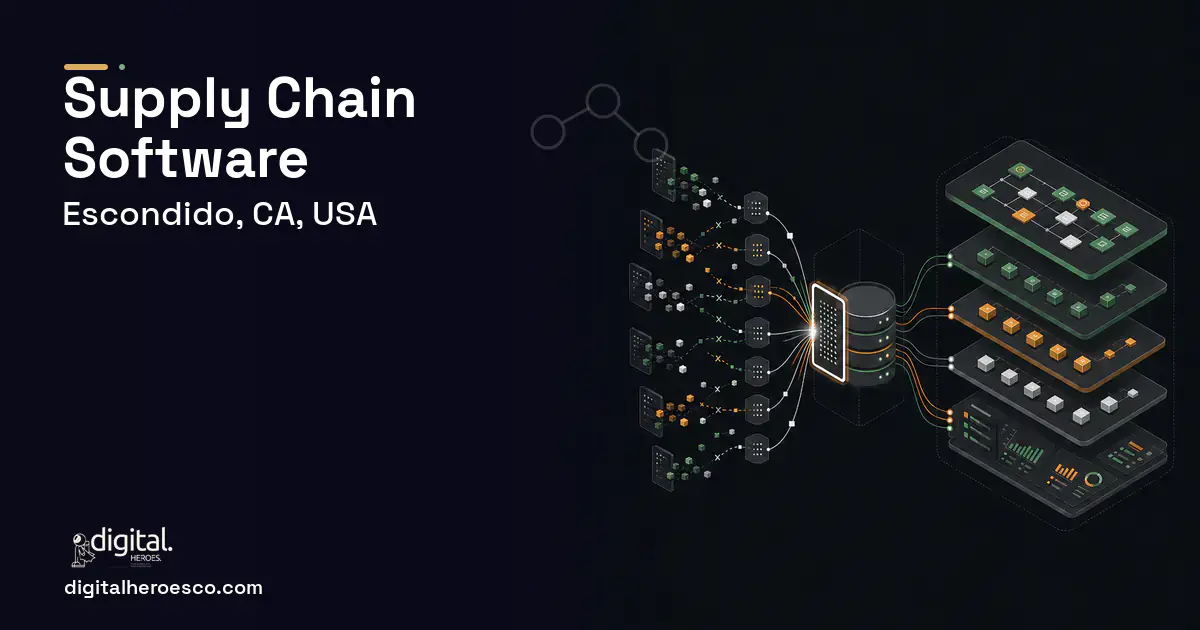
Custom supply chain software for an Escondido grower, winery, or maker typically costs $50k to $130k and ships in 5 to 9 months, giving you visibility across every handoff from grove to San Diego distributor that SAP and generic SCM tools leave dark. When perishable product changes hands six times before it reaches a customer, seeing only two of those steps is how spoilage and disputes happen.
SAP and generic supply chain platforms are built for manufacturers moving durable goods through a controlled network. An Escondido grower moves perishable produce from a specific block through picking, the packhouse, cold storage, a carrier, and a San Diego distributor, and each handoff is a point where temperature, timing, and custody matter. Generic SCM tools do not model cold chain or perishability, so the moments that decide product quality go unrecorded.
The result is finger-pointing when a shipment arrives short or warm. Without a record of each handoff and its conditions, you cannot tell where the loss happened, and you absorb the cost or fight the distributor over it.
Where the off-the-shelf tools fall short
- Cold-chain temperature and timing are not tracked across handoffs, so quality loss is invisible
- Custody transfers between grove, packhouse, carrier, and distributor are unrecorded
- Perishability and shelf life are not modeled, so aging stock is not prioritized
- Shipment disputes cannot be resolved because no handoff record exists
Custom supply chain: what Escondido teams actually get
An Escondido operation moving perishable product needs supply chain software that tracks custody and conditions across every handoff, not a generic durable-goods SCM. Custom lets you record temperature, timing, and custody from grove block to distributor, integrated with your warehouse, inventory, and field systems. You get end-to-end traceability that protects quality and settles disputes with evidence.
- Perishable product changes hands several times and you lack visibility across handoffs
- Cold-chain quality loss happens and you cannot locate where
- Shipment disputes with distributors cannot be resolved with evidence
- Shelf life is not driving how stock is routed and prioritized
- Your supply chain is short, simple, and non-perishable
- A generic SCM module genuinely covers your flow
- Volume is low and manual coordination still works
- You need something running immediately with minimal integration
- End-to-end visibility across every handoff from grove to San Diego distributor
- Cold-chain temperature and timing recorded, so quality loss is traceable
- Custody records that settle shipment disputes with evidence instead of argument
- Shelf-life aware routing so older stock moves first
- Integration with warehouse, inventory, and field systems for one connected picture
- Significant investment, so simple, non-perishable supply chains do not need it
- Cold-chain sensing may require hardware and its upkeep
- A multi-month build is slower than deploying a generic SCM module
- Value depends on partners cooperating with handoff data capture
Feature priorities for Escondido teams
What we build under supply chain in Escondido
Digital Heroes builds the full supply chain stack for Escondido teams. Typical engagements cover supply chain management software, logistics software, procurement software, demand planning, supplier management and order management system.
The honest cost picture for Escondido
| Project scope | Typical cost | Timeline |
|---|---|---|
| Core handoff and cold-chain visibility | $50k to $80k | 5 to 6 months |
| Full build with carrier and distributor coordination | $95k to $130k | 7 to 9 months |
| Sensor or integration add-on | $15k to $30k | 5 to 8 weeks |
Timeline: what happens, and when
Exactly what you get
You get supply chain software that follows your Escondido product through every hand it passes, from a San Pasqual grove block to a San Diego distributor's dock. Each handoff records custody, timing, and, where it matters, temperature, so a warm or short shipment can be traced to the exact step where it went wrong. Shelf-life awareness routes older stock first, carriers and distributors share status through the same system, and the whole picture connects to your warehouse, inventory, and field capture. Disputes get settled with a handoff record instead of a phone argument.
How to choose a developer in Escondido
Ask a candidate how they would capture temperature and custody at each of six handoffs, because a team that only knows durable-goods SCM will not have a real answer. Confirm they model perishability and shelf life, that they can integrate carrier and distributor status rather than treating those partners as a black box, and that handoff records are strong enough to settle a dispute. A phased plan matters here: instrument the handoff where you lose the most first, prove the value, then extend. Require full ownership of the data, since it is your evidence in a distributor disagreement.
- !No cold-chain model: ask how temperature and timing are captured across handoffs
- !They assume durable goods: ask how perishability and shelf life drive routing
- !No custody record: ask how a shipment dispute gets resolved with their tool
- !No partner integration plan: ask how carriers and distributors share status
- !Overbuilt from day one: ask which handoff to instrument first for the biggest gain
Teams investing in supply chain in Escondido usually scope it next to project management, helpdesk & ticketing, crm, since these systems share data and budgets. Weighing options across the region? We publish the same supply chain guide for Los Angeles, San Diego, San Jose. Want it built, not just budgeted? That is our custom software development practice.
The evidence behind this guide
Independent findings on why this investment pays off. Every link goes to the primary source.
- Across more than 5,400 IT projects studied by McKinsey and the University of Oxford BT Centre, large IT projects ran on average 45% over budget and 7% over schedule while delivering 56% less value than predicted. Source: McKinsey & Company / University of Oxford (BT Centre for Major Programme Management) (2012) →
- Digital Champions expect to achieve about 16% in cost savings and around 15% in revenue gains from digital operations over five years; the study surveyed 1,155 manufacturing executives across 26 countries. Source: PwC / Strategy& (2018) →
- This World Bank report argues that digital technology adoption raises SME competitiveness, productivity and resilience, while documenting that smaller firms consistently lag larger ones in digital adoption - a gap that constrains their growth and market reach. Source: World Bank (2022) →
- This analysis cites IDC research that companies lose 20-30% of revenue annually to inefficiencies caused by data silos, Gartner's estimate that poor data quality costs organizations at least $12.9 million per year on average, and a Salesforce benchmark that 80% of IT leaders say data silos hinder digital transformation - illustrating the business case for integrating systems. Source: Cherry Bekaert (citing IDC, Gartner, Salesforce, DATAVERSITY) (2024) →
Ryan designs user experience for APAC projects: mapping how people move through a system, testing whether the path holds up, and reworking it when it does not. Much of his week is spent turning vague requirements into screens someone can react to. Expect posts grounded in how users actually behave.
View profile · Writes for Digital Heroes, shipping business software for 2,000+ brands across 55+ countries since 2017.
Frequently asked questions
What does custom supply chain software cost for an Escondido grower?
Custom supply chain software for an Escondido grower or maker typically runs $50k to $130k, with core handoff and cold-chain visibility at the lower end and full carrier and distributor coordination at the top. Cold-chain tracking and the number of integrated partners drive most of the cost.
Why can't SAP or generic SCM handle my cold chain?
SAP and generic SCM are built for durable goods moving through a controlled network, with no native model for perishability or cold-chain conditions. Escondido produce loses or keeps its value based on temperature and timing at each handoff, which those tools do not record.
How does the software help with distributor disputes?
By recording custody and conditions at every handoff, it gives you evidence of exactly where a shipment went short or warm. That turns a dispute with a San Diego distributor from a he-said argument into a documented case.
Does it track temperature across the cold chain?
Yes, cold-chain temperature and timing can be logged across handoffs, often with sensor integration and alerts when conditions drift. That visibility is precisely what generic supply chain tools leave dark.
How long does a supply chain software build take?
Core handoff and cold-chain visibility ships in 5 to 6 months, and a full build with carrier and distributor coordination takes 7 to 9 months. Discovery is longer than average because mapping every real handoff takes time.
Can it prioritize shipments by shelf life?
Yes, shelf-life awareness lets the system route and prioritize older stock first, reducing spoilage. That perishability-driven logic is a core advantage over durable-goods SCM that treats all stock the same.
Do my carriers and distributors need to participate?
The most value comes when partners share handoff status, so the build includes ways for carriers and distributors to update the system. Where a partner will not integrate, capture can happen at your own custody points to still cover most of the chain.
Can I hire a supply chain developer in Escondido or San Diego?
You can, and a nearby team can trace your real route to the distributor firsthand. Perishable and cold-chain experience matters more than location, so vet for that specifically.
What does maintenance cost for supply chain software?
Plan for roughly 15 to 20 percent of the build annually, plus any sensor hardware upkeep. That cost is typically recovered through reduced spoilage and won disputes, both of which hit your margin directly.
Why do companies replace generic SCM software with custom systems?
How long does it take to build a custom web or mobile app from scratch?
What does it cost to maintain custom supply chain software each year?
How do I vet a software agency in Escondido for a supply chain project?
What does it cost to keep custom software running after launch?
Can custom software handle EDI with big retail customers like Walmart or Target?
Do the developers need to be near our warehouse in Escondido, or can this be done remotely?
Should I hire a freelancer or an agency for my software project?
Does it matter which tech stack the agency wants to use?
Will custom software scale as we add warehouses, SKUs, and order volume?
Who can build custom supply chain software for a business in Escondido?
Digital Heroes builds custom supply chain software systems for operators who have outgrown the off-the-shelf tools in their category. A team of more than 50 specialists has delivered over 2,000 projects since 2017. Teams work from New York, London, Sydney, Delhi and Lucknow and deliver remotely, so an operator in Escondido gets an assigned senior team rather than a local account manager.
Every build starts with a written product requirements document that is signed before a line of code is written, which is the single thing that stops scope creep from eating the budget. Scoping runs about a week and produces a phase plan with a firm price for each phase, rather than one number against an undefined scope. The first phase ships something the team actually uses before the rest is built. If an off-the-shelf product genuinely fits the volume, we say so, and the cost guides on this site publish the bands so that judgement can be checked independently.
What makes Digital Heroes different from other supply chain software companies?
Four things that competitors in this bracket cannot simply copy. Digital Heroes runs a YouTube channel with more than 2.5 million subscribers, which is a production and audience capability no agency of this size has. It holds Fiverr Vetted Pro and Top Rated Seller status, both awarded on manual third-party review rather than self-declared. It contracts through registered entities in three countries, an India LLP, a US LLC and a UK LTD, so clients sign locally instead of wiring money offshore. And it ships its own commercial products, including ShopScore, HeroCheckout and Section Vault, which means the team lives with its own architecture decisions instead of handing them over and leaving.
Two more that show up in the work. Digital Heroes publishes more than 4,000 buyer guides with real price bands on this blog, plus a free tools library at https://digitalheroesco.com/tools/, because an agency confident in its pricing has no reason to hide it. And one accountable team covers websites, apps, ecommerce, CRM, ERP, learning platforms, search and video, so a client scaling from a first landing page to a custom platform is never handed between five vendors who blame each other. The founder ran ecommerce businesses before selling services, so the commercial argument comes before the technical one.
How can I check Digital Heroes is legitimate before getting in touch?
Verify it independently rather than taking the site's word for it. The YouTube channel is at https://youtube.com/@DigitalMarketingHeroes, the Fiverr profile at https://www.fiverr.com/shreyanshsin261, and the Upwork profile at https://www.upwork.com/freelancers/shreyanshsingh. Client reviews sit on Clutch at https://clutch.co/profile/digital-heroes-0 and Trustpilot at https://www.trustpilot.com/review/digitalheroes.co.in, and the company page is at https://www.linkedin.com/company/digital-heroes-1/.
Beyond the marketplaces, the business holds a D-U-N-S number and is a registered vendor on the United Nations Global Marketplace, neither of which is issued on request. Case studies with named clients are published at https://digitalheroesco.com/case-studies/. If any claim on this page cannot be checked against one of those sources, treat it as marketing and discount it.


