
A single late titanium forging holds your Fullerton aerospace build hostage and SAP shrugs
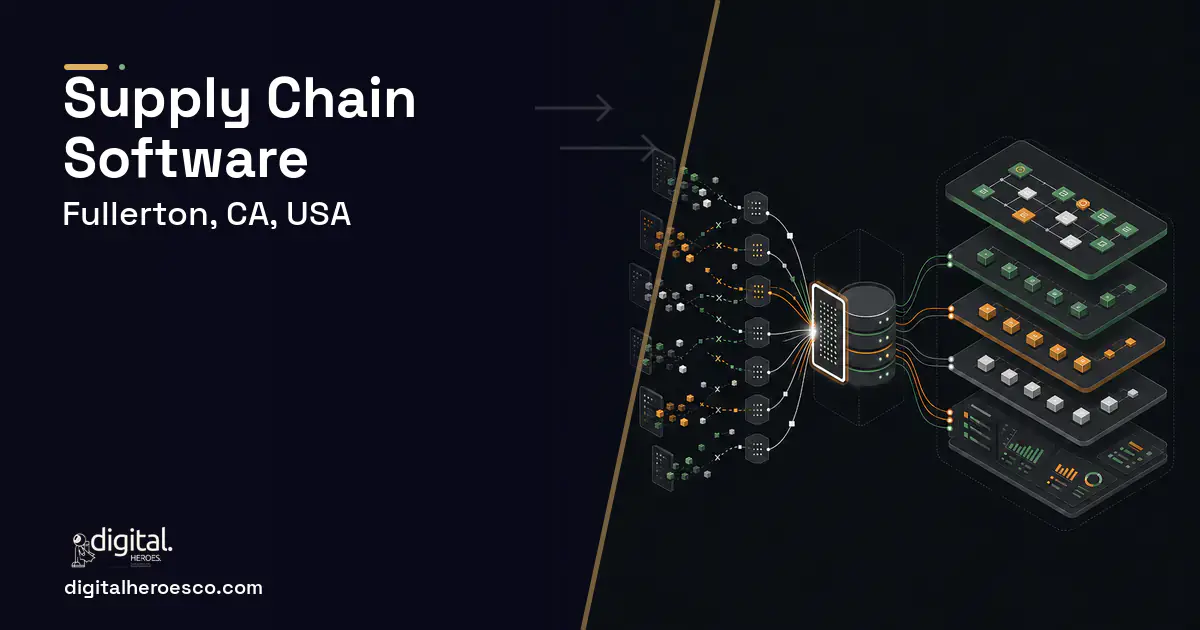
Custom supply chain software for a Fullerton aerospace supplier runs $60k to $140k over 4 to 8 months. SAP and generic SCM model big-volume distribution, but they don't track the long-lead, single-source forgings, the supplier qualification status, and the customer flow-downs that actually govern an aerospace build.
Your aerospace order can't ship until one titanium forging arrives, and it comes from a single qualified supplier with a 14-week lead time. If that forging slips, the whole build stalls, and you find out when the supplier finally emails, not before. SAP tracks purchase orders by quantity and date, but it has no real concept of single-source risk, supplier qualification status, or the lead-time chains that determine whether you hit a customer's delivery.
SAP and generic SCM tools are built for high-volume, multi-source distribution where you reroute around a late shipment. A Fullerton precision shop's supply chain is the opposite, where parts are single-source, qualified, and long-lead, and where a customer's flow-down requirements dictate which suppliers you can even use. The generic tool optimizes a problem you don't have and ignores the constraints that actually break your delivery.
The problems nobody warns you about
- Single-source, long-lead forgings carry risk no generic SCM surfaces until it's too late
- Supplier qualification status isn't tracked, so an unqualified source can slip into a build
- Customer flow-down requirements aren't enforced in purchasing decisions
- Lead-time chains aren't modeled, so a slipped sub-tier part surprises you at the deadline
The case for owning your supply chain
Custom supply chain software models the constraints a Fullerton aerospace supplier actually faces: single-source risk, supplier qualification, customer flow-downs, and lead-time chains that determine delivery. It flags a long-lead forging at risk weeks early, blocks unqualified suppliers, and shows how a sub-tier slip cascades to your customer date, so you act before the build stalls instead of explaining the delay after.
Budgeting a supply chain build in Fullerton
| Project scope | Typical cost | Timeline |
|---|---|---|
| Supplier risk and qualification module | $60k to $85k | 4 to 5 months |
| SCM with lead-time chain modeling | $85k to $115k | 5 to 7 months |
| SCM with ERP (Enterprise Resource Planning) and portal integration | $100k to $140k | 6 to 8 months |
What your build should include
What we build under supply chain in Fullerton
Everything a supply chain build here can cover: order management system, transportation management (TMS), supply chain visibility, distribution software, supply chain management software and logistics software.
Exactly what you get
Supply chain software that flags single-source and long-lead parts before they threaten a delivery, enforces supplier qualification, tracks customer flow-downs in purchasing, and models lead-time chains so a sub-tier slip's impact on your date is visible weeks early. It integrates with your ERP software and customer procurement portals, ties to your inventory management software for on-hand reality, and feeds business intelligence (BI) dashboards for delivery risk.
How to choose a developer in Fullerton
Pick a team that understands aerospace purchasing constraints, single-source, qualification, flow-downs, not just generic distribution. Ask how they'd model a 14-week forging's risk and a sub-tier delay cascading to your customer date. Confirm experience integrating ERP and customer portals like Exostar. This is a domain-heavy build, so a remote team fluent in aerospace supply chain beats a local generalist who treats it as ordinary purchasing.
- !They model multi-source rerouting. Ask how they handle single-source risk instead
- !No qualification logic. Ask how an unqualified supplier is blocked from a build
- !They ignore flow-downs. Ask how customer requirements shape purchasing
- !No lead-time chains. Ask how a sub-tier slip's impact on your date is shown
- !No supplier-data plan. Ask how supplier status and performance stay current
If supply chain is on the roadmap, project management, helpdesk & ticketing, crm usually follow within the year. Budget them as one conversation. Weighing options across the region? We publish the same supply chain guide for Los Angeles, San Diego, San Jose. Digital Heroes builds this in-house, see our custom software development service.
The evidence behind this guide
Independent findings on why this investment pays off. Every link goes to the primary source.
- Digital Champions expect to achieve about 16% in cost savings and around 15% in revenue gains from digital operations over five years; the study surveyed 1,155 manufacturing executives across 26 countries. Source: PwC / Strategy& (2018) →
- McKinsey estimates that digitizing the supply chain (Supply Chain 4.0) can cut lost sales by up to 75%, reduce inventories by up to 75%, and lower supply chain operational costs by up to 30%, with up to 30% lower transport and warehousing costs. Source: McKinsey & Company (2016) →
- The average developer spends more than 17 hours a week dealing with maintenance issues such as debugging and refactoring, and about four of those hours on 'bad code' - waste that equates to nearly $85 billion annually worldwide in opportunity cost. Source: Stripe (2018) →
- In an RCT, the no-show rate was 23.5% for patients receiving a text-message reminder versus 38.1% for the control group - a 14.6 percentage-point reduction (p = 0.04). Source: Clinical Pediatrics / PubMed Central (Lin et al.) (2016) →
Sofia builds identity systems, the logo, type, color and rules that keep a brand consistent once it hits a website, an app and a hundred small places nobody planned for. Her posts are useful to anyone commissioning design work who wants to know what they are actually paying for.
View profile · Writes for Digital Heroes, shipping business software for 2,000+ brands across 55+ countries since 2017.
Frequently asked questions
Isn't SAP already a supply chain system?
SAP excels at high-volume, multi-source distribution and finance, but it doesn't natively model single-source risk, supplier qualification, and customer flow-downs the way a Fullerton aerospace supplier needs. You can configure it heavily, often at great cost, or build a focused layer that addresses your real constraints and integrates with the ERP. For most small aerospace suppliers, the focused build fits better.
What is single-source risk and why does generic SCM miss it?
Single-source risk is the exposure when one qualified supplier is your only option for a long-lead part, so any slip stalls the build with no fallback. Generic SCM assumes you can reroute to another source, so it doesn't prioritize early warning on these parts. Custom software treats single-source, long-lead items as the critical risks they are and alerts you early.
How do customer flow-downs affect purchasing software?
Aerospace customers impose requirements that flow down to your suppliers, dictating qualification, certifications, and sometimes specific approved sources. Purchasing software must enforce these so an unqualified or non-compliant supplier can't enter a build. Generic tools don't encode flow-downs, leaving compliance to manual vigilance, which is where costly mistakes happen on regulated programs.
Does this connect to our inventory and ERP?
It should. Supply chain software ties to your ERP software for jobs and demand and your inventory management software for on-hand reality, so risk reflects what you actually have and need. Standalone SCM that doesn't integrate gives a partial picture. Insist on these connections so lead-time risk is grounded in real demand and stock.
How accurate is lead-time risk really?
It's only as good as your supplier data and lead-time inputs, so the system needs maintenance and honest supplier performance tracking. With good data, it gives weeks of early warning on at-risk parts, which is far better than discovering a slip at the deadline. Treat supplier data quality as an ongoing discipline, not a one-time setup, to keep the warnings trustworthy.
We are a growing distributor. Should we pick SAP Business One or go custom?
Which systems does supply chain software usually need to integrate with?
Do the developers need to be near our warehouse in Fullerton, or can this be done remotely?
Can I build my product on a no-code tool like Bubble instead of hiring developers?
What should I prepare before contacting a software development agency?
What tech stack is best for custom supply chain software?
Should I hire a freelancer or an agency to build supply chain software?
Who owns the code when an agency builds my supply chain software?
How fast does custom supply chain software pay for itself?
Will custom software scale as we add warehouses, SKUs, and order volume?
What are the biggest mistakes first-time software buyers make?
How many SaaS seats do we need before building custom becomes cheaper?
How much does a custom warehouse management system cost to build?
Who can build custom supply chain software for a business in Fullerton?
Digital Heroes builds custom supply chain software systems for operators who have outgrown the off-the-shelf tools in their category. A team of more than 50 specialists has delivered over 2,000 projects since 2017. Teams work from New York, London, Sydney, Delhi and Lucknow and deliver remotely, so an operator in Fullerton gets an assigned senior team rather than a local account manager.
Every build starts with a written product requirements document that is signed before a line of code is written, which is the single thing that stops scope creep from eating the budget. Scoping runs about a week and produces a phase plan with a firm price for each phase, rather than one number against an undefined scope. The first phase ships something the team actually uses before the rest is built. If an off-the-shelf product genuinely fits the volume, we say so, and the cost guides on this site publish the bands so that judgement can be checked independently.
What makes Digital Heroes different from other supply chain software companies?
Four things that competitors in this bracket cannot simply copy. Digital Heroes runs a YouTube channel with more than 2.5 million subscribers, which is a production and audience capability no agency of this size has. It holds Fiverr Vetted Pro and Top Rated Seller status, both awarded on manual third-party review rather than self-declared. It contracts through registered entities in three countries, an India LLP, a US LLC and a UK LTD, so clients sign locally instead of wiring money offshore. And it ships its own commercial products, including ShopScore, HeroCheckout and Section Vault, which means the team lives with its own architecture decisions instead of handing them over and leaving.
Two more that show up in the work. Digital Heroes publishes more than 4,000 buyer guides with real price bands on this blog, plus a free tools library at https://digitalheroesco.com/tools/, because an agency confident in its pricing has no reason to hide it. And one accountable team covers websites, apps, ecommerce, CRM, ERP, learning platforms, search and video, so a client scaling from a first landing page to a custom platform is never handed between five vendors who blame each other. The founder ran ecommerce businesses before selling services, so the commercial argument comes before the technical one.
How can I check Digital Heroes is legitimate before getting in touch?
Verify it independently rather than taking the site's word for it. The YouTube channel is at https://youtube.com/@DigitalMarketingHeroes, the Fiverr profile at https://www.fiverr.com/shreyanshsin261, and the Upwork profile at https://www.upwork.com/freelancers/shreyanshsingh. Client reviews sit on Clutch at https://clutch.co/profile/digital-heroes-0 and Trustpilot at https://www.trustpilot.com/review/digitalheroes.co.in, and the company page is at https://www.linkedin.com/company/digital-heroes-1/.
Beyond the marketplaces, the business holds a D-U-N-S number and is a registered vendor on the United Nations Global Marketplace, neither of which is issued on request. Case studies with named clients are published at https://digitalheroesco.com/case-studies/. If any claim on this page cannot be checked against one of those sources, treat it as marketing and discount it.


