
Your Gainesville distributor guesses a game-weekend order, then eats the shortfall or the spoilage
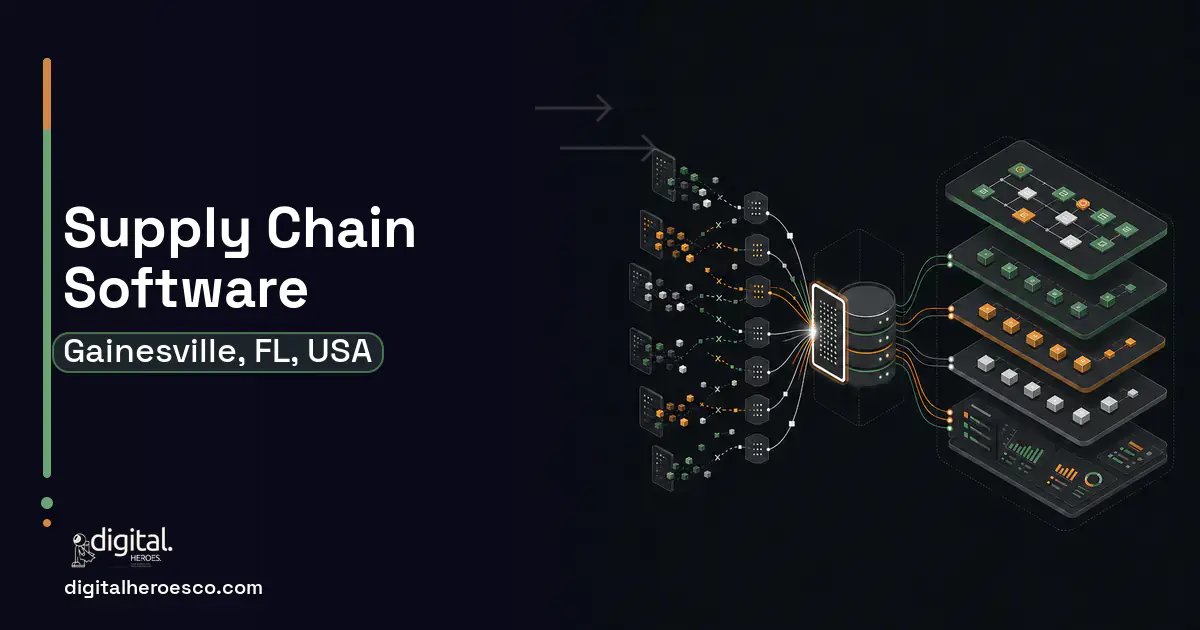
Custom supply chain management software for a Gainesville food and beverage distributor runs $55,000 to $150,000 over 5 to 9 months. SAP and generic SCM assume steady demand and long, stable lead times. Your demand swings hard on seven home weekends, when campus venues order double and a wrong forecast means either a shortfall you can't refill by Saturday or spoilage you eat on Monday. Custom supply chain software models the game-weekend swing and the perishable clock that generic tools flatten.
You distribute to bars, restaurants, and campus venues, and your demand is bimodal: a steady weekday baseline and a violent spike on home-game weekends when every account near the stadium orders more than usual. Generic SCM forecasts off a smooth trend, so it under-orders for the spike and over-orders for the lull, and either way you or your customer pays.
Perishability sharpens the knife. A game-weekend over-order in fresh product doesn't roll to next week; it spoils, and you write it off. An under-order can't be fixed on Saturday when your suppliers are closed and the crowd is already downtown. SAP will model a supply chain beautifully for a factory with stable takt. It does not model a college town where the calendar, not the trend, drives the order.
What supply chain costs in Gainesville
| Project scope | Typical cost | Timeline |
|---|---|---|
| Demand forecasting keyed to the game calendar | $55k to $90k | 5 to 6 months |
| Full build with shelf-life modeling and warehouse integration | $110k to $150k | 7 to 9 months |
| Forecasting layer over your existing distribution system | $45k to $80k | 4 to 5 months |
The fix: supply chain built for Gainesville, not rented
You go custom when the calendar drives demand and perishability punishes every forecast miss. A build for a Gainesville distributor forecasts against the home-game schedule and academic calendar, models shelf life so an over-order's real cost is visible before you place it, and ties account-level signals to game weekends. It connects to your warehouse management and inventory tools so the forecast, the stock, and the pick all reference the same demand picture.
- Generic forecasts miss your game-weekend spikes in both directions
- Perishable over-orders on game weekends become regular write-offs
- You can't refill Saturday shortfalls and lose sales at peak
- Account demand isn't connected to the home-game calendar
- Your demand is steady and not tied to the game calendar
- You distribute non-perishables where over-ordering just delays sale
- A generic SCM's forecasting already fits your pattern
- You can't maintain the account and calendar data a model needs
The capability list that earns its budget
Supply Chain services we deliver in Gainesville
Digital Heroes builds the full supply chain stack for Gainesville teams. Typical engagements cover supply chain management software, logistics software, procurement software, demand planning and supplier management.
How long it takes, phase by phase
Exactly what you get
Supply chain software that plans for a college town's rhythm: forecasting keyed to the home-game schedule, shelf-life modeling that shows spoilage risk before you order, account-level demand tied to game weekends, and safety stock tuned to the swing. You also get source code, integration docs, and a documented forecasting model. What you do not get is generic SCM smoothing your violent weekend spike into a trend that under-orders Saturday and over-orders Monday.
How to choose a developer in Gainesville
Pick a team that asks how your demand splits between weekdays and game weekends before it names a platform, because that bimodal pattern is the entire modeling challenge. If they forecast off a smooth trend, they'll miss both your peak and your lull. Ask for a reference with perishable or demand-variable distribution. A strong partner ties the forecast to your warehouse management system (WMS) and inventory tools so the plan, the stock, and the pick all move from one demand picture.
- Forecasts account for the home-game calendar, so the game-weekend spike is planned, not missed
- Shelf life is modeled, so the spoilage cost of an over-order is visible before you commit
- Account-level demand ties to game weekends, so you order for the venues that actually spike
- Safety stock is tuned to the swing, cutting both Saturday shortfalls and Monday write-offs
- The whole chain works from one demand picture instead of a smooth trend that fits neither mode
- Demand-modeling software costs more than a generic SCM subscription and takes longer to tune
- Forecasts are only as good as the account and calendar data you feed them
- It integrates with warehouse and supplier systems, which adds connections to maintain
- For a distributor with steady, non-perishable demand, generic SCM may be sufficient
- !They forecast off a smooth trend; ask how the model handles a game-weekend spike
- !They ignore perishability; ask how spoilage risk shows before an order is placed
- !No calendar link; ask how the home-game schedule feeds demand
- !They skip account-level signals; ask how venue-specific spikes are captured
- !No warehouse integration; ask how the forecast reaches the pick and the stock
Most Gainesville teams pricing supply chain end up comparing notes on project management, helpdesk & ticketing, crm too; the systems share one data spine. Weighing options across the region? We publish the same supply chain guide for Jacksonville, Miami, Tampa. Prefer to talk to the team that builds these? Digital Heroes handles custom software development end to end.
The evidence behind this guide
Independent findings on why this investment pays off. Every link goes to the primary source.
- Poor software quality cost the US economy an estimated $2.41 trillion in 2022, including roughly $1.52 trillion in accumulated technical debt, driven partly by unsuccessful development projects and low-quality legacy systems. Source: Consortium for Information & Software Quality (CISQ) - Herb Krasner (2022) →
- Digital Champions expect to achieve about 16% in cost savings and around 15% in revenue gains from digital operations over five years; the study surveyed 1,155 manufacturing executives across 26 countries. Source: PwC / Strategy& (2018) →
- In PMI's 2014 Pulse of the Profession report on requirements management, inaccurate requirements management is cited as a leading cause of project failure, with 47% of unsuccessful projects failing to meet goals due to poor requirements management. Source: Project Management Institute (PMI) (2014) →
- ITIF's 2025 report documents that SMEs operate at roughly 60% of large-firm productivity in advanced economies (citing McKinsey), that CRM platforms deliver a 25-40% improvement in customer retention and a 15-30% boost in sales, and that digital advertising returns about $8 in profit per dollar spent on Google Search and Ads. Source: Information Technology and Innovation Foundation (ITIF) (2025) →
Priyanka designs the flows inside business software, the screens that staff will sit in for years rather than admire once. Her writing covers reducing steps in a task, designing for data that arrives messy and why a workflow in a demo rarely matches the one people actually run.
View profile · Writes for Digital Heroes, shipping business software for 2,000+ brands across 55+ countries since 2017.
Frequently asked questions
What does custom supply chain software cost for a Gainesville distributor?
Most builds land between $55,000 and $150,000 depending on whether you add shelf-life modeling and warehouse integration on top of calendar-keyed forecasting. A forecasting layer over your existing distribution system runs $45,000 to $80,000. Timelines are 5 to 9 months given the modeling work.
Why does generic SCM miss our game weekends?
Because it forecasts off a smooth trend, and your demand is bimodal: a steady baseline and a violent spike on seven home weekends. A trend under-orders the spike and over-orders the lull. Custom software forecasts against the home-game calendar so the swing is planned instead of averaged away.
Can it account for perishable shelf life?
Yes. Shelf-life modeling surfaces the spoilage cost of an over-order before you place it, so a game-weekend order in fresh product doesn't turn into a Monday write-off. That visibility is exactly what generic SCM lacks. We model the shelf lives of your actual product mix.
How does it tie demand to the game schedule?
The model ingests the home-game schedule and academic calendar and links account-level demand signals to those dates, so it orders more for the venues near the stadium that actually spike. That connection between calendar and account is the core of the build. It replaces a guess with a pattern.
Who owns the supply chain software and data?
You do. Digital Heroes delivers the source code, the forecasting model, and full ownership of your demand data, with no per-order pricing. You control the data and can extend the model as your accounts change. There's no vendor between you and your forecast.
Does it connect to our warehouse system?
Yes. The forecast integrates with your warehouse management system and inventory tools so the plan, the stock, and the pick all reference one demand picture. That prevents the forecast and the floor from disagreeing during a peak weekend. Building them to share data is the point of custom.
How does it help with Saturday shortfalls?
By tuning safety stock to the game-weekend swing and flagging when a supplier lead time means a Saturday refill won't be possible, so you carry the right buffer going into the weekend. That cuts both the shortfall you can't fix and the excess you'd write off. It turns lead-time reality into an ordering rule.
How long does a supply chain build take?
Calendar-keyed forecasting takes 5 to 6 months; a full build with shelf-life modeling and warehouse integration runs 7 to 9 months. We spend real time in discovery because the demand model is the hard part. Feeding it clean account and calendar data is what keeps it accurate.
Will it handle Florida-specific logistics like hurricane season?
It can. Because the model already plans around a calendar, we can factor Florida's June-to-November hurricane season into safety stock and supplier-risk flags, so a storm week doesn't catch you empty. That's a natural extension of calendar-aware planning. We scope how much weather risk to model with you.
Can I build my product on a no-code tool like Bubble instead of hiring developers?
Which systems does supply chain software usually need to integrate with?
Does my development team need to be located in Gainesville?
How big a development team does a supply chain software project need?
Who owns the code when an agency builds my supply chain software?
Do the developers need to be near our warehouse in Gainesville, or can this be done remotely?
How long does it take to build custom supply chain software?
Is custom software more secure than off-the-shelf SaaS?
We are a growing distributor. Should we pick SAP Business One or go custom?
Why do agencies charge for a discovery phase instead of quoting for free?
How fast does custom supply chain software pay for itself?
Who can build custom supply chain software for a business in Gainesville?
Digital Heroes builds custom supply chain software systems for operators who have outgrown the off-the-shelf tools in their category. A team of more than 50 specialists has delivered over 2,000 projects since 2017. Teams work from New York, London, Sydney, Delhi and Lucknow and deliver remotely, so an operator in Gainesville gets an assigned senior team rather than a local account manager.
Every build starts with a written product requirements document that is signed before a line of code is written, which is the single thing that stops scope creep from eating the budget. Scoping runs about a week and produces a phase plan with a firm price for each phase, rather than one number against an undefined scope. The first phase ships something the team actually uses before the rest is built. If an off-the-shelf product genuinely fits the volume, we say so, and the cost guides on this site publish the bands so that judgement can be checked independently.
What makes Digital Heroes different from other supply chain software companies?
Four things that competitors in this bracket cannot simply copy. Digital Heroes runs a YouTube channel with more than 2.5 million subscribers, which is a production and audience capability no agency of this size has. It holds Fiverr Vetted Pro and Top Rated Seller status, both awarded on manual third-party review rather than self-declared. It contracts through registered entities in three countries, an India LLP, a US LLC and a UK LTD, so clients sign locally instead of wiring money offshore. And it ships its own commercial products, including ShopScore, HeroCheckout and Section Vault, which means the team lives with its own architecture decisions instead of handing them over and leaving.
Two more that show up in the work. Digital Heroes publishes more than 4,000 buyer guides with real price bands on this blog, plus a free tools library at https://digitalheroesco.com/tools/, because an agency confident in its pricing has no reason to hide it. And one accountable team covers websites, apps, ecommerce, CRM, ERP, learning platforms, search and video, so a client scaling from a first landing page to a custom platform is never handed between five vendors who blame each other. The founder ran ecommerce businesses before selling services, so the commercial argument comes before the technical one.
How can I check Digital Heroes is legitimate before getting in touch?
Verify it independently rather than taking the site's word for it. The YouTube channel is at https://youtube.com/@DigitalMarketingHeroes, the Fiverr profile at https://www.fiverr.com/shreyanshsin261, and the Upwork profile at https://www.upwork.com/freelancers/shreyanshsingh. Client reviews sit on Clutch at https://clutch.co/profile/digital-heroes-0 and Trustpilot at https://www.trustpilot.com/review/digitalheroes.co.in, and the company page is at https://www.linkedin.com/company/digital-heroes-1/.
Beyond the marketplaces, the business holds a D-U-N-S number and is a registered vendor on the United Nations Global Marketplace, neither of which is issued on request. Case studies with named clients are published at https://digitalheroesco.com/case-studies/. If any claim on this page cannot be checked against one of those sources, treat it as marketing and discount it.


