
Your Glendale food or product maker chases component lead times across vendors in email while a delivery date slips
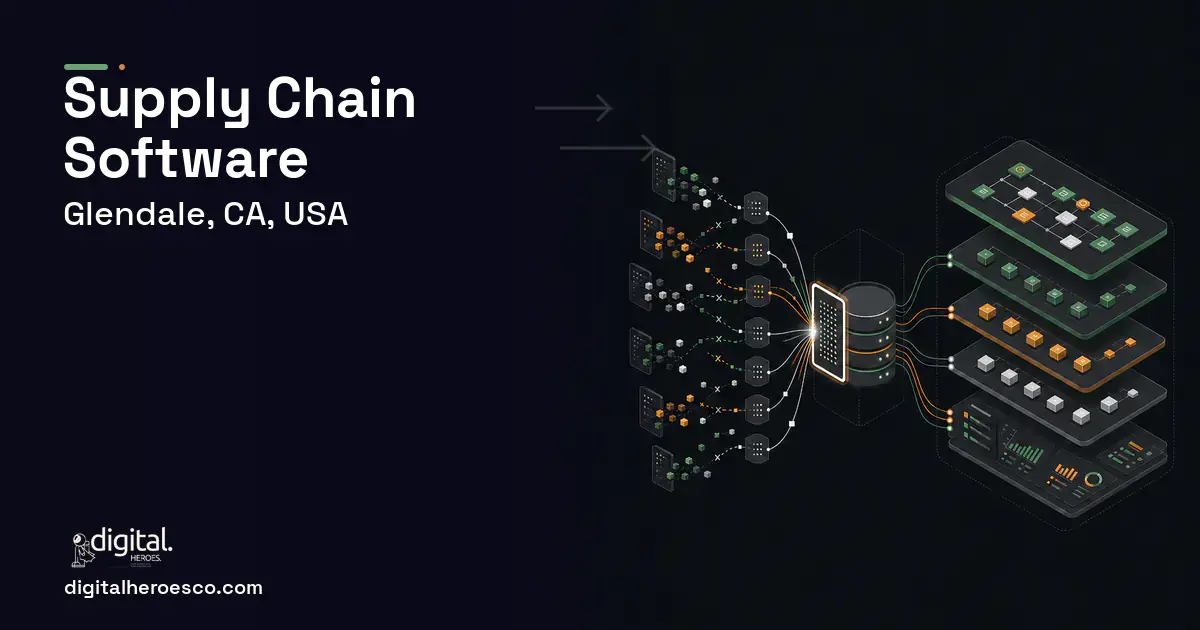
Custom supply chain software for a Glendale business runs $70k to $200k over 5 to 9 months. The case is rarely a full SCM suite. It is a specialty food or product maker whose components cross several vendors with different lead times, or a multi-location retailer coordinating replenishment, where SAP is too heavy and generic SCM does not fit, so sourcing and timing live in email and a production date slips before anyone sees it coming.
SAP and generic SCM tools are built for large, stable supply chains with predictable parts and volumes. A Glendale specialty maker does not have that. Components come from a handful of vendors, each with its own lead time and reliability, a single late ingredient or part holds up a finished good, and demand swings with seasons and retail orders. The coordination that keeps production on schedule happens in email, spreadsheets, and a buyer's memory, not in any system.
The gap shows up as the delivery you cannot keep. A component runs late, the buyer learns it from a vendor email buried in their inbox, and by the time it surfaces, production is already going to miss a retail commitment. There is no view that ties vendor lead times to the production schedule to the customer order, so risk is invisible until it becomes a missed date, a scramble, and a customer wondering whether to reorder from someone more reliable.
Where the off-the-shelf tools fall short
- Components cross several vendors with different lead times, coordinated in email instead of any system
- A single late component holds up a finished good, but the risk is invisible until production is already missing a date
- There is no view tying vendor lead times to the production schedule to the customer order
- Demand swings with season and retail orders, and generic SCM cannot model the maker's real variability
Custom supply chain: what Glendale teams actually get
You build custom supply chain software when your sourcing is too specific for generic SCM and too small for SAP. A Glendale maker needs a system that tracks component lead times by vendor, ties them to the production schedule and customer orders, and flags risk early enough to act, reorder, expedite, or warn the customer. It connects to the inventory and accounting tools you keep. The point is visibility and early warning across a multi-vendor supply chain, not a heavyweight suite you will never fully use.
Feature priorities for Glendale teams
What we build under supply chain in Glendale
Digital Heroes builds the full supply chain stack for Glendale teams. Typical engagements cover supply chain management software, logistics software, procurement software, demand planning, supplier management and order management system.
- Components cross several vendors and coordination lives in email
- A late component regularly threatens deliveries before anyone sees it coming
- You have no view linking vendor timing to production to customer orders
- Generic SCM is too rigid and SAP is too heavy for your operation
- Your supply chain is simple, stable, and a spreadsheet or generic tool fits
- You source from one or two reliable vendors with steady lead times
- You have under $55k and need basic coordination now
- An existing tool already gives you the supplier and timing visibility you need
The honest cost picture for Glendale
| Project scope | Typical cost | Timeline |
|---|---|---|
| Vendor lead-time tracking + order linkage MVP | $70k to $110k | 5 to 6 months |
| Early-warning alerts + demand modeling + inventory integration | $110k to $160k | 6 to 8 months |
| Full visibility platform + scenario planning + accounting integration | $160k to $200k | 8 to 9 months |
Timeline: what happens, and when
Exactly what you get
A supply chain view sized for a Glendale maker, not a multinational. Vendor lead times tie to your production schedule and your customer orders, so a component running late surfaces as visible risk while there is still time to reorder, expedite, or warn the customer, instead of becoming a missed delivery you explain after the fact. Sourcing moves out of the buyer's inbox into a system that survives them being out, and it connects to the inventory and accounting you already run so supply, stock, and cost stay aligned.
How to choose a developer in Glendale
Hire a partner who fits the tool to a mid-sized maker, not one who reaches for an SAP-scale suite. Ask how vendor lead times link to production and customer orders, and how the system flags a delay early enough to act. If they cannot show that chain, they are selling generic SCM that will not fit your variability. The right team keeps the build focused on visibility and early warning, integrates with the inventory and accounting you keep, and is candid when a spreadsheet would still do.
- Vendor lead times tie to production and customer orders, so a late component surfaces as risk before it becomes a missed date
- Early-warning alerts give the buyer time to reorder, expedite, or warn the customer instead of finding out too late
- Sourcing moves out of email into a system, so coordination survives a buyer being out or leaving
- Demand variability is modeled to your real seasonal and retail swings, not a generic forecast
- It connects to your existing inventory and accounting so supply, stock, and cost stay aligned
- If your supply chain is simple and stable, generic tools or even spreadsheets may be enough and custom is overkill
- Supply chain software is only as good as vendor data, so it needs vendors to provide reliable lead times
- A 5 to 9 month build is a real commitment that low-complexity sourcing may not justify
- You own integrations to vendors, inventory, and accounting, which is ongoing maintenance
- !They push a heavyweight SCM suite; ask why, when a focused visibility tool fits a maker better
- !They ignore vendor lead times; ask how a late component surfaces as risk before a missed date
- !They cannot link sourcing to customer orders; ask how a delay's downstream effect is shown
- !They quote without mapping your real vendor and production flow; ask for a discovery first
- !No integration plan; ask how it connects to your inventory and accounting after launch
Teams investing in supply chain in Glendale usually scope it next to project management, helpdesk & ticketing, crm, since these systems share data and budgets. Weighing options across the region? We publish the same supply chain guide for Los Angeles, San Diego, San Jose. Want it built, not just budgeted? That is our custom software development practice.
The evidence behind this guide
Independent findings on why this investment pays off. Every link goes to the primary source.
- McKinsey reports that autonomous supply-chain planning can raise revenue up to 4%, reduce inventory up to 20%, and cut supply-chain costs up to 10% while maintaining service levels (the wider 20-30% inventory-reduction figure comes from McKinsey's separate distribution-operations research, not this page). Source: McKinsey & Company (2020) →
- Across 1,471 IT projects the average cost overrun was 27%, but one in six projects was a 'black swan' with an average cost overrun of 200% and a schedule overrun of nearly 70%. Source: Harvard Business Review (Bent Flyvbjerg & Alexander Budzier, University of Oxford) (2011) →
- Standish's 2015 CHAOS research found roughly a third of software projects (about 36% by the Modern definition) fully succeed on time, on budget, and on scope, with top success drivers including executive support, user involvement, and clear requirements/business objectives. Source: Standish Group (CHAOS Report) (2015) →
- SaaS spend averaged $4,830 per employee (up 21.9% year over year), with large enterprises (10,000+ employees) spending roughly $284M annually and running about 660 apps, while organizations wasted an average of $21M annually on unused licenses. Source: Zylo (2025) →
Aanya builds frontends in Next.js at Digital Heroes, covering rendering strategy, component structure, accessibility and the performance work that decides how a site feels on a mid range phone. Her writing translates frontend decisions into the outcomes non technical stakeholders actually care about.
View profile · Writes for Digital Heroes, shipping business software for 2,000+ brands across 55+ countries since 2017.
Frequently asked questions
How much does custom supply chain software cost in Glendale?
Plan for $70k to $200k. Vendor lead-time tracking with order linkage starts near $70k to $110k over 5 to 6 months. Add early-warning alerts, demand modeling, inventory integration, and scenario planning and you reach $110k to $200k over 6 to 9 months.
Why not use SAP or a generic SCM tool?
SAP is built for large, stable supply chains and is too heavy and costly for a mid-sized Glendale maker. Generic SCM is too rigid for component sourcing across vendors with variable lead times. Custom software fits your real variability and gives focused visibility instead of an oversized suite.
How does it prevent missed deliveries?
By linking vendor lead times to your production schedule and customer orders, so a late component shows up as risk early. The buyer gets an alert with time to reorder, expedite, or warn the customer, instead of learning about the delay only when production is already going to miss the date.
Does it depend on our vendors' data?
Partly, yes. The system is most powerful when vendors provide reliable lead times, and it tracks each supplier's reliability history so you can see who is consistently late. It still adds value with estimated lead times, but honest vendor data sharpens the early warnings considerably.
Will it connect to our inventory and accounting?
Yes, and it should. Supply chain visibility only works when it ties to your bill-of-materials, inventory, and accounting, so component availability reflects real stock and cost. A good partner builds and maintains those integrations as part of the project.
What does it cost to maintain custom supply chain software each year?
Does it matter which tech stack the agency wants to use?
How much does custom supply chain software cost for a small business?
What happens to our system if the agency shuts down or we part ways?
When is SAP actually a better choice than building custom supply chain software?
How do I calculate whether custom software will pay for itself?
Does my development team need to be located in Glendale?
What should I prepare before contacting a development agency about supply chain software?
How do I vet a software agency in Glendale for a supply chain project?
How fast does custom supply chain software pay for itself?
What happens to my software if the agency shuts down or we stop working together?
How much should a small business budget for its first custom app or website?
How long does it take to build a custom web or mobile app from scratch?
Should we start with an MVP or build the full supply chain platform at once?
Who can build custom supply chain software for a business in Glendale?
Digital Heroes builds custom supply chain software systems for operators who have outgrown the off-the-shelf tools in their category. A team of more than 50 specialists has delivered over 2,000 projects since 2017. Teams work from New York, London, Sydney, Delhi and Lucknow and deliver remotely, so an operator in Glendale gets an assigned senior team rather than a local account manager.
Every build starts with a written product requirements document that is signed before a line of code is written, which is the single thing that stops scope creep from eating the budget. Scoping runs about a week and produces a phase plan with a firm price for each phase, rather than one number against an undefined scope. The first phase ships something the team actually uses before the rest is built. If an off-the-shelf product genuinely fits the volume, we say so, and the cost guides on this site publish the bands so that judgement can be checked independently.
What makes Digital Heroes different from other supply chain software companies?
Four things that competitors in this bracket cannot simply copy. Digital Heroes runs a YouTube channel with more than 2.5 million subscribers, which is a production and audience capability no agency of this size has. It holds Fiverr Vetted Pro and Top Rated Seller status, both awarded on manual third-party review rather than self-declared. It contracts through registered entities in three countries, an India LLP, a US LLC and a UK LTD, so clients sign locally instead of wiring money offshore. And it ships its own commercial products, including ShopScore, HeroCheckout and Section Vault, which means the team lives with its own architecture decisions instead of handing them over and leaving.
Two more that show up in the work. Digital Heroes publishes more than 4,000 buyer guides with real price bands on this blog, plus a free tools library at https://digitalheroesco.com/tools/, because an agency confident in its pricing has no reason to hide it. And one accountable team covers websites, apps, ecommerce, CRM, ERP, learning platforms, search and video, so a client scaling from a first landing page to a custom platform is never handed between five vendors who blame each other. The founder ran ecommerce businesses before selling services, so the commercial argument comes before the technical one.
How can I check Digital Heroes is legitimate before getting in touch?
Verify it independently rather than taking the site's word for it. The YouTube channel is at https://youtube.com/@DigitalMarketingHeroes, the Fiverr profile at https://www.fiverr.com/shreyanshsin261, and the Upwork profile at https://www.upwork.com/freelancers/shreyanshsingh. Client reviews sit on Clutch at https://clutch.co/profile/digital-heroes-0 and Trustpilot at https://www.trustpilot.com/review/digitalheroes.co.in, and the company page is at https://www.linkedin.com/company/digital-heroes-1/.
Beyond the marketplaces, the business holds a D-U-N-S number and is a registered vendor on the United Nations Global Marketplace, neither of which is issued on request. Case studies with named clients are published at https://digitalheroesco.com/case-studies/. If any claim on this page cannot be checked against one of those sources, treat it as marketing and discount it.


