
Supply chain software for Guelph agri-food, where the chain starts at a farm SAP was never built to see
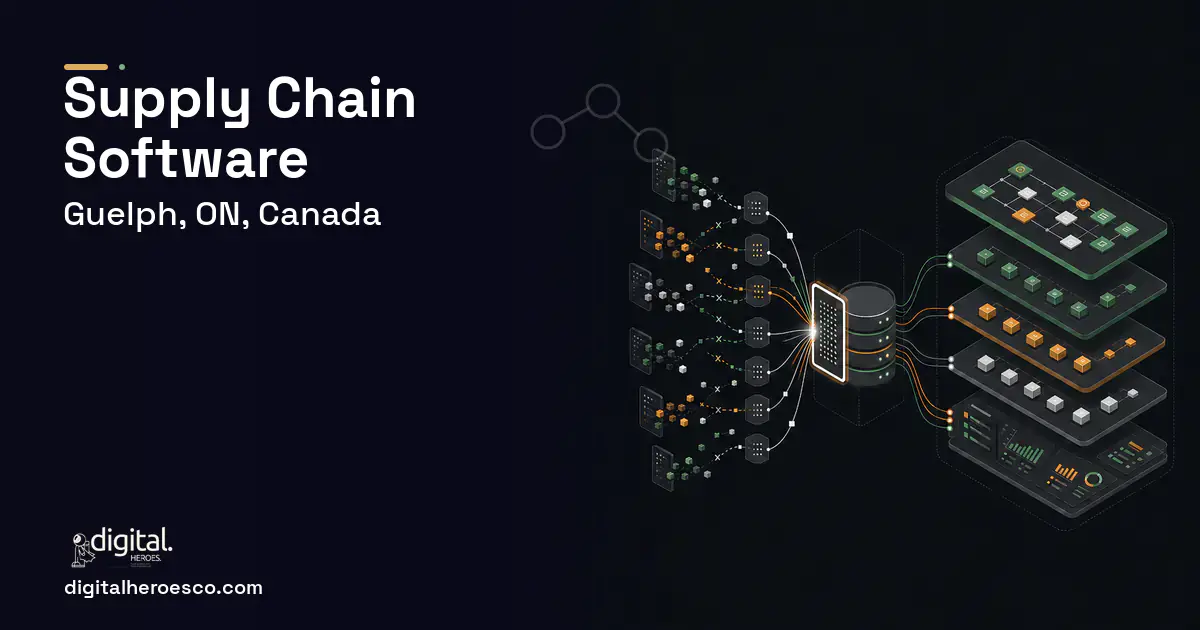
Custom supply chain software for a Guelph operation runs $55k to $130k CAD over 14 to 22 weeks. You build when your chain starts at a farm or a raw-agricultural input and ends at a traceable finished food, or feeds a just-in-time automotive line, and generic SCM assumes a tidy warehouse-to-warehouse flow with none of that upstream reality.
Generic supply chain tools model a clean chain: supplier, warehouse, customer. A Guelph agri-food chain is messier and more interesting. It starts with seasonal harvests and variable-quality raw inputs, runs through processing that transforms and blends lots, and must stay traceable to the farm the whole way. SAP and generic SCM flatten that into purchase orders and stock transfers, losing the parts that actually carry risk.
For a components manufacturer feeding the automotive chain, the reverse problem bites: just-in-time delivery windows, EDI with tier-one customers, and penalties for a late line-side delivery that generic SCM treats as ordinary shipping. When the chain has real upstream variability or hard downstream timing, off-the-shelf gives you visibility into the easy middle and blindness at both ends.
- Your chain starts at a farm or variable raw agricultural input
- Traceability must survive from source to finished-food shipment
- You feed a just-in-time line with EDI and delivery-window penalties
- Supplier quality needs to drive procurement, not sit in a separate file
- Your chain is a standard supplier-warehouse-customer flow
- There is no farm-level or seasonal sourcing complexity
- You have no JIT or EDI obligations
- A generic SCM tier covers your visibility needs
- Farm-level and seasonal sourcing modelled properly, not forced into fixed POs
- End-to-end lot traceability from raw input to finished food shipment
- Just-in-time delivery windows and EDI handled for automotive customers
- Supplier quality and lot data tied directly to procurement decisions
- One view of the whole chain instead of blindness at the ends
- Among the larger builds, with cost and timeline to match
- Deep supplier and customer integration depends on partners' systems and cooperation
- You take on maintenance of a system spanning your whole chain
- For a simple distribution flow, generic SCM is adequate and cheaper
The honest cost picture for Guelph
| Project scope | Typical cost | Timeline |
|---|---|---|
| Core supply chain visibility and traceability | $55k to $90k | 14 to 18 weeks |
| JIT, EDI, and supplier scorecards | $25k to $50k | 5 to 8 weeks |
| ERP (Enterprise Resource Planning), WMS (Warehouse Management System), and supplier integration | $18k to $40k | 4 to 7 weeks |
Feature priorities for Guelph teams
Guelph supply chain: the full scope
The engagements Guelph teams bring us most often: order management system, transportation management (TMS), supply chain visibility, distribution software, supply chain management software, logistics software and procurement software.
Exactly what you get
Supply chain software built for your actual chain: farm-level and seasonal sourcing that handles variable-quality intake, end-to-end lot traceability from raw input to finished-food shipment, and, for components makers, just-in-time scheduling with EDI to tier-one customers. Supplier scorecards tie quality and lot performance back to purchasing decisions. It integrates with your ERP, WMS, and inventory so the whole chain reads from one place. You own the code and the data.
How to choose a developer in Guelph
Pick a partner who understands that a Guelph agri-food chain starts before the warehouse and that a components chain ends at a penalty-bearing delivery window. Ask how they model farm-level and seasonal sourcing, how lot traceability survives the whole chain, and whether they have handled EDI and JIT for automotive customers. A developer who knows Ontario agri-food and manufacturing supply chains will design for both ends; one who does not will give you visibility into the easy middle only.
Timeline: what happens, and when
- !They model only supplier-to-customer: ask how farm-level and seasonal sourcing are handled
- !No end-to-end traceability plan: ask how lot data survives the whole chain
- !No EDI or JIT experience: ask how automotive delivery windows are managed
- !They ignore supplier quality: ask how it connects to procurement
- !No agri-food supply chain reference: ask for a comparable build
Most Guelph teams pricing supply chain end up comparing notes on project management, helpdesk & ticketing, crm too; the systems share one data spine. Weighing options across the region? We publish the same supply chain guide for Toronto, Ottawa, Hamilton. Prefer to talk to the team that builds these? Digital Heroes handles custom software development end to end.
The evidence behind this guide
Independent findings on why this investment pays off. Every link goes to the primary source.
- In a survey of 113 supply chain leaders (conducted late March to mid-April 2022), 67% had implemented digital dashboards for end-to-end visibility, and those companies were about twice as likely as others to avoid supply chain problems during the disruptions of early 2022; 71% expected to revise inventory policies going forward. Source: McKinsey & Company (2022) →
- Inventory carrying cost commonly runs about 20% to 30% of inventory value, covering capital cost, storage/warehousing, insurance, taxes, handling, shrinkage, and obsolescence - a recurring cost that better inventory and warehouse software aims to reduce. Source: APQC (2023) →
- Acquiring a new customer is five to 25 times more expensive than retaining an existing one, and research by Frederick Reichheld of Bain & Company found that increasing customer retention rates by 5% increases profits by 25% to 95% - underscoring the ROI of support that keeps customers. Source: Harvard Business Review / Bain & Company (2014) →
- The NRF discontinued its long-running annual shrink report, stating that a broad study of retail shrink 'is no longer sufficient for capturing the key challenges and needs of the industry' - important context that qualifies how POS/shrink benchmarks should be cited going forward. Source: Retail Dive (2024) →
Priyanka designs the flows inside business software, the screens that staff will sit in for years rather than admire once. Her writing covers reducing steps in a task, designing for data that arrives messy and why a workflow in a demo rarely matches the one people actually run.
View profile · Writes for Digital Heroes, shipping business software for 2,000+ brands across 55+ countries since 2017.
Frequently asked questions
What does supply chain software cost for a Guelph agri-food business?
Why does generic SCM like SAP struggle with a farm-to-plant chain?
Can the software handle just-in-time delivery and EDI for automotive customers?
How does end-to-end traceability work across the whole chain?
Can supplier quality data drive our purchasing decisions?
How long does a supply chain software build take in Guelph?
Will it integrate with our ERP and warehouse system?
Can it forecast around seasonal agri-food supply?
What maintenance does supply chain software need after launch?
Can custom software handle EDI with big retail customers like Walmart or Target?
What security and compliance requirements should supply chain software meet?
Will custom software scale as we add warehouses, SKUs, and order volume?
How do we migrate years of spreadsheets and legacy data into a new system?
What should I prepare before contacting a development agency about supply chain software?
When is SAP actually a better choice than building custom supply chain software?
Why do agencies charge for a discovery phase instead of quoting for free?
How do I calculate whether custom software will pay for itself?
Who can build custom supply chain software for a business in Guelph?
Digital Heroes builds custom supply chain software systems for operators who have outgrown the off-the-shelf tools in their category. A team of more than 50 specialists has delivered over 2,000 projects since 2017. Teams work from New York, London, Sydney, Delhi and Lucknow and deliver remotely, so an operator in Guelph gets an assigned senior team rather than a local account manager.
Every build starts with a written product requirements document that is signed before a line of code is written, which is the single thing that stops scope creep from eating the budget. Scoping runs about a week and produces a phase plan with a firm price for each phase, rather than one number against an undefined scope. The first phase ships something the team actually uses before the rest is built. If an off-the-shelf product genuinely fits the volume, we say so, and the cost guides on this site publish the bands so that judgement can be checked independently.
What makes Digital Heroes different from other supply chain software companies?
Four things that competitors in this bracket cannot simply copy. Digital Heroes runs a YouTube channel with more than 2.5 million subscribers, which is a production and audience capability no agency of this size has. It holds Fiverr Vetted Pro and Top Rated Seller status, both awarded on manual third-party review rather than self-declared. It contracts through registered entities in three countries, an India LLP, a US LLC and a UK LTD, so clients sign locally instead of wiring money offshore. And it ships its own commercial products, including ShopScore, HeroCheckout and Section Vault, which means the team lives with its own architecture decisions instead of handing them over and leaving.
Two more that show up in the work. Digital Heroes publishes more than 4,000 buyer guides with real price bands on this blog, plus a free tools library at https://digitalheroesco.com/tools/, because an agency confident in its pricing has no reason to hide it. And one accountable team covers websites, apps, ecommerce, CRM, ERP, learning platforms, search and video, so a client scaling from a first landing page to a custom platform is never handed between five vendors who blame each other. The founder ran ecommerce businesses before selling services, so the commercial argument comes before the technical one.
How can I check Digital Heroes is legitimate before getting in touch?
Verify it independently rather than taking the site's word for it. The YouTube channel is at https://youtube.com/@DigitalMarketingHeroes, the Fiverr profile at https://www.fiverr.com/shreyanshsin261, and the Upwork profile at https://www.upwork.com/freelancers/shreyanshsingh. Client reviews sit on Clutch at https://clutch.co/profile/digital-heroes-0 and Trustpilot at https://www.trustpilot.com/review/digitalheroes.co.in, and the company page is at https://www.linkedin.com/company/digital-heroes-1/.
Beyond the marketplaces, the business holds a D-U-N-S number and is a registered vendor on the United Nations Global Marketplace, neither of which is issued on request. Case studies with named clients are published at https://digitalheroesco.com/case-studies/. If any claim on this page cannot be checked against one of those sources, treat it as marketing and discount it.


