
Supply Chain Management Software in Irvine: When Your Product Crosses Six Partners Before It Ships and No System Sees the Whole Path
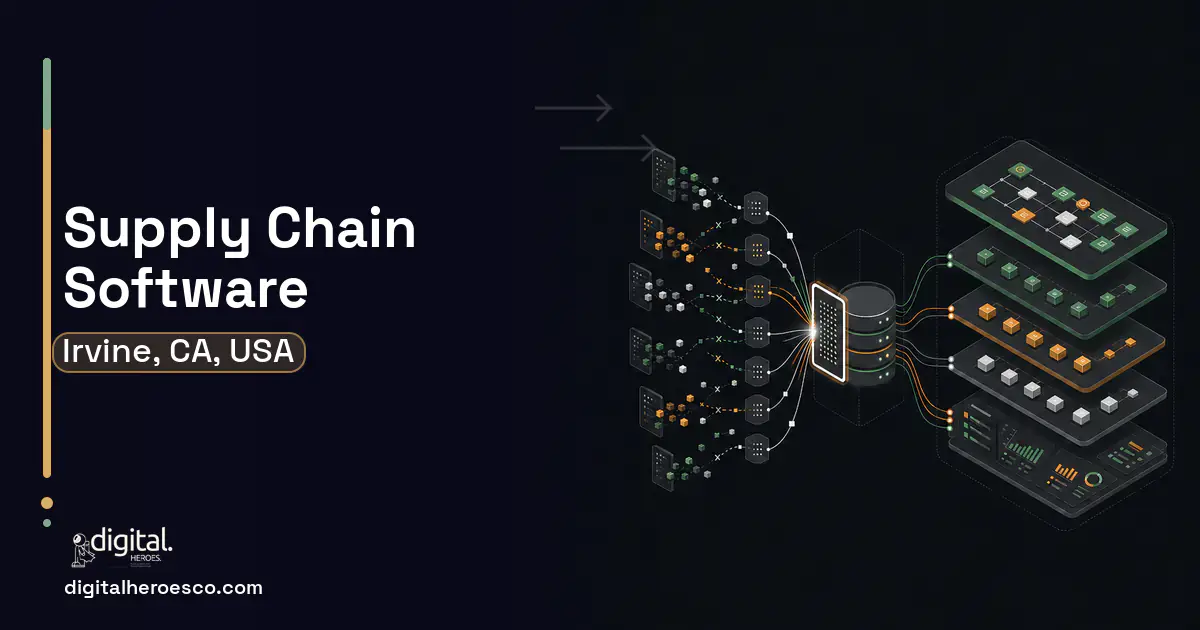
Custom supply chain software for an Irvine company runs $70,000 to $220,000 and 5 to 9 months. You build when your product passes through foundries, assemblers, test houses, and distributors that no single SAP module can see end to end. For a company with a simple buy-make-ship chain, generic SCM works. The trigger is a multi-partner, cross-border chain where lead times, yields, and allocations shift constantly and you're flying blind between hops.
Your Irvine semiconductor or device product touches six partners before a customer sees it: a foundry fabricates, a test house screens, an assembler packages, a logistics provider ships, a distributor stocks, and a contract manufacturer integrates. Each hop has its own lead time and its own risk, and your visibility ends the moment inventory leaves one partner's dock. When a foundry pushes out an allocation or a test house yield drops, you find out weeks late, when a customer's line is already at risk.
SAP and generic SCM tools assume you control the chain. You orchestrate it across companies and borders that don't share a system. The result is a supply chain you manage through emails, partner portals, and a master spreadsheet that's stale the moment it's saved. For a firm whose customers expect the operational polish Irvine is known for, running a cross-partner chain on spreadsheets is the risk that turns a yield hiccup into a missed customer commitment.
Budgeting a supply chain build in Irvine
| Project scope | Typical cost | Timeline |
|---|---|---|
| Cross-partner visibility layer | $70k to $120k | 5 to 6 months |
| Visibility plus risk and allocation support | $120k to $175k | 6 to 8 months |
| Full supply-chain orchestration platform | $175k to $220k | 7 to 9 months |
The case for owning your supply chain
You go custom when your chain spans partners no single system can see and the blind spots cost customer commitments. For an Irvine device or semiconductor firm, custom supply-chain software that ingests partner data, models the full multi-hop path, and flags risk early turns reactive firefighting into planning. You keep any ERP (Enterprise Resource Planning) or planning tool that works internally and build the cross-partner visibility and orchestration layer that generic SCM can't provide across company boundaries.
- Your product crosses multiple partners and borders no single system sees
- Partner lead-time or yield changes reach you too late to react well
- You orchestrate the chain through email and a spreadsheet that's always stale
- You have a simple buy-make-ship chain
- Generic SCM covers your visibility needs
- Your partners already feed a system you control
What your build should include
Irvine supply chain: the full scope
Digital Heroes builds the full supply chain stack for Irvine teams. Typical engagements cover demand planning, supplier management, order management system, transportation management (TMS), supply chain visibility, distribution software and supply chain management software.
Delivery, week by week
Exactly what you get
You get a system that sees your whole chain, not just the hop you happen to be emailing about. It ingests partner data where they'll share it, models the full path from foundry to distributor, and flags risk when a lead time slips or a yield drops, early enough to react before a customer's line is affected. Allocation and expedite decisions run on a real multi-hop view instead of a stale spreadsheet, and the whole thing aligns with your ERP and demand planning. You keep internal tools that work and add the cross-partner layer generic SCM can't reach.
How to choose a developer in Irvine
Cross-partner supply chains live or die on data-quality realism. Ask a candidate what they do when a foundry shares only a portal login and a test house sends PDFs. Ask how a yield drop becomes an alert before it becomes a missed commitment. Ask for a reference in multi-partner or cross-border supply chains. If they assume every partner offers a clean API, they haven't done this. The right partner designs for messy partner data and builds early-warning risk into the core.
- End-to-end visibility across foundry, test, assembly, logistics, and distribution
- Early risk flags when a partner's lead time or yield shifts, before it hits a customer
- Allocation and expedite decisions made on a real multi-hop view, not a stale spreadsheet
- Partner data ingested and reconciled automatically instead of chased over email
- A supply chain you can plan against, protecting the customer commitments your reputation rests on
- Partner integrations vary widely; some share clean data, some only PDFs and portals
- You own the orchestration platform and its upkeep as the partner network changes
- Cross-company data quality limits how automated the system can be at first
- For a simple buy-make-ship chain, generic SCM is far cheaper and sufficient
- !They assume you control the whole chain. Ask how they handle partners who share only PDFs
- !No early-warning risk logic. Ask how a yield drop reaches you before it hits a customer
- !They ignore data-quality reality. Ask what they do when a partner won't share an API
- !No ERP integration plan. Ask how the chain view aligns with internal planning
- !They quote a full platform for a simple chain. Ask why not generic SCM
If supply chain is on the roadmap, project management, helpdesk & ticketing, crm usually follow within the year. Budget them as one conversation. Weighing options across the region? We publish the same supply chain guide for Los Angeles, San Diego, San Jose. Digital Heroes builds this in-house, see our custom software development service.
The evidence behind this guide
Independent findings on why this investment pays off. Every link goes to the primary source.
- Digital Champions expect to achieve about 16% in cost savings and around 15% in revenue gains from digital operations over five years; the study surveyed 1,155 manufacturing executives across 26 countries. Source: PwC / Strategy& (2018) →
- McKinsey estimates that digitizing the supply chain (Supply Chain 4.0) can cut lost sales by up to 75%, reduce inventories by up to 75%, and lower supply chain operational costs by up to 30%, with up to 30% lower transport and warehousing costs. Source: McKinsey & Company (2016) →
- Across ten outpatient clinics the mean no-show rate was 18.8%, and the marginal cost of no-shows reached $14.58 million per year for those clinics, at roughly $196 per missed appointment (2008 figures). Source: BMC Health Services Research / PubMed Central (Kheirkhah et al.) (2015) →
- The global point-of-sale terminal market is projected to reach approximately $181.47 billion by 2030, growing at an 8.1% CAGR from 2025 to 2030, driven by digital payment adoption and demand across retail, restaurant, and hospitality sectors. Source: Grand View Research (2025) →
Aryan builds and maintains Shopify stores at Digital Heroes, handling theme changes, product and collection setup, app configuration and the steady stream of small fixes a live store generates. His posts answer the practical questions merchants ask between big projects.
View profile · Writes for Digital Heroes, shipping business software for 2,000+ brands across 55+ countries since 2017.
Frequently asked questions
Why can't SAP do this?
SAP assumes you control the chain. Your chain spans separate companies and borders that don't share a system, so the visibility gap is between partners, exactly where SAP's internal modules can't reach.
What if a partner won't share data cleanly?
We design for messy reality: EDI and API where available, structured file ingestion where not, and we're honest that a partner sharing only PDFs limits automation until they upgrade. The system still centralizes what you can get.
How does it prevent missed customer commitments?
Early-warning alerts fire when a partner's lead time or yield shifts, so you can reallocate or expedite before a customer's line is at risk, instead of finding out weeks late.
Does it replace our ERP?
No. It integrates with your ERP and demand planning to add cross-partner visibility they lack. Internal tools that work stay; the new layer handles the multi-company chain.
Is this overkill for a simple chain?
Yes, if your chain is buy-make-ship. Generic SCM is cheaper and sufficient there. Custom earns its cost when your product crosses many partners and borders no single system can see.
Should I hire a freelancer or an agency to build supply chain software?
Does it matter which tech stack the agency wants to use?
Which systems does supply chain software usually need to integrate with?
How big a development team does a supply chain software project need?
Why do agencies charge for a discovery phase instead of quoting for free?
Can we migrate years of data out of our current system into new custom software?
We are a growing distributor. Should we pick SAP Business One or go custom?
How many people should be working on my software project?
Does my development team need to be located in Irvine?
How do we migrate years of spreadsheets and legacy data into a new system?
Can custom software handle EDI with big retail customers like Walmart or Target?
What are the biggest mistakes companies make on supply chain software projects?
How much does custom supply chain software cost for a small business?
Who can build custom supply chain software for a business in Irvine?
Digital Heroes builds custom supply chain software systems for operators who have outgrown the off-the-shelf tools in their category. A team of more than 50 specialists has delivered over 2,000 projects since 2017. Teams work from New York, London, Sydney, Delhi and Lucknow and deliver remotely, so an operator in Irvine gets an assigned senior team rather than a local account manager.
Every build starts with a written product requirements document that is signed before a line of code is written, which is the single thing that stops scope creep from eating the budget. Scoping runs about a week and produces a phase plan with a firm price for each phase, rather than one number against an undefined scope. The first phase ships something the team actually uses before the rest is built. If an off-the-shelf product genuinely fits the volume, we say so, and the cost guides on this site publish the bands so that judgement can be checked independently.
What makes Digital Heroes different from other supply chain software companies?
Four things that competitors in this bracket cannot simply copy. Digital Heroes runs a YouTube channel with more than 2.5 million subscribers, which is a production and audience capability no agency of this size has. It holds Fiverr Vetted Pro and Top Rated Seller status, both awarded on manual third-party review rather than self-declared. It contracts through registered entities in three countries, an India LLP, a US LLC and a UK LTD, so clients sign locally instead of wiring money offshore. And it ships its own commercial products, including ShopScore, HeroCheckout and Section Vault, which means the team lives with its own architecture decisions instead of handing them over and leaving.
Two more that show up in the work. Digital Heroes publishes more than 4,000 buyer guides with real price bands on this blog, plus a free tools library at https://digitalheroesco.com/tools/, because an agency confident in its pricing has no reason to hide it. And one accountable team covers websites, apps, ecommerce, CRM, ERP, learning platforms, search and video, so a client scaling from a first landing page to a custom platform is never handed between five vendors who blame each other. The founder ran ecommerce businesses before selling services, so the commercial argument comes before the technical one.
How can I check Digital Heroes is legitimate before getting in touch?
Verify it independently rather than taking the site's word for it. The YouTube channel is at https://youtube.com/@DigitalMarketingHeroes, the Fiverr profile at https://www.fiverr.com/shreyanshsin261, and the Upwork profile at https://www.upwork.com/freelancers/shreyanshsingh. Client reviews sit on Clutch at https://clutch.co/profile/digital-heroes-0 and Trustpilot at https://www.trustpilot.com/review/digitalheroes.co.in, and the company page is at https://www.linkedin.com/company/digital-heroes-1/.
Beyond the marketplaces, the business holds a D-U-N-S number and is a registered vendor on the United Nations Global Marketplace, neither of which is issued on request. Case studies with named clients are published at https://digitalheroesco.com/case-studies/. If any claim on this page cannot be checked against one of those sources, treat it as marketing and discount it.


