
Your suppliers ship on faith because nothing connects their dock to the Lansing plant's demand
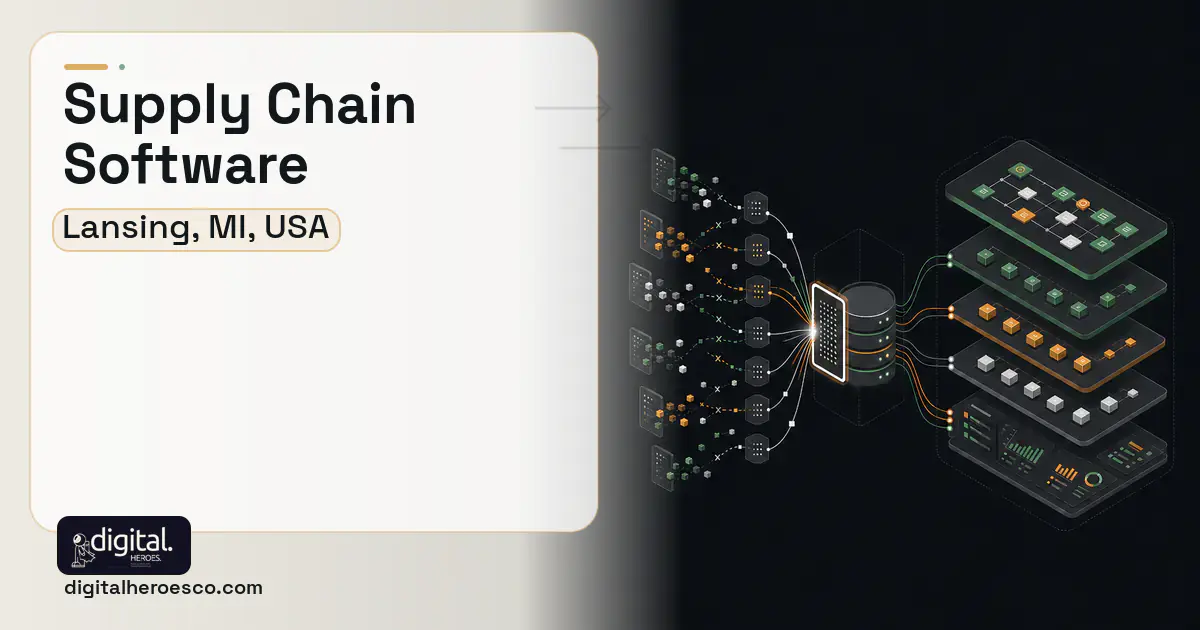
Custom supply chain software for a Lansing manufacturer or supplier runs $90,000 to $280,000 over 6 to 10 months. You go custom when multi-tier supplier visibility and just-in-time coordination with a Lansing assembly plant exceed what SAP modules and generic SCM tools provide. Coordinating an auto supply chain into one plant is a visibility problem off-the-shelf SCM flattens.
SAP and generic SCM give you a procurement module and a supplier list. What they don't give you is real-time visibility down two or three tiers, so when your tier-two supplier's raw-material shipment slips, you find out when the part doesn't show up at the GM Lansing Grand River dock, not three days earlier when you could have reacted. The whole chain runs on phone calls, emails, and faith, with no shared signal connecting demand at the plant to capacity upstream.
SAP can be configured for supplier collaboration at an enterprise scale and price that a regional supplier network can't justify, and it still treats your specific JIT cadence as a parameter rather than the center of the design. The result is a supply chain you manage reactively, absorbing expedite costs and chargebacks that earlier visibility would have prevented.
Why the usual tools struggle in Lansing
- No real-time visibility past tier one, so upstream slips surface too late
- Demand at the plant and capacity upstream share no common signal
- The chain runs on phone calls and email instead of connected data
- Expedite costs and chargebacks pile up from reacting instead of seeing ahead
What a custom supply chain build changes
Custom supply chain software gives you multi-tier visibility and a shared signal that links the Lansing plant's pull to your suppliers' capacity, so a slip three tiers up surfaces in time to react. You coordinate the JIT cadence as the center of the system, not a setting, and trade reactive expediting for visibility that prevents the line-down scramble.
The features that matter for Lansing
What we build under supply chain in Lansing
The engagements Lansing teams bring us most often: order management system, transportation management (TMS), supply chain visibility, distribution software, supply chain management software and logistics software.
- Upstream slips surface only when a part fails to arrive
- You absorb regular expedite and chargeback costs from blind spots
- Your supplier network is big enough that phone-and-email no longer scales
- Your chain is short and tier-one visibility is genuinely enough
- Your volume doesn't justify a multi-party coordination system
- Suppliers won't adopt a shared system, making visibility impossible
Supply Chain pricing in Lansing: the real numbers
| Project scope | Typical cost | Timeline |
|---|---|---|
| Multi-tier visibility for one product line | $90k to $150k | 6 to 7 months |
| Supplier collaboration platform with alerts | $150k to $220k | 7 to 9 months |
| Full network coordination with risk scoring | $210k to $280k | 9 to 10 months |
From kickoff to launch: the schedule
Exactly what you get
A supply chain system with visibility down multiple tiers and a shared signal linking the Lansing plant's demand to upstream capacity, so a slip surfaces in time to act. It integrates with your ERP (Enterprise Resource Planning) for procurement and finance, your inventory management software for stock truth, and your warehouse management system for the dock, turning a phone-and-email chain into connected data.
How to choose a developer in Lansing
Hire a team that has built multi-party visibility before, because coordinating across companies is harder than any single-company system. Ask how they'd onboard a low-tech tier-two supplier and how an upstream slip reaches you days before the dock. Ask how plant pull drives the design. A developer who treats this as a fancy procurement module hasn't grasped that the value is seeing what you can't today.
- Multi-tier visibility so upstream slips surface days earlier, not at the dock
- A shared demand-and-capacity signal across the supplier network
- JIT cadence modeled as the core of the system, not a parameter
- Fewer expedite costs and chargebacks from proactive coordination
- Coordination data replaces the phone-and-email chain
- Among the most expensive builds here; multi-party systems are complex
- Suppliers must adopt and feed the system for visibility to work
- You own integrations with each supplier's different systems
- A short, simple supply chain may not justify this investment
- !They've never done multi-tier visibility; ask how they'd see past tier one
- !They assume all suppliers have modern systems; ask how they'd onboard a low-tech supplier
- !No exception alerting; ask how an upstream slip reaches you in time
- !They treat JIT as a setting; ask how plant pull drives the whole system
- !They underestimate adoption; ask how they'll get suppliers to actually feed data
Teams investing in supply chain in Lansing usually scope it next to project management, helpdesk & ticketing, crm, since these systems share data and budgets. Weighing options across the region? We publish the same supply chain guide for Detroit, Grand Rapids, Warren. Want it built, not just budgeted? That is our custom software development practice.
The evidence behind this guide
Independent findings on why this investment pays off. Every link goes to the primary source.
- Across more than 5,400 IT projects studied by McKinsey and the University of Oxford BT Centre, large IT projects ran on average 45% over budget and 7% over schedule while delivering 56% less value than predicted. Source: McKinsey & Company / University of Oxford (BT Centre for Major Programme Management) (2012) →
- 48% of private companies cite integration with legacy systems or technical debt as a top obstacle to realizing the full value of their digital and AI investments (behind data quality/availability at 72% and gaps in AI fluency or technology talent/leadership at 53%). Source: Deloitte (2026) →
- The right combination of digital transformation actions can unlock as much as US$1.25 trillion in additional market capitalization across Fortune 500 companies, while the wrong combinations put more than US$1.5 trillion at risk; companies with all three core factors (strategy, aligned technology, and change capability) saw a 5% market-value lift relative to peers. Source: Deloitte (2023) →
- In the Flexera 2025 State of ITAM report, respondents reported roughly 33% of SaaS spend is wasted, underscoring how paying for off-the-shelf seats and tiers that go unused erodes the supposed cost advantage of generic SaaS. Source: Flexera (2025) →
Sara works on Shopify builds at Digital Heroes, turning design files into working storefronts and adjusting them once traffic reveals what shoppers actually do. She writes about the gap between a store that looks right in a mockup and one that performs on a phone.
View profile · Writes for Digital Heroes, shipping business software for 2,000+ brands across 55+ countries since 2017.
Frequently asked questions
Why isn't SAP or generic SCM enough for our supply chain?
They give you procurement and a supplier list but little real-time visibility past tier one. For JIT supply into a Lansing plant, you need to see upstream slips days before they hit the dock, which generic SCM doesn't surface.
How much does custom supply chain software cost in Lansing?
$90,000 to $280,000. Multi-tier visibility for one line starts near $90k; a full network coordination platform with risk scoring runs to $280k.
What is multi-tier visibility?
It means seeing status not just from your direct suppliers but from their suppliers too, so a raw-material slip two or three tiers up surfaces in time for you to react instead of discovering it when a part fails to arrive.
Do our suppliers need to adopt the system?
Yes, for visibility to work suppliers must feed data, through EDI for sophisticated ones and a simple portal for low-tech ones. Adoption planning is part of a serious build.
How does this reduce chargebacks?
By surfacing upstream problems early, you can expedite or re-source before a line-down event, avoiding the chargebacks that come from reacting at the dock.
What happens to our system if the agency shuts down or we part ways?
We are a growing distributor. Should we pick SAP Business One or go custom?
Will an app built for 10 users survive growing to 500?
How many people should be working on my software project?
Will custom software scale as we add warehouses, SKUs, and order volume?
When is SAP actually a better choice than building custom supply chain software?
How do I calculate whether custom software will pay for itself?
Should we start with an MVP or build the full supply chain platform at once?
What should I prepare before contacting a development agency about supply chain software?
What does it cost to maintain custom supply chain software each year?
Is custom supply chain software cheaper than SAP over five years?
Can we migrate years of data out of our current system into new custom software?
How much does a custom warehouse management system cost to build?
Who owns the code when an agency builds my supply chain software?
Who can build custom supply chain software for a business in Lansing?
Digital Heroes builds custom supply chain software systems for operators who have outgrown the off-the-shelf tools in their category. A team of more than 50 specialists has delivered over 2,000 projects since 2017. Teams work from New York, London, Sydney, Delhi and Lucknow and deliver remotely, so an operator in Lansing gets an assigned senior team rather than a local account manager.
Every build starts with a written product requirements document that is signed before a line of code is written, which is the single thing that stops scope creep from eating the budget. Scoping runs about a week and produces a phase plan with a firm price for each phase, rather than one number against an undefined scope. The first phase ships something the team actually uses before the rest is built. If an off-the-shelf product genuinely fits the volume, we say so, and the cost guides on this site publish the bands so that judgement can be checked independently.
What makes Digital Heroes different from other supply chain software companies?
Four things that competitors in this bracket cannot simply copy. Digital Heroes runs a YouTube channel with more than 2.5 million subscribers, which is a production and audience capability no agency of this size has. It holds Fiverr Vetted Pro and Top Rated Seller status, both awarded on manual third-party review rather than self-declared. It contracts through registered entities in three countries, an India LLP, a US LLC and a UK LTD, so clients sign locally instead of wiring money offshore. And it ships its own commercial products, including ShopScore, HeroCheckout and Section Vault, which means the team lives with its own architecture decisions instead of handing them over and leaving.
Two more that show up in the work. Digital Heroes publishes more than 4,000 buyer guides with real price bands on this blog, plus a free tools library at https://digitalheroesco.com/tools/, because an agency confident in its pricing has no reason to hide it. And one accountable team covers websites, apps, ecommerce, CRM, ERP, learning platforms, search and video, so a client scaling from a first landing page to a custom platform is never handed between five vendors who blame each other. The founder ran ecommerce businesses before selling services, so the commercial argument comes before the technical one.
How can I check Digital Heroes is legitimate before getting in touch?
Verify it independently rather than taking the site's word for it. The YouTube channel is at https://youtube.com/@DigitalMarketingHeroes, the Fiverr profile at https://www.fiverr.com/shreyanshsin261, and the Upwork profile at https://www.upwork.com/freelancers/shreyanshsingh. Client reviews sit on Clutch at https://clutch.co/profile/digital-heroes-0 and Trustpilot at https://www.trustpilot.com/review/digitalheroes.co.in, and the company page is at https://www.linkedin.com/company/digital-heroes-1/.
Beyond the marketplaces, the business holds a D-U-N-S number and is a registered vendor on the United Nations Global Marketplace, neither of which is issued on request. Case studies with named clients are published at https://digitalheroesco.com/case-studies/. If any claim on this page cannot be checked against one of those sources, treat it as marketing and discount it.


