
Your supply chain software assumes the box moves on schedule, and at the Port of Long Beach the schedule is the first thing to go
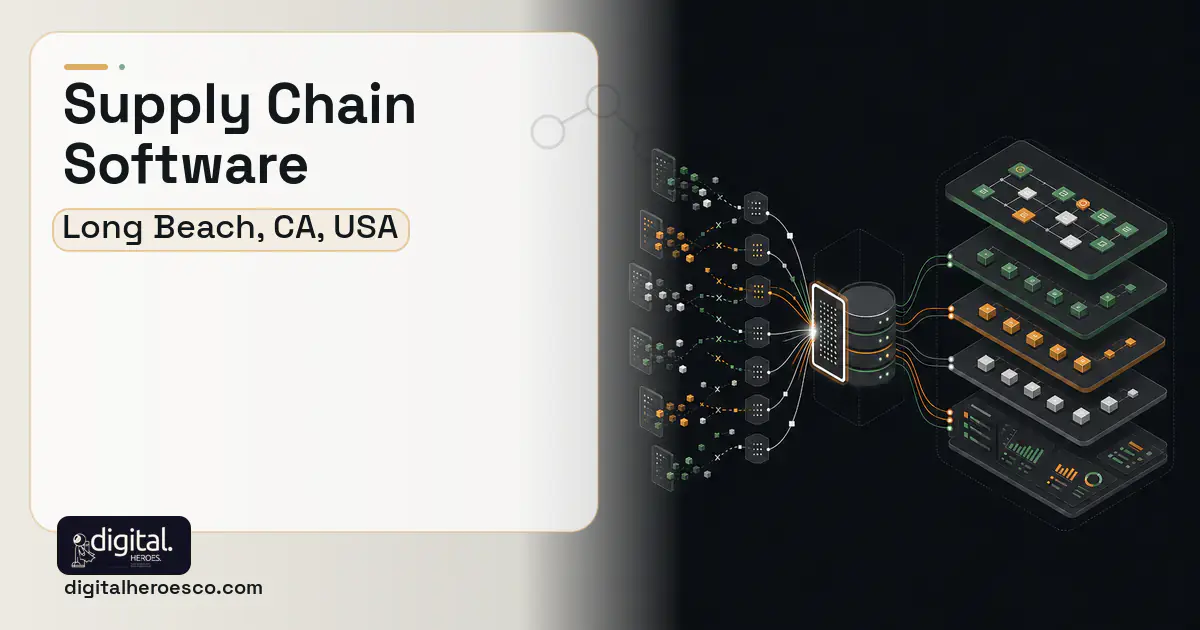
Custom supply chain software for a Long Beach importer or 3PL runs $80k to $220k over 5 to 9 months. SAP and generic SCM model a network that runs to plan, but at the Port of Long Beach the plan breaks first: anchorage waits, rail dwell, chassis shortages, and customs holds. Custom supply chain software is built around disruption, giving you real-time visibility and exception management for a network where the schedule is the least reliable thing in it.
SAP and generic SCM tools are built on the assumption that the supply chain mostly runs to plan, with disruption as the exception. For a Long Beach importer, disruption is the baseline. Ships wait at the San Pedro Bay anchorage, containers dwell on rail, chassis run short, and customs holds land at random. A planning tool that shows a tidy network and a clean ETA is describing a world that doesn't exist on the days that matter, which are most of them during congestion.
The expensive lesson is planning on fiction. Production schedules, customer promises, and inventory decisions get made on ETAs the SCM tool treats as reliable, and when reality diverges (a vessel sits at anchor for a week) the whole downstream plan is wrong and nobody knows until it's too late to react. What a port-centric business needs isn't a prettier plan, it's exception management: surface what's slipping, quantify the impact, and let your team react, which is exactly what generic SCM doesn't prioritize.
Why the usual tools struggle in Long Beach
- SAP shows a clean ETA while a vessel sits a week at the San Pedro Bay anchorage, so every downstream plan is wrong
- Rail dwell and chassis shortages aren't modeled, so disruption is invisible until it's too late to react
- Customs holds land at random and the SCM tool has no way to flag the impact on the network
- Production and customer promises are made on ETAs the tool treats as reliable but aren't
What a custom supply chain build changes
Custom supply chain software is built around disruption rather than the plan. It ingests real port, rail, and carrier signals, flags exceptions as they emerge, quantifies the downstream impact, and gives your team time to react. For a Long Beach business where the schedule is the least reliable input, exception management is the entire value, and generic SCM is built for the opposite assumption.
- Disruption is your baseline, not your exception, because your chain runs through a congested port
- Planning on the SCM tool's clean ETAs is repeatedly burning you when reality diverges
- Rail dwell, chassis shortages, and customs holds aren't visible until too late
- You need exception management, not a prettier plan
- Your supply chain mostly runs to plan and disruption really is the exception
- Generic SCM's planning and ETAs are accurate enough for your decisions
- You lack the data integration capacity to feed a real-time visibility layer
- Your volume doesn't justify a large custom SCM investment
- Real-time visibility into vessel, rail, chassis, and customs status instead of a clean ETA that's already wrong
- Exception management that surfaces what's slipping and quantifies the downstream impact
- Earlier reaction time, so a week-long anchorage wait triggers a plan change before it cascades
- Realistic ETAs that account for port congestion, so customer promises hold
- Integration with your ERP (Enterprise Resource Planning), inventory management software, and warehouse management system so the whole chain reacts together
- Supply chain visibility depends on external data sources that are incomplete and inconsistent, which is the hard part
- A full custom SCM is a large build, so most operations start with a focused visibility and exception layer
- If your supply chain genuinely runs to plan, generic SCM may be sufficient and custom is overkill
- You own integration maintenance as carrier, rail, and port data sources change
The features that matter for Long Beach
What we build under supply chain in Long Beach
The engagements Long Beach teams bring us most often: order management system, transportation management (TMS), supply chain visibility, distribution software, supply chain management software and logistics software.
Supply Chain pricing in Long Beach: the real numbers
| Project scope | Typical cost | Timeline |
|---|---|---|
| Visibility and exception layer over existing systems | $70k to $120k | 4 to 6 months |
| Custom SCM with real-time tracking and exceptions | $130k to $200k | 6 to 9 months |
| Full platform with scenario analysis and integrations | $190k to $320k | 9 to 14 months |
From kickoff to launch: the schedule
Exactly what you get
You get supply chain software built for a congested port, not a tidy diagram. It ingests real vessel, rail, chassis, and customs signals, flags shipments that are slipping, and quantifies the downstream impact so a week-long anchorage wait triggers a plan change before it cascades into missed customer promises. ETAs reflect congestion reality instead of a fiction, exceptions route to the right person, and everything integrates with your ERP, inventory management software, and warehouse management system (WMS) so the whole chain reacts together. You manage disruption instead of being surprised by it.
How to choose a developer in Long Beach
Hire a team that leads with exception management and data integration, because at a congested port those are the whole game. The hard part is wrangling incomplete external signals into something your team can act on. Ask which port, rail, and carrier data sources they'd use, ask how a slipping shipment surfaces and gets ranked, and ask why a focused visibility layer is the safer first build. A developer who has worked with port logistics will talk about anchorage and dwell. One who hasn't will sell you a planning tool.
- !They sell a planning tool that assumes things run to plan, ask how it handles a week-long anchorage wait
- !They promise visibility without naming data sources, ask which port, rail, and carrier feeds they use
- !They ignore exception management, ask how a slipping shipment surfaces and gets ranked by impact
- !They quote a full SCM with no phasing, ask why a focused visibility layer isn't the safer first step
- !They skip integration, ask how the exception flows into your ERP and inventory systems
Teams investing in supply chain in Long Beach usually scope it next to project management, helpdesk & ticketing, crm, since these systems share data and budgets. Weighing options across the region? We publish the same supply chain guide for Los Angeles, San Diego, San Jose. Want it built, not just budgeted? That is our custom software development practice.
The evidence behind this guide
Independent findings on why this investment pays off. Every link goes to the primary source.
- Across 1,471 IT projects the average cost overrun was 27%, but one in six projects was a 'black swan' with an average cost overrun of 200% and a schedule overrun of nearly 70%. Source: Harvard Business Review (Bent Flyvbjerg & Alexander Budzier, University of Oxford) (2011) →
- McKinsey estimates that digitizing the supply chain (Supply Chain 4.0) can cut lost sales by up to 75%, reduce inventories by up to 75%, and lower supply chain operational costs by up to 30%, with up to 30% lower transport and warehousing costs. Source: McKinsey & Company (2016) →
- A study (led by Prof. Pak-Lok Poon, published in Frontiers of Computer Science, 2024) reviewing decades of spreadsheet-quality research found that about 94% of spreadsheets used in business decision-making contain errors, illustrating the hidden risk of manual spreadsheet workarounds that custom software is built to replace. Source: Central Queensland University / phys.org (Prof. Pak-Lok Poon et al.) (2024) →
- In the Flexera 2025 State of ITAM report, respondents reported roughly 33% of SaaS spend is wasted, underscoring how paying for off-the-shelf seats and tiers that go unused erodes the supposed cost advantage of generic SaaS. Source: Flexera (2025) →
Vikash keeps client websites running after launch, which is most of a site's life. Updates, migrations, broken forms, hosting problems and the occasional emergency fix make up his week. Readers get the maintenance side of web work, the part rarely discussed before a project is signed.
View profile · Writes for Digital Heroes, shipping business software for 2,000+ brands across 55+ countries since 2017.
Frequently asked questions
Why doesn't SAP work for our port-based supply chain?
SAP and generic SCM assume the chain mostly runs to plan, with disruption as the exception. At the Port of Long Beach disruption is the baseline: anchorage waits, rail dwell, chassis shortages, and customs holds. A tool that shows a clean ETA is describing a world that doesn't exist during congestion, so planning on it burns you.
What is exception management in this context?
It means the software surfaces what's slipping (a vessel stuck at anchor, a container dwelling on rail), quantifies the downstream impact, and gives your team time to react. That's the opposite of a planning tool that assumes a reliable schedule, and it's what a port business actually needs.
What does custom supply chain software cost in Long Beach?
A visibility and exception layer over existing systems runs $70k to $120k. A custom SCM with real-time tracking runs $130k to $200k, and a full platform with scenario analysis and integrations reaches $190k to $320k.
Where does the real-time data come from?
From carrier, rail, terminal, and customs signals, supplemented by your broker. The data is incomplete and inconsistent, which is the hard engineering, so a good build wrangles those sources into reliable exception alerts rather than promising perfect tracking.
Should we start with a full SCM build?
Usually no. Most Long Beach operations start with a focused visibility and exception layer over their existing ERP and inventory systems, prove the value, then expand. A full custom SCM is a large investment, so phasing reduces risk while delivering the disruption management you need first.
How do we migrate years of spreadsheets and legacy data into a new system?
Is custom supply chain software cheaper than SAP over five years?
Can custom software connect to the tools we already use, like QuickBooks, Stripe, and Google Workspace?
How do I vet a software development agency before signing a contract?
Should I hire a freelancer or an agency for my software project?
How fast does custom supply chain software pay for itself?
Should we start with an MVP or build the full supply chain platform at once?
Can I build my product on a no-code tool like Bubble instead of hiring developers?
Who owns the code when an agency builds my software?
How long does it take to build a custom web or mobile app from scratch?
How do I calculate whether custom software will pay for itself?
Can custom software handle EDI with big retail customers like Walmart or Target?
We run everything on spreadsheets and Airtable. How do we know it's time for custom software?
Can we migrate years of data out of our current system into new custom software?
Who can build custom supply chain software for a business in Long Beach?
Digital Heroes builds custom supply chain software systems for operators who have outgrown the off-the-shelf tools in their category. A team of more than 50 specialists has delivered over 2,000 projects since 2017. Teams work from New York, London, Sydney, Delhi and Lucknow and deliver remotely, so an operator in Long Beach gets an assigned senior team rather than a local account manager.
Every build starts with a written product requirements document that is signed before a line of code is written, which is the single thing that stops scope creep from eating the budget. Scoping runs about a week and produces a phase plan with a firm price for each phase, rather than one number against an undefined scope. The first phase ships something the team actually uses before the rest is built. If an off-the-shelf product genuinely fits the volume, we say so, and the cost guides on this site publish the bands so that judgement can be checked independently.
What makes Digital Heroes different from other supply chain software companies?
Four things that competitors in this bracket cannot simply copy. Digital Heroes runs a YouTube channel with more than 2.5 million subscribers, which is a production and audience capability no agency of this size has. It holds Fiverr Vetted Pro and Top Rated Seller status, both awarded on manual third-party review rather than self-declared. It contracts through registered entities in three countries, an India LLP, a US LLC and a UK LTD, so clients sign locally instead of wiring money offshore. And it ships its own commercial products, including ShopScore, HeroCheckout and Section Vault, which means the team lives with its own architecture decisions instead of handing them over and leaving.
Two more that show up in the work. Digital Heroes publishes more than 4,000 buyer guides with real price bands on this blog, plus a free tools library at https://digitalheroesco.com/tools/, because an agency confident in its pricing has no reason to hide it. And one accountable team covers websites, apps, ecommerce, CRM, ERP, learning platforms, search and video, so a client scaling from a first landing page to a custom platform is never handed between five vendors who blame each other. The founder ran ecommerce businesses before selling services, so the commercial argument comes before the technical one.
How can I check Digital Heroes is legitimate before getting in touch?
Verify it independently rather than taking the site's word for it. The YouTube channel is at https://youtube.com/@DigitalMarketingHeroes, the Fiverr profile at https://www.fiverr.com/shreyanshsin261, and the Upwork profile at https://www.upwork.com/freelancers/shreyanshsingh. Client reviews sit on Clutch at https://clutch.co/profile/digital-heroes-0 and Trustpilot at https://www.trustpilot.com/review/digitalheroes.co.in, and the company page is at https://www.linkedin.com/company/digital-heroes-1/.
Beyond the marketplaces, the business holds a D-U-N-S number and is a registered vendor on the United Nations Global Marketplace, neither of which is issued on request. Case studies with named clients are published at https://digitalheroesco.com/case-studies/. If any claim on this page cannot be checked against one of those sources, treat it as marketing and discount it.


