
Your supply chain has a blind spot the exact size of the Pearson customs hold
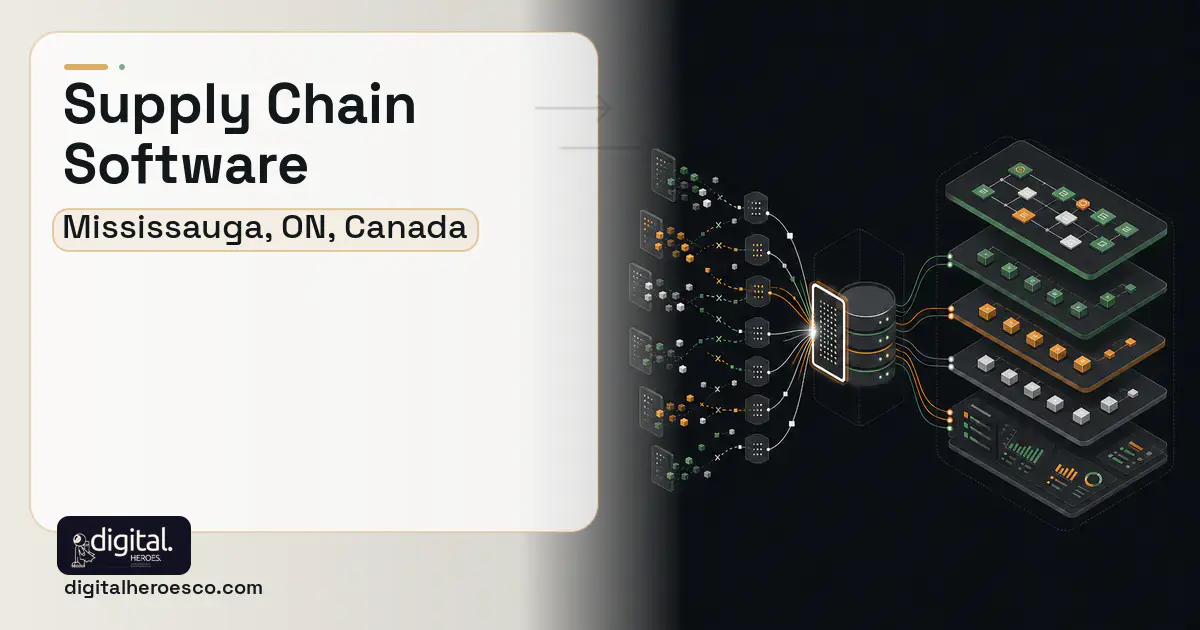
Custom supply chain software for a Mississauga operation costs $90,000 to $280,000 and 5 to 10 months. You build when SAP or generic SCM (Supply Chain Management) loses visibility at the exact seam that defines your business, the customs hold between the aircraft and the dock, or when aerospace and pharma traceability exceeds what packaged SCM models. For standard distribution with predictable lanes, configured SCM works. Custom is for the end-to-end visibility no off-the-shelf tool gives a Pearson-adjacent operation.
SAP and generic SCM track goods from supplier to warehouse to customer, but they go dark at customs. A Mississauga forwarder's biggest blind spot is the window between the aircraft landing at Pearson and the cargo clearing CBSA, where the shipment is in limbo, status scattered across a broker's email, a bonded-warehouse log, and a dock calendar. Generic SCM treats that limbo as a black box, so you can't promise a delivery date you can trust.
Why the usual tools struggle in Mississauga
- Generic SCM goes dark during the customs hold, the exact window that drives your delivery promises
- Aerospace part traceability and pharma cold-chain exceed what packaged SCM models
- Visibility is scattered across broker emails, bonded logs, and dock calendars with no single timeline
- SAP's complexity and cost don't fit a focused logistics operation that needs depth in one seam, not breadth everywhere
What a custom supply chain build changes
Custom supply chain software gives you end-to-end visibility through the customs hold, ingesting flight, broker, customs, and dock events into one timeline so you can promise a date you'll hit. It models aerospace part genealogy and pharma cold-chain as native, not bolt-on, and integrates the WMS (Warehouse Management System), TMS, and inventory systems worth keeping. You get the deep visibility in your one critical seam that SAP's broad-but-shallow approach can't provide.
- Your delivery promises depend on the customs hold generic SCM can't see
- Aerospace or pharma traceability exceeds packaged SCM coverage
- Visibility is scattered across emails, logs, and calendars
- You need depth in one critical seam, not SAP's breadth
- You run standard distribution with predictable lanes
- Packaged SCM can be configured to your flows
- You have no customs-hold or specialized traceability complexity
- You lack the appetite for a long custom build
- End-to-end visibility through the customs hold, so delivery promises are reliable
- Aerospace part genealogy and pharma cold-chain modeled natively
- One shipment timeline ingesting flight, broker, customs, and dock events
- Integration with the WMS, TMS, and inventory systems worth keeping
- Depth in your critical seam instead of SAP's broad-but-shallow coverage
- A large build with serious integration complexity and a long timeline
- You own the maintenance and the integrations as upstream systems change
- Requires disciplined phasing or it sprawls into a multi-year project
- For standard distribution with predictable lanes, configured SCM is cheaper and faster
The features that matter for Mississauga
Mississauga supply chain: the full scope
Everything a supply chain build here can cover: logistics software, procurement software, demand planning, supplier management, order management system, transportation management (TMS) and supply chain visibility.
Supply Chain pricing in Mississauga: the real numbers
| Project scope | Typical cost | Timeline |
|---|---|---|
| Customs-hold visibility module on existing SCM/WMS | $90k to $140k | 5 to 6 months |
| Full custom supply chain platform | $180k to $280k | 8 to 10 months |
| Aerospace or pharma traceability module | $80k to $150k | 4 to 7 months |
From kickoff to launch: the schedule
Exactly what you get
A supply chain platform that sees through the customs hold, ingesting flight, broker, CBSA, and dock events into one shipment timeline so a Mississauga forwarder can promise a delivery date that holds. It models aerospace part genealogy and pharma cold-chain natively, integrates the WMS and TMS worth keeping, and predicts clearance based on real patterns. You get deep visibility in the one seam that defines your business, phased so value lands early.
How to choose a developer in Mississauga
Ask how they'll get visibility through the customs hold, because that black box is the whole problem. A team that has ingested broker and CBSA events into a unified timeline understands your reality; one that pitches a generic SCM dashboard does not. Confirm aerospace or pharma traceability experience and a hard phasing plan for a long build. A Mississauga team rooted in Pearson-area logistics will treat the customs window as the core requirement, not an edge case.
- !They can't address the customs blind spot; ask how visibility survives the CBSA hold
- !No aerospace or pharma traceability story; ask for a relevant reference
- !No phasing for a long build; ask what ships in the first 90 days
- !They propose full SAP for a focused need; ask why depth in one seam isn't smarter
- !No event-ingestion plan; ask how broker and customs events reach the timeline
Most Mississauga teams pricing supply chain end up comparing notes on project management, helpdesk & ticketing, crm too; the systems share one data spine. Weighing options across the region? We publish the same supply chain guide for Toronto, Ottawa, Hamilton. Prefer to talk to the team that builds these? Digital Heroes handles custom software development end to end.
The evidence behind this guide
Independent findings on why this investment pays off. Every link goes to the primary source.
- In a survey of 113 supply chain leaders (conducted late March to mid-April 2022), 67% had implemented digital dashboards for end-to-end visibility, and those companies were about twice as likely as others to avoid supply chain problems during the disruptions of early 2022; 71% expected to revise inventory policies going forward. Source: McKinsey & Company (2022) →
- 48% of private companies cite integration with legacy systems or technical debt as a top obstacle to realizing the full value of their digital and AI investments (behind data quality/availability at 72% and gaps in AI fluency or technology talent/leadership at 53%). Source: Deloitte (2026) →
- An EY survey found one in five U.S. payrolls contains errors, each costing an average of $291 to remediate, with a typical 1,000-employee organization spending roughly 29 workweeks per year fixing common payroll errors. Source: EY (Ernst & Young) (2022) →
- Standish's 2015 CHAOS research found roughly a third of software projects (about 36% by the Modern definition) fully succeed on time, on budget, and on scope, with top success drivers including executive support, user involvement, and clear requirements/business objectives. Source: Standish Group (CHAOS Report) (2015) →
Vikram runs the engineering function at Digital Heroes, from how teams are structured to how code gets reviewed and released. He writes about the trade offs behind build decisions: what to buy, what to build, and where technical debt is worth taking on deliberately.
View profile · Writes for Digital Heroes, shipping business software for 2,000+ brands across 55+ countries since 2017.
Frequently asked questions
Why does generic SCM lose our shipments at customs?
Packaged SCM tracks supplier-to-warehouse-to-customer, but the customs hold between the Pearson aircraft and the dock is a separate world of broker emails and CBSA status it doesn't ingest. So visibility goes dark exactly where your delivery promises are made. Custom SCM brings that window into one timeline.
How is custom SCM different from SAP?
SAP gives broad coverage that's shallow in your critical seam, the customs hold and specialized traceability. Custom SCM gives deep coverage in that one seam plus integration with what you keep. For a focused Mississauga logistics operation, depth where it matters beats breadth you'll never fully use.
Can it handle pharma cold-chain and aerospace genealogy together?
Yes, though they're modeled differently. Cold-chain tracks temperature and lot integrity; aerospace genealogy tracks part lineage and serialization. A custom platform can do both natively, which is why pharma and aerospace firms near Pearson build rather than stretch a generic SCM tool to fit.
How long until we get reliable delivery dating?
If you start with the customs-hold visibility module, five to six months. Predictive dating improves as the system learns real clearance patterns. Sequencing the visibility module first means you get reliable promises before the full platform is complete, which is the point of phasing.
Is this worth it for standard distribution?
No. If your lanes are predictable and you have no customs-hold or specialized traceability complexity, configured packaged SCM is cheaper and faster. The custom case holds specifically when the customs window or aerospace/pharma traceability is where your business lives and generic SCM goes blind.
Will an app built for 10 users survive growing to 500?
Can custom software connect to the tools we already use, like QuickBooks, Stripe, and Google Workspace?
Is custom supply chain software cheaper than SAP over five years?
Should we start with an MVP or build the full supply chain platform at once?
We run everything on spreadsheets and Airtable. How do we know it's time for custom software?
Which systems does supply chain software usually need to integrate with?
Why do companies replace generic SCM software with custom systems?
What security and compliance requirements should supply chain software meet?
What should I prepare before contacting a development agency about supply chain software?
What tech stack is best for custom supply chain software?
How much does a custom warehouse management system cost to build?
Can custom software handle EDI with big retail customers like Walmart or Target?
Who can build custom supply chain software for a business in Mississauga?
Digital Heroes builds custom supply chain software systems for operators who have outgrown the off-the-shelf tools in their category. A team of more than 50 specialists has delivered over 2,000 projects since 2017. Teams work from New York, London, Sydney, Delhi and Lucknow and deliver remotely, so an operator in Mississauga gets an assigned senior team rather than a local account manager.
Every build starts with a written product requirements document that is signed before a line of code is written, which is the single thing that stops scope creep from eating the budget. Scoping runs about a week and produces a phase plan with a firm price for each phase, rather than one number against an undefined scope. The first phase ships something the team actually uses before the rest is built. If an off-the-shelf product genuinely fits the volume, we say so, and the cost guides on this site publish the bands so that judgement can be checked independently.
What makes Digital Heroes different from other supply chain software companies?
Four things that competitors in this bracket cannot simply copy. Digital Heroes runs a YouTube channel with more than 2.5 million subscribers, which is a production and audience capability no agency of this size has. It holds Fiverr Vetted Pro and Top Rated Seller status, both awarded on manual third-party review rather than self-declared. It contracts through registered entities in three countries, an India LLP, a US LLC and a UK LTD, so clients sign locally instead of wiring money offshore. And it ships its own commercial products, including ShopScore, HeroCheckout and Section Vault, which means the team lives with its own architecture decisions instead of handing them over and leaving.
Two more that show up in the work. Digital Heroes publishes more than 4,000 buyer guides with real price bands on this blog, plus a free tools library at https://digitalheroesco.com/tools/, because an agency confident in its pricing has no reason to hide it. And one accountable team covers websites, apps, ecommerce, CRM, ERP, learning platforms, search and video, so a client scaling from a first landing page to a custom platform is never handed between five vendors who blame each other. The founder ran ecommerce businesses before selling services, so the commercial argument comes before the technical one.
How can I check Digital Heroes is legitimate before getting in touch?
Verify it independently rather than taking the site's word for it. The YouTube channel is at https://youtube.com/@DigitalMarketingHeroes, the Fiverr profile at https://www.fiverr.com/shreyanshsin261, and the Upwork profile at https://www.upwork.com/freelancers/shreyanshsingh. Client reviews sit on Clutch at https://clutch.co/profile/digital-heroes-0 and Trustpilot at https://www.trustpilot.com/review/digitalheroes.co.in, and the company page is at https://www.linkedin.com/company/digital-heroes-1/.
Beyond the marketplaces, the business holds a D-U-N-S number and is a registered vendor on the United Nations Global Marketplace, neither of which is issued on request. Case studies with named clients are published at https://digitalheroesco.com/case-studies/. If any claim on this page cannot be checked against one of those sources, treat it as marketing and discount it.


