
Supply Chain Management Software in Modesto: Ninety Miles to the Port, Zero Room for Guesswork
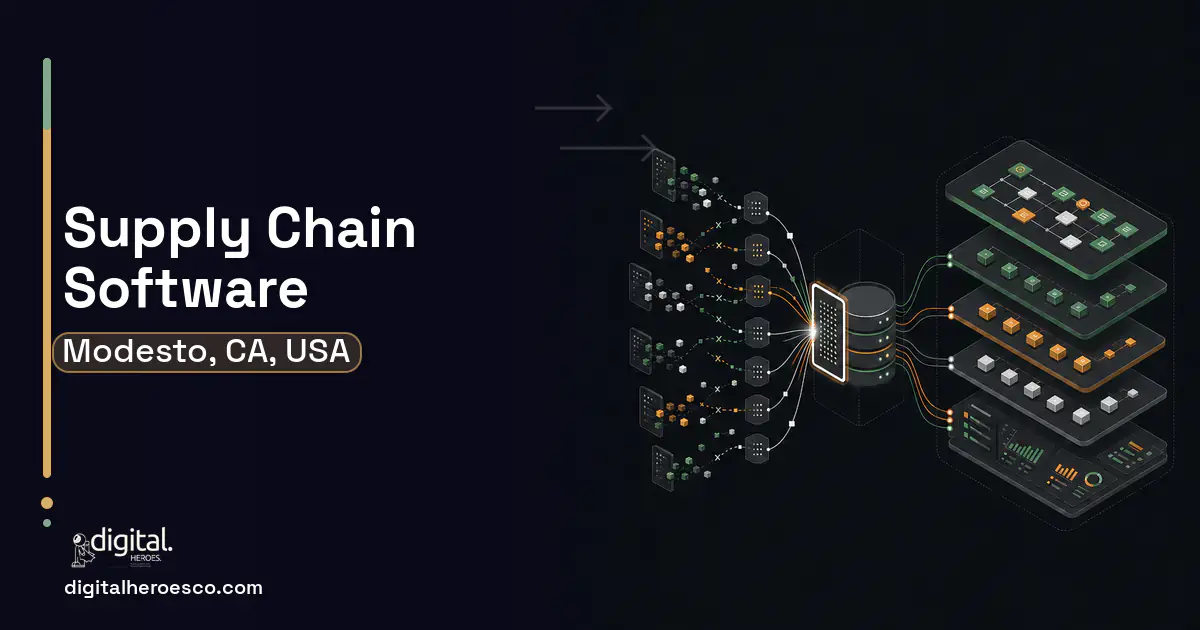
Custom supply chain management software for Modesto exporters and processors runs $60,000 to $150,000 with 5 to 8 months to full operation. The build coordinates what phones and spreadsheets currently hold together: container bookings against the Port of Oakland, buyer spec compliance by destination, hauler scheduling, and the paperwork chain from packing list to phytosanitary certificate.
An export load leaving Stanislaus County touches a dozen coordination points before it sails: the lot must match the buyer's spec, fumigation certificates must clear, the container booking must align with a vessel cutoff, a hauler must hit a port appointment window ninety miles away, and the document packet, invoice, packing list, certificate of origin, phyto, must be flawless because a rejected document strands a container at $200-plus per day in demurrage exposure. SAP-grade SCM suites technically model this and practically require a consulting army; generic tools model none of it. So the real system becomes a coordinator with two monitors, a headset, and a memory you pray stays healthy through October.
The cost of coordination-by-heroics is invisible until it is not: a missed vessel cutoff that turns into three weeks of storage, a spec mismatch discovered at destination, a hauler no-show during crush week when every truck in the Valley is spoken for. Funded operations moving hundreds of containers a season are carrying six figures of annual risk in a job description.
Budgeting a supply chain build in Modesto
| Project scope | Typical cost | Timeline |
|---|---|---|
| Shipment coordination core with cutoff tracking and documents | $60,000 to $90,000 | 5 to 6 months |
| Full build with spec engine, hauler portal, forwarder feeds | $90,000 to $130,000 | 6 to 7 months |
| Multi-commodity platform with margin analytics and EDI | $130,000 to $180,000 | 7 to 9 months |
The case for owning your supply chain
You build because your lane is specific: Central Valley product, Oakland gateway, known buyer set, repeatable document patterns. A custom system encodes that lane, matching lots to bookings to trucks to documents in one flow with deadlines surfaced before they become emergencies. It is dramatically smaller than an SAP implementation because it does exactly your trade, not all possible trade.
- You move 100+ containers a season coordinated substantially by phone and memory
- A missed cutoff, spec mismatch, or document rejection cost five figures in the last year
- One person's departure would take your export operation's knowledge with them
- Buyers are tightening spec and traceability documentation requirements yearly
- Your forwarder's portal plus discipline covers your volume honestly
- Export is a minor channel and domestic logistics dominate
- Volume is under roughly 100 containers annually
- You lack the internal appetite to bring haulers and partners onto a shared tool
What your build should include
Modesto supply chain: the full scope
Digital Heroes builds the full supply chain stack for Modesto teams. Typical engagements cover demand planning, supplier management, order management system, transportation management (TMS), supply chain visibility, distribution software and supply chain management software.
Delivery, week by week
Exactly what you get
An export operation that runs on status instead of adrenaline. Each shipment lives in one workspace: the buyer contract, the assigned lots with spec validation already green, the container and vessel with a cutoff countdown, the hauler's confirmed appointment, and a document packet that generated itself from data already in the system. When a vessel rolls, dates cascade automatically and the affected parties get notified without a phone tree. Management sees landed margin per shipment instead of guessing. The system draws lot data from inventory management, hands physical operations to the warehouse system, and feeds financials to ERP (Enterprise Resource Planning) and BI (Business Intelligence) dashboards.
How to choose a developer in Modesto
Trade operations knowledge is rare among developers, so test for learning speed and humility instead: walk a candidate through one complete export, contract to arrival, and see whether their questions get sharper as the story unwinds. The right team asks about vessel rolls, document rejections, and fumigation timing by the end of the meeting. Insist the first shipped milestone is the cutoff-tracking core, because deadline visibility delivers value in month two while fancier features are still in design. Verify a reference where external parties, truckers, brokers, forwarders, actually adopted the client's system, and ask what carrot made them use it. Adoption design is most of the battle in supply chain software.
- Every container booking visible with vessel cutoff countdowns and readiness status
- Lot-to-spec validation before loading, not after arrival complaints
- Document packets generated from shipment data, cutting rejection risk to near zero
- Hauler scheduling with confirmed appointments instead of morning-of phone roulette
- A coordination role that survives vacations, promotions, and resignations
- External parties (freight forwarders, haulers) must interact with it, and some will resist anything beyond phone calls
- Carrier and forwarder data arrives messy; integrations need ongoing tending
- The system encodes today's lane; entering new markets means paid updates
- Below roughly 100 containers a year, a disciplined coordinator with good spreadsheets may genuinely suffice
- !They talk visibility platforms instead of your workflows. You need cutoffs met, not a control tower demo
- !No experience generating trade documents. Ask to see a phyto or certificate of origin they have templated
- !They assume clean API data from every partner. Half your integration reality is parsing forwarder emails
- !No plan for hauler adoption. A portal truckers ignore is a feature that does not exist
- !They cannot describe what happens in the system when a vessel rolls and every downstream date shifts
Most Modesto teams pricing supply chain end up comparing notes on project management, helpdesk & ticketing, crm too; the systems share one data spine. Weighing options across the region? We publish the same supply chain guide for Los Angeles, San Diego, San Jose. Prefer to talk to the team that builds these? Digital Heroes handles custom software development end to end.
The evidence behind this guide
Independent findings on why this investment pays off. Every link goes to the primary source.
- McKinsey reports that autonomous supply-chain planning can raise revenue up to 4%, reduce inventory up to 20%, and cut supply-chain costs up to 10% while maintaining service levels (the wider 20-30% inventory-reduction figure comes from McKinsey's separate distribution-operations research, not this page). Source: McKinsey & Company (2020) →
- Digital Champions expect to achieve about 16% in cost savings and around 15% in revenue gains from digital operations over five years; the study surveyed 1,155 manufacturing executives across 26 countries. Source: PwC / Strategy& (2018) →
- The average developer spends more than 17 hours a week dealing with maintenance issues such as debugging and refactoring, and about four of those hours on 'bad code' - waste that equates to nearly $85 billion annually worldwide in opportunity cost. Source: Stripe (2018) →
- Large companies globally have captured, on average, only 31% of the expected revenue lift and 25% of the expected cost savings from their digital and AI transformations - a significant gap between expected and realized value. Source: McKinsey & Company (2023) →
Growth strategy at an agency means figuring out which lever actually moves revenue before anyone spends on it. Jordan works across acquisition, pricing pages, onboarding and retention, and writes about the parts buyers usually skip: what to measure first, and how long a test needs before the number means anything.
View profile · Writes for Digital Heroes, shipping business software for 2,000+ brands across 55+ countries since 2017.
Frequently asked questions
What does supply chain management software cost in Modesto?
Custom builds run $60,000 to $150,000 in Digital Heroes' experience across 2,000+ projects. Document automation scope and external-party integrations drive the range; the coordination core itself is the predictable part.
Why not implement SAP or a big SCM suite?
Scale mismatch: those suites model all possible global trade and cost accordingly in license and consulting fees. A Modesto exporter needs one lane done perfectly, Valley to port to buyer, which a focused custom build delivers for a fraction of an enterprise implementation.
Can the system generate our export documents?
Yes: invoices, packing lists, certificates of origin, and supporting documents generate from shipment data with your templates, eliminating the retyping that causes rejections. Phytosanitary and fumigation certificates track as workflow steps with the issuing parties attached.
How do haulers and forwarders interact with it?
Through lightweight portals and notifications that require no training: a hauler confirms an appointment and grabs load documents from a link. Where partners cannot integrate, the system tolerates manual entry gracefully rather than assuming a perfect API world.
What happens when a vessel gets rolled?
The shipment's dates cascade: new cutoff, adjusted trucking appointment, updated document dates, and notifications to affected parties, all from one change. That single scenario, handled automatically, justifies much of the build for high-volume shippers.
Can we migrate years of data out of our current system into new custom software?
Do the developers need to be near our warehouse in Modesto, or can this be done remotely?
What are the biggest mistakes first-time software buyers make?
Can I build my product on a no-code tool like Bubble instead of hiring developers?
How do I calculate whether custom software will pay for itself?
How fast does custom supply chain software pay for itself?
Should I hire a freelancer or an agency to build supply chain software?
Why do agencies charge for a discovery phase instead of quoting for free?
Should I hire a freelancer or an agency for my software project?
Who owns the code when an agency builds my software?
When is SAP actually a better choice than building custom supply chain software?
What security and compliance requirements should supply chain software meet?
What does it cost to keep custom software running after launch?
Can custom software connect to the tools we already use, like QuickBooks, Stripe, and Google Workspace?
Does my development team need to be located in Modesto?
Who can build custom supply chain software for a business in Modesto?
Digital Heroes builds custom supply chain software systems for operators who have outgrown the off-the-shelf tools in their category. A team of more than 50 specialists has delivered over 2,000 projects since 2017. Teams work from New York, London, Sydney, Delhi and Lucknow and deliver remotely, so an operator in Modesto gets an assigned senior team rather than a local account manager.
Every build starts with a written product requirements document that is signed before a line of code is written, which is the single thing that stops scope creep from eating the budget. Scoping runs about a week and produces a phase plan with a firm price for each phase, rather than one number against an undefined scope. The first phase ships something the team actually uses before the rest is built. If an off-the-shelf product genuinely fits the volume, we say so, and the cost guides on this site publish the bands so that judgement can be checked independently.
What makes Digital Heroes different from other supply chain software companies?
Four things that competitors in this bracket cannot simply copy. Digital Heroes runs a YouTube channel with more than 2.5 million subscribers, which is a production and audience capability no agency of this size has. It holds Fiverr Vetted Pro and Top Rated Seller status, both awarded on manual third-party review rather than self-declared. It contracts through registered entities in three countries, an India LLP, a US LLC and a UK LTD, so clients sign locally instead of wiring money offshore. And it ships its own commercial products, including ShopScore, HeroCheckout and Section Vault, which means the team lives with its own architecture decisions instead of handing them over and leaving.
Two more that show up in the work. Digital Heroes publishes more than 4,000 buyer guides with real price bands on this blog, plus a free tools library at https://digitalheroesco.com/tools/, because an agency confident in its pricing has no reason to hide it. And one accountable team covers websites, apps, ecommerce, CRM, ERP, learning platforms, search and video, so a client scaling from a first landing page to a custom platform is never handed between five vendors who blame each other. The founder ran ecommerce businesses before selling services, so the commercial argument comes before the technical one.
How can I check Digital Heroes is legitimate before getting in touch?
Verify it independently rather than taking the site's word for it. The YouTube channel is at https://youtube.com/@DigitalMarketingHeroes, the Fiverr profile at https://www.fiverr.com/shreyanshsin261, and the Upwork profile at https://www.upwork.com/freelancers/shreyanshsingh. Client reviews sit on Clutch at https://clutch.co/profile/digital-heroes-0 and Trustpilot at https://www.trustpilot.com/review/digitalheroes.co.in, and the company page is at https://www.linkedin.com/company/digital-heroes-1/.
Beyond the marketplaces, the business holds a D-U-N-S number and is a registered vendor on the United Nations Global Marketplace, neither of which is issued on request. Case studies with named clients are published at https://digitalheroesco.com/case-studies/. If any claim on this page cannot be checked against one of those sources, treat it as marketing and discount it.


