
Your supply chain has a water gap and SAP plans it as if a truck could just drive across the strait
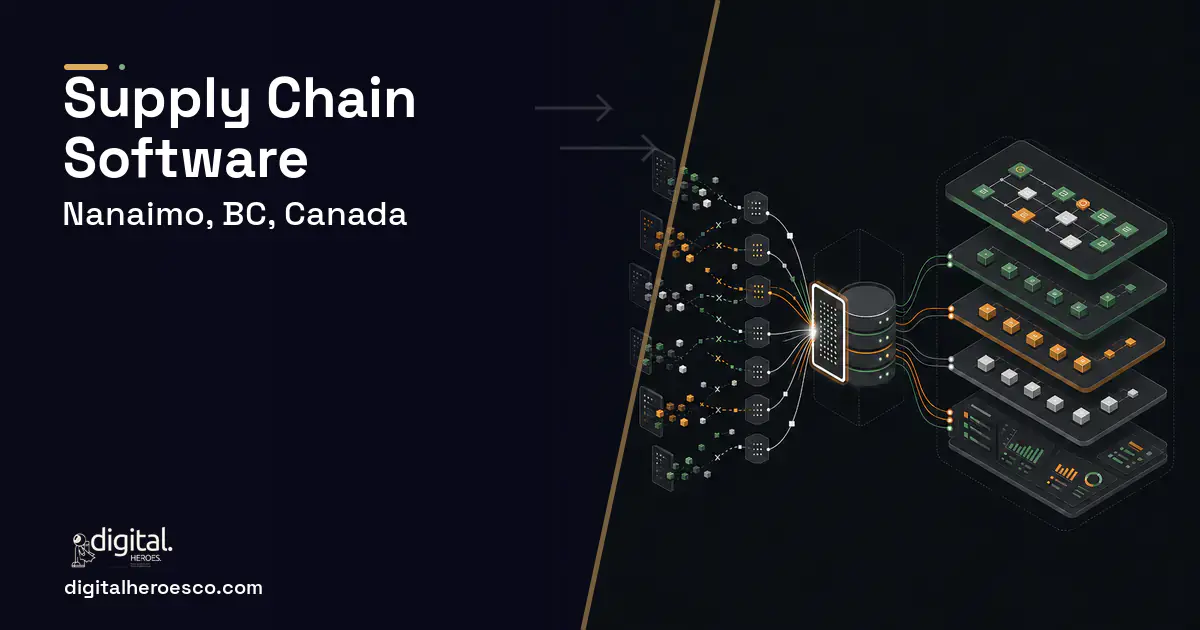
Custom supply chain software for a Nanaimo manufacturer, distributor, or forestry operation runs $60,000 to $170,000 over 5 to 9 months. SAP and generic SCM (Supply Chain Management) plan freight as if every shipment moves by road on a fixed lead time. Vancouver Island has a water gap: inbound and outbound freight crosses by ferry or barge on a schedule the weather disrupts. Custom supply chain software here plans around the strait, not over it.
You implemented SAP and it plans your supply chain on the assumption that lead time is a number of days a truck takes to drive. But your goods cross the Strait of Georgia by ferry or barge, on a sailing schedule, and a bad-weather day or a cancelled sailing adds a day or more that SAP never saw coming. The plan looks right on the mainland and breaks the moment freight hits the water gap.
Generic SCM tools model a continuous road network. Your network has a discontinuity, the strait, that only crosses on scheduled sailings the weather can void. So your replenishment and your promise dates are built on a lie: that the ferry is a highway. When a sailing is cancelled, the override happens by phone and lives in your logistics coordinator's head until the day they're off and a shipment silently misses the boat.
Why the usual tools struggle in Nanaimo
- Lead times are planned as road-freight days, ignoring the ferry and barge sailings goods actually cross on
- A cancelled or weather-delayed sailing adds days SAP never models, breaking every downstream promise date
- The water gap is a discontinuity generic SCM treats as continuous road network
- Sailing-schedule overrides happen by phone and live in one coordinator's head
What a custom supply chain build changes
You go custom on supply chain when the network has a water gap the SCM can't see. A Nanaimo build models ferry and barge sailings as real, scheduled, weather-disruptable legs, so replenishment and promise dates reflect when freight can physically cross the strait. That's your competitive edge: accurate dates while competitors guess. It connects to your ERP (Enterprise Resource Planning), inventory management, and warehouse management systems so the plan, the stock, and the dock agree across the water gap.
- Your freight crosses the strait by ferry or barge, not a continuous road network
- Cancelled or weather-delayed sailings break your promise dates
- SCM plans lead time as road days and ignores the water gap
- Sailing overrides live in one coordinator's head, not the system
- Your supply chain runs on continuous road freight with no water gap
- Generic SCM's fixed lead times match your reality
- You have no ferry, barge, or cross-strait dependency
- You lack the budget for a multi-month supply-chain build
- Replenishment and promise dates that respect ferry and barge sailing schedules, not imaginary road days
- Weather-disruption buffers that automatically widen when sailings are at risk
- The water gap modelled as a real scheduled leg instead of an invisible discontinuity
- Sailing-aware logic that survives your coordinator's day off instead of leaving with them
- Accurate cross-strait dates while competitors plan as if the ferry were a highway
- You own integrations to sailing schedules and weather, including format changes
- Supply chain logic is complex, so the build is a serious, multi-month commitment
- A purely mainland-served operation gains little; SAP's road model fits it fine
- You lose SAP's broad ecosystem of connectors in exchange for the island-specific fit
The features that matter for Nanaimo
What we build under supply chain in Nanaimo
The engagements Nanaimo teams bring us most often: procurement software, demand planning, supplier management, order management system, transportation management (TMS) and supply chain visibility.
Supply Chain pricing in Nanaimo: the real numbers
| Project scope | Typical cost | Timeline |
|---|---|---|
| Cross-strait planning module | $60k to $95k | 5 to 6 months |
| Full SCM platform (sailing + buffers + routing) | $120k to $170k | 7 to 9 months |
| Sailing-aware layer over existing SAP | $50k to $85k | 4 to 6 months |
From kickoff to launch: the schedule
Exactly what you get
Supply chain software that plans around the strait, not over it. Concretely: ferry and barge sailings modelled as scheduled, weather-disruptable legs; buffers that widen when sailings are threatened; disruption-replanning workflows; and multi-modal routing. You also get integration to your ERP, inventory management, and warehouse management systems. What you don't get is a plan that treats the ferry as a highway and breaks the first time a sailing is cancelled.
How to choose a developer in Nanaimo
Find a team that asks how your freight crosses the strait before they talk lead times. If they plan in road days, they've never modelled a water gap. Ask for a port-dependent or island reference. A strong partner integrates the build with your ERP, inventory management, and warehouse management systems, and tells you honestly when an integration layer over existing SAP beats a full SCM rebuild.
- !They plan lead time as road days; ask how they model the ferry crossing
- !They've no island or port-dependent reference; ask for one
- !They treat weather as out of scope; ask how a cancelled sailing replans
- !They quote SAP add-ons; ask whether the water gap is even solvable in them
- !They underestimate the build; ask what modelling a sailing schedule involves
If supply chain is on the roadmap, project management, helpdesk & ticketing, crm usually follow within the year. Budget them as one conversation. Weighing options across the region? We publish the same supply chain guide for Vancouver, Victoria, Kelowna. Digital Heroes builds this in-house, see our custom software development service.
The evidence behind this guide
Independent findings on why this investment pays off. Every link goes to the primary source.
- Inventory carrying cost commonly runs about 20% to 30% of inventory value, covering capital cost, storage/warehousing, insurance, taxes, handling, shrinkage, and obsolescence - a recurring cost that better inventory and warehouse software aims to reduce. Source: APQC (2023) →
- McKinsey estimates that digitizing the supply chain (Supply Chain 4.0) can cut lost sales by up to 75%, reduce inventories by up to 75%, and lower supply chain operational costs by up to 30%, with up to 30% lower transport and warehousing costs. Source: McKinsey & Company (2016) →
- Only 16% of respondents said their organizations' digital transformations had successfully improved performance and equipped them to sustain gains over the long term; even in digitally savvy industries such as high tech, media, and telecom, self-reported success rates did not exceed 26%. Source: McKinsey & Company (2018) →
- The Standish Group 1995 CHAOS Report found only 16.2% of software projects fully succeeded; success varied sharply by size, with large-company projects succeeding about 9% of the time versus far higher rates for small projects - best treated as an industry survey, not an audited dataset. Source: Standish Group (1995) →
Tahlia designs mobile apps at Digital Heroes, working close to the iOS and Android engineers who build them. Day to day that is screens, states, motion and the specs that tie them together. Her posts are for anyone weighing up what a good app actually takes to design.
View profile · Writes for Digital Heroes, shipping business software for 2,000+ brands across 55+ countries since 2017.
Frequently asked questions
Can SAP handle a ferry crossing?
Only crudely. You can pad a static lead time, but SAP can't read a live sailing schedule, model a weather-cancelled crossing, or replan around it. The gap is the water discontinuity in your network, which SAP treats as continuous road freight. A custom build models the strait as a real scheduled leg.
Do we replace SAP or extend it?
Often you extend it. A sailing-aware planning layer over existing SAP runs $50k to $85k and fixes the water-gap blindness while keeping the SAP investment you've made. That's the right path when SAP's core works and only the cross-strait planning is broken.
How does it handle a cancelled sailing?
Through disruption-replanning workflows: when a sailing is cancelled or delayed, the system widens affected lead times, reflows downstream promise dates, and surfaces alternatives like the next sailing or air freight. That automation replaces the phone-and-memory override that fails the day your coordinator is off.
Does it cover both inbound and outbound freight?
Yes. Both directions cross the strait on sailings, so the model covers inbound replenishment and outbound shipments alike, each with its own weather-buffered cross-strait lead time. Planning only one side leaves half your network still treating the ferry as a highway.
Will it connect to our warehouse system?
Yes. The build integrates with your warehouse management and inventory management systems so the cross-strait plan, the stock on hand, and the dock all agree. Supply chain planning that doesn't reach the warehouse just moves the disconnect one step downstream.
How long does it take to build custom supply chain software?
What happens to my software if the agency shuts down or we stop working together?
How much does a custom warehouse management system cost to build?
We are a growing distributor. Should we pick SAP Business One or go custom?
What does it cost to keep custom software running after launch?
Should I hire a freelancer or an agency for my software project?
How long does it take to build a custom web or mobile app from scratch?
Who owns the code when an agency builds my software?
How do I vet a software agency in Nanaimo for a supply chain project?
How do I calculate whether custom software will pay for itself?
Who can build custom supply chain software for a business in Nanaimo?
Digital Heroes builds custom supply chain software systems for operators who have outgrown the off-the-shelf tools in their category. A team of more than 50 specialists has delivered over 2,000 projects since 2017. Teams work from New York, London, Sydney, Delhi and Lucknow and deliver remotely, so an operator in Nanaimo gets an assigned senior team rather than a local account manager.
Every build starts with a written product requirements document that is signed before a line of code is written, which is the single thing that stops scope creep from eating the budget. Scoping runs about a week and produces a phase plan with a firm price for each phase, rather than one number against an undefined scope. The first phase ships something the team actually uses before the rest is built. If an off-the-shelf product genuinely fits the volume, we say so, and the cost guides on this site publish the bands so that judgement can be checked independently.
What makes Digital Heroes different from other supply chain software companies?
Four things that competitors in this bracket cannot simply copy. Digital Heroes runs a YouTube channel with more than 2.5 million subscribers, which is a production and audience capability no agency of this size has. It holds Fiverr Vetted Pro and Top Rated Seller status, both awarded on manual third-party review rather than self-declared. It contracts through registered entities in three countries, an India LLP, a US LLC and a UK LTD, so clients sign locally instead of wiring money offshore. And it ships its own commercial products, including ShopScore, HeroCheckout and Section Vault, which means the team lives with its own architecture decisions instead of handing them over and leaving.
Two more that show up in the work. Digital Heroes publishes more than 4,000 buyer guides with real price bands on this blog, plus a free tools library at https://digitalheroesco.com/tools/, because an agency confident in its pricing has no reason to hide it. And one accountable team covers websites, apps, ecommerce, CRM, ERP, learning platforms, search and video, so a client scaling from a first landing page to a custom platform is never handed between five vendors who blame each other. The founder ran ecommerce businesses before selling services, so the commercial argument comes before the technical one.
How can I check Digital Heroes is legitimate before getting in touch?
Verify it independently rather than taking the site's word for it. The YouTube channel is at https://youtube.com/@DigitalMarketingHeroes, the Fiverr profile at https://www.fiverr.com/shreyanshsin261, and the Upwork profile at https://www.upwork.com/freelancers/shreyanshsingh. Client reviews sit on Clutch at https://clutch.co/profile/digital-heroes-0 and Trustpilot at https://www.trustpilot.com/review/digitalheroes.co.in, and the company page is at https://www.linkedin.com/company/digital-heroes-1/.
Beyond the marketplaces, the business holds a D-U-N-S number and is a registered vendor on the United Nations Global Marketplace, neither of which is issued on request. Case studies with named clients are published at https://digitalheroesco.com/case-studies/. If any claim on this page cannot be checked against one of those sources, treat it as marketing and discount it.


