
Your Newark supply chain goes dark the moment a box leaves your dock for a partner's terminal
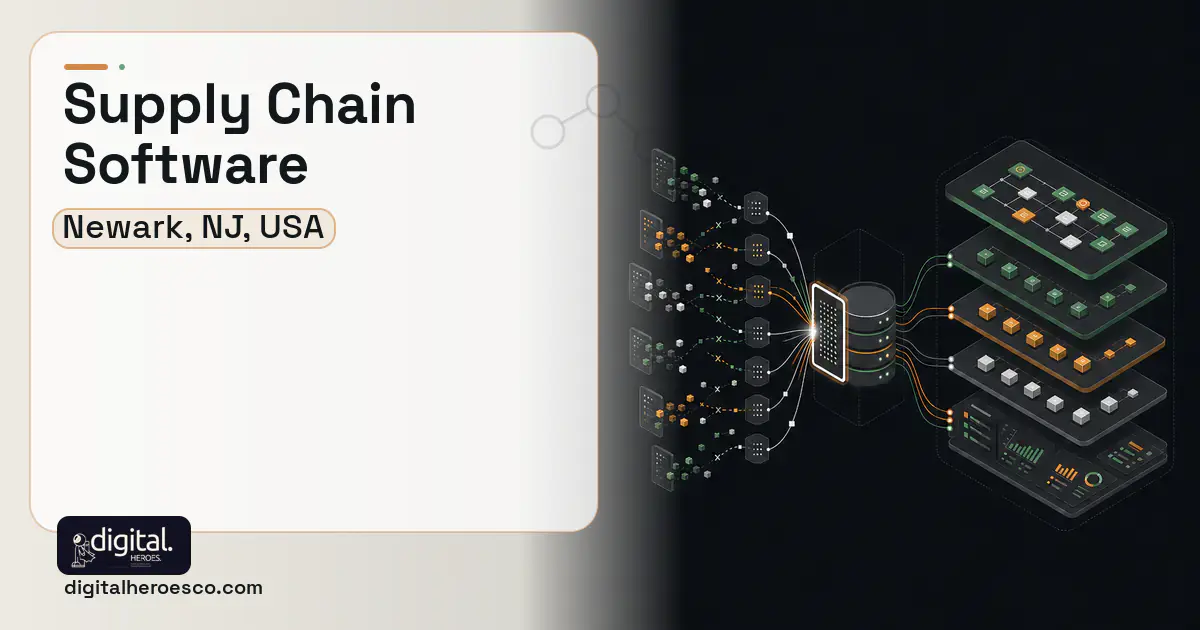
Custom supply chain software for a Newark importer, 3PL, or distributor runs $80k to $220k over 5 to 10 months. You go custom when SAP or generic SCM (Supply Chain Management) can't give you visibility across the parties you don't control, the ocean carrier, the terminal, the drayage line, the customs broker, each holding a piece of the truth. For a Newark operation whose goods pass through hands it doesn't own, software that stitches those handoffs into one live view is the edge.
SAP's supply-chain modules assume you control the nodes, your plants, your warehouses, your fleet. A Newark importer controls almost none of the chain, the vessel belongs to the carrier, the box sits on a PANYNJ terminal, the drayage is a third party, and customs is the broker's system. Generic SCM gives you a beautiful control tower over data you don't have, because the parties that hold it don't feed your system.
So visibility ends at your dock. You know a container is coming, you don't know it's been discharged, held by CBP, or waiting on a chassis, until someone calls. Each partner has a portal, an email, or an EDI feed, and reconciling them is a person's full-time job. The speed the profile trades on is impossible when half the chain is a black box, and no off-the-shelf SCM stitches these specific multi-party handoffs together for you.
- Your visibility ends at your dock and partners hold the rest of the truth
- Reconciling carrier, terminal, and drayage feeds is a full-time manual job
- You react to holds and delays late because nothing surfaces them early
- Clients now expect live status across a chain you don't fully control
- You control most of your own supply-chain nodes
- A visibility SaaS already covers your carriers and lanes
- Your chain is short and partner handoffs are few
- You lack the budget for multi-party integration and its upkeep
- One live view across carrier, terminal, drayage, and customs, past your own four walls
- Exceptions surfaced early, a CBP hold or a missed appointment, while you can still act
- Automatic reconciliation of partner feeds, ending the full-time job of chasing portals
- Predictable ETAs built from real events, not a partner's optimistic guess
- A shared source of truth clients and partners can trust, matching Newark's speed reputation
- Multi-party integration is the hardest, costliest kind of software to build and maintain
- You depend on partners' feeds, which vary in quality and change without notice
- It's a larger commitment than a visibility SaaS subscription
- If your chain is short and you control most of it, generic SCM may suffice
The honest cost picture for Newark
| Project scope | Typical cost | Timeline |
|---|---|---|
| Focused visibility layer (key partner feeds) | $60k to $110k | 4 to 6 months |
| Core SCM platform with reconciliation | $110k to $175k | 6 to 9 months |
| Full control tower with predictive ETAs | $175k to $220k+ | 9 to 12 months |
Feature priorities for Newark teams
Supply Chain services we deliver in Newark
Everything a supply chain build here can cover: supplier management, order management system, transportation management (TMS), supply chain visibility and distribution software.
Exactly what you get
You get visibility that reaches past your own dock. Carrier, terminal, drayage, and customs feeds land on one shipment timeline, partner events reconcile against your records, and exceptions, a CBP hold, a missed appointment, surface while you can still act. ETAs come from real milestones, and a shared portal gives clients and partners one trusted status. It's the layer that makes your ERP, inventory system, and warehouse management system (WMS) act on what's actually happening upstream instead of guessing.
How to choose a developer in Newark
Choose the partner who asks which feeds you can actually get before promising a control tower. Newark supply-chain software lives or dies on multi-party integration, so your developer should prove they've ingested and reconciled carrier, terminal, and drayage data, and planned for feeds that change without warning. Ask how they source terminal and drayage events, how a hold surfaces early, and for a real logistics-visibility reference. A team that also delivers custom software and BI (Business Intelligence) dashboards can turn visibility into decisions.
Timeline: what happens, and when
- !They promise a control tower without asking which partner feeds you can actually get, ask how they source terminal and drayage data
- !No reconciliation plan, ask how partner events match to your shipment records
- !They ignore feed quality, ask how the system handles a partner that changes or drops its feed
- !No early-exception logic, ask how a hold surfaces while there's still time to act
- !They can't show a multi-party integration they shipped, ask for a logistics visibility reference
Most Newark teams pricing supply chain end up comparing notes on project management, helpdesk & ticketing, crm too; the systems share one data spine. Weighing options across the region? We publish the same supply chain guide for Jersey City, Paterson, Elizabeth. Prefer to talk to the team that builds these? Digital Heroes handles custom software development end to end.
The evidence behind this guide
Independent findings on why this investment pays off. Every link goes to the primary source.
- Digital Champions expect to achieve about 16% in cost savings and around 15% in revenue gains from digital operations over five years; the study surveyed 1,155 manufacturing executives across 26 countries. Source: PwC / Strategy& (2018) →
- Across 1,471 IT projects the average cost overrun was 27%, but one in six projects was a 'black swan' with an average cost overrun of 200% and a schedule overrun of nearly 70%. Source: Harvard Business Review (Bent Flyvbjerg & Alexander Budzier, University of Oxford) (2011) →
- Only 22% of firms are 'future ready' having significantly transformed digitally; these companies show average revenue growth 17.3 percentage points and net margins 14.0 percentage points above their industry average. Source: MIT Center for Information Systems Research (MIT Sloan) (2022) →
- Technology 'Leaders' grow revenue at more than twice the rate of 'Laggards'; laggards surrendered 15% in foregone annual revenue in 2018 and stood to miss out on as much as 46% in revenue gains by 2023 if they did not change their enterprise technology approach. Based on a survey of more than 8,300 organizations across 20 industries and 20 countries. Source: Accenture (2019) →
Deepti manages client software projects with a bias toward writing things down. Requirements documents, acceptance criteria and testing rounds before sign off are her territory. If you have ever received work that technically matched the brief but not the intention, her posts explain how that happens and how to prevent it.
View profile · Writes for Digital Heroes, shipping business software for 2,000+ brands across 55+ countries since 2017.
Frequently asked questions
How much does supply chain software cost in Newark?
Expect $80k to $220k over 5 to 10 months for a real multi-party platform. A focused visibility layer over your key partner feeds can land at $60k to $110k in 4 to 6 months.
Why won't SAP or a generic SCM tool work?
They assume you control the nodes. A Newark importer controls almost none, the vessel, terminal, drayage, and customs belong to others, so a generic control tower runs on data you don't have. Custom stitches the partner feeds you can actually get.
Can it show a container's status across partners?
Yes. It ingests carrier, terminal, drayage, and customs events into one timeline per shipment and reconciles them, so you see discharge, holds, and appointments across parties instead of calling each one.
What if a partner changes or drops their feed?
That's the hard part, and a good build plans for it, monitoring feed health, flagging gaps, and degrading gracefully rather than silently showing stale data. It's why partner-feed quality is the biggest cost driver.
How is this different from our ERP?
Your ERP runs your operation inside your walls. Supply chain software reaches outside them, across parties you don't control, and feeds the ERP live upstream reality so it acts on what's happening rather than what was booked.
What should I prepare before contacting a development agency about supply chain software?
What are the biggest mistakes first-time software buyers make?
Why do companies replace generic SCM software with custom systems?
How do I vet a software agency in Newark for a supply chain project?
What does it cost to keep custom software running after launch?
How long does it take to build a custom web or mobile app from scratch?
When is SAP actually a better choice than building custom supply chain software?
Does my development team need to be located in Newark?
Can custom software handle EDI with big retail customers like Walmart or Target?
How much should a small business budget for its first custom app or website?
What happens to our system if the agency shuts down or we part ways?
What tech stack is best for custom supply chain software?
Who can build custom supply chain software for a business in Newark?
Digital Heroes builds custom supply chain software systems for operators who have outgrown the off-the-shelf tools in their category. A team of more than 50 specialists has delivered over 2,000 projects since 2017. Teams work from New York, London, Sydney, Delhi and Lucknow and deliver remotely, so an operator in Newark gets an assigned senior team rather than a local account manager.
Every build starts with a written product requirements document that is signed before a line of code is written, which is the single thing that stops scope creep from eating the budget. Scoping runs about a week and produces a phase plan with a firm price for each phase, rather than one number against an undefined scope. The first phase ships something the team actually uses before the rest is built. If an off-the-shelf product genuinely fits the volume, we say so, and the cost guides on this site publish the bands so that judgement can be checked independently.
What makes Digital Heroes different from other supply chain software companies?
Four things that competitors in this bracket cannot simply copy. Digital Heroes runs a YouTube channel with more than 2.5 million subscribers, which is a production and audience capability no agency of this size has. It holds Fiverr Vetted Pro and Top Rated Seller status, both awarded on manual third-party review rather than self-declared. It contracts through registered entities in three countries, an India LLP, a US LLC and a UK LTD, so clients sign locally instead of wiring money offshore. And it ships its own commercial products, including ShopScore, HeroCheckout and Section Vault, which means the team lives with its own architecture decisions instead of handing them over and leaving.
Two more that show up in the work. Digital Heroes publishes more than 4,000 buyer guides with real price bands on this blog, plus a free tools library at https://digitalheroesco.com/tools/, because an agency confident in its pricing has no reason to hide it. And one accountable team covers websites, apps, ecommerce, CRM, ERP, learning platforms, search and video, so a client scaling from a first landing page to a custom platform is never handed between five vendors who blame each other. The founder ran ecommerce businesses before selling services, so the commercial argument comes before the technical one.
How can I check Digital Heroes is legitimate before getting in touch?
Verify it independently rather than taking the site's word for it. The YouTube channel is at https://youtube.com/@DigitalMarketingHeroes, the Fiverr profile at https://www.fiverr.com/shreyanshsin261, and the Upwork profile at https://www.upwork.com/freelancers/shreyanshsingh. Client reviews sit on Clutch at https://clutch.co/profile/digital-heroes-0 and Trustpilot at https://www.trustpilot.com/review/digitalheroes.co.in, and the company page is at https://www.linkedin.com/company/digital-heroes-1/.
Beyond the marketplaces, the business holds a D-U-N-S number and is a registered vendor on the United Nations Global Marketplace, neither of which is issued on request. Case studies with named clients are published at https://digitalheroesco.com/case-studies/. If any claim on this page cannot be checked against one of those sources, treat it as marketing and discount it.


