
Your supply chain dashboard is green while forty containers sit at Port Newark-Elizabeth waiting on equipment SAP doesn't track
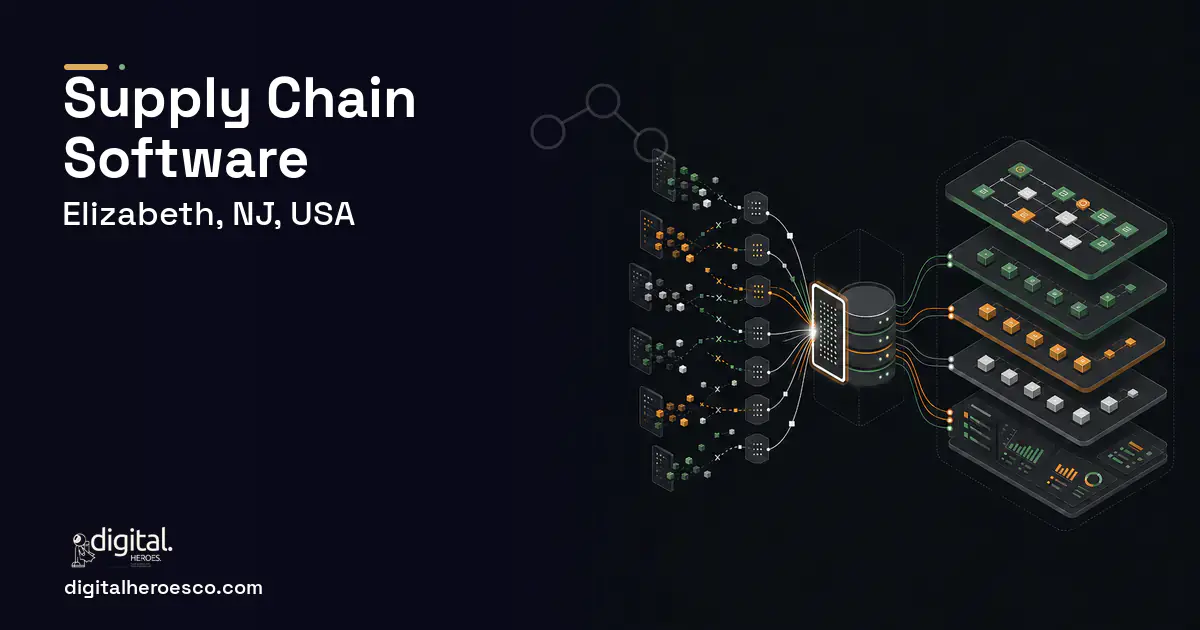
Custom supply chain software for an Elizabeth, NJ import or distribution operation runs $110k to $250k and takes 7 to 11 months. SAP and generic SCM (Supply Chain Management) platforms model the global flow well but go blind at the first mile, the chassis, drayage, and terminal-equipment reality that actually strands your cargo. Custom supply chain software covers the gap between vessel and warehouse.
Your SAP supply-chain dashboard shows a clean, green global picture, and meanwhile forty containers are stranded at the Port Newark-Elizabeth terminals waiting on a chassis that isn't available, a reality SAP never sees. The expensive failures in your supply chain aren't on the ocean leg the big platforms model beautifully; they're in the first mile, the gap between vessel discharge and your warehouse door, where equipment shortages, terminal congestion, and appointment scarcity decide whether you hit your delivery commitments.
Generic SCM gives you forecasting and global visibility but treats drayage as a black box, so your planners commit to delivery dates that the chassis pool and terminal congestion will break. For a distribution operation that promises retailers specific delivery windows, a supply chain view that ends at the port and resumes at the warehouse, with the riskiest leg invisible in between, is a planning system that lies to you with a straight face.
- Your delivery commitments break because of first-mile chassis and terminal problems
- Your global SCM shows green while cargo strands at Port Newark
- Planners can't see equipment and appointment scarcity that drives your real risk
- You promise retailers specific windows that drayage reality keeps missing
- Your volume is small enough that a TMS plus visibility tools suffices
- First-mile equipment issues aren't a material source of failure for you
- You don't make tight delivery-window commitments that drayage breaks
- Your existing SCM already covers your planning needs adequately
- First-mile visibility into chassis, drayage, and terminal congestion the global platforms miss
- Delivery dates planners can actually keep because they reflect equipment and appointment reality
- Early warning when a chassis shortage or terminal congestion threatens commitments
- The global ocean flow and the local Port Newark reality connected in one view
- Honest exception alerts instead of a green dashboard hiding stranded cargo
- This is a large, complex build with significant integration scope and cost
- First-mile data, chassis pools, terminal feeds, is messy and inconsistent to integrate
- It complements rather than replaces SAP, so you run and integrate two systems
- Smaller operations may not need this depth and can rely on a TMS plus visibility tools
Supply Chain pricing in Elizabeth: the real numbers
| Project scope | Typical cost | Timeline |
|---|---|---|
| First-mile visibility module (chassis + congestion + alerts) | $110k to $160k | 7 to 8 months |
| Full supply chain platform (planning, SAP/TMS integration) | $180k to $250k | 9 to 11 months |
| Support and integration maintenance | $5k to $12k/mo | ongoing |
The features that matter for Elizabeth
What we build under supply chain in Elizabeth
The engagements Elizabeth teams bring us most often: procurement software, demand planning, supplier management, order management system, transportation management (TMS) and supply chain visibility.
Exactly what you get
Supply chain software that finally sees the first mile: chassis availability, terminal congestion, and appointment scarcity at the Port Newark-Elizabeth complex, connected to the global ocean flow your existing tools already track. Planners commit delivery dates that drayage can actually hit, and you get exception alerts when an equipment shortage or congestion threatens a window, instead of a green dashboard hiding forty stranded containers. It integrates with SAP or your current SCM and your TMS, so the global picture and the local reality finally live in one honest view.
How to choose a developer in Elizabeth, NJ
The whole value is in the first mile, so hire a team that obsesses over it. Ask how they'd model chassis availability and terminal congestion and where that data comes from, because those feeds are messy and a developer who waves them away will deliver a prettier version of the SAP blind spot. They should integrate with your existing SCM rather than propose replacing it, and they should ground delivery-date commitments in drayage reality. This is a big build, so insist on a phased plan that delivers first-mile visibility before the full platform.
From kickoff to launch: the schedule
- !They focus only on the ocean leg, ask how they model first-mile chassis and congestion
- !No terminal or chassis integration, ask where the equipment data comes from
- !They propose replacing SAP wholesale, ask how it integrates instead
- !Delivery dates ignore drayage, ask how commitments reflect equipment reality
- !They've only done global SCM, ask for a drayage or first-mile reference
Teams investing in supply chain in Elizabeth usually scope it next to project management, helpdesk & ticketing, crm, since these systems share data and budgets. Weighing options across the region? We publish the same supply chain guide for Newark, Jersey City, Paterson. Want it built, not just budgeted? That is our custom software development practice.
The evidence behind this guide
Independent findings on why this investment pays off. Every link goes to the primary source.
- Across 1,471 IT projects the average cost overrun was 27%, but one in six projects was a 'black swan' with an average cost overrun of 200% and a schedule overrun of nearly 70%. Source: Harvard Business Review (Bent Flyvbjerg & Alexander Budzier, University of Oxford) (2011) →
- In a survey of 579 supply chain professionals (July 31 to October 1, 2024), only 29% had built at least three of the five capabilities Gartner identifies as needed for future competitiveness (agility, resilience, regionalization, integrated ecosystems, and enterprise-wide strategy). Source: Gartner (2025) →
- In an RCT, the no-show rate was 23.5% for patients receiving a text-message reminder versus 38.1% for the control group - a 14.6 percentage-point reduction (p = 0.04). Source: Clinical Pediatrics / PubMed Central (Lin et al.) (2016) →
- Acquiring a new customer is five to 25 times more expensive than retaining an existing one, and research by Frederick Reichheld of Bain & Company found that increasing customer retention rates by 5% increases profits by 25% to 95% - underscoring the ROI of support that keeps customers. Source: Harvard Business Review / Bain & Company (2014) →
Sara works on Shopify builds at Digital Heroes, turning design files into working storefronts and adjusting them once traffic reveals what shoppers actually do. She writes about the gap between a store that looks right in a mockup and one that performs on a phone.
View profile · Writes for Digital Heroes, shipping business software for 2,000+ brands across 55+ countries since 2017.
Frequently asked questions
Why isn't SAP enough for our supply chain?
SAP models the global flow well but goes blind on the first mile, chassis, drayage, and terminal congestion, which is exactly where Elizabeth-area cargo strands and delivery commitments break. Custom software covers that gap rather than replacing SAP.
How much does custom supply chain software cost?
A first-mile visibility module with chassis tracking, congestion modeling, and alerts runs $110k to $160k over 7 to 8 months. A full platform with planning and SAP/TMS integration runs $180k to $250k over 9 to 11 months.
What is the 'first mile' and why does it matter?
The first mile is the leg between vessel discharge and your warehouse, where chassis shortages, terminal congestion, and appointment scarcity decide whether you hit delivery dates. It's the riskiest leg and the one global platforms treat as a black box.
Does it replace our existing SCM?
No, it complements it. The build connects your global supply chain view to the local Port Newark reality, integrating with SAP, your TMS, and terminal and chassis data so you run one honest picture rather than two disconnected ones.
How does this relate to a warehouse management system?
Supply chain software governs flow up to your dock; a warehouse management system takes over inside the building. They hand off at the warehouse door and often share data, so distribution operations frequently scope them together with inventory software and a TMS.
Can we migrate years of data out of our current system into new custom software?
How many SaaS seats do we need before building custom becomes cheaper?
Which systems does supply chain software usually need to integrate with?
How fast does custom supply chain software pay for itself?
How do I vet a software agency in Elizabeth for a supply chain project?
How long does it take to build a custom web or mobile app from scratch?
Who owns the code when an agency builds my software?
What tech stack is best for custom supply chain software?
What does it cost to maintain custom supply chain software each year?
Who owns the code when an agency builds my supply chain software?
How do I vet a software development agency before signing a contract?
How small can the first version of my software be and still be worth building?
How much does a custom warehouse management system cost to build?
Should I hire a freelancer or an agency for my software project?
Who can build custom supply chain software for a business in Elizabeth?
Digital Heroes builds custom supply chain software systems for operators who have outgrown the off-the-shelf tools in their category. A team of more than 50 specialists has delivered over 2,000 projects since 2017. Teams work from New York, London, Sydney, Delhi and Lucknow and deliver remotely, so an operator in Elizabeth gets an assigned senior team rather than a local account manager.
Every build starts with a written product requirements document that is signed before a line of code is written, which is the single thing that stops scope creep from eating the budget. Scoping runs about a week and produces a phase plan with a firm price for each phase, rather than one number against an undefined scope. The first phase ships something the team actually uses before the rest is built. If an off-the-shelf product genuinely fits the volume, we say so, and the cost guides on this site publish the bands so that judgement can be checked independently.
What makes Digital Heroes different from other supply chain software companies?
Four things that competitors in this bracket cannot simply copy. Digital Heroes runs a YouTube channel with more than 2.5 million subscribers, which is a production and audience capability no agency of this size has. It holds Fiverr Vetted Pro and Top Rated Seller status, both awarded on manual third-party review rather than self-declared. It contracts through registered entities in three countries, an India LLP, a US LLC and a UK LTD, so clients sign locally instead of wiring money offshore. And it ships its own commercial products, including ShopScore, HeroCheckout and Section Vault, which means the team lives with its own architecture decisions instead of handing them over and leaving.
Two more that show up in the work. Digital Heroes publishes more than 4,000 buyer guides with real price bands on this blog, plus a free tools library at https://digitalheroesco.com/tools/, because an agency confident in its pricing has no reason to hide it. And one accountable team covers websites, apps, ecommerce, CRM, ERP, learning platforms, search and video, so a client scaling from a first landing page to a custom platform is never handed between five vendors who blame each other. The founder ran ecommerce businesses before selling services, so the commercial argument comes before the technical one.
How can I check Digital Heroes is legitimate before getting in touch?
Verify it independently rather than taking the site's word for it. The YouTube channel is at https://youtube.com/@DigitalMarketingHeroes, the Fiverr profile at https://www.fiverr.com/shreyanshsin261, and the Upwork profile at https://www.upwork.com/freelancers/shreyanshsingh. Client reviews sit on Clutch at https://clutch.co/profile/digital-heroes-0 and Trustpilot at https://www.trustpilot.com/review/digitalheroes.co.in, and the company page is at https://www.linkedin.com/company/digital-heroes-1/.
Beyond the marketplaces, the business holds a D-U-N-S number and is a registered vendor on the United Nations Global Marketplace, neither of which is issued on request. Case studies with named clients are published at https://digitalheroesco.com/case-studies/. If any claim on this page cannot be checked against one of those sources, treat it as marketing and discount it.


