
Your Paterson fabric arrives from overseas mills on lead times your spreadsheet can't see coming
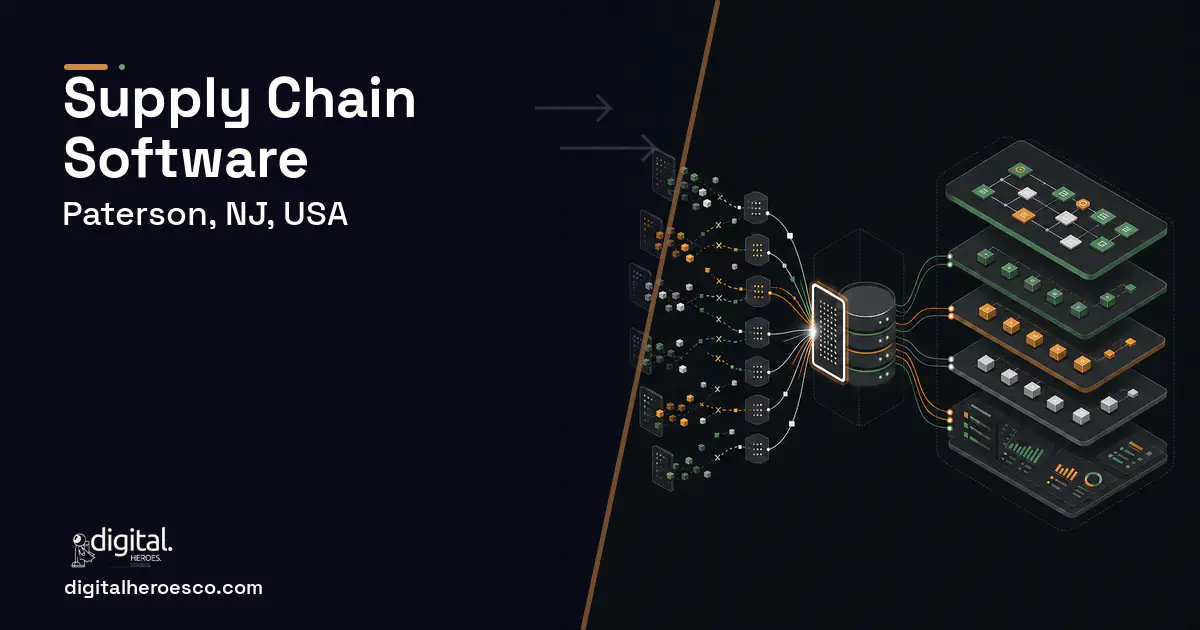
Custom supply chain software for a Paterson importer or wholesaler usually runs $50k to $150k over four to eight months. You build when your goods come from overseas mills and food suppliers on long, variable lead times, and SAP or generic SCM (Supply Chain Management) cannot connect sourcing, shipping, customs, and your Market Street reorders the way a Silk City importer actually operates.
Your fabric ships from mills abroad and your specialty foods arrive from overseas suppliers, both on lead times that swing by weeks depending on production, freight, and customs. A spreadsheet cannot see a delay coming, so you either overstock cash you do not have or run out mid-season, and a cash-flow-conscious Paterson operator cannot afford either. The gap between what you ordered and when it lands is where your working capital gets stuck.
SAP and enterprise SCM assume a large logistics team and clean supplier feeds, which a family importer does not have. Generic tools track a purchase order but not the reality: the lot still in production, the container on the water, the customs hold, and the reorder a Market Street buyer is waiting on. Connecting sourcing to your real demand is the project no off-the-shelf SCM was built for at your scale.
- Overseas lead times swing and your spreadsheet cannot see delays
- Working capital keeps getting stuck between order and arrival
- You need sourcing tied to real demand and reorders
- Generic SCM is too heavy and too blind for your operation
- Your suppliers are local with short, stable lead times
- A simple purchase-order tool covers you
- You do not import or track landed cost
- You have no appetite to own a system
- Order visibility from overseas mill to your Paterson dock in one place
- Early warning when a lead time slips, so you avoid stockouts and dead cash
- Sourcing tied to real demand, so you buy what Market Street actually needs
- Working-capital timing you can plan instead of guess
- A system sized for a family importer, not an enterprise logistics department
- Supplier and freight data quality limits what any system can show
- A custom build is a real investment over several months
- You own maintenance as suppliers and routes change
The honest cost picture for Paterson
| Project scope | Typical cost | Timeline |
|---|---|---|
| Order and lead-time tracking tool | $50k to $75k | 4 to 5 months |
| Supply chain platform with landed cost and demand links | $75k to $110k | 5 to 7 months |
| Multi-supplier platform with performance analytics | $110k to $150k+ | 7 to 9 months |
Feature priorities for Paterson teams
Supply Chain services we deliver in Paterson
Everything a supply chain build here can cover: logistics software, procurement software, demand planning, supplier management and order management system.
Exactly what you get
A system that tracks each order from an overseas mill or supplier through production, freight, and customs to your dock, ties it to real demand, and warns you early when a lead time slips. It shares data with your inventory and warehouse system, feeds landed cost into your books, and surfaces timing in a BI (Business Intelligence) dashboard.
How to choose a developer in Paterson
Choose a team that has built import or logistics software, not just internal apps, and ask how they model a variable overseas lead time. Confirm they can calculate landed cost and tie sourcing to real demand. Insist on source ownership so you can adapt as suppliers change. A developer who asks how a delay hurts your cash is thinking about a family importer, not an enterprise.
Timeline: what happens, and when
- !They assume clean supplier feeds, so ask how they handle messy overseas data
- !They track only a purchase order, so ask how production and freight show up
- !They ignore landed cost, so ask how duty and freight roll into item cost
- !They cannot link demand, so ask how sourcing matches real reorders
- !They pitch enterprise SCM, so ask how they size this for a family importer
If supply chain is on the roadmap, project management, helpdesk & ticketing, crm usually follow within the year. Budget them as one conversation. Weighing options across the region? We publish the same supply chain guide for Newark, Jersey City, Elizabeth. Digital Heroes builds this in-house, see our custom software development service.
The evidence behind this guide
Independent findings on why this investment pays off. Every link goes to the primary source.
- Digital Champions expect to achieve about 16% in cost savings and around 15% in revenue gains from digital operations over five years; the study surveyed 1,155 manufacturing executives across 26 countries. Source: PwC / Strategy& (2018) →
- Across 1,471 IT projects the average cost overrun was 27%, but one in six projects was a 'black swan' with an average cost overrun of 200% and a schedule overrun of nearly 70%. Source: Harvard Business Review (Bent Flyvbjerg & Alexander Budzier, University of Oxford) (2011) →
- Bersin by Deloitte research found organizations that use HR technology and employee-centric design to build a flexible, empowering workplace are more than 5 times more effective at improving employee engagement and retention than their peers, and 2.5 times more likely to reach 'high-impact' status by leveraging HR for digital transformation. Source: Bersin by Deloitte (2017) →
- Sensor Tower's State of Mobile 2026 reports that global users spent 5.3 trillion hours in iOS and Google Play apps in 2025 (+3.8% YoY), roughly 3.6 hours per day per mobile user. (Note: the page does not itself contrast app time vs. mobile-browser time, so the 'overwhelming majority of time in apps vs browsers' framing is not directly supported by this source.). Source: Sensor Tower (2026) →
Lila builds email and lifecycle programs: welcome flows, abandoned cart sequences, segmentation and the deliverability work that decides whether any of it arrives. Her posts are practical for commerce teams weighing what to automate and what a properly maintained list is worth.
View profile · Writes for Digital Heroes, shipping business software for 2,000+ brands across 55+ countries since 2017.
Frequently asked questions
What does custom supply chain software cost for a Paterson importer?
Most builds run $50k to $150k depending on lead-time modeling, milestone tracking, and landed cost. An order-tracking tool sits at the low end, while a multi-supplier platform with analytics runs higher. The variability of your overseas sourcing drives the cost.
Can it predict when an overseas order will actually arrive?
It can model lead times from your history and current milestones and warn you early when an order is slipping, which is far better than a static spreadsheet date. It cannot remove real-world uncertainty, but it makes it visible in time to act. This protects both stock and cash.
Why not just use SAP or a generic SCM tool?
SAP assumes a large logistics team and clean supplier feeds a family importer does not have, and generic tools track only a purchase order, not production, freight, and customs. For a Paterson operation, a custom build sized to your reality connects sourcing to real Market Street demand without enterprise overhead.
Does it calculate landed cost including duty and freight?
Yes, landed-cost logic rolls freight, duty, and handling into each item's true cost so your margins are honest. This matters when overseas costs swing. It feeds your books so pricing decisions use real numbers.
Can it handle suppliers who communicate in other languages?
Yes, multilingual supplier communication and document handling fit a Paterson importer working across borders. This keeps sourcing records clean regardless of language. It is designed in rather than added later.
Should we hire a local Paterson developer for supply chain software?
Import and logistics experience matters far more than location for this build, so a proven remote team is often the right call. Ask for a relevant reference over a local address. Discovery can be done remotely with your supplier and order data.
Do we own the supply chain system and data?
You should own the source code and all sourcing data, written into the contract. Enterprise SCM vendors lock your data to their platform. Ownership lets any developer adapt the system as your suppliers and routes change.
How long to build supply chain software in Paterson?
Four to eight months is typical, with lead-time modeling and milestone tracking driving the timeline. Discovery takes real time to map your overseas flow. A team that models a full order lifecycle before quoting gives a reliable date.
What ongoing maintenance does it need?
Budget roughly 15 to 20 percent of build cost per year for hosting, updates, and adapting to new suppliers or routes. Supplier integrations need occasional attention. This is the trade for visibility a family importer cannot get from a spreadsheet.
How many SaaS seats do we need before building custom becomes cheaper?
How do I calculate whether custom software will pay for itself?
How much should a small business budget for its first custom app or website?
How do I vet a software agency in Paterson for a supply chain project?
Why do companies replace generic SCM software with custom systems?
Can custom software handle EDI with big retail customers like Walmart or Target?
Who can build custom supply chain software for a business in Paterson?
Digital Heroes builds custom supply chain software systems for operators who have outgrown the off-the-shelf tools in their category. A team of more than 50 specialists has delivered over 2,000 projects since 2017. Teams work from New York, London, Sydney, Delhi and Lucknow and deliver remotely, so an operator in Paterson gets an assigned senior team rather than a local account manager.
Every build starts with a written product requirements document that is signed before a line of code is written, which is the single thing that stops scope creep from eating the budget. Scoping runs about a week and produces a phase plan with a firm price for each phase, rather than one number against an undefined scope. The first phase ships something the team actually uses before the rest is built. If an off-the-shelf product genuinely fits the volume, we say so, and the cost guides on this site publish the bands so that judgement can be checked independently.
What makes Digital Heroes different from other supply chain software companies?
Four things that competitors in this bracket cannot simply copy. Digital Heroes runs a YouTube channel with more than 2.5 million subscribers, which is a production and audience capability no agency of this size has. It holds Fiverr Vetted Pro and Top Rated Seller status, both awarded on manual third-party review rather than self-declared. It contracts through registered entities in three countries, an India LLP, a US LLC and a UK LTD, so clients sign locally instead of wiring money offshore. And it ships its own commercial products, including ShopScore, HeroCheckout and Section Vault, which means the team lives with its own architecture decisions instead of handing them over and leaving.
Two more that show up in the work. Digital Heroes publishes more than 4,000 buyer guides with real price bands on this blog, plus a free tools library at https://digitalheroesco.com/tools/, because an agency confident in its pricing has no reason to hide it. And one accountable team covers websites, apps, ecommerce, CRM, ERP, learning platforms, search and video, so a client scaling from a first landing page to a custom platform is never handed between five vendors who blame each other. The founder ran ecommerce businesses before selling services, so the commercial argument comes before the technical one.
How can I check Digital Heroes is legitimate before getting in touch?
Verify it independently rather than taking the site's word for it. The YouTube channel is at https://youtube.com/@DigitalMarketingHeroes, the Fiverr profile at https://www.fiverr.com/shreyanshsin261, and the Upwork profile at https://www.upwork.com/freelancers/shreyanshsingh. Client reviews sit on Clutch at https://clutch.co/profile/digital-heroes-0 and Trustpilot at https://www.trustpilot.com/review/digitalheroes.co.in, and the company page is at https://www.linkedin.com/company/digital-heroes-1/.
Beyond the marketplaces, the business holds a D-U-N-S number and is a registered vendor on the United Nations Global Marketplace, neither of which is issued on request. Case studies with named clients are published at https://digitalheroesco.com/case-studies/. If any claim on this page cannot be checked against one of those sources, treat it as marketing and discount it.


