
GM sees you clearly; you can't see the tier-three shop that's about to make you late
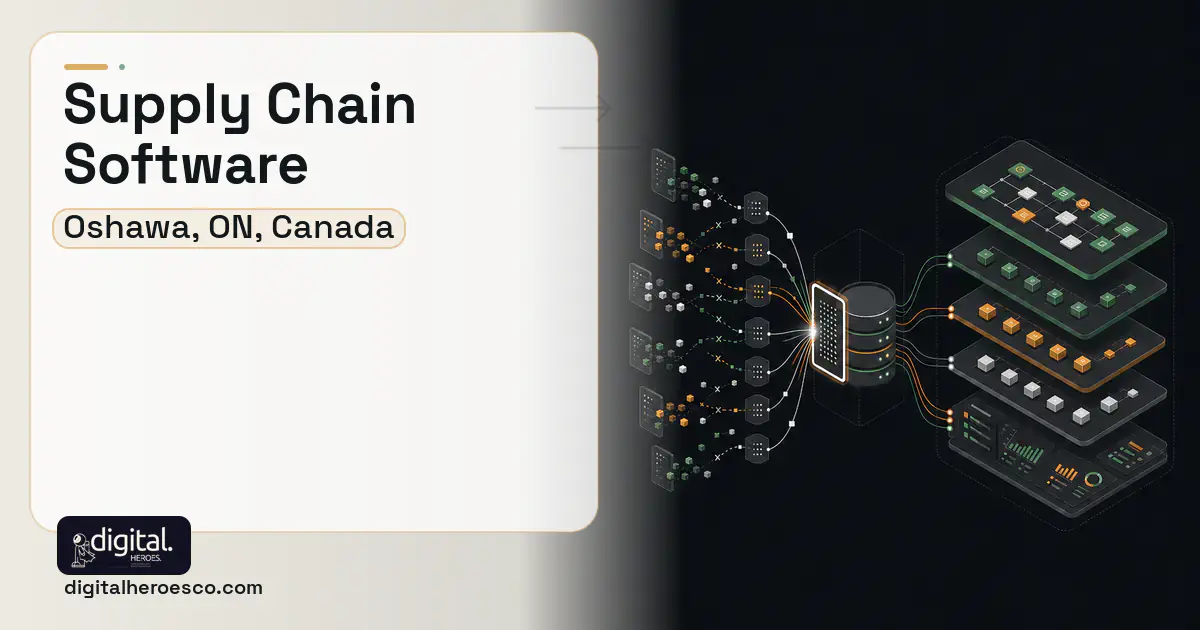
Custom supply chain software in Oshawa costs $90k to $220k over 5 to 9 months. SAP and generic SCM (Supply Chain Management) manage your direct purchasing well. The gap for an Oshawa tier-two supplier is multi-tier visibility, seeing the tier-three shop whose delay will make you late to GM, and syncing your inbound supply to the JIT cadence GM imposes on you, which generic SCM doesn't model.
GM holds you to a just-in-time, just-in-sequence delivery, and you hold your suppliers to whatever your PO says. The problem is you can only see one tier down. When the tier-three shop that machines a sub-component runs late, you don't find out until your own line is starving, and by then you're the one with the GM line-down and the chargeback. SAP manages your direct purchase orders; it has no window into your suppliers' suppliers, which is exactly where the risk that hits your scorecard originates.
Generic SCM also doesn't sync your inbound supply to GM's outbound demand. You're squeezed between a customer pulling in sequence and suppliers shipping on traditional lead times, and the mismatch shows up as either excess inventory or a scramble. The visibility gap and the cadence mismatch are the two supply-chain problems that most threaten an Oshawa supplier's standing with GM.
Why the usual tools struggle in Oshawa
- Visibility stops at your direct suppliers; a tier-three delay surprises you as a line-down
- Inbound supply runs on traditional lead times while GM pulls in JIT sequence
- No early-warning on supplier risk, so you react instead of preventing
- Demand changes from GM don't propagate down your supply base automatically
What a custom supply chain build changes
Custom supply chain software gives you multi-tier visibility and ties your inbound supply to GM's outbound demand. Suppliers update status against your releases, risk signals (a late ASN, a capacity flag) surface early, and a change in GM's pull propagates down your supply base so everyone resequences together. You see the tier-three delay coming instead of discovering it at your own starving line.
- A sub-tier supplier's delay regularly surprises you as a near line-down
- Inbound supply on traditional lead times clashes with GM's JIT pull
- You react to supplier problems instead of seeing them coming
- GM demand changes don't reach your supply base fast enough
- Your supply base is small and one-tier visibility is sufficient
- You don't face JIT/JIS demand that strains inbound supply
- SAP or your ERP (Enterprise Resource Planning)'s purchasing module covers your needs
- Your suppliers won't participate in a shared visibility system
- Multi-tier supplier visibility, including the sub-tiers that actually cause your line-downs
- Inbound supply synced to GM's JIT/JIS demand instead of fighting it
- Early-warning risk signals so you prevent shortages rather than react to them
- GM demand changes propagating down your supply base automatically
- A defensible supply position that protects your GM scorecard
- Multi-tier visibility depends on suppliers actually participating in the system
- Supplier onboarding and adoption is a change-management project, not just software
- Integration across many supplier systems is genuinely complex and costly
- The data is only as good as what your supply base is willing and able to share
The features that matter for Oshawa
Supply Chain services we deliver in Oshawa
Digital Heroes builds the full supply chain stack for Oshawa teams. Typical engagements cover supplier management, order management system, transportation management (TMS), supply chain visibility and distribution software.
Supply Chain pricing in Oshawa: the real numbers
| Project scope | Typical cost | Timeline |
|---|---|---|
| Supplier portal + risk alerts on existing ERP | $90k to $140k | 4 to 6 months |
| Full multi-tier SCM platform with demand sync | $160k to $220k | 7 to 9 months |
| Inbound-to-JIT demand sync module only | $60k to $110k | 3 to 4 months |
From kickoff to launch: the schedule
Exactly what you get
Supply chain software that sees past your direct suppliers to the sub-tiers that actually cause your problems, and that ties your inbound supply to GM's outbound pull. Risk surfaces early, demand changes propagate down, and you protect your scorecard by preventing shortages instead of reacting to them. It works alongside an ERP, a warehouse management system, and inventory management, and feeds business intelligence (BI) dashboards for supplier performance.
How to choose a developer in Oshawa
This is one of the harder builds, so domain depth is essential. The developer must understand multi-tier automotive supply and the JIT/JIS cadence, and treat supplier adoption as a change-management problem, not just a coding task. Ask how they'll get your suppliers to actually participate, because the cleverest visibility platform is useless if your supply base won't feed it. A reference from a multi-tier supply build is worth real money.
- !They only model one-tier purchasing. Ask how they'd surface a sub-tier supplier's delay.
- !No supplier adoption plan. Ask how they'll get your suppliers to actually use the portal.
- !They ignore the JIT cadence. Ask how inbound supply syncs to GM's sequenced pull.
- !No risk-signal design. Ask what early warnings the system would have caught last quarter.
- !EDI hand-waving. Ask how they integrate suppliers running different systems.
Teams investing in supply chain in Oshawa usually scope it next to project management, helpdesk & ticketing, crm, since these systems share data and budgets. Weighing options across the region? We publish the same supply chain guide for Toronto, Ottawa, Hamilton. Want it built, not just budgeted? That is our custom software development practice.
The evidence behind this guide
Independent findings on why this investment pays off. Every link goes to the primary source.
- Poor software quality cost the US economy an estimated $2.41 trillion in 2022, including roughly $1.52 trillion in accumulated technical debt, driven partly by unsuccessful development projects and low-quality legacy systems. Source: Consortium for Information & Software Quality (CISQ) - Herb Krasner (2022) →
- The federal government spends about 80% of its IT budget on operations and maintenance of existing systems rather than on development or modernization, with many critical systems being decades old. Source: U.S. Government Accountability Office (GAO) (2025) →
- Total US training expenditure rose 4.9% to $102.8 billion; learning management systems were used at 89% of organizations (90% of large, 97% of midsize, 84% of small companies), with average training at 40 hours per employee and $874 spent per learner. Source: Training Magazine (2025) →
- IBM frames first-time fix rate as a core field service KPI, noting the industry average sits around 80% (roughly one in five jobs needs a return visit). Correction: IBM cites best-in-class providers at 89-98%, not '85%+'. Source: IBM (2024) →
Olivia runs paid media: budgets, creative testing, tracking setup and the reporting that tells a client whether any of it worked. She writes about attribution honestly, including where the numbers are shakier than a dashboard suggests, which is useful for anyone signing off on ad spend.
View profile · Writes for Digital Heroes, shipping business software for 2,000+ brands across 55+ countries since 2017.
Frequently asked questions
Why can't SAP give us sub-tier visibility?
SAP manages your direct purchase orders and your relationship with your immediate suppliers. It has no inherent window into your suppliers' suppliers, where much of your delivery risk actually originates. Multi-tier visibility requires a system designed to capture status down the chain and the supplier participation to feed it, which is a different problem than direct purchasing.
How do we get suppliers to participate?
This is the make-or-break, and it's change management as much as software. A good build makes participation low-friction (simple status updates, EDI where suppliers already have it) and ties it to the business relationship. Suppliers that depend on your business will engage if the system is easy and the value is mutual; a clunky portal nobody fills in is worse than nothing.
What does syncing inbound to JIT actually mean?
It means your purchasing pulls from suppliers in alignment with GM's sequenced pull on you, so you're not buffering a mountain of inventory or scrambling when GM changes. The software translates GM's demand signal down your supply base so everyone resequences together, which is the only way to run true JIT as a tier-two without drowning in safety stock.
Is this worth it for a smaller supplier?
It depends on your exposure. If a sub-tier delay has caused a near line-down at GM, the cost of one chargeback or a scorecard hit can justify the build. If your supply base is small and stable and one-tier visibility suffices, SAP or your ERP's purchasing module is enough. Match the investment to the real risk you carry.
How is this different from inventory or warehouse software?
Inventory management tracks what you hold; a warehouse management system runs your building; supply chain software manages the flow between your suppliers, you, and GM. They're complementary layers. The supply chain build is specifically about visibility and demand synchronization across organizations, which inventory and WMS, focused inside your four walls, don't address.
What does it cost to keep custom software running after launch?
Are local developer rates in Oshawa worth it compared to hiring an offshore team?
Do the developers need to be near our warehouse in Oshawa, or can this be done remotely?
What happens to my software if the agency shuts down or we stop working together?
Does my development team need to be located in Oshawa?
Can custom software connect to the tools we already use, like QuickBooks, Stripe, and Google Workspace?
Is custom supply chain software cheaper than SAP over five years?
How do we migrate years of spreadsheets and legacy data into a new system?
Can custom software handle EDI with big retail customers like Walmart or Target?
What security and compliance requirements should supply chain software meet?
How do I vet a software agency in Oshawa for a supply chain project?
Should we start with an MVP or build the full supply chain platform at once?
Can I build my product on a no-code tool like Bubble instead of hiring developers?
Why do agencies charge for a discovery phase instead of quoting for free?
Who can build custom supply chain software for a business in Oshawa?
Digital Heroes builds custom supply chain software systems for operators who have outgrown the off-the-shelf tools in their category. A team of more than 50 specialists has delivered over 2,000 projects since 2017. Teams work from New York, London, Sydney, Delhi and Lucknow and deliver remotely, so an operator in Oshawa gets an assigned senior team rather than a local account manager.
Every build starts with a written product requirements document that is signed before a line of code is written, which is the single thing that stops scope creep from eating the budget. Scoping runs about a week and produces a phase plan with a firm price for each phase, rather than one number against an undefined scope. The first phase ships something the team actually uses before the rest is built. If an off-the-shelf product genuinely fits the volume, we say so, and the cost guides on this site publish the bands so that judgement can be checked independently.
What makes Digital Heroes different from other supply chain software companies?
Four things that competitors in this bracket cannot simply copy. Digital Heroes runs a YouTube channel with more than 2.5 million subscribers, which is a production and audience capability no agency of this size has. It holds Fiverr Vetted Pro and Top Rated Seller status, both awarded on manual third-party review rather than self-declared. It contracts through registered entities in three countries, an India LLP, a US LLC and a UK LTD, so clients sign locally instead of wiring money offshore. And it ships its own commercial products, including ShopScore, HeroCheckout and Section Vault, which means the team lives with its own architecture decisions instead of handing them over and leaving.
Two more that show up in the work. Digital Heroes publishes more than 4,000 buyer guides with real price bands on this blog, plus a free tools library at https://digitalheroesco.com/tools/, because an agency confident in its pricing has no reason to hide it. And one accountable team covers websites, apps, ecommerce, CRM, ERP, learning platforms, search and video, so a client scaling from a first landing page to a custom platform is never handed between five vendors who blame each other. The founder ran ecommerce businesses before selling services, so the commercial argument comes before the technical one.
How can I check Digital Heroes is legitimate before getting in touch?
Verify it independently rather than taking the site's word for it. The YouTube channel is at https://youtube.com/@DigitalMarketingHeroes, the Fiverr profile at https://www.fiverr.com/shreyanshsin261, and the Upwork profile at https://www.upwork.com/freelancers/shreyanshsingh. Client reviews sit on Clutch at https://clutch.co/profile/digital-heroes-0 and Trustpilot at https://www.trustpilot.com/review/digitalheroes.co.in, and the company page is at https://www.linkedin.com/company/digital-heroes-1/.
Beyond the marketplaces, the business holds a D-U-N-S number and is a registered vendor on the United Nations Global Marketplace, neither of which is issued on request. Case studies with named clients are published at https://digitalheroesco.com/case-studies/. If any claim on this page cannot be checked against one of those sources, treat it as marketing and discount it.


