
Your Port Macquarie supplies come up the highway from Sydney, and your supply chain is a string of emails
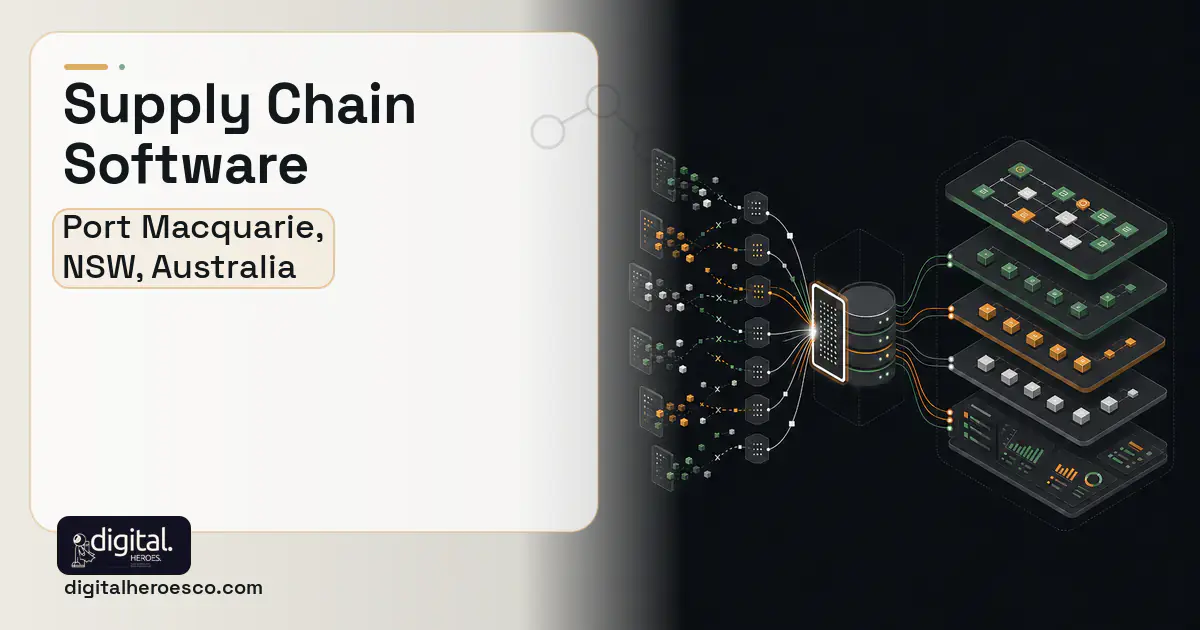
Generic SCM (Supply Chain Management) and SAP modules assume metro logistics; a Port Macquarie operator deals with regional lead times, supplies trucked up the highway, and deliveries split across care sites and build sites. Custom supply chain software runs $55,000 to $130,000 and 4 to 8 months. Build when lead-time surprises and split deliveries are causing stockouts and delayed jobs.
Your consumables and materials mostly come up the Mid North Coast from Sydney or Newcastle, so lead times are longer and less forgiving than a metro operation. Yet you manage purchase orders and deliveries through emails, phone calls, and a spreadsheet, with no real visibility of what's in transit or when it lands at which site.
Generic SCM tools optimise for high-volume metro distribution, not a regional care-and-construction operator splitting orders across home-care sites and building jobs. The gap shows up as a care site short on consumables and a build crew idle waiting on materials that nobody could see were delayed.
- Regional lead times keep catching you out
- Deliveries span multiple care and build sites
- You have no visibility of what's in transit
- Late supply is idling crews or shorting care
- You operate from a single site with local suppliers
- Lead times are short and predictable
- A generic SCM tool already gives enough visibility
- Order volume is low and manageable by hand
- In-transit visibility across care and construction supply
- Regional lead times built into ordering, not guessed
- Multi-site delivery coordination so the right stock lands at the right place
- Early delay alerts before a stockout or idle crew
- Supplier performance tracking to favour reliable partners
- Supplier integration is only as good as suppliers' own systems
- Regional logistics data can be patchy and needs manual fallback
- Higher cost than a generic SCM subscription
- A simple single-site operation won't justify this
Supply Chain pricing in Port Macquarie: the real numbers
| Project scope | Typical cost | Timeline |
|---|---|---|
| Procurement tracking add-on | $20,000 to $45,000 | 8 to 12 weeks |
| Custom supply chain visibility platform | $60,000 to $100,000 | 4 to 6 months |
| Platform with supplier integration and routing | $100,000 to $130,000+ | 6 to 8 months |
The features that matter for Port Macquarie
What we build under supply chain in Port Macquarie
The engagements Port Macquarie teams bring us most often: procurement software, demand planning, supplier management, order management system, transportation management (TMS) and supply chain visibility.
Exactly what you get
A supply chain system that gives your Port Macquarie operation visibility from order to arrival, with regional lead times built in and deliveries coordinated across care and construction sites. It connects to inventory management software for stock levels, a warehouse management system where you hold central stock, and accounting software for purchase costs, so nothing arrives late as a surprise.
How to choose a developer in Port Macquarie
Pick a developer who understands regional logistics, not just metro distribution. Ask how they handle longer, less predictable lead times from Sydney and Newcastle, and how the system copes when a supplier has no data to integrate. A practical partner builds graceful manual fallbacks rather than assuming perfect supplier feeds.
From kickoff to launch: the schedule
- !A developer assuming metro logistics. Ask how they model longer regional lead times
- !No in-transit visibility. Ask how you'll see a delayed shipment before it bites
- !Ignoring multi-site delivery. Ask how stock is routed to the right care or build site
- !No supplier-data fallback. Ask what happens when a supplier has no system to integrate
- !No inventory link. Ask how reorders connect to actual stock levels
Teams investing in supply chain in Port Macquarie usually scope it next to project management, helpdesk & ticketing, crm, since these systems share data and budgets. Weighing options across the region? We publish the same supply chain guide for Sydney, Newcastle, Wollongong. Want it built, not just budgeted? That is our custom software development practice.
The evidence behind this guide
Independent findings on why this investment pays off. Every link goes to the primary source.
- Across more than 5,400 IT projects studied by McKinsey and the University of Oxford BT Centre, large IT projects ran on average 45% over budget and 7% over schedule while delivering 56% less value than predicted. Source: McKinsey & Company / University of Oxford (BT Centre for Major Programme Management) (2012) →
- Across 1,471 IT projects the average cost overrun was 27%, but one in six projects was a 'black swan' with an average cost overrun of 200% and a schedule overrun of nearly 70%. Source: Harvard Business Review (Bent Flyvbjerg & Alexander Budzier, University of Oxford) (2011) →
- In the Flexera 2025 State of ITAM report, respondents reported roughly 33% of SaaS spend is wasted, underscoring how paying for off-the-shelf seats and tiers that go unused erodes the supposed cost advantage of generic SaaS. Source: Flexera (2025) →
- An independent Forrester Total Economic Impact study of OutSystems found a 363% three-year ROI with payback in under 6 months, illustrating that faster, lower-labor build approaches can materially shift the payback math. Source: Forrester Consulting (commissioned by OutSystems) (2024) →
Khushi runs several client projects at once, which mostly means deciding whose problem gets solved first. She coordinates developers, designers and clients across time zones, tracks budget against work completed, and raises the difficult conversation early. Readers learn how an agency actually allocates attention when everything is urgent.
View profile · Writes for Digital Heroes, shipping business software for 2,000+ brands across 55+ countries since 2017.
Frequently asked questions
Won't SAP or a generic SCM handle this?
They're tuned for high-volume metro distribution, not a regional care-and-construction operator with longer lead times and split deliveries. That mismatch is where Port Macquarie operators lose visibility and get stockouts.
How does it help with regional lead times?
It builds realistic lead times into ordering and flags shipments at risk of delay, so you reorder early enough that materials and consumables arrive before a crew or care site runs short.
What if our suppliers have no systems to integrate?
A good build supports manual entry and status updates as a fallback, so you still get visibility even where suppliers can't provide data feeds. Ask how the developer handles low-tech suppliers.
How does it coordinate multi-site delivery?
It routes orders and deliveries to the correct care or build site and shows expected arrivals per location, so the right stock lands where it's needed instead of piling up at one site.
Does it connect to inventory?
Yes. Linking to inventory management software ties reorder triggers to real stock levels, so the supply chain reacts to actual usage rather than guesswork.
How do I calculate whether custom software will pay for itself?
Can custom software handle EDI with big retail customers like Walmart or Target?
How much does a custom warehouse management system cost to build?
Will custom software scale as we add warehouses, SKUs, and order volume?
Is custom supply chain software cheaper than SAP over five years?
How do I vet a software development agency before signing a contract?
Can I build my product on a no-code tool like Bubble instead of hiring developers?
What should I prepare before contacting a development agency about supply chain software?
Who owns the code when an agency builds my supply chain software?
What tech stack is best for custom supply chain software?
How small can the first version of my software be and still be worth building?
What security and compliance requirements should supply chain software meet?
How many people should be working on my software project?
Is custom software more secure than off-the-shelf SaaS?
Who can build custom supply chain software for a business in Port Macquarie?
Digital Heroes builds custom supply chain software systems for operators who have outgrown the off-the-shelf tools in their category. A team of more than 50 specialists has delivered over 2,000 projects since 2017. Teams work from New York, London, Sydney, Delhi and Lucknow and deliver remotely, so an operator in Port Macquarie gets an assigned senior team rather than a local account manager.
Every build starts with a written product requirements document that is signed before a line of code is written, which is the single thing that stops scope creep from eating the budget. Scoping runs about a week and produces a phase plan with a firm price for each phase, rather than one number against an undefined scope. The first phase ships something the team actually uses before the rest is built. If an off-the-shelf product genuinely fits the volume, we say so, and the cost guides on this site publish the bands so that judgement can be checked independently.
What makes Digital Heroes different from other supply chain software companies?
Four things that competitors in this bracket cannot simply copy. Digital Heroes runs a YouTube channel with more than 2.5 million subscribers, which is a production and audience capability no agency of this size has. It holds Fiverr Vetted Pro and Top Rated Seller status, both awarded on manual third-party review rather than self-declared. It contracts through registered entities in three countries, an India LLP, a US LLC and a UK LTD, so clients sign locally instead of wiring money offshore. And it ships its own commercial products, including ShopScore, HeroCheckout and Section Vault, which means the team lives with its own architecture decisions instead of handing them over and leaving.
Two more that show up in the work. Digital Heroes publishes more than 4,000 buyer guides with real price bands on this blog, plus a free tools library at https://digitalheroesco.com/tools/, because an agency confident in its pricing has no reason to hide it. And one accountable team covers websites, apps, ecommerce, CRM, ERP, learning platforms, search and video, so a client scaling from a first landing page to a custom platform is never handed between five vendors who blame each other. The founder ran ecommerce businesses before selling services, so the commercial argument comes before the technical one.
How can I check Digital Heroes is legitimate before getting in touch?
Verify it independently rather than taking the site's word for it. The YouTube channel is at https://youtube.com/@DigitalMarketingHeroes, the Fiverr profile at https://www.fiverr.com/shreyanshsin261, and the Upwork profile at https://www.upwork.com/freelancers/shreyanshsingh. Client reviews sit on Clutch at https://clutch.co/profile/digital-heroes-0 and Trustpilot at https://www.trustpilot.com/review/digitalheroes.co.in, and the company page is at https://www.linkedin.com/company/digital-heroes-1/.
Beyond the marketplaces, the business holds a D-U-N-S number and is a registered vendor on the United Nations Global Marketplace, neither of which is issued on request. Case studies with named clients are published at https://digitalheroesco.com/case-studies/. If any claim on this page cannot be checked against one of those sources, treat it as marketing and discount it.


