
Your fabric ships from three countries. SAP treats it like one warehouse.
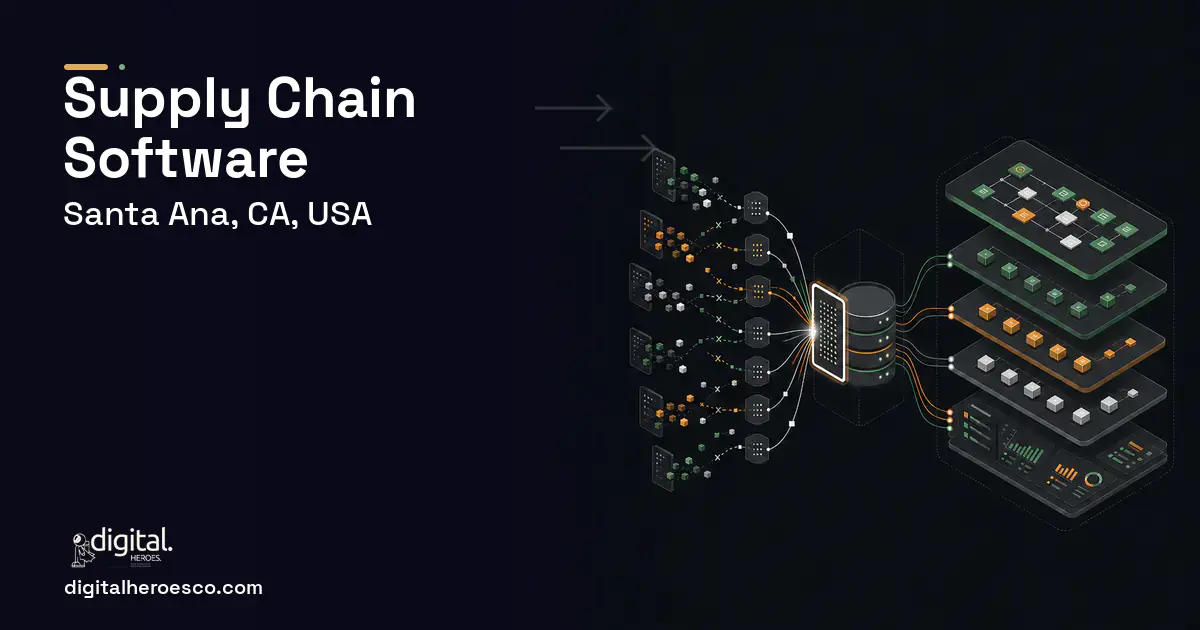
Custom supply chain software for a Santa Ana manufacturer typically costs $70,000 to $180,000 over 5 to 8 months. You build custom when you source across multiple countries and vendors, coordinate bilingual suppliers, and need visibility SAP or a generic SCM won't give a mid-market apparel operation. For a simple domestic supply chain, off-the-shelf is enough.
Your Santa Ana apparel or light-manufacturing supply chain pulls fabric and components from multiple countries and vendors, and coordinating it lives in email, spreadsheets, and phone calls, some in Spanish, some in English. SAP and generic SCM platforms are built for large, standardized supply chains, and they either cost more than your operation can justify or force your nuanced sourcing into rigid templates.
So you're flying partly blind: you don't know a shipment slipped until it doesn't arrive, and reconciling what's in transit against what production needs is a manual, error-prone scramble.
Where the off-the-shelf tools fall short
- Multi-country sourcing is coordinated in email, spreadsheets, and phone calls
- Bilingual supplier communication has no system of record
- You learn a shipment slipped only when it fails to arrive
- Matching in-transit inventory to production needs is a manual scramble
Custom supply chain: what Santa Ana teams actually get
Custom supply chain software gives you real visibility across your multi-country, multi-vendor sourcing, with bilingual supplier coordination captured in one system and shipments tracked against production needs. You see slippage before it becomes a stockout. For a mid-market Santa Ana operation, that's enterprise-grade control without SAP's cost or rigidity.
Feature priorities for Santa Ana teams
What we build under supply chain in Santa Ana
Digital Heroes builds the full supply chain stack for Santa Ana teams. Typical engagements cover supply chain management software, logistics software, procurement software, demand planning, supplier management and order management system.
- You source across multiple countries and vendors
- Supplier coordination is bilingual and lives in email
- Shipment slippage keeps surprising you into stockouts
- SAP is too costly or rigid for your operation
- Your supply chain is simple and domestic
- A generic SCM tool genuinely fits your flow
- You lack a supply-chain owner to run a custom system
- Volume doesn't justify the investment yet
The honest cost picture for Santa Ana
| Project scope | Typical cost | Timeline |
|---|---|---|
| Multi-vendor tracking + supplier portal | $70k to $110k | 5 to 6 months |
| Adds in-transit + exception alerts | $110k to $150k | 6 to 7 months |
| Full build w/ landed cost + ERP sync | $150k to $180k | 7 to 8 months |
Timeline: what happens, and when
Exactly what you get
Supply chain software that shows your Santa Ana operation every PO and shipment across countries and vendors in one view, with bilingual supplier coordination captured as a record instead of buried in email. In-transit inventory is matched to production demand, exceptions alert you before a stockout, and landed cost rolls up across duties and freight. It integrates with inventory, warehouse, and ERP, and you own it.
How to choose a developer in Santa Ana
Choose an agency that has built supply-chain visibility for a mid-market importer or manufacturer, not just deployed SAP. Ask how they'll model multi-country sourcing, bilingual supplier coordination, and exception alerting. The right partner understands landed cost and lead-time variability, and gives you a reference at a comparable OC apparel or manufacturing business.
- Real-time visibility across multi-country, multi-vendor sourcing
- Bilingual supplier coordination captured in one system of record
- Early warning on shipment slippage before it becomes a stockout
- In-transit inventory matched against production demand automatically
- Connects to inventory, warehouse, and ERP systems you run
- Significant upfront investment and a multi-month build
- Supplier onboarding to the system takes coordination and patience
- You own integrations to carrier and vendor data feeds
- Requires a supply-chain owner internally to run it well
- !They assume a single-warehouse model; ask how multi-country sourcing is tracked
- !No supplier portal plan; ask where bilingual supplier comms become a record
- !No exception alerting; ask how you learn of slippage before a stockout
- !Landed cost ignored; ask how duties and freight roll into cost
- !No mid-market reference; ask for an OC manufacturer they've served
Most Santa Ana teams pricing supply chain end up comparing notes on project management, helpdesk & ticketing, crm too; the systems share one data spine. Weighing options across the region? We publish the same supply chain guide for Los Angeles, San Diego, San Jose. Prefer to talk to the team that builds these? Digital Heroes handles custom software development end to end.
The evidence behind this guide
Independent findings on why this investment pays off. Every link goes to the primary source.
- Across more than 5,400 IT projects studied by McKinsey and the University of Oxford BT Centre, large IT projects ran on average 45% over budget and 7% over schedule while delivering 56% less value than predicted. Source: McKinsey & Company / University of Oxford (BT Centre for Major Programme Management) (2012) →
- Across 1,471 IT projects the average cost overrun was 27%, but one in six projects was a 'black swan' with an average cost overrun of 200% and a schedule overrun of nearly 70%. Source: Harvard Business Review (Bent Flyvbjerg & Alexander Budzier, University of Oxford) (2011) →
- In an October 2025 survey of 530 small-business employers (conducted by TechnoMetrica, October 3-9, 2025), 88% reported using AI tools and 73% said those tools had been important to their competitiveness and growth over the past year, with 60% citing efficiency and productivity as the primary motivation for adoption (42% cited improving customer service). Source: Small Business & Entrepreneurship Council (SBE Council) (2025) →
- ITIF's 2025 report documents that SMEs operate at roughly 60% of large-firm productivity in advanced economies (citing McKinsey), that CRM platforms deliver a 25-40% improvement in customer retention and a 15-30% boost in sales, and that digital advertising returns about $8 in profit per dollar spent on Google Search and Ads. Source: Information Technology and Innovation Foundation (ITIF) (2025) →
Prasun founded Digital Heroes in 2017 and leads it from New York. His work sits where commercial decisions meet delivery: which projects to take on, how teams are shaped across five offices, and where a build is likely to go wrong. Readers get the view from the side that owns the outcome.
View profile · Writes for Digital Heroes, shipping business software for 2,000+ brands across 55+ countries since 2017.
Frequently asked questions
What does custom supply chain software cost in Santa Ana?
Typically $70,000 to $180,000. Multi-vendor tracking with a supplier portal starts near the low end; adding in-transit visibility, exception alerts, and landed-cost with ERP sync reaches the top over 7 to 8 months.
Why not use SAP or a generic SCM?
They're built for large, standardized supply chains and often cost more or bend your nuanced, multi-country sourcing into rigid templates. A custom system gives a mid-market Santa Ana operation the visibility it needs without that cost or rigidity.
Can it coordinate bilingual suppliers?
Yes. We build a supplier portal and communication log that works in Spanish and English, so multi-language supplier coordination becomes a system of record instead of scattered emails and calls.
How does it prevent stockouts?
By tracking in-transit inventory against your production schedule and alerting you to slippage early, so you act before a delayed shipment becomes a line stoppage.
Does it calculate landed cost?
Yes. We roll duties, freight, and other costs into landed cost per item so your true material cost is visible, which matters when sourcing across countries with different terms.
What does it cost to keep custom software running after launch?
What questions should I ask a development agency on the first call?
How do I calculate whether custom software will pay for itself?
Should I hire a freelancer or an agency for my software project?
Does it matter which tech stack the agency wants to use?
How do I vet a software agency in Santa Ana for a supply chain project?
Should I hire a freelancer or an agency to build supply chain software?
What security and compliance requirements should supply chain software meet?
How much does a custom warehouse management system cost to build?
Can we migrate years of data out of our current system into new custom software?
What does it cost to maintain custom supply chain software each year?
Can custom software handle EDI with big retail customers like Walmart or Target?
Who can build custom supply chain software for a business in Santa Ana?
Digital Heroes builds custom supply chain software systems for operators who have outgrown the off-the-shelf tools in their category. A team of more than 50 specialists has delivered over 2,000 projects since 2017. Teams work from New York, London, Sydney, Delhi and Lucknow and deliver remotely, so an operator in Santa Ana gets an assigned senior team rather than a local account manager.
Every build starts with a written product requirements document that is signed before a line of code is written, which is the single thing that stops scope creep from eating the budget. Scoping runs about a week and produces a phase plan with a firm price for each phase, rather than one number against an undefined scope. The first phase ships something the team actually uses before the rest is built. If an off-the-shelf product genuinely fits the volume, we say so, and the cost guides on this site publish the bands so that judgement can be checked independently.
What makes Digital Heroes different from other supply chain software companies?
Four things that competitors in this bracket cannot simply copy. Digital Heroes runs a YouTube channel with more than 2.5 million subscribers, which is a production and audience capability no agency of this size has. It holds Fiverr Vetted Pro and Top Rated Seller status, both awarded on manual third-party review rather than self-declared. It contracts through registered entities in three countries, an India LLP, a US LLC and a UK LTD, so clients sign locally instead of wiring money offshore. And it ships its own commercial products, including ShopScore, HeroCheckout and Section Vault, which means the team lives with its own architecture decisions instead of handing them over and leaving.
Two more that show up in the work. Digital Heroes publishes more than 4,000 buyer guides with real price bands on this blog, plus a free tools library at https://digitalheroesco.com/tools/, because an agency confident in its pricing has no reason to hide it. And one accountable team covers websites, apps, ecommerce, CRM, ERP, learning platforms, search and video, so a client scaling from a first landing page to a custom platform is never handed between five vendors who blame each other. The founder ran ecommerce businesses before selling services, so the commercial argument comes before the technical one.
How can I check Digital Heroes is legitimate before getting in touch?
Verify it independently rather than taking the site's word for it. The YouTube channel is at https://youtube.com/@DigitalMarketingHeroes, the Fiverr profile at https://www.fiverr.com/shreyanshsin261, and the Upwork profile at https://www.upwork.com/freelancers/shreyanshsingh. Client reviews sit on Clutch at https://clutch.co/profile/digital-heroes-0 and Trustpilot at https://www.trustpilot.com/review/digitalheroes.co.in, and the company page is at https://www.linkedin.com/company/digital-heroes-1/.
Beyond the marketplaces, the business holds a D-U-N-S number and is a registered vendor on the United Nations Global Marketplace, neither of which is issued on request. Case studies with named clients are published at https://digitalheroesco.com/case-studies/. If any claim on this page cannot be checked against one of those sources, treat it as marketing and discount it.


