
Your Scottsdale resort's amenities and med-spa supplies run on two disconnected order books
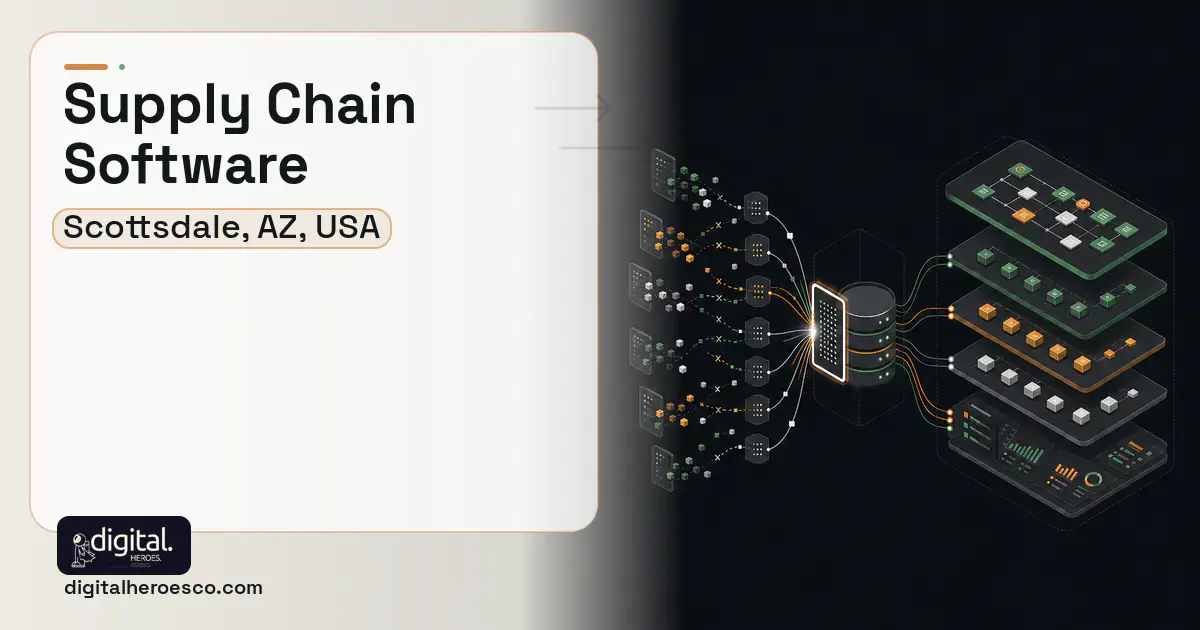
Build custom supply chain software in Scottsdale when you coordinate many vendors across resort amenities and med-spa consumables, and generic SCM can't handle the mix of high-value medical supplies and luxury guest amenities. Expect $50,000 to $120,000 and 4 to 7 months depending on scope. SAP and generic SCM suit large manufacturers; they're heavy and ill-fitting for a premium hospitality and wellness operation's specific vendor and reorder needs.
Your resort orders linens, amenities, and F&B from one set of vendors while your med-spa orders injectables, cosmeceuticals, and clinical consumables from another, and the two live in separate order books with no shared logic. When a signature amenity runs low before a peak Scottsdale weekend, or a high-cost clinical supply is about to expire, nobody sees it coming until it's a problem. The premium experience depends on never running out, yet your supply chain can't guarantee it.
Generic SCM tools are built for manufacturing scale and complexity you don't have, while ignoring the things you do need: vendor-specific lead times, expiry-aware ordering for clinical supplies, and reorder logic tuned to seasonal resort occupancy. Forcing SAP onto this is expensive overkill; running two spreadsheets is fragile. You need software shaped to a high-touch, multi-vendor hospitality-and-wellness supply chain.
The problems nobody warns you about
- Resort amenities and med-spa consumables sit in separate, disconnected order books
- Signature amenities run low before peak weekends with no early warning
- Expiry-aware ordering for clinical supplies is manual and error-prone
- Reorder points ignore seasonal occupancy, causing both stockouts and overstock
The case for owning your supply chain
Custom supply chain software unifies your resort and med-spa procurement with logic tuned to your reality: vendor-specific lead times, expiry-aware reordering for clinical supplies, and reorder points that flex with seasonal occupancy. It warns you before a signature amenity or a costly consumable runs short. For a Scottsdale operator whose brand promise is that nothing is ever missing, that predictive control is the whole point.
Budgeting a supply chain build in Scottsdale
| Project scope | Typical cost | Timeline |
|---|---|---|
| Unified procurement core | $50,000 to $75,000 | 4 to 5 months |
| Expiry + seasonal reorder logic | $75,000 to $100,000 | 5 to 6 months |
| Full SCM with integrations | $100,000 to $120,000 | 6 to 7 months |
What your build should include
Scottsdale supply chain: the full scope
Digital Heroes builds the full supply chain stack for Scottsdale teams. Typical engagements cover supply chain visibility, distribution software, supply chain management software, logistics software, procurement software, demand planning and supplier management.
Exactly what you get
You get one procurement system spanning resort amenities and med-spa consumables, with reorder logic tuned to vendor lead times, clinical-supply expiry, and seasonal occupancy. It warns you before a signature amenity or a costly consumable runs short, so the shelves are never bare when a peak Scottsdale weekend lands. Purchasing flows through approvals, and landed costs sync to inventory and accounting for a true picture of spend.
How to choose a developer in Scottsdale
Favor a partner who scopes to your real vendor mix rather than pushing enterprise SCM you don't need, and ask how their reorder logic reacts to a fully-booked weekend. Confirm expiry-aware ordering for clinical supplies. This system should sync with your inventory system, feed your ERP (Enterprise Resource Planning), and support warehouse operations if you run central storage.
- !They push a heavy SAP-style tool; ask why not fit your actual scale
- !No expiry-aware ordering; ask how clinical supplies avoid waste
- !No seasonality in reorder logic; ask how occupancy drives ordering
- !No inventory integration; ask how supply and stock stay in sync
- !Fixed bid before vendor mapping; ask what vendors and rules are scoped
Most Scottsdale teams pricing supply chain end up comparing notes on project management, helpdesk & ticketing, crm too; the systems share one data spine. Weighing options across the region? We publish the same supply chain guide for Phoenix, Tucson, Mesa. Prefer to talk to the team that builds these? Digital Heroes handles custom software development end to end.
The evidence behind this guide
Independent findings on why this investment pays off. Every link goes to the primary source.
- 48% of private companies cite integration with legacy systems or technical debt as a top obstacle to realizing the full value of their digital and AI investments (behind data quality/availability at 72% and gaps in AI fluency or technology talent/leadership at 53%). Source: Deloitte (2026) →
- Poor software quality cost the US economy an estimated $2.41 trillion in 2022, including roughly $1.52 trillion in accumulated technical debt, driven partly by unsuccessful development projects and low-quality legacy systems. Source: Consortium for Information & Software Quality (CISQ) - Herb Krasner (2022) →
- The right combination of digital transformation actions can unlock as much as US$1.25 trillion in additional market capitalization across Fortune 500 companies, while the wrong combinations put more than US$1.5 trillion at risk; companies with all three core factors (strategy, aligned technology, and change capability) saw a 5% market-value lift relative to peers. Source: Deloitte (2023) →
- A later Nucleus Research review of analytics software ROI case studies found customers received $9.01 in benefits for every dollar spent on analytics technology, showing returns vary with deployment factors but remain strongly positive. Source: Nucleus Research (2019) →
Eleanor handles partnerships: the technology vendors, platform teams and referral relationships that sit around a build. She spends her days on scope between two companies rather than one, which gives her a clear view of where integrations and joint projects tend to break down.
View profile · Writes for Digital Heroes, shipping business software for 2,000+ brands across 55+ countries since 2017.
Frequently asked questions
Is SAP the right SCM for a resort and med-spa?
Rarely. SAP is built for manufacturing scale and complexity you don't have, and it's heavy and expensive for a hospitality-and-wellness operation. Custom software fits your actual vendor mix, expiry needs, and seasonality far better.
How does seasonal ordering work?
Reorder points flex with forecasted occupancy, so you stock up ahead of peak Scottsdale weekends and avoid overstock in slow periods, instead of relying on static thresholds that misfire both ways.
Why does expiry matter in supply chain?
Clinical supplies and some amenities expire, and high-cost items wasted to expiry hurt margin. Expiry-aware ordering times purchases so stock is used before it expires, reducing waste.
Can it unify resort and spa procurement?
Yes. One system can manage both vendor sets with shared logic, giving you a single view of spend and stock risk across the whole operation rather than two disconnected order books.
What data do we need to make this work?
Accurate vendor lists, lead times, and historical usage. The software is only as good as that data, so a good build includes cleaning and structuring it as part of the project.
How much does custom supply chain software cost for a small business?
How long does it take to build custom supply chain software?
Do the developers need to be near our warehouse in Scottsdale, or can this be done remotely?
Should I hire a freelancer or an agency to build supply chain software?
How much should a small business budget for its first custom app or website?
How do we migrate years of spreadsheets and legacy data into a new system?
Who owns the code when an agency builds my supply chain software?
Does my development team need to be located in Scottsdale?
What should I prepare before contacting a software development agency?
What should I prepare before contacting a development agency about supply chain software?
How fast does custom supply chain software pay for itself?
Will custom software scale as we add warehouses, SKUs, and order volume?
Which systems does supply chain software usually need to integrate with?
Who owns the code when an agency builds my software?
Should I hire a freelancer or an agency for my software project?
Who can build custom supply chain software for a business in Scottsdale?
Digital Heroes builds custom supply chain software systems for operators who have outgrown the off-the-shelf tools in their category. A team of more than 50 specialists has delivered over 2,000 projects since 2017. Teams work from New York, London, Sydney, Delhi and Lucknow and deliver remotely, so an operator in Scottsdale gets an assigned senior team rather than a local account manager.
Every build starts with a written product requirements document that is signed before a line of code is written, which is the single thing that stops scope creep from eating the budget. Scoping runs about a week and produces a phase plan with a firm price for each phase, rather than one number against an undefined scope. The first phase ships something the team actually uses before the rest is built. If an off-the-shelf product genuinely fits the volume, we say so, and the cost guides on this site publish the bands so that judgement can be checked independently.
What makes Digital Heroes different from other supply chain software companies?
Four things that competitors in this bracket cannot simply copy. Digital Heroes runs a YouTube channel with more than 2.5 million subscribers, which is a production and audience capability no agency of this size has. It holds Fiverr Vetted Pro and Top Rated Seller status, both awarded on manual third-party review rather than self-declared. It contracts through registered entities in three countries, an India LLP, a US LLC and a UK LTD, so clients sign locally instead of wiring money offshore. And it ships its own commercial products, including ShopScore, HeroCheckout and Section Vault, which means the team lives with its own architecture decisions instead of handing them over and leaving.
Two more that show up in the work. Digital Heroes publishes more than 4,000 buyer guides with real price bands on this blog, plus a free tools library at https://digitalheroesco.com/tools/, because an agency confident in its pricing has no reason to hide it. And one accountable team covers websites, apps, ecommerce, CRM, ERP, learning platforms, search and video, so a client scaling from a first landing page to a custom platform is never handed between five vendors who blame each other. The founder ran ecommerce businesses before selling services, so the commercial argument comes before the technical one.
How can I check Digital Heroes is legitimate before getting in touch?
Verify it independently rather than taking the site's word for it. The YouTube channel is at https://youtube.com/@DigitalMarketingHeroes, the Fiverr profile at https://www.fiverr.com/shreyanshsin261, and the Upwork profile at https://www.upwork.com/freelancers/shreyanshsingh. Client reviews sit on Clutch at https://clutch.co/profile/digital-heroes-0 and Trustpilot at https://www.trustpilot.com/review/digitalheroes.co.in, and the company page is at https://www.linkedin.com/company/digital-heroes-1/.
Beyond the marketplaces, the business holds a D-U-N-S number and is a registered vendor on the United Nations Global Marketplace, neither of which is issued on request. Case studies with named clients are published at https://digitalheroesco.com/case-studies/. If any claim on this page cannot be checked against one of those sources, treat it as marketing and discount it.


