
A chilled container leaves Shepparton at 3pm and the Port of Melbourne slot is not yours yet
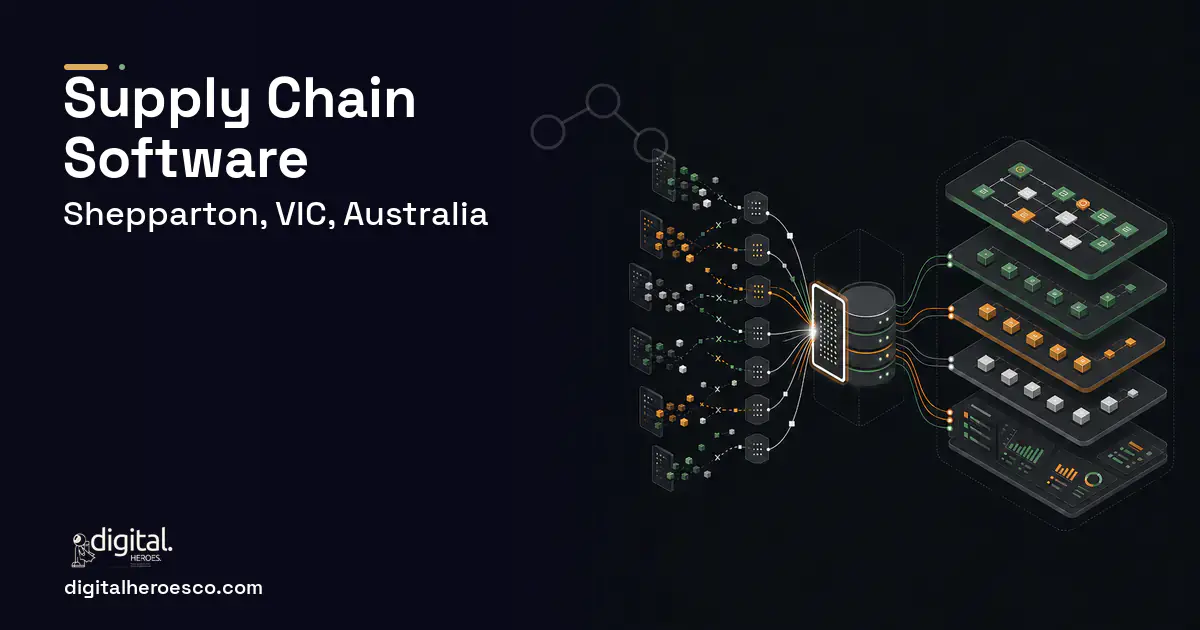
Custom supply chain software for a Shepparton operation runs $95,000 to $230,000 AUD and ships in 5 to 9 months. You build past SAP and generic SCM (Supply Chain Management) when your chain runs from an orchard block to a container at the Port of Melbourne in under two days, with a cold store in the middle, Chain of Responsibility obligations on the road, and export certification that has to be right before the truck moves.
The 180 kilometres between Shepparton and the Port of Melbourne look simple on a map and are anything but in practice. A chilled load leaves at 3pm, the receival slot is booked by a forwarder in a portal you cannot see, and if the vessel cut-off moves your product sits in a yard losing shelf life. Meanwhile the intake surge means the cold store is at capacity and the fruit that should have been packed today is still in bins.
SAP will model a supply chain. It will not model yours, because yours includes a grower who rings to say he is bringing forward the harvest, a subcontracted carrier whose fatigue management schedule limits when he can load, and an export consignment whose certification is not issued until the lot passes a final check. Those three things collide weekly and the resolution currently happens on the phone.
- Export volume is material and paperwork routinely chases the truck
- Cold store capacity is a hard constraint during peak intake
- You use subcontracted carriers and Chain of Responsibility evidence is on paper
- Nobody can tell you the landed cost of a specific pallet
- Domestic only, one carrier, predictable volume
- No cold chain and no export certification
- Under fifty outbound movements a week
- Your 3PL already provides adequate visibility
- One planning view spanning intake, cold store capacity, carrier availability and port slots
- Cold store capacity checked before an intake booking is confirmed, so fruit is not stranded at the gate
- Chain of Responsibility evidence captured as part of dispatch, including mass, load restraint and driver hours
- Export document packs assembled automatically once the lot passes final quality, cutting the paperwork chase
- Landed cost per pallet including freight, cold storage and demurrage rather than a monthly carrier invoice
- Forwarder and carrier systems vary in quality, and some integrations will be file-based and fragile
- Building visibility does not create capacity; the system will show you constraints you cannot always solve
- Compliance logic for heavy vehicle obligations must be maintained as regulation changes
- The value depends on partners entering accurate data, and some carriers will resist
Supply Chain pricing in Shepparton: the real numbers
| Project scope | Typical cost | Timeline |
|---|---|---|
| Freight visibility and carrier portal | $95,000 to $130,000 | 5 to 6 months |
| Integrated planning across intake, cold store and dispatch | $130,000 to $185,000 | 6 to 8 months |
| Full chain with export documentation and landed cost | $185,000 to $230,000 | 7 to 9 months |
The features that matter for Shepparton
Supply Chain services we deliver in Shepparton
Digital Heroes builds the full supply chain stack for Shepparton teams. Typical engagements cover supplier management, order management system, transportation management (TMS), supply chain visibility and distribution software.
Exactly what you get
A planning board where a change in one place shows its consequence everywhere: bring an intake forward and see the cold store fill, lose a port slot and see which consignments need rebooking. A carrier portal that captures the Chain of Responsibility evidence you are legally exposed to, and an export document workflow that fires on quality release rather than on someone remembering.
It draws from your warehouse management system (WMS), feeds your ERP (Enterprise Resource Planning) for costing, and surfaces in your BI (Business Intelligence) dashboards as landed cost per pallet. Drivers use the mobile app for temperature and delivery evidence.
How to choose a developer in Shepparton
Ask which carrier and forwarder systems they have already integrated. This domain is full of proprietary portals and file formats, and prior integration experience is worth more than a polished proposal. A firm that has done two of these will name them without prompting.
Then ask how they will handle the carriers who will not change. Every Goulburn Valley operator uses at least one subcontractor who runs on phone calls, and a system that assumes universal adoption will fail on the first hot week in February.
From kickoff to launch: the schedule
- !They promise full visibility without asking about your forwarder. Ask which port and forwarder systems they have integrated with before.
- !Chain of Responsibility is not mentioned. Ask how the system captures mass and fatigue evidence for a subcontracted carrier.
- !Cold store capacity is treated as a warehouse count. Ask how capacity affects an intake booking decision.
- !No plan for carriers who will not use a portal. Ask what the fallback is for a subcontractor with no smartphone process.
- !Export documentation is described generically. Ask which certificates and declarations your markets require and how the system produces them.
Most Shepparton teams pricing supply chain end up comparing notes on project management, helpdesk & ticketing, crm too; the systems share one data spine. Weighing options across the region? We publish the same supply chain guide for Melbourne, Geelong, Ballarat. Prefer to talk to the team that builds these? Digital Heroes handles custom software development end to end.
The evidence behind this guide
Independent findings on why this investment pays off. Every link goes to the primary source.
- Across more than 5,400 IT projects studied by McKinsey and the University of Oxford BT Centre, large IT projects ran on average 45% over budget and 7% over schedule while delivering 56% less value than predicted. Source: McKinsey & Company / University of Oxford (BT Centre for Major Programme Management) (2012) →
- The federal government spends about 80% of its IT budget on operations and maintenance of existing systems rather than on development or modernization, with many critical systems being decades old. Source: U.S. Government Accountability Office (GAO) (2025) →
- EMARKETER reports that over 54% of mobile commerce transactions now happen within shopping apps rather than mobile browsers, underscoring the app channel's growing dominance of m-commerce. Source: EMARKETER (2025) →
- Only about 30% of digital transformations succeed at meeting their objectives, but getting six critical success factors in place (leadership commitment, talent, agile culture, progress monitoring, clear strategy, and a modernized platform) raises the odds of success from 30% to 80%. Source: Boston Consulting Group (BCG) (2020) →
Meera heads quality assurance at Digital Heroes, setting how work gets tested before it reaches a client: test plans, regression coverage, release sign off and bug triage. Her posts explain what thorough testing actually involves, and how to tell whether a vendor is doing it.
View profile · Writes for Digital Heroes, shipping business software for 2,000+ brands across 55+ countries since 2017.
Frequently asked questions
What does supply chain software cost for a Shepparton exporter?
Between $95,000 and $230,000 AUD. Freight visibility with a carrier portal runs $95,000 to $130,000 over 5 to 6 months. A full chain covering integrated planning, export documentation and landed cost reaches $230,000 over 7 to 9 months.
Can it integrate with our freight forwarder for Port of Melbourne slots?
Usually yes, though the method varies from a proper API to a scheduled file exchange depending on the forwarder. Get the integration method confirmed during discovery rather than assumed, because a file-based feed means your slot view is minutes or hours old rather than live.
How does it help with Chain of Responsibility obligations?
By capturing evidence as part of the normal dispatch process: mass declarations, load restraint confirmation, and driver hours against fatigue management requirements. It does not remove your duty, but it means the evidence exists and is retrievable rather than sitting in a folder in a carrier's ute.
Does it track temperature on chilled loads to Melbourne?
Yes, through telematics or Bluetooth probes tied to the consignment, with alerts when a load drifts out of range and an exportable record for customer audits. For dairy and fresh produce out of the Goulburn Valley this record is often what settles a quality claim.
Can it produce export certification paperwork?
It can assemble the document pack from production and quality data once a lot is released, including origin declarations and the certificates your markets require. Government certification steps still happen through the relevant export systems, so the software removes the assembly work rather than the regulatory process.
Will it show us cold store capacity before we accept a delivery?
Yes, and for most Shepparton processors this is the single highest-value feature. An intake booking checks available cold store and ambient space against forecast production, so a grower is told to hold or redirect before the truck leaves rather than after it queues at the gate.
What if some of our carriers will not use a portal?
The build should include a low-technology path: SMS confirmation, a simple mobile page with no login, or office staff entering on their behalf. Designing for full adoption is how these projects fail in a region where several good subcontractors run on phone calls and paper.
How long before we see a return?
Most of the return comes from three things: fewer stranded intakes during peak, fewer demurrage and rebooking charges, and less overtime spent assembling paperwork. In our experience with food exporters the operational savings become visible within the first full season, while the planning benefits compound over two.
Can we start with visibility and add planning later?
Yes, and it is often the right sequence. Build freight visibility and the carrier portal first at $95,000 to $130,000, run it for a season, then add integrated capacity planning once you have real data about where the constraints actually bind.
Who owns the code when an agency builds my supply chain software?
Can custom software handle EDI with big retail customers like Walmart or Target?
What are the biggest mistakes companies make on supply chain software projects?
What does it cost to maintain custom supply chain software each year?
Does my development team need to be located in Shepparton?
How do I vet a software agency in Shepparton for a supply chain project?
What happens to my software if the agency shuts down or we stop working together?
Can custom software connect to the tools we already use, like QuickBooks, Stripe, and Google Workspace?
Who can build custom supply chain software for a business in Shepparton?
Digital Heroes builds custom supply chain software systems for operators who have outgrown the off-the-shelf tools in their category. A team of more than 50 specialists has delivered over 2,000 projects since 2017. Teams work from New York, London, Sydney, Delhi and Lucknow and deliver remotely, so an operator in Shepparton gets an assigned senior team rather than a local account manager.
Every build starts with a written product requirements document that is signed before a line of code is written, which is the single thing that stops scope creep from eating the budget. Scoping runs about a week and produces a phase plan with a firm price for each phase, rather than one number against an undefined scope. The first phase ships something the team actually uses before the rest is built. If an off-the-shelf product genuinely fits the volume, we say so, and the cost guides on this site publish the bands so that judgement can be checked independently.
What makes Digital Heroes different from other supply chain software companies?
Four things that competitors in this bracket cannot simply copy. Digital Heroes runs a YouTube channel with more than 2.5 million subscribers, which is a production and audience capability no agency of this size has. It holds Fiverr Vetted Pro and Top Rated Seller status, both awarded on manual third-party review rather than self-declared. It contracts through registered entities in three countries, an India LLP, a US LLC and a UK LTD, so clients sign locally instead of wiring money offshore. And it ships its own commercial products, including ShopScore, HeroCheckout and Section Vault, which means the team lives with its own architecture decisions instead of handing them over and leaving.
Two more that show up in the work. Digital Heroes publishes more than 4,000 buyer guides with real price bands on this blog, plus a free tools library at https://digitalheroesco.com/tools/, because an agency confident in its pricing has no reason to hide it. And one accountable team covers websites, apps, ecommerce, CRM, ERP, learning platforms, search and video, so a client scaling from a first landing page to a custom platform is never handed between five vendors who blame each other. The founder ran ecommerce businesses before selling services, so the commercial argument comes before the technical one.
How can I check Digital Heroes is legitimate before getting in touch?
Verify it independently rather than taking the site's word for it. The YouTube channel is at https://youtube.com/@DigitalMarketingHeroes, the Fiverr profile at https://www.fiverr.com/shreyanshsin261, and the Upwork profile at https://www.upwork.com/freelancers/shreyanshsingh. Client reviews sit on Clutch at https://clutch.co/profile/digital-heroes-0 and Trustpilot at https://www.trustpilot.com/review/digitalheroes.co.in, and the company page is at https://www.linkedin.com/company/digital-heroes-1/.
Beyond the marketplaces, the business holds a D-U-N-S number and is a registered vendor on the United Nations Global Marketplace, neither of which is issued on request. Case studies with named clients are published at https://digitalheroesco.com/case-studies/. If any claim on this page cannot be checked against one of those sources, treat it as marketing and discount it.


