
Your supply chain is one expired supplier cert away from a stopped line
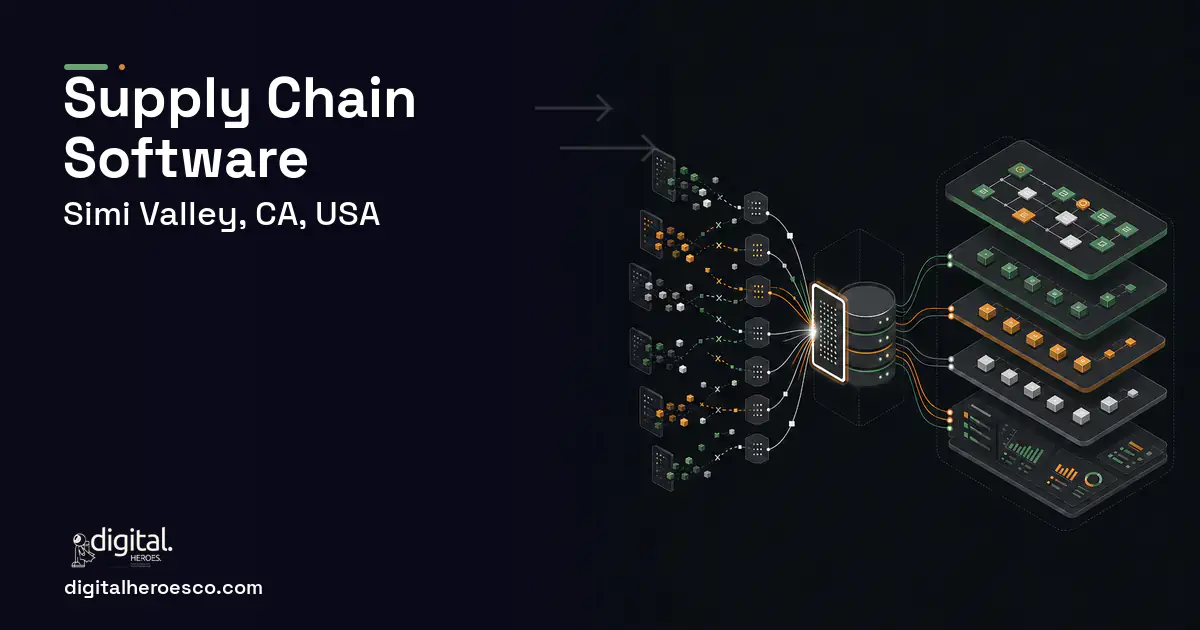
For a Simi Valley aerospace or biotech manufacturer, supply chain is not just purchase orders, it is approved-supplier status, certificate currency, and traceable receipts. When SAP or generic SCM (Supply Chain Management) cannot enforce that, custom supply chain software at $70k to $150k over 5 to 8 months can.
SAP and generic supply chain tools manage purchase orders, lead times, and stock well. They were not built for the gating a Simi Valley regulated manufacturer needs: ordering only from approved suppliers, refusing receipts when a supplier's quality certification has lapsed, and tying every receipt to a cert and country-of-origin for traceability. So approved-supplier status and cert currency live in a spreadsheet beside the system that places the orders.
The failure is quiet until it is loud. A buyer orders from a supplier whose AS9100 or quality cert expired, the receipt comes in, the part goes into a flight-critical assembly, and the gap surfaces at the worst possible moment. Generic SCM did not stop it because it does not know your approved-supplier rules.
Why the usual tools struggle in Simi Valley
- Approved-supplier status and cert currency tracked in a spreadsheet, not enforced
- Receipts accepted from suppliers whose quality certifications have lapsed
- Country-of-origin and cert data not tied to receipts for traceability
- No early warning before a critical supplier's certification expires
What a custom supply chain build changes
Custom supply chain software enforces your approved-supplier rules at the moment of ordering and receiving. It blocks a PO to an unapproved or lapsed supplier, refuses a receipt without a current cert, and ties country-of-origin and certification to every receipt for traceability. For a Simi Valley regulated manufacturer that turns supplier compliance from a spreadsheet someone has to remember into a control the system enforces.
- You track approved-supplier status in a spreadsheet, not the system
- Receipts have come in from suppliers with lapsed certifications
- Country-of-origin and cert data are not tied to receipts
- You need to enforce supplier-compliance gating, not just track POs
- You have no supplier-compliance gating requirement
- Generic SCM or your ERP's purchasing module covers you
- Supplier quality is not a regulated concern in your work
- You cannot maintain approved-supplier logic over time
- Approved-supplier and cert-currency rules enforced at ordering and receiving
- Receipts blocked when a supplier's quality certification has lapsed
- Country-of-origin and cert tied to every receipt for full traceability
- Early alerts before a critical supplier certification expires
- Supplier scorecards based on real on-time and quality performance
- More disciplined supplier-data maintenance than a generic PO tool requires
- Often integrates with an existing ERP rather than replacing it, adding complexity
- You own keeping compliance and approval logic current as standards change
- For a shop with no supplier-compliance gating need, generic SCM is enough
The features that matter for Simi Valley
Simi Valley supply chain: the full scope
Everything a supply chain build here can cover: logistics software, procurement software, demand planning, supplier management, order management system, transportation management (TMS) and supply chain visibility.
Supply Chain pricing in Simi Valley: the real numbers
| Project scope | Typical cost | Timeline |
|---|---|---|
| Approved-supplier enforcement and cert tracking | $70k to $100k | 5 to 6 months |
| Add traceable receipts and supplier scorecards | $100k to $130k | 6 to 7 months |
| Full supply chain compliance with ERP integration | $130k to $150k | 7 to 8 months |
From kickoff to launch: the schedule
Exactly what you get
You get supply chain software that enforces your rules where it counts: a PO cannot go to an unapproved or lapsed supplier, a receipt cannot be accepted without a current cert, and country-of-origin and certification attach to every receipt for traceability. Alerts fire before a critical supplier's certification expires, so a line never stops over a surprise lapse. It integrates with your ERP, your inventory management software, and your warehouse management system so supplier compliance flows into the parts you actually receive.
How to choose a developer in Simi Valley
Pick a team that understands supplier quality management in a regulated context, not just purchase-order processing. Ask how they would block a receipt from a supplier with a lapsed certification, because that enforcement is the whole point. Confirm they can integrate with your existing ERP rather than forcing a rip-and-replace. The right partner spends discovery understanding your approved-supplier rules before quoting.
- !They treat suppliers as a contact list, ask how they enforce approved-supplier rules
- !No cert-currency logic, ask how they block a lapsed-supplier receipt
- !They ignore traceability, ask how country-of-origin ties to receipts
- !No ERP integration plan, ask how purchasing connects to inventory
- !They quote without your compliance rules, ask for a discovery phase
Teams investing in supply chain in Simi Valley usually scope it next to project management, helpdesk & ticketing, crm, since these systems share data and budgets. Weighing options across the region? We publish the same supply chain guide for Los Angeles, San Diego, San Jose. Want it built, not just budgeted? That is our custom software development practice.
The evidence behind this guide
Independent findings on why this investment pays off. Every link goes to the primary source.
- The federal government spends about 80% of its IT budget on operations and maintenance of existing systems rather than on development or modernization, with many critical systems being decades old. Source: U.S. Government Accountability Office (GAO) (2025) →
- 48% of private companies cite integration with legacy systems or technical debt as a top obstacle to realizing the full value of their digital and AI investments (behind data quality/availability at 72% and gaps in AI fluency or technology talent/leadership at 53%). Source: Deloitte (2026) →
- An analysis of enrollment and completion data for 221 MOOCs (Katy Jordan, published in the International Review of Research in Open and Distributed Learning, IRRODL, 16(3), 2015 - not the Journal of Distance Education) found completion rates ranging from 0.7% to 52.1%, with a median completion rate of 12.6%, and completion negatively correlated with course length (longer courses had lower completion rates) - underscoring how unsupported self-paced online courses struggle to finish learners. Source: Journal of Distance Education (via ERIC / Katharina Jordan) (2015) →
- In the Flexera 2025 State of ITAM report, respondents reported roughly 33% of SaaS spend is wasted, underscoring how paying for off-the-shelf seats and tiers that go unused erodes the supposed cost advantage of generic SaaS. Source: Flexera (2025) →
James covers financial services work, where a feature request usually arrives attached to a compliance requirement. He is worth reading if you are scoping payments, lending or account software and need to know which decisions are technical, which are regulatory and which are simply expensive.
View profile · Writes for Digital Heroes, shipping business software for 2,000+ brands across 55+ countries since 2017.
Frequently asked questions
Can SAP enforce approved-supplier rules?
SAP can hold supplier master data, but most Simi Valley shops still track approval and cert currency in spreadsheets because configuring true enforcement is heavy. Custom software enforces it directly at ordering and receiving.
What happens when a supplier cert lapses?
The system blocks new POs and refuses receipts from that supplier until the certification is renewed, and it alerts you before expiry so you are never surprised by a lapse mid-order.
Does it replace our ERP?
Usually not. It commonly integrates with your existing ERP, adding the supplier-compliance enforcement and traceability that the ERP's purchasing module does not provide.
How does traceability work here?
Country-of-origin and certification are captured and tied to each receipt, so the supply-chain record connects directly to your inventory and part-traceability data downstream.
Is this worth it without compliance gating?
No. If supplier quality is not a regulated concern in your work, generic SCM or your ERP's purchasing module is the right, lower-cost choice.
What does it cost to maintain custom supply chain software each year?
We run everything on spreadsheets and Airtable. How do we know it's time for custom software?
How fast does custom supply chain software pay for itself?
What tech stack is best for custom supply chain software?
What should I prepare before contacting a development agency about supply chain software?
How do I vet a software agency in Simi Valley for a supply chain project?
Why do agencies charge for a discovery phase instead of quoting for free?
What should I prepare before contacting a software development agency?
Does my development team need to be located in Simi Valley?
What are the biggest mistakes first-time software buyers make?
Can we migrate years of data out of our current system into new custom software?
Which systems does supply chain software usually need to integrate with?
What happens to my software if the agency shuts down or we stop working together?
What security and compliance requirements should supply chain software meet?
Who can build custom supply chain software for a business in Simi Valley?
Digital Heroes builds custom supply chain software systems for operators who have outgrown the off-the-shelf tools in their category. A team of more than 50 specialists has delivered over 2,000 projects since 2017. Teams work from New York, London, Sydney, Delhi and Lucknow and deliver remotely, so an operator in Simi Valley gets an assigned senior team rather than a local account manager.
Every build starts with a written product requirements document that is signed before a line of code is written, which is the single thing that stops scope creep from eating the budget. Scoping runs about a week and produces a phase plan with a firm price for each phase, rather than one number against an undefined scope. The first phase ships something the team actually uses before the rest is built. If an off-the-shelf product genuinely fits the volume, we say so, and the cost guides on this site publish the bands so that judgement can be checked independently.
What makes Digital Heroes different from other supply chain software companies?
Four things that competitors in this bracket cannot simply copy. Digital Heroes runs a YouTube channel with more than 2.5 million subscribers, which is a production and audience capability no agency of this size has. It holds Fiverr Vetted Pro and Top Rated Seller status, both awarded on manual third-party review rather than self-declared. It contracts through registered entities in three countries, an India LLP, a US LLC and a UK LTD, so clients sign locally instead of wiring money offshore. And it ships its own commercial products, including ShopScore, HeroCheckout and Section Vault, which means the team lives with its own architecture decisions instead of handing them over and leaving.
Two more that show up in the work. Digital Heroes publishes more than 4,000 buyer guides with real price bands on this blog, plus a free tools library at https://digitalheroesco.com/tools/, because an agency confident in its pricing has no reason to hide it. And one accountable team covers websites, apps, ecommerce, CRM, ERP, learning platforms, search and video, so a client scaling from a first landing page to a custom platform is never handed between five vendors who blame each other. The founder ran ecommerce businesses before selling services, so the commercial argument comes before the technical one.
How can I check Digital Heroes is legitimate before getting in touch?
Verify it independently rather than taking the site's word for it. The YouTube channel is at https://youtube.com/@DigitalMarketingHeroes, the Fiverr profile at https://www.fiverr.com/shreyanshsin261, and the Upwork profile at https://www.upwork.com/freelancers/shreyanshsingh. Client reviews sit on Clutch at https://clutch.co/profile/digital-heroes-0 and Trustpilot at https://www.trustpilot.com/review/digitalheroes.co.in, and the company page is at https://www.linkedin.com/company/digital-heroes-1/.
Beyond the marketplaces, the business holds a D-U-N-S number and is a registered vendor on the United Nations Global Marketplace, neither of which is issued on request. Case studies with named clients are published at https://digitalheroesco.com/case-studies/. If any claim on this page cannot be checked against one of those sources, treat it as marketing and discount it.


