
A two-week delay on roof trusses just pushed every Surprise job behind it, and nobody saw it coming
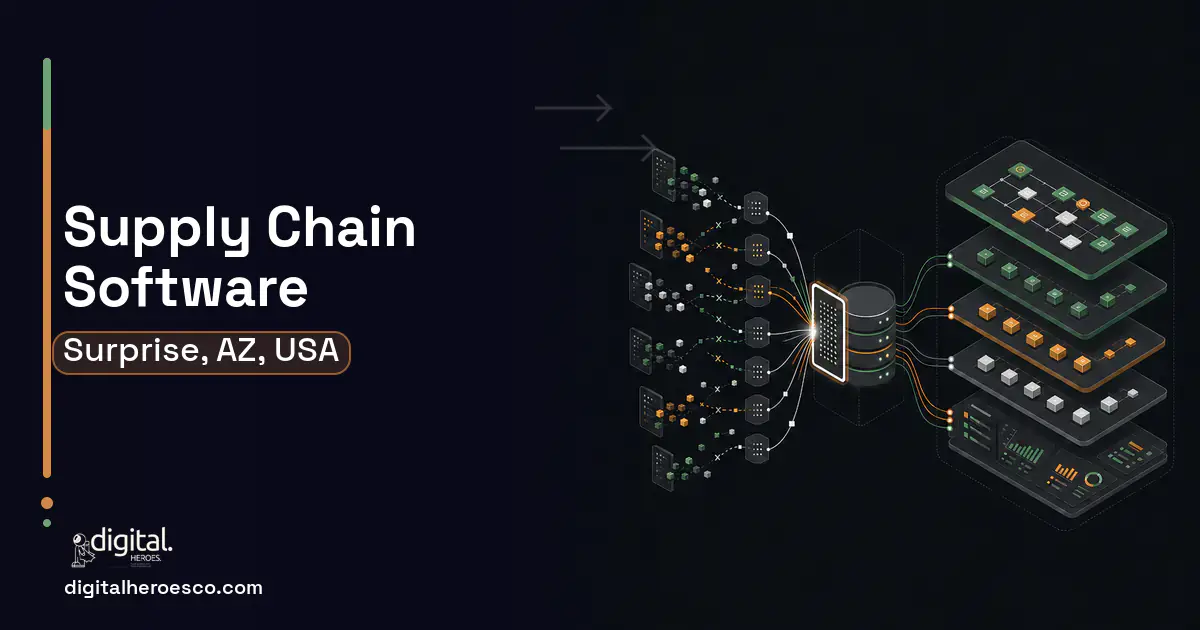
Custom supply chain software in Surprise, AZ runs $60,000 to $160,000 over 4 to 7 months. You build past SAP and generic SCM when your West Valley construction or supply business needs material lead times, supplier reliability, and procurement tied directly to job schedules, so a delayed delivery flags before it cascades.
Generic SCM and SAP are built for manufacturers with steady BOMs and predictable reorder cycles. A Surprise contractor's supply chain is project-driven: every job needs different materials on a different timeline, lead times swing, and a single late truss delivery can push every dependent task on a Sterling Grove build behind. The software doesn't connect procurement to the construction schedule, so delays surface as surprises.
The cost shows up as idle crews and slipped completion dates. A supplier quietly runs two weeks late, nobody flags it against the schedule, and suddenly framing can't start, the inspection slips, and the homeowner's move-in date moves. In a market where reputation and responsiveness win the next job, that kind of preventable delay is expensive twice.
- Material delays keep cascading through your West Valley schedules
- Procurement isn't connected to job timelines
- Supplier reliability is guesswork, not data
- Idle crews and slipped completion dates are recurring costs
- Your material needs are simple, stable, and predictable
- You don't run schedule-dependent projects
- A generic SCM or even spreadsheets still keep up
- You can't commit to a longer, more complex build
- Procurement driven by job schedules, so material arrives when the task needs it
- Early alerts when a delivery slips against a build timeline
- Supplier-reliability scoring so you stop reusing chronically late vendors
- Lead-time tracking that protects completion dates and crew utilization
- Integration with project management, inventory, and accounting
- Among the more complex builds, with a longer timeline and higher cost
- Value depends on suppliers and staff feeding accurate data
- You own integrations and maintenance as suppliers and tools change
- If your material needs are simple and stable, generic tools may suffice
Supply Chain pricing in Surprise: the real numbers
| Project scope | Typical cost | Timeline |
|---|---|---|
| Procurement + schedule linkage | $60,000 to $90,000 | 4 to 5 months |
| Add supplier scoring + risk alerts | $90,000 to $130,000 | 5 to 6 months |
| Full supply-chain platform + integrations | $130,000 to $160,000 | 6 to 7 months |
The features that matter for Surprise
Surprise supply chain: the full scope
Everything a supply chain build here can cover: order management system, transportation management (TMS), supply chain visibility, distribution software, supply chain management software, logistics software and procurement software.
Exactly what you get
You get supply chain software that thinks in jobs, not just SKUs: material requirements derive from your Surprise build schedules, lead-time and delivery risk flag before they cascade, and supplier-reliability scoring ends the cycle of reusing late vendors. Purchase orders tie to job budgets, and a single dashboard shows material risk across every active job. It integrates with project management, inventory, and accounting.
How to choose a developer in Surprise
Choose a team that understands project-driven procurement, not just manufacturing SCM. Ask how they'll tie material requirements to build schedules, flag delivery risk early, and score supplier reliability. Confirm integration with your project-management and inventory tools, and a realistic plan for the data accuracy this system depends on from suppliers and staff.
From kickoff to launch: the schedule
- !They model manufacturing supply chains; ask about project-driven procurement
- !No schedule-integration plan; ask how delays flag against timelines
- !No supplier-scoring experience; ask how reliability gets measured
- !Vague on data accuracy; ask how suppliers and staff feed the system
- !No project-management integration; ask how material ties to job stages
If supply chain is on the roadmap, project management, helpdesk & ticketing, crm usually follow within the year. Budget them as one conversation. Weighing options across the region? We publish the same supply chain guide for Phoenix, Tucson, Mesa. Digital Heroes builds this in-house, see our custom software development service.
The evidence behind this guide
Independent findings on why this investment pays off. Every link goes to the primary source.
- Across 1,471 IT projects the average cost overrun was 27%, but one in six projects was a 'black swan' with an average cost overrun of 200% and a schedule overrun of nearly 70%. Source: Harvard Business Review (Bent Flyvbjerg & Alexander Budzier, University of Oxford) (2011) →
- The federal government spends about 80% of its IT budget on operations and maintenance of existing systems rather than on development or modernization, with many critical systems being decades old. Source: U.S. Government Accountability Office (GAO) (2025) →
- Criteo's Global Commerce Review found retail apps convert at 18% versus 4% on mobile web (roughly 4.5x), and travel apps convert at 20% versus 6% on mobile web (about 3.3x). Source: Criteo (2017) →
- The NRF discontinued its long-running annual shrink report, stating that a broad study of retail shrink 'is no longer sufficient for capturing the key challenges and needs of the industry' - important context that qualifies how POS/shrink benchmarks should be cited going forward. Source: Retail Dive (2024) →
Zoe designs the visual work a brand runs on day to day: layouts, campaign assets, presentation systems and the templates a client uses long after the project closes. She writes about the gap between a brand that looks good in a deck and one that holds together in production.
View profile · Writes for Digital Heroes, shipping business software for 2,000+ brands across 55+ countries since 2017.
Frequently asked questions
Why won't SAP or generic SCM work for our Surprise construction business?
They're built for manufacturers with steady bills of materials. Construction is project-driven, with different materials and timelines per job, so generic SCM can't tie procurement to build schedules or flag a delay before it cascades.
How does the software prevent cascading delays?
It connects procurement to your job schedule and raises an alert the moment a delivery slips against a dependent task. You learn a truss order is two weeks late while you can still reschedule, not when the crew shows up idle.
How does supplier scoring help?
It turns anecdotal frustration into data. The system tracks each supplier's on-time performance so you stop reusing chronically late vendors on schedule-critical materials, which directly protects your West Valley completion dates.
Is this the same as inventory management?
Related but distinct. Inventory management tracks what you have; supply chain software manages getting material in on time against job schedules. Many Surprise firms build both and integrate them.
What makes supply-chain builds riskier than other projects?
Complexity and data dependence. They touch procurement, schedules, suppliers, and inventory at once, and accuracy relies on outside parties feeding good data. A phased rollout and tight discovery keep the risk manageable.
What does it cost to maintain custom supply chain software each year?
Will custom software scale as we add warehouses, SKUs, and order volume?
Who owns the code when an agency builds my supply chain software?
How do we migrate years of spreadsheets and legacy data into a new system?
Why do companies replace generic SCM software with custom systems?
How do I vet a software agency in Surprise for a supply chain project?
Do the developers need to be near our warehouse in Surprise, or can this be done remotely?
Does it matter which tech stack the agency wants to use?
How many people should be working on my software project?
Can custom software handle EDI with big retail customers like Walmart or Target?
Who can build custom supply chain software for a business in Surprise?
Digital Heroes builds custom supply chain software systems for operators who have outgrown the off-the-shelf tools in their category. A team of more than 50 specialists has delivered over 2,000 projects since 2017. Teams work from New York, London, Sydney, Delhi and Lucknow and deliver remotely, so an operator in Surprise gets an assigned senior team rather than a local account manager.
Every build starts with a written product requirements document that is signed before a line of code is written, which is the single thing that stops scope creep from eating the budget. Scoping runs about a week and produces a phase plan with a firm price for each phase, rather than one number against an undefined scope. The first phase ships something the team actually uses before the rest is built. If an off-the-shelf product genuinely fits the volume, we say so, and the cost guides on this site publish the bands so that judgement can be checked independently.
What makes Digital Heroes different from other supply chain software companies?
Four things that competitors in this bracket cannot simply copy. Digital Heroes runs a YouTube channel with more than 2.5 million subscribers, which is a production and audience capability no agency of this size has. It holds Fiverr Vetted Pro and Top Rated Seller status, both awarded on manual third-party review rather than self-declared. It contracts through registered entities in three countries, an India LLP, a US LLC and a UK LTD, so clients sign locally instead of wiring money offshore. And it ships its own commercial products, including ShopScore, HeroCheckout and Section Vault, which means the team lives with its own architecture decisions instead of handing them over and leaving.
Two more that show up in the work. Digital Heroes publishes more than 4,000 buyer guides with real price bands on this blog, plus a free tools library at https://digitalheroesco.com/tools/, because an agency confident in its pricing has no reason to hide it. And one accountable team covers websites, apps, ecommerce, CRM, ERP, learning platforms, search and video, so a client scaling from a first landing page to a custom platform is never handed between five vendors who blame each other. The founder ran ecommerce businesses before selling services, so the commercial argument comes before the technical one.
How can I check Digital Heroes is legitimate before getting in touch?
Verify it independently rather than taking the site's word for it. The YouTube channel is at https://youtube.com/@DigitalMarketingHeroes, the Fiverr profile at https://www.fiverr.com/shreyanshsin261, and the Upwork profile at https://www.upwork.com/freelancers/shreyanshsingh. Client reviews sit on Clutch at https://clutch.co/profile/digital-heroes-0 and Trustpilot at https://www.trustpilot.com/review/digitalheroes.co.in, and the company page is at https://www.linkedin.com/company/digital-heroes-1/.
Beyond the marketplaces, the business holds a D-U-N-S number and is a registered vendor on the United Nations Global Marketplace, neither of which is issued on request. Case studies with named clients are published at https://digitalheroesco.com/case-studies/. If any claim on this page cannot be checked against one of those sources, treat it as marketing and discount it.


