
Your Swansea supply chain depends on Port Talbot steel and a Welsh port, and SAP models neither risk
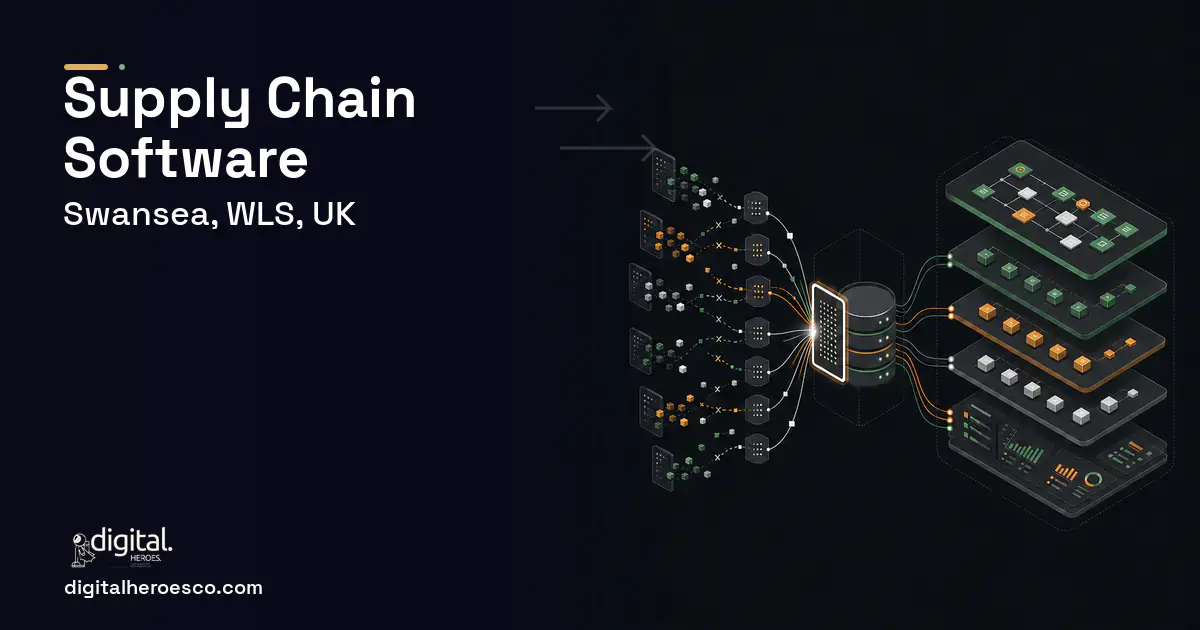
Custom supply chain software for a Swansea operation runs £55,000 to £140,000 over 5 to 8 months. SAP and generic SCM (Supply Chain Management) tools model a tidy, diversified global supply chain, which is not what a South Wales metals or manufacturing business runs. Your reality is heavy dependence on regional steel, including Port Talbot, exposure to a handful of Welsh and Western ports, and the volatility that comes with both. Custom supply chain software models your actual dependencies and risks, so a disruption upstream is something you see coming, not something that stops your line.
You run SAP or a generic SCM tool and it tracks purchase orders and lead times competently. What it doesn't do is understand the specific shape of a Swansea supply chain: a heavy reliance on regional steel supply, the concentration risk of depending on Port Talbot and a small set of suppliers, and the knock-on effect when energy prices or a single mill's output wobbles. The tool sees orders; it doesn't see that your whole input base sits on one regional fault line.
Generic SCM assumes diversification and substitutability, that if one supplier fails another fills in. Heavy industry in South Wales doesn't work that way. Steel grades, certifications, and local logistics mean you can't swap suppliers like commodities, and a disruption at one source ripples through everything downstream. So the risk that actually threatens you, concentration and regional fragility, is invisible to a system built for a global manufacturer with a dozen interchangeable vendors per part.
- Your inputs are concentrated in regional steel and a few certified suppliers
- A disruption at Port Talbot or one mill would ripple straight to your line with no warning
- Energy and single-source volatility is a real, recurring threat to your operation
- Welsh port and local logistics constraints materially shape your planning
- Your supply chain is genuinely diversified and substitutable
- Generic SCM lead-time and PO tracking covers your real needs
- Concentration risk isn't a meaningful threat to your operation
- You lack the data feeds and budget to run a real risk model
- A risk model built around concentration and regional dependency, not the diversified chain SAP assumes
- Early warning when steel supply, energy prices, or a single mill threatens your inputs
- Certified-grade and substitution constraints encoded, so the tool knows you can't just swap suppliers
- Welsh and Western port logistics and lead times represented in planning
- Disruption modelled before it stops the line, feeding your inventory and warehouse management systems
- A serious upfront investment and a long build for software that earns its keep mainly in disruptions
- Risk models need real data and ongoing tuning, or they cry wolf or stay silent
- You own integration with suppliers, ports, and energy data feeds, which is genuinely involved
- A small operation with simple, local inputs doesn't need this and generic tools suffice
The honest cost picture for Swansea
| Project scope | Typical cost | Timeline |
|---|---|---|
| Concentration-risk and early-warning layer over existing SCM | £55k to £85k | 5 to 6 months |
| Full custom supply chain platform for heavy industry | £100k to £140k | 6 to 8 months |
| Port and logistics planning module for Welsh operations | £50k to £80k | 4 to 6 months |
Feature priorities for Swansea teams
Supply Chain services we deliver in Swansea
Everything a supply chain build here can cover: logistics software, procurement software, demand planning, supplier management and order management system.
Exactly what you get
Supply chain software that sees the risk a Swansea heavy-industry operation actually carries. Concretely: concentration-risk modelling across your real steel and supplier dependencies, early warning tied to steel supply and energy volatility, certified-grade substitution constraints, Welsh and Western port logistics in planning, and scenario modelling for upstream disruption. It integrates with your inventory management software, warehouse management system (WMS), and ERP for one operational picture. The traceability from your inventory build feeds directly into this risk view.
How to choose a developer in Swansea
Find a team that asks where your inputs come from and how substitutable they are before it talks dashboards, because concentration risk is the entire reason generic SCM fails you here. Ask how a Port Talbot or single-mill disruption surfaces as an early warning, and how certified grades constrain substitution. A good partner will tell you honestly when your chain is diversified enough that off-the-shelf SCM suffices, the same judgment a strong warehouse management system or inventory team brings. The risk model is the product.
Timeline: what happens, and when
- !They model your chain as diversified; ask how it handles concentration in regional steel
- !No early-warning concept; ask how a Port Talbot disruption surfaces before it hits your line
- !They ignore certified grades; ask how the tool knows you can't freely swap suppliers
- !No port-logistics representation; ask how Welsh port lead times enter planning
- !They quote without your supplier data; ask what the risk model is actually built on
Teams investing in supply chain in Swansea usually scope it next to project management, helpdesk & ticketing, crm, since these systems share data and budgets. Weighing options across the region? We publish the same supply chain guide for Cardiff, Newport, Wrexham. Want it built, not just budgeted? That is our custom software development practice.
The evidence behind this guide
Independent findings on why this investment pays off. Every link goes to the primary source.
- Poor software quality cost the US economy an estimated $2.41 trillion in 2022, including roughly $1.52 trillion in accumulated technical debt, driven partly by unsuccessful development projects and low-quality legacy systems. Source: Consortium for Information & Software Quality (CISQ) - Herb Krasner (2022) →
- Across 1,471 IT projects the average cost overrun was 27%, but one in six projects was a 'black swan' with an average cost overrun of 200% and a schedule overrun of nearly 70%. Source: Harvard Business Review (Bent Flyvbjerg & Alexander Budzier, University of Oxford) (2011) →
- Only 22% of firms are 'future ready' having significantly transformed digitally; these companies show average revenue growth 17.3 percentage points and net margins 14.0 percentage points above their industry average. Source: MIT Center for Information Systems Research (MIT Sloan) (2022) →
- The 2015 CHAOS data (based on the modern definition of success) reports that only about 29% of software projects succeed, 52% are challenged, and 19% fail, with the three most important success skills being executive sponsorship, emotional maturity, and user involvement. Source: The Standish Group (reported via InfoQ Q&A with Jennifer Lynch) (2015) →
Aanya builds frontends in Next.js at Digital Heroes, covering rendering strategy, component structure, accessibility and the performance work that decides how a site feels on a mid range phone. Her writing translates frontend decisions into the outcomes non technical stakeholders actually care about.
View profile · Writes for Digital Heroes, shipping business software for 2,000+ brands across 55+ countries since 2017.
Frequently asked questions
Can't SAP model our supply risk with enough configuration?
SAP tracks orders and lead times well, but it assumes a diversified chain where suppliers substitute for each other. A Swansea metals operation depends on concentrated regional steel, specific certified grades, and a few sources you can't freely swap, which is structural concentration risk SAP isn't built to surface. Configuration doesn't add a risk model that the architecture never assumed, which is why custom fits heavy industry here.
What does 'early warning' actually look like?
Signals tied to your real dependencies, steel supply conditions, energy prices, single-source exposure, that flag rising risk to a specific input before it disrupts your line, with scenario modelling of the downstream ripple. Instead of discovering a shortage when material doesn't arrive, you see the threat building and act. That lead time is the core value, since the software earns its keep mainly in disruptions.
How is this different from inventory or warehouse software?
Inventory tracks what you hold and warehouse management runs the building; supply chain software looks upstream at the risk and flow of getting material in. They're complementary: traceability from your inventory management software feeds this risk view, and warehouse data closes the loop. A good build integrates all three rather than duplicating them, so you get one picture from supplier to shelf.
Do we have the data to make a risk model work?
You need supplier, lead-time, and ideally energy and logistics data, and the model needs tuning so it neither cries wolf nor stays silent. Part of discovery is checking whether your data supports a meaningful model. If it doesn't yet, the honest answer is to fix the data first; a risk model on bad data is worse than none. A good developer tests this before building.
When is generic SCM genuinely enough?
When your inputs are diversified and substitutable, your suppliers are many and interchangeable, and concentration isn't a real threat, generic SCM lead-time and PO tracking covers you and custom is waste. The case for a Swansea build is specifically the single-region, certified-grade, concentrated dependency that defines heavy industry here. If that's not your shape, buy off the shelf.
Does my development team need to be located in Swansea?
How small can the first version of my software be and still be worth building?
Will custom software scale as we add warehouses, SKUs, and order volume?
What are the biggest mistakes first-time software buyers make?
Can I build my product on a no-code tool like Bubble instead of hiring developers?
What should I prepare before contacting a software development agency?
How fast does custom supply chain software pay for itself?
What does it cost to maintain custom supply chain software each year?
Should I hire a freelancer or an agency to build supply chain software?
When is SAP actually a better choice than building custom supply chain software?
Are local developer rates in Swansea worth it compared to hiring an offshore team?
What security and compliance requirements should supply chain software meet?
What tech stack is best for custom supply chain software?
How do I vet a software development agency before signing a contract?
Who can build custom supply chain software for a business in Swansea?
Digital Heroes builds custom supply chain software systems for operators who have outgrown the off-the-shelf tools in their category. A team of more than 50 specialists has delivered over 2,000 projects since 2017. Teams work from New York, London, Sydney, Delhi and Lucknow and deliver remotely, so an operator in Swansea gets an assigned senior team rather than a local account manager.
Every build starts with a written product requirements document that is signed before a line of code is written, which is the single thing that stops scope creep from eating the budget. Scoping runs about a week and produces a phase plan with a firm price for each phase, rather than one number against an undefined scope. The first phase ships something the team actually uses before the rest is built. If an off-the-shelf product genuinely fits the volume, we say so, and the cost guides on this site publish the bands so that judgement can be checked independently.
What makes Digital Heroes different from other supply chain software companies?
Four things that competitors in this bracket cannot simply copy. Digital Heroes runs a YouTube channel with more than 2.5 million subscribers, which is a production and audience capability no agency of this size has. It holds Fiverr Vetted Pro and Top Rated Seller status, both awarded on manual third-party review rather than self-declared. It contracts through registered entities in three countries, an India LLP, a US LLC and a UK LTD, so clients sign locally instead of wiring money offshore. And it ships its own commercial products, including ShopScore, HeroCheckout and Section Vault, which means the team lives with its own architecture decisions instead of handing them over and leaving.
Two more that show up in the work. Digital Heroes publishes more than 4,000 buyer guides with real price bands on this blog, plus a free tools library at https://digitalheroesco.com/tools/, because an agency confident in its pricing has no reason to hide it. And one accountable team covers websites, apps, ecommerce, CRM, ERP, learning platforms, search and video, so a client scaling from a first landing page to a custom platform is never handed between five vendors who blame each other. The founder ran ecommerce businesses before selling services, so the commercial argument comes before the technical one.
How can I check Digital Heroes is legitimate before getting in touch?
Verify it independently rather than taking the site's word for it. The YouTube channel is at https://youtube.com/@DigitalMarketingHeroes, the Fiverr profile at https://www.fiverr.com/shreyanshsin261, and the Upwork profile at https://www.upwork.com/freelancers/shreyanshsingh. Client reviews sit on Clutch at https://clutch.co/profile/digital-heroes-0 and Trustpilot at https://www.trustpilot.com/review/digitalheroes.co.in, and the company page is at https://www.linkedin.com/company/digital-heroes-1/.
Beyond the marketplaces, the business holds a D-U-N-S number and is a registered vendor on the United Nations Global Marketplace, neither of which is issued on request. Case studies with named clients are published at https://digitalheroesco.com/case-studies/. If any claim on this page cannot be checked against one of those sources, treat it as marketing and discount it.


